
Bridge Mutual tokenomics: the model held, the market didn't move.
DeFi's first fully decentralized insurance protocol needed roughly $500M in TVL to be commercially sustainable. It peaked near $150M. Protocol quality was never the missing piece.
Working with Hristo redefines your understanding of 'great work' and 'work ethics'. As a CPO, Hristo completely redefined the areas he was supervising, consistently introducing new models and ideas, all followed by flawless execution. The workflow of the company can be assessed by its daily rituals and Hristo raised our standards in everything: he was always prepared, communicated efficiently with all members of the team, and was always ready to over-deliver for the sake of the project's good. All this amplified by his amazing enthusiasm and positive personality. Hristo is literally irreplaceable: some of the responsibilities he was handling alone had to be divided amongst several people. I feel extremely happy we got to work together, and can wholeheartedly recommend him to any venture: his personal qualities will 100% make it better.
TL;DR
- Client: Bridge Mutual, the first fully decentralized, permissionless on-chain insurance protocol.
- Challenge: Design a token economy for a two-sided risk marketplace requiring roughly $500M in TVL to reach sustainable unit economics.
- Approach: Full tokenomics architecture with Hristo joining as CPO and remaining embedded for nine months post-launch.
- Result: Protocol peaked at roughly $150M TVL. Post-launch technical issues, DeFi Summer's APY arms race, and a market not yet mature enough for decentralized insurance all contributed to the gap.
What problems did Bridge Mutual have?
The business model required scale the market couldn't yet supply
Decentralized insurance is a volume business. Coverage providers earn yield from premiums paid by policyholders, and that yield only becomes meaningful at real pool depth. Bridge Mutual needed roughly $500M in TVL to generate enough organic premium revenue to operate without heavy native token subsidies. In 2021 that number looked reachable on paper. What was harder to price was whether the population of users who both held significant DeFi positions and understood on-chain coverage well enough to actually buy it was large enough to get there.
DeFi Summer turned TVL acquisition into an arms race
Bridge Mutual launched into the most competitive TVL environment in DeFi's history. Every protocol was running liquidity mining programs at yields that bore little relationship to underlying revenue. To attract coverage providers, Bridge Mutual had to offer comparable BMI incentives. That worked for bootstrapping. It also meant early TVL was farming capital: quick to arrive, quick to rotate when conditions shifted. The token design anticipated this tension. It couldn't resolve a market-wide dynamic.
US regulatory posture forced BMI to launch as a pure governance token
Bridge Mutual was a US-based project, and in 2021 the regulatory environment made any token with explicit value capture (fee shares, protocol buybacks, yield routed from protocol revenue) a clear target for SEC scrutiny. The decision was made to launch BMI as a pure governance token, with the intention that the DAO could later vote to activate value accrual mechanisms once the regulatory position was clearer. That was the correct compliance call. It was a harder one from a market-signaling standpoint: most buyers do not price in the probability of a future governance vote activating value capture, so BMI had to defend its price on narrative and emissions rather than on fundamentals. This was a constraint on what any token design could do at launch, not a flaw in the architecture, but the consequence showed up in how BMI traded during stress.
Post-launch smart contract issues hit at the worst possible moment
Bugs discovered after launch required two significant responses: token-based compensation distributions to affected users, and a full migration of TVL to restructured contracts. Both were handled. Both imposed friction at exactly the moment Bridge Mutual needed to compound early momentum, across user trust, team bandwidth, and token supply. Early DeFi protocols frequently encounter this class of issue. Timing is what made it costly here.
Counterparty risk in decentralized insurance is harder to model than it looks
Roughly one month before Celsius collapsed in 2022, the project approached Bridge Mutual to open an insurance coverage pool, offering significant TVL and investment as incentives. The deal didn't proceed. In retrospect, the episode illustrated a structural problem in decentralized insurance: the counterparties most eager to open coverage pools are often the ones with the most reason to want coverage. Governance-based whitelisting can slow this down. It cannot fully neutralize it.
How did FinDaS approach the problem?
Protocol and Business Deep Dive
Bridge Mutual wasn't a lending market or a DEX. It was a two-sided risk marketplace where coverage providers acted as underwriters and policyholders bought financial protection. Traditional insurance economics translated only partially to an on-chain, permissionless environment: there is no actuarial table, no underwriting team, and no regulator setting reserve requirements. The first weeks of the engagement mapped how premium pricing, capital efficiency, and claims resolution could each be governed by protocol mechanics rather than human judgment.
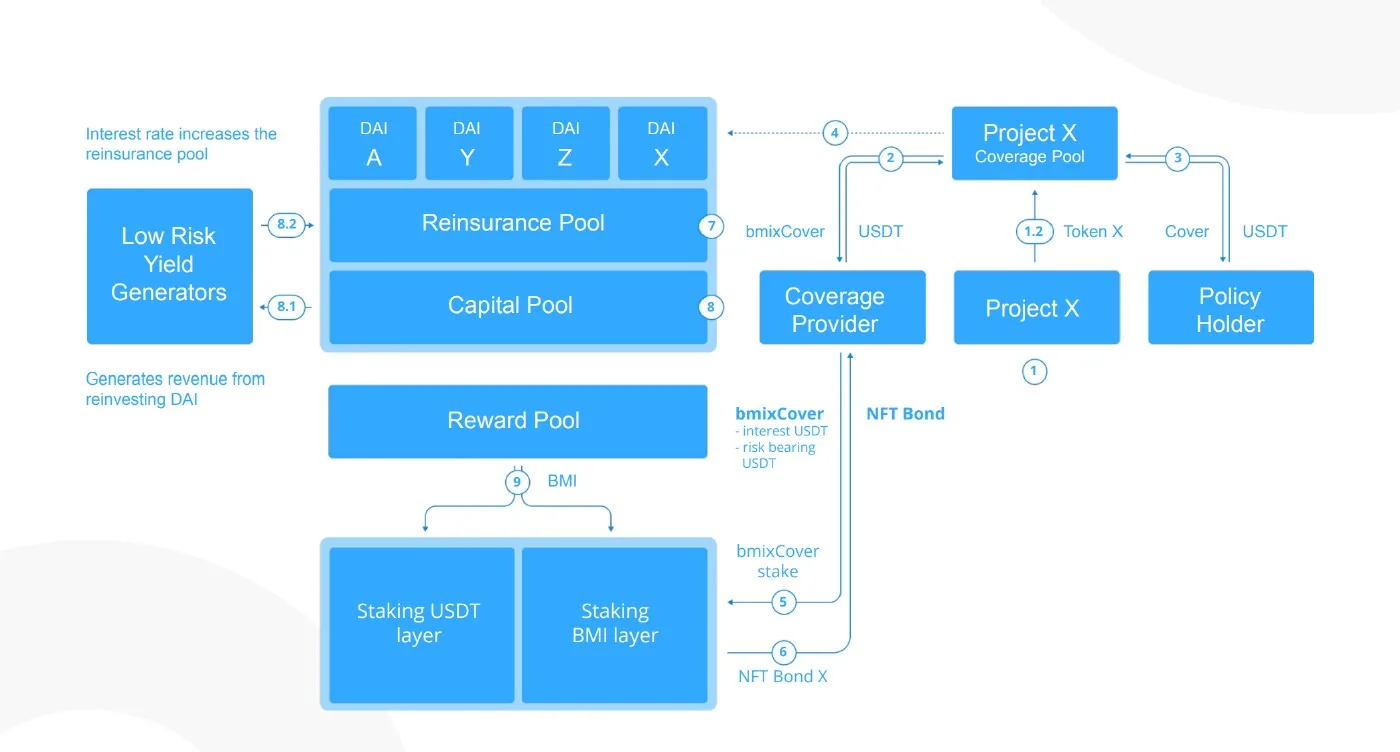
The early conclusion shaped everything that followed. Yield for coverage providers had to be real, not inflationary. If the primary incentive to underwrite was BMI emissions, the protocol would attract yield farmers rather than long-term underwriters.
Token Utility and Value Capture Design
BMI needed to do three things: serve as a staking asset, confer governance rights over claims, and function as a claims participation deposit. A single mechanic would create conflicts. A token holder farming staking yield has different incentives from one adjudicating a contested claim. The answer was sequential commitment: BMI to stkBMI, stkBMI to vBMI, with progressively longer lockups and progressively more protocol rights at each step.
The harder constraint was that BMI had to launch without direct value capture for regulatory reasons. FinDaS designed the governance layer to be rich enough that the DAO could later activate fee switches, buybacks, or revenue distribution by vote, without requiring a new token or a migration. That optionality was structural. Whether the market would price it in ahead of an actual DAO vote was always the open question, and in the end the answer was that it largely did not.
Economic Modeling
The utilization-ratio pricing model was the technical core. Coverage premiums had to rise automatically as pool utilization increased, pricing risk into coverage cost without governance intervention. This required calibrating the pricing curve across dozens of utilization scenarios in Google Sheets before the parameters were finalized. Machinations was used to simulate coverage provider behavior under stress, particularly what happened when a large claim triggered simultaneous withdrawal pressure across multiple pools.
Stress Testing and Valuation
The Celsius approach, which came after Hristo had already flagged adverse selection risk in coverage pool design, validated a concern built into the original architecture. The reinsurance pool and governance whitelisting were designed to manage exactly this class of risk. They worked as intended. What they couldn't do was move faster than market events.
During this period Hristo also proposed a forward-looking mechanism: using yield-bearing aTokens from Aave as Bridge Mutual insurance liquidity. A user holding aDAI could post it as coverage collateral, effectively doubling their yield without deploying fresh capital. This anticipated what later became liquid staking and restaking infrastructure, proposed in 2021, before the tooling to implement it at scale existed. It was not built before Hristo's departure.
Documentation and Launch Readiness
Hristo delivered the full tokenomics architecture, joined as CPO, managed the compensation distributions and TVL migration, and left in early 2022 when FinDaS's broader client load made the time commitment untenable. TVL at departure was approximately $90M.
| Deliverable | Description | Why it mattered |
|---|---|---|
| Three-layer staking | BMI to stkBMI to vBMI pipeline with progressively longer lockups and progressively more rights | Gated claims adjudication behind real commitment, so short-term holders couldn't swing governance |
| Utilization pricing curve | Premiums scaled linearly below a risk threshold and steeply above it, with a minimum floor | Pool risk was priced automatically, without waiting for governance to react |
| Risk-based reward multiplier | Higher BMI rewards for coverage providers staking into higher-utilization pools | Capital routed to underserved pools without manual intervention |
| Reputation-weighted claims voting | Multiplicative voting power tied to historical voting accuracy, plus minority penalties | Repeated honest participation was rewarded; single large holders couldn't force a contested outcome |
| NFT bond coverage positions | Tradeable NFTs representing staked bmiDAIx positions and maturity dates | Coverage providers had exit liquidity without destabilizing the underlying pools |
Protocol quality and protocol-market fit are different diagnoses. One is a tokenomics problem. The other is not.
What did FinDaS design?
1. Three-layer staking architecture (BMI, stkBMI, vBMI)
BMI staked into the BMI Staking Contract issued stkBMI, which accumulated protocol rewards. stkBMI locked further issued vBMI, which was non-transferable and usable only for governance and claims voting. Each transition required a progressively longer cooldown. Passive holders participated at the first layer. Active governance participants had to commit further.
Outcome: Claims adjudication, the decisions that determined whether policyholders received payouts, was gated behind real commitment. Short-term holders couldn't swing governance.
2. Utilization-ratio pricing model
Coverage premiums were set dynamically by pool utilization. Below a risk threshold, pricing scaled linearly. Above it, the curve steepened sharply, making high-utilization coverage expensive before pool concentration became dangerous. A minimum premium floor prevented pools from sitting idle at near-zero cost.
Outcome: The pricing model was self-correcting. Pools under stress became expensive automatically, reducing further demand without manual governance action.
3. Risk-based reward multiplier
Coverage providers staking bmiDAIx in higher-utilization pools received a higher BMI reward multiplier. Riskier pools paid more. Capital was incentivized to flow where the protocol needed it.
Outcome: Liquidity routing was market-driven. The protocol didn't need to manually direct capital to underserved pools. The reward structure did it.
4. Reputation-weighted claims governance
Voters earned or lost reputation based on whether they voted with the majority. Reputation modified voting power multiplicatively. Voters in the extreme minority lost a portion of their staked tokens. The top 15% of active voters by reputation, the Trusted Voters, handled all appeals, and appeals were final.
Outcome: Repeated honest participation was directly rewarded. A single large holder couldn't sway a contested claim without sustained reputational commitment.
5. NFT bond mechanism for coverage positions
Coverage providers who locked bmiDAIx in the staking contract received a tradeable NFT bond representing their position and maturity date. Bonds could be sold on any NFT marketplace, transferring the staked position to a buyer.
Outcome: Coverage providers had a liquidity exit that didn't require withdrawing from the pool, an early-stage innovation in DeFi liquidity design.
What were the results?
Bridge Mutual peaked at approximately $150M TVL: a real number for a novel protocol operating a genuine two-sided risk marketplace in a first-generation decentralized insurance environment. It fell materially short of the $500M threshold required for the business model to stand on organic premium revenue.
The TVL required to sustain Bridge Mutual was ambitious relative to the actual size of the DeFi insurance user base in 2021. Most capital in DeFi at the time was farming yield, not managing risk. Users who held large enough DeFi positions to warrant buying coverage, and who trusted a governance-based claims process to adjudicate disputes fairly, were a smaller population than total DeFi TVL suggested.
DeFi Summer pushed Bridge Mutual to compete on APY. The BMI rewards that bootstrapped early TVL created sell pressure as market conditions normalized and capital rotated. BMI's pure-governance launch compounded this: without direct value capture on day one, there was no fundamental floor for the market to price against, only a future promise that the DAO could activate value accrual later. The post-launch technical issues compounded it further. Both the compensation distributions and the contract migration absorbed team capacity and user trust at the moment growth was most sensitive to friction. The architecture itself, a live claims process, a successful migration, and a functioning compensation event, performed as designed.
What we would do differently.
The aToken liquidity mechanism Hristo proposed in 2021 is the clearest answer. Letting Aave collateral holders post yield-bearing positions as Bridge Mutual coverage liquidity would have expanded the addressable provider pool without relying on BMI emissions. The infrastructure to support this at scale exists now in a way it didn't then.
FinDaS would also push harder for a launch strategy that didn't depend on matching unsustainable APYs. Slower early TVL growth, less emissions pressure, a smaller but more committed coverage provider base: that path was available and would have built a more durable foundation, even if it meant a slower start in a crowded market.
The third change is on value capture. The regulatory constraint that pushed BMI into a governance-only launch was real in 2021, and the compliance logic still stands. But a tokenomics design can anticipate future value accrual, as BMI's did via DAO-activated mechanisms, and markets still rarely pay for an option they cannot exercise. Where regulation allows it, FinDaS now advocates for value capture to be live on day one with DAO-controlled parameters, rather than a DAO-controlled on/off switch. The difference in what the market is willing to price is substantial.
Key takeaways.
A technically sound token economy can fail commercially if the market it depends on doesn't exist at the required scale. That is a different problem from bad tokenomics, and it requires a different diagnosis.
Decentralized insurance has a structural bootstrapping problem
Organic premium revenue only becomes meaningful at TVL scale most protocols haven't reached, which means early coverage providers are effectively subsidized by token emissions, which creates sell pressure, which makes it harder to reach scale.
Adverse selection is DeFi insurance's most underestimated risk
The Celsius episode, a near-miss that illustrated exactly what the protocol's whitelisting governance was designed to slow down, is a reminder that on-chain governance moves deliberately while markets move fast.
Embedded post-launch presence generates pattern recognition no pre-launch model captures
Nine months inside a live protocol surfaces how users behave after incentives change, how technical crises interact with token price, and how the gap between designed behavior and actual behavior widens over time.
Correct ideas often arrive before the infrastructure to implement them
The liquid-collateral mechanism for insurance liquidity sketched in 2021 anticipated restaking by several years. In DeFi, the distance between a correct idea and an implementable one is often infrastructure timing, not validity.
What we took forward.
The Bridge Mutual engagement changed how FinDaS structures every DeFi protocol assessment. The TVL or user threshold at which the business becomes viable is now an explicit model in every engagement, not an assumption, alongside a direct conversation about whether that threshold is realistic given current market conditions. Market maturity risk sits alongside token design risk as a standard variable. The Celsius near-miss sharpened FinDaS's thinking on counterparty risk in two-sided DeFi markets, and it appears in current client work whenever a design involves pooled risk exposure, coverage mechanics, or governance-gated onboarding of large counterparties. The aToken liquidity concept first sketched during this engagement has informed later FinDaS work on restaking tokenomics, real-world asset yield structures, and yield-bearing collateral design.
Bring your project to a real token economist.
Free, no obligation, no juniors. We'll answer every question about your token design and tell you candidly where the weak spots are.
The questions we keep getting.
How do you design a token economy for a decentralized insurance protocol?
The core challenge is aligning three parties with conflicting short-term incentives: policyholders who want cheap coverage, coverage providers who want high yield, and governance participants who adjudicate claims. FinDaS separates each role into a distinct token layer with different rights and lockup requirements, so passive holders, active stakers, and governance voters each face commitment mechanics that reflect their actual role in the protocol. Pricing should be utilization-driven and self-correcting rather than governance-set, and coverage provider yield should have a real organic revenue component alongside any token emissions.
What causes DeFi insurance protocols to fall short of their TVL targets?
The most common cause is a mismatch between the TVL required for the business model to work and the actual size of the addressable user base at launch. Decentralized insurance requires users who hold significant DeFi assets and trust on-chain claims adjudication, and in most market cycles that population is smaller than total DeFi TVL implies. A secondary cause is over-reliance on native token emissions to bootstrap coverage provider liquidity, which attracts farming capital that rotates out when yields normalize.
How do you prevent adverse selection in a decentralized coverage pool?
No mechanism eliminates adverse selection entirely in a permissionless environment. Governance-based whitelisting slows it down, utilization-based pricing makes high-risk pool concentration expensive before it becomes dangerous, and a reinsurance pool with protocol-owned funds can subsidize low-risk pools while limiting high-risk exposure. All three mechanisms worked as designed at Bridge Mutual. What they cannot do is respond faster than market events, which is why insurance protocol governance needs clearly defined emergency mechanisms.
What is the difference between emissions-based TVL and organic protocol revenue in DeFi?
Emissions-based TVL is coverage provider liquidity attracted by native token rewards rather than by premiums paid by policyholders. It is fast to bootstrap and fast to leave when token price drops or better yield appears elsewhere. Organic protocol revenue is yield generated directly from premium payments, which reflects real demand but is slower to build. For DeFi insurance protocols, the business model only becomes sustainable when organic premium revenue is large enough to fund meaningful coverage yield without ongoing token subsidies.
When does it make sense to embed tokenomics expertise inside a protocol post-launch?
When the protocol's token economy involves active governance, ongoing emissions calibration, or mechanisms that behave differently under live user conditions than pre-launch models predict. Pre-launch models are built on assumptions about user behavior, TVL growth, and market conditions that almost always need adjusting within the first six months. Having the tokenomics designer embedded post-launch, as FinDaS was with Bridge Mutual, means those adjustments happen faster, with direct access to on-chain data and user feedback, rather than through delayed consulting cycles.
Why do DeFi protocols launch as governance-only tokens?
It is usually a regulatory choice. Launching a token with direct value capture (revenue shares, buybacks, staking yield drawn from protocol fees) exposes a US-based project to greater securities scrutiny, particularly around the profit-expectation prong of the Howey test. A pure governance token pushes the decision about value accrual to the DAO, preserving the option to activate those mechanisms later when regulatory clarity improves. The tradeoff is that markets rarely price in future value accrual the DAO might one day vote for, so governance-only tokens tend to trade on narrative and emissions rather than on fundamentals.