Picking a chain is a distribution decision, not a technical one. The chain that wins for your project is the one where your users already transact, your required integrations (oracles, CEXes, payment rails) already run, and your team can ship without a six-month learning tax. Grants, benchmarks, and marketing narratives rarely change the answer.
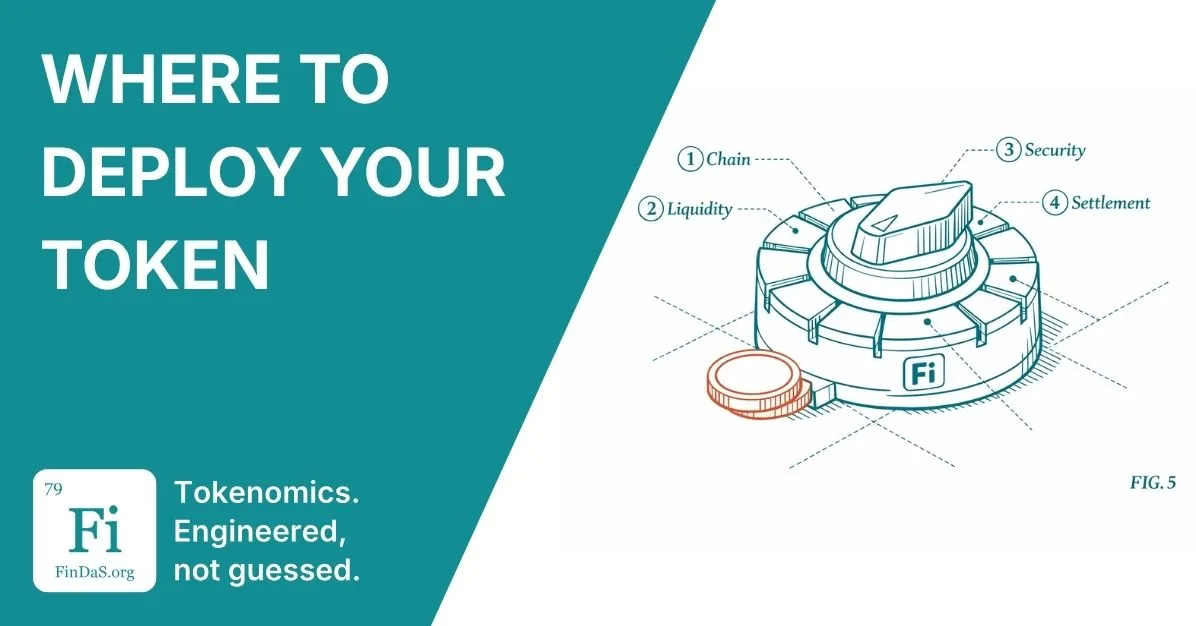
Chain choice gets treated as a technical decision. It is mostly a distribution decision, and the defaults have shifted materially in the last two years. The five questions below are the ones I actually work through with clients, in rough order of how much they move the outcome.
Most articles on picking a chain give you the same abstract checklist: speed, security, scalability, fees, community. All real inputs, none of them discriminating. Every serious chain claims to be fast, secure, and scalable. Every chain has a community. That list cannot tell you what to do.
1. Where are your users already on-chain?
The single strongest signal. A DeFi protocol targeting power users ends up where liquidity lives (Ethereum mainnet and its L2s). A consumer app targeting first-time crypto users picks a chain with cheap transactions and a working mobile wallet story (Solana, Base, TON). A gaming token follows the players (Ronin, Immutable, and a few app-chains).
If you launch somewhere your target users are not active, acquisition cost triples. They need to bridge, install a wallet they have never used, and trust a chain they have never heard of, all before they can touch your product. Each of those steps is a drop-off point, and the drop-offs compound.
2. What do you need to integrate with?
Tokens do not live alone. They integrate with DEXes, lending markets, oracles, custody providers, payroll tools, accounting tools, and CEX listing pipelines. Each of those integrations has a chain preference. If your protocol needs Chainlink feeds on day one, that narrows the list. If you want to be listed on a specific CEX, ask which chains they support custody for. If you need Stripe-to-stablecoin rails, that narrows it again.
The practical test: list every external system you have to plug into in year one, then look at which chain shows up on every list. If nothing does, something has to give. In my experience the compromise is usually a custom integration that takes three months you did not budget for.
3. What does the gas economics look like at your transaction volume?
Fee sensitivity depends entirely on what the token does. A governance token voted on quarterly does not care about gas. A micro-transaction token used hundreds of times per user per month cares enormously. A trading token that settles in and out of pools lives and dies by slippage plus fees.
Run the numbers at your target volume, not at one transaction. Ethereum mainnet is unworkable for a lot of use cases that were fine on it in 2021. Several L2s are cheap until a popular app saturates the sequencer. Solana is cheap unless the network is under load. The answer is always "it depends," and the dependency is your specific transaction pattern.
4. What is your team actually good at?
Shipping Solidity and shipping Rust are different jobs. If your team has spent five years on EVM and you move to Solana because of a grant, you are paying the learning curve in shipping speed and bugs for the first six months. Sometimes that tradeoff is worth it. Often the chain does not matter enough to justify it.
EVM compatibility is the path of least resistance for most teams. Ethereum mainnet, the major L2s (Base, Arbitrum, Optimism), Polygon, BNB Chain, and a long tail of EVM chains all share toolchains and mental models. Moving between them is weeks. Moving to a non-EVM chain is months.
5. Will the chain still be here in three years?
The least glamorous question, and the one that kills the most projects. Chains launch with aggressive incentives, peak, and fade. Teams that deployed on them are stuck migrating, or worse, marooned on a chain with no liquidity and no active integrations.
Heuristic I use: a chain needs three things working for it before I treat it as a safe bet.
- Survived at least one full market cycle.
- Non-incentivized on-chain activity (TVL that stays when the rewards end).
- A clear funding model for infrastructure beyond the foundation's token treasury.
Chains that fail one of those three tend to fail all three. Launching on a chain because its grant program is generous is the single most common mistake I see. The grant ends. The chain stays.
What the 2026 defaults look like
Defaults change faster than most founders think. The map below is where most of my clients end up today, by project type. Treat it as a starting point, not a rule; the five questions above beat any default.
DeFi protocols
Ethereum mainnet plus the major L2s. Base for the Coinbase distribution channel, Arbitrum for the DeFi-native user base, Optimism/Superchain for the rollup-native bet. Multichain deployment via a shared governance token is the common pattern, not a single-chain play. The DeFi tokenomics patterns that justify the extra complexity have to be in place before multichain starts paying off.
Consumer apps and payments
Solana if speed and mobile wallets matter most. Base if the user acquisition channel is Coinbase. TON if the target is Telegram-native users. Polygon still gets picked for Web2-to-Web3 bridges by teams that value predictability over novelty.
Gaming and entertainment
Chain follows genre. Ronin and Immutable for gaming-first user bases. An app-chain (Cosmos, Avalanche subnet, or similar) for games that need custom economics and can afford the infrastructure. Rarely Ethereum mainnet, almost never without an L2 in front of it, and the economics work built into the chain choice is as load-bearing as the GameFi tokenomics itself.
RWA and stablecoin-adjacent
Ethereum mainnet still dominates for regulated assets, because institutional custody and audit trails are mature there in a way they are not elsewhere. L2s are catching up for specific use cases, particularly where the issuer controls the end-to-end flow. The gap is narrower each quarter, but "narrower" is not "closed", see the RWA tokenomics patterns for why the custody story dominates the chain choice here.
The failure modes worth avoiding
Three patterns have cost projects meaningful money in my work. Each is easy to fall into because the short-term incentive points the wrong way. None of them are terminal on their own, but they compound.
Chasing the grant
Grants are a legitimate input but a terrible primary reason. The chain you pick has to make sense on its own technical and distribution merits at year three, not at year zero when the grant pays for your launch. Grant programs are structured to reward early deployments, not to guarantee you are still happy you deployed when the program winds down.
Overestimating migration
Teams tell themselves they can launch on the wrong chain now and migrate later. Migration is always harder than projected. Users have to move, integrations have to redo security reviews, liquidity has to re-seed. Pick correctly the first time, because relaunching on a new chain is a two to three quarter project with its own failure modes.
Underestimating non-EVM cost
Teams underprice the move to a non-EVM chain (Solana, Move-based chains, Bitcoin L2s). The language learning curve is real. The toolchain immaturity is real. The smaller developer pool is real. These are manageable if the chain is the right call; they are avoidable pain if it is not.
Chain-by-chain deep dives
Specific chains have specific tradeoffs. The posts below drill into individual chains at the deployment level, covering the engineering, liquidity, and distribution picture in more detail than fits here. Use them as the follow-up read once the five questions above narrow your list.
- Algorand Smart Contracts: Benefits and Drawbacks
- Arbitrum Smart Contracts: Key Pros and Cons
- Avalanche Smart Contracts: Key Benefits and Risks
- Deploying Smart Contracts on Aztec: Pros and Cons
- BSC Smart Contracts: Benefits and Trade-Offs
- Deploying Smart Contracts on Boba Network: Pros and Cons
- Cardano Smart Contracts: Benefits and Drawbacks
- Cartesi Rollups for Smart Contracts: Key Pros & Cons
- Celer Network Smart Contracts: Pros and Cons
- Corda Smart Contracts: Key Benefits and Drawbacks
- Deploying Smart Contracts on Cosmos: Key Pros and Cons
- EOS Smart Contracts: Benefits and Drawbacks
- Ethereum Smart Contracts: Key Pros and Cons
- Fantom Smart Contracts: Key Benefits and Drawbacks
- Deploying Smart Contracts on Flow: Pros and Cons
- Fuel Network Smart Contracts: Pros and Cons
- Harmony Smart Contracts: Key Benefits and Risks
- Hedera Smart Contracts: Key Pros and Cons
- Hermez Network Smart Contracts: Pros and Cons
- Hyperledger Fabric Smart Contracts: Pros and Cons
- ICON Smart Contracts: Key Benefits and Drawbacks
- Immutable X Smart Contracts: Benefits and Risks
- Kusama Smart Contracts: Benefits and Drawbacks
- Loopring Smart Contracts: Benefits and Drawbacks
- Metis Smart Contracts: Key Benefits and Drawbacks
- Deploying Smart Contracts on MultiversX: Pros & Cons
- Deploying Smart Contracts on NEAR: Pros and Cons
- NEO Smart Contracts: Key Advantages and Drawbacks
- OMG Network Smart Contracts: Advantages and Risks
- Ontology Smart Contracts: Key Pros and Cons
- Deploying Smart Contracts on Optimism: Pros and Cons
- Polkadot Smart Contracts: Key Benefits and Drawbacks
- Deploying Smart Contracts on Polygon: Pros and Cons
- Deploying Smart Contracts on Qtum: Pros and Cons
- Solana Smart Contracts: Key Benefits and Trade-Offs
- Should You Deploy Smart Contracts on StarkNet?
- Stellar Smart Contracts: Key Benefits and Drawbacks
- Tezos Smart Contracts: Key Advantages and Drawbacks
- Deploying Smart Contracts on Theta: Pros and Cons
- TRON Smart Contracts: Benefits and Drawbacks
- VeChain Smart Contracts: Deployment Pros and Cons
- Wanchain Smart Contracts: Key Benefits and Risks
- Waves Smart Contracts: Key Pros and Cons
- Zilliqa Smart Contracts: Key Pros and Cons
- Deploying Smart Contracts on zkSync: Pros and Cons
Frequently asked questions
01
Can I launch on multiple chains at the same time, or should I pick one?
+
02
How should a token grant program affect my chain decision?
+
03
What does migrating to a new chain actually involve if I pick wrong?
+
04
How important is chain choice compared to the tokenomics design itself?
+