RWA tokenomics is token economy design for an on-chain instrument whose value and enforceability depend on off-chain assets, contracts, and operating controls. Unlike crypto-native tokenomics, where the design problem is mostly internal (incentives, issuance, governance), RWA tokenomics is primarily constrained from outside the chain: cashflows, custody, settlement, and legal enforceability all live off-chain. Good design makes supply, redemption, transferability, and yield faithfully track the real asset, without creating unintended classification, liquidity, or run-risk.
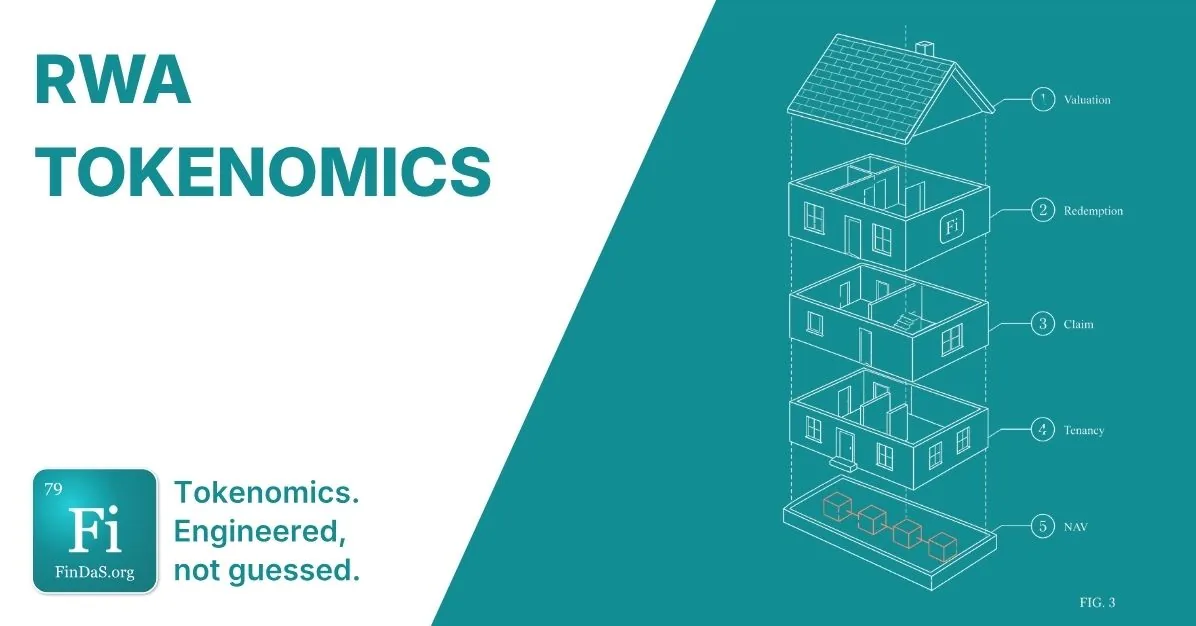
Token economy design components
"RWA tokenomics" is not a generic token distribution exercise. It is token economy design for an on-chain instrument whose value and enforceability ultimately depend on off-chain assets, contracts, and operating controls. That dependency changes what "good tokenomics" means.
In most crypto-native tokenomics, the design problem is mainly internal: incentives, issuance, sinks, governance, and market structure on-chain. In RWA tokenomics, the primary constraints sit outside the chain:
- Cashflows are external (interest, rent, invoice repayments, commodity financing spreads, fund distributions).
- Control is external (custody, administrators, transfer agents, servicers).
- Settlement and finality are external (bank rails, registries, brokers, CSDs, transfer restrictions).
- Enforceability is external (rights against an issuer, SPV, or trust, and what happens in disputes or insolvency).
So the goal of RWA tokenomics is to make a token's supply mechanics, redemption logic, transferability, and yield distribution faithfully track a real asset program, without creating unintended classification, liquidity, or run-risk. A tokenomics expert or token economy advisor will usually start by clarifying which outcome is the true "product":
- Programmable access to an asset exposure (collateral utility, composability, faster settlement).
- Funding for origination or inventory (private credit warehouse, receivables financing).
- Distribution of regulated products (tokenized fund shares, tokenized notes).
- Operational efficiency (shorter reconciliation cycles, atomic delivery-versus-payment designs).
Different goals produce different tokenomics. A redemption-at-NAV token has different failure modes than a token with discretionary buybacks. A pooled-vehicle token behaves differently from a token representing a claim on a single asset. These are not stylistic choices; they define the economic reality regulators, counterparties, and markets will evaluate.
The RWA token "economic primitives": claims, control, and redemption
- What does the token legally represent? Is it (a) a direct interest in an instrument, (b) a contractual claim against an issuer, or (c) a "receipt" or beneficial interest issued by an SPV or trust? Tokenomics cannot compensate for ambiguity here; it can only price it (usually negatively).
- Who controls the asset and the cap table? If a token is meant to represent a security-like interest, there is typically a notion of an "official record" (share register, transfer agent, fund administrator) even if a blockchain mirrors ownership. That creates tokenomics-relevant constraints such as whitelists, transfer windows, lockups, investor eligibility, and forced transfers in certain edge cases.
- How does redemption work, and when? Redemption is the core of RWA token economics because it pins on-chain value to off-chain value. Under the EU's MiCA framework, for example, marketing communications for asset-referenced tokens must state that holders have a right of redemption against the issuer, and MiCA also draws hard lines around what is inside and outside its crypto-asset perimeter (including exclusions for instruments that qualify as MiFID financial instruments). This matters because redemption promises and the nature of the underlying referenced assets can change which regime applies. See: Regulation (EU) 2023/1114 on markets in crypto-assets (MiCA), EUR-Lex (2023-06-09).
Tokenomics design levers that look "optional" in crypto-native systems become risk controls in RWAs:
- Mint and burn only against verified subscription and redemption, not "elastic supply" for its own sake.
- Redemption gates and notice periods that mirror underlying liquidity, especially for credit and real estate.
- Transfer restrictions aligned with investor eligibility and secondary market reality.
- Fee and yield policies that avoid hidden leverage, such as paying "yield" that is not being earned by the underlying asset.
Tokenomics consulting in RWAs is therefore closer to structured finance and fund engineering than to meme-coin supply choreography. The design vocabulary overlaps (supply schedules, sinks, distribution curves), but the dominant concerns shift toward underwriting, liquidity management, and enforceability. Treating an RWA token as a yield-bearing memecoin with extra steps is the fastest way to ship something that fails at its first real redemption cycle.
Asset categories and tokenomics-relevant constraints (what changes by RWA type)
RWA tokenomics must match the underlying asset's cashflow shape, liquidity, valuation method, and enforceability path. The categories below are not a taxonomy for its own sake. They are the specific constraint sets that dictate which design choices are available and which are self-destructive.
Treasuries and bonds (including tokenized money-market style exposures): cashflows are predictable, with coupons or money-market accrual. Custody and control are typically straightforward but institutionally operated. Valuation and oracles are mostly about timeliness, governance, and failure handling, more than price discovery. Underlying liquidity may be high while token liquidity remains constrained by eligibility, and the attraction is often 24/7 transfer plus off-chain interoperability, even though off-chain settlement still exists for the underlying.
A practical example is BlackRock's USD Institutional Digital Liquidity Fund (BUIDL), described as a tokenized fund issued on public blockchains with on-chain features like near real-time transfers and dividend-related mechanics for qualified investors. The tokenomics point: for "Treasury-like" RWAs, economics are primarily about accurate accrual plus operationally credible redemption, not speculative reflexivity. See: BlackRock Launches New BUIDL Share Classes Across Multiple Blockchains, PR Newswire (2024-11-13).
Private credit and direct lending: cashflows are path-dependent, with prepayments, defaults, and recoveries driving the return pattern. Control often requires a lender-of-record or SPV plus a servicer, and valuation is model-based and lagged, so tokenomics must assume stale pricing risk. Underlying liquidity is low, so "manufactured liquidity" via secondary markets or redemption facilities can fail under stress, and fast token settlement does not remove slow loan transfer mechanics. Token value ultimately reduces to the enforceability of its claim on the structure holding the loans. Implication: notice-based redemptions, liquidity buffers, and explicit loss-allocation rules are often necessary, and "daily liquidity" on illiquid credit is a red flag unless the structure truly supports it.
Invoices and receivables: short-duration and binary-ish (paid or not paid), with dispute and dilution risk. Documentation quality and assignment mechanics dominate, and the key "oracle" is payment verification and dispute status, not price. Bank rails and invoicing systems are the real settlement backbone, so redemption should be treated like short-duration note exposure and not left open-ended without matching facilities. Implication: batch-level accounting, reserve funds, and concentration limits usually matter, even if executed off-chain.
Real estate (equity-like or income-like): rent net of expenses, with lumpy capex and vacancy cycles driving volatility. Title and property management are jurisdiction-specific and off-chain, and valuation is appraisal-based and slow, so "real-time pricing" can mislead. Liquidity is inherently limited, and many structures tokenize vehicle shares or units rather than deeds, which makes redemption something that should be gated, periodic, or event-driven unless the wrapper is genuinely designed like a liquid fund. Implication: conservative assumptions about pricing latency and redemption mismatch, and an honest acknowledgement that fractionalization increases operational and regulatory complexity, not just market access.
Commodities (gold, energy-linked exposures, inventory finance): often no cashflow at all unless paired with lending or lease structures. Custody is the product: audit trails, chain-of-custody, warehouse controls. Price feeds exist, but the core risk is asset existence and encumbrance, not price discovery, and physical redemption adds friction, fees, minimums, and jurisdictional constraints. Implication: clear rules for storage costs, redemption fees, and allocation of shrinkage and insurance risks.
Funds and structured products (tokenized fund shares, notes, tranches): economics depend on strategy and may include waterfalls and layered fees. Administrators and transfer agents, along with eligibility checks, constrain transfers, and NAV plus dealing frequency and gates must be mirrored on-chain. Subscriptions and redemptions are often made operationally cheaper, not instantly liquid. Implication: prioritize correctness over "DeFi-like" constant liquidity narratives.
Equities (tokenized shares or share-linked claims): dividends, corporate actions, and voting all matter. Share registries and broker or custodian infrastructure dominate, public markets solve price discovery but legal linkage is complex, and token settlement can be fast while corporate-action processing remains slow. Implication: less about emissions, more about cap-table integrity, transfer restrictions, and corporate-action handling.
Carbon and renewable credits: typically no cashflow, with value coming from retirement claims and compliance or voluntary demand. Registry integrity and double-counting prevention are the core risks, so you need state oracles (issued, retired, invalidated), not just price oracles, and "redemption" often means retirement. Implication: the sink is retirement, and the token economy must prevent the same credit being claimed twice.
Compliance framing (no legal advice): EU MiCA, and high-level U.S., U.K., and Singapore lenses
RWA tokenomics cannot ignore compliance, because compliance constraints change token behavior, and token behavior is tokenomics. The right regulatory framing does not live after the design; it is baked into every meaningful choice about supply, transfer, and redemption. The paragraphs below summarize four jurisdictional lenses at a high level, not as legal advice but as the direction of travel a designer needs to keep in view.
EU (MiCA, and when other EU frameworks matter): MiCA creates a harmonized framework for crypto-assets in the EU, while explicitly excluding crypto-assets that qualify as financial instruments under MiFID II (and other exclusions). That boundary is directly relevant to many RWA structures that look like transferable securities or fund interests. See: Regulation (EU) 2023/1114 on markets in crypto-assets (MiCA), EUR-Lex (2023-06-09).
U.S. (securities-law lens at a high level): classification analysis frequently turns on whether a token offering involves an "investment contract" test, evaluated on facts and circumstances including rights conveyed and how the token is marketed and sold. Tokenomics choices, such as promising profits, emphasizing secondary trading, or structuring pooled exposure, can increase that appearance depending on context. See: Framework for "Investment Contract" Analysis of Digital Assets, U.S. SEC (2019-04-03).
U.K. (FCA perimeter clarity): FCA guidance helps determine whether cryptoassets fall within the U.K. regulatory perimeter: specified investments, e-money, payment services, or outside regulation. For RWA tokenomics, transferability, redemption promises, and entitlement to underlying assets or cashflows can push a design toward regulated territory. See: PS19/22: Guidance on Cryptoassets, FCA (2019-07-31).
Singapore (MAS substance-over-form approach): MAS guidance describes examining a token's structure and characteristics, including the rights attached, to determine whether it constitutes regulated capital markets products such as shares, debentures, or units in a collective investment scheme. This matches the RWA tokenomics reality that tokenholder rights are not just UX. They are regulatory signal. See: A Guide to Digital Token Offerings, Monetary Authority of Singapore (last updated 2020-05-26).
Compliance note: the discussion above is informational and not legal advice. In practice, a tokenomics advisor works closely with counsel because token economics and legal characterization are coupled. Changes to redemption language, transfer restrictions, or yield mechanics routinely re-open regulatory questions that looked settled, so legal review is a recurring part of the design loop, not a one-time gate.
Token classification risk (security vs commodity) as a function of tokenization approach
There is no universal "RWA token = security" rule. But design patterns materially affect classification risk. The key is economic reality: what does the buyer get, and what are they relying on?
- On-chain claim to cashflows: if the token entitles holders to interest, dividends, or rent distributions from an issuer, pool, or SPV, it increasingly resembles a traditional security. Auto-distribution, yield advertising, or performance incentives can amplify that perception (see the SEC framework cited above).
- Pooled vehicles vs single-asset representations: pooled structures concentrate managerial discretion (asset selection, servicing, hedging, liquidity management), so tokenomics must specify fee layers, loss allocation, and redemption mechanics. That often makes the wrapper look more like a managed product.
- Redemption promises and "stable value" representations: if marketed or engineered to maintain stable value through redemption, reserve management, or issuer commitments, a token can resemble regulated money-like or note-like instruments in many jurisdictions (MiCA is one relevant example).
- Bearer-like vs registered or whitelisted tokens: bearer-like designs improve DeFi integration but increase eligibility, sanctions, AML, and cap-table integrity challenges. Registered or whitelisted designs reduce some of that risk while reducing liquidity and composability, which changes secondary market dynamics.
- Fractional ownership and "NFT-wrapping": labeling something an NFT does not eliminate financial-instrument analysis if the economic reality is fungible fractional exposure or a managed return product. MiCA also reflects substance-over-form thinking in its scope boundary discussions.
The practical takeaway: classification risk is not an afterthought. Minting, burning, yield, transfer rules, and redemption mechanics are often the strongest evidence of what the token "really is." If those mechanics point at a security, the token is a security regardless of whitepaper rhetoric.
Where to go from here: a pragmatic RWA tokenomics workflow
A disciplined RWA tokenomics process, whether done in-house or via tokenomics consulting, usually avoids two common failure modes. The first is building a great on-chain token that cannot be operated legally or safely off-chain. The second is building a compliant wrapper with broken incentives and no sustainable liquidity.
- Define the instrument precisely: exposure type (spot, yield-bearing, tranche), legal wrapper (SPV, fund, issuer), and who the tokenholder has a claim against.
- Map liquidity truthfully: underlying liquidation time, expected dealing frequency, and what happens under stress (gates, suspensions, buffers).
- Engineer valuation and state oracles: not only price and NAV, but also state changes such as defaults, repayments, retirements, and corporate actions.
- Design transfer and custody policy as tokenomics: whitelists, jurisdictional restrictions, and settlement assumptions change market structure and therefore pricing.
- Align incentives across operators: issuer, servicer, custodian, administrator, market maker. Fee design is tokenomics.
- Stress-test redemption and secondary markets: simulate runs, oracle failures, and liquidity shocks. If the token economy breaks under stress, it is a design fault, not bad luck.
RWA tokenomics is best viewed as the economic operating system for an on-chain representation of off-chain finance. The more faithfully it matches the asset's real constraints (cashflow, custody, valuation, settlement, enforceability), the more resilient the token economy will be, and the easier it is to defend the design to exchanges, institutions, and regulators. Everything else, whether token design fashion, narrative framing, or ecosystem partnerships, follows from that fit.
Frequently Asked Questions
01How does RWA tokenomics differ from stablecoin tokenomics?
+
02Can the same RWA structure work under both EU and US regulation?
+
03When should a project tokenize an SPV vehicle instead of the asset directly?
+
04What happens to an RWA token if the issuing SPV defaults or enters insolvency?
+