
How MELD pioneered the first-ever ISPO, and why a strategic pivot undid a billion-dollar start.
FinDaS designed the token economy behind crypto's first Initial Stake Pool Offering, attracting $1B+ in committed capital. Two years later, a pivot to a Layer 1 blockchain (without updating the tokenomics) turned a DeFi success into a cautionary tale.
TL;DR
- Client: MELD, a DeFi lending, borrowing, and AMM protocol on Cardano, aiming to bridge crypto and fiat banking
- Challenge: Design a token economy for a multi-product DeFi protocol that needed to incentivize liquidity providers, protect lenders, fund development without a traditional ICO, and produce a defensible valuation for accredited investors
- Approach: FinDaS designed a fixed-supply token with a perpetual reward pool, an insurance pool generating real cash flow for stakers, duration-weighted governance, and the first-ever Initial Stake Pool Offering on Cardano. Valuation was anchored to a DCF model benchmarked against Aave and Uniswap
- Result: The ISPO attracted $1B+ in committed ADA and 40,000 participants. The protocol-level mechanics worked as designed. Two years later, MELD pivoted to a Layer 1 EVM blockchain without consulting FinDaS, invalidating the protocol-specific tokenomics
What problems did MELD have?
No precedent for community-first fundraising on Cardano
In mid-2021, Cardano had just launched smart contracts and had no established DeFi ecosystem. MELD wanted to raise capital without a traditional ICO or private-sale-only model, but the ISPO concept had never been executed. There was no playbook, no legal precedent, and no technical template for turning Cardano's delegation mechanism into a fundraising tool.
Multi-product DeFi protocol requiring coherent token utility
MELD planned to offer wrapped assets, lending (both centralized and decentralized), and an AMM with single-sided liquidity and impermanent loss protection, all from day one. The MELD token had to serve governance, incentivization, fee reduction, and insurance functions across all three product lines simultaneously. A utility model that worked for the AMM might create perverse incentives for the lending side.
Insurance pool design with real cash-flow generation
MELD's impermanent loss protection and lender safety net both required an insurance pool funded by token stakers. The challenge: how do you incentivize users to lock tokens in an insurance pool (taking on risk) while keeping enough liquidity for the rest of the protocol? And how do you prevent a bank run if an insured event occurs?
Defensible token valuation for accredited investors
MELD was raising via SAFT with a $30M hard cap. Accredited investors needed a valuation methodology that went beyond "comparable market caps." At the time, rigorous DCF-based token valuation was virtually unheard of in DeFi.
How did FinDaS approach the problem?
MELD contacted FinDaS at the peak of DeFi summer 2021. The firm had a six-month waiting list. MELD's CFO kept calling Hristo until FinDaS agreed to take the engagement, a persistence that reflected how seriously the team took its token economy.
Protocol and Business Deep Dive
Hristo and the FinDaS team mapped MELD's full product suite: wrapped assets from Ethereum to Cardano, centralized and decentralized lending, and a Bancor-style AMM with single-sided liquidity. Revenue would come from three streams: wrapping fees (0.2% each direction), loan interest margins (3%), and swap fees (0.2%, split between LPs and the protocol). FinDaS benchmarked projected revenue against Aave ($10B TVL at the time) and Uniswap ($700M daily volume).
Token Utility and Value Capture Design
FinDaS designed the MELD token as a fixed-supply (2 billion), dual-purpose asset with deflationary mechanisms (buyback and LP). Four utility layers were defined: governance, incentivization, fee reduction, and platform insurance. The critical design insight was turning the insurance pool into a cash-flow-generating mechanism: stakers earn a share of all protocol fees in exchange for backstopping lender losses and impermanent loss events.
Economic Modeling
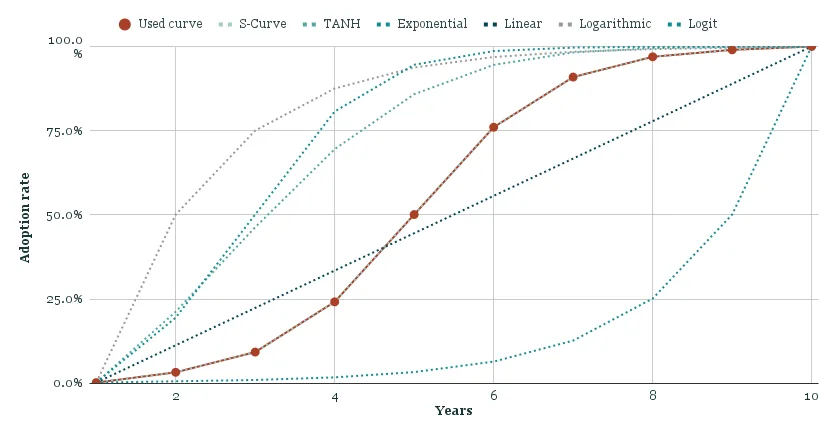
FinDaS built the economic model in Google Sheets, covering token distribution schedules, vesting, reward pool depletion curves, inflation projections, and a full 10-year circulation model. The perpetual reward pool (distributing 0.10% of outstanding tokens daily) was modeled to show its asymptotic behavior: technically infinite but with diminishing emissions, creating a natural incentive to participate early. Multiple adoption curves were tested before settling on the most conservative trajectory: S-curve, TANH, exponential, linear, logarithmic, and logit functions were each run against the revenue model to stress-test how sensitive protocol economics were to the speed and shape of user growth.
Stress Testing and Valuation
Hristo applied FinDaS's proprietary DCF-based valuation framework, one of the first rigorous applications of discounted cash flow analysis to a DeFi token. The model incorporated discount rates, long-term growth rates, and terminal value calculations, producing a sensitivity matrix across nine discount rate scenarios and nine growth rate assumptions. A 15% discount rate and 5% long-term growth rate served as the base case. The valuation section was explicitly designed for accredited investors only, with clear disclaimers and uncertainty modeling.
Documentation and Launch Readiness
FinDaS delivered the complete Token Economy Summary, including the ISPO mechanism design, sale financials, token generation event parameters, and the investor-grade valuation. The deliverable was structured so MELD could present it directly to SAFT investors.
| Deliverable | Description | Why it mattered |
|---|---|---|
| Token Economy Summary | Full tokenomics covering utility, allocations, ISPO, governance, insurance, and fee structure | Gave MELD a coherent economic narrative across three product lines |
| ISPO Mechanism Design | First-ever Initial Stake Pool Offering framework on Cardano | Enabled $1B+ community fundraise without requiring users to risk capital |
| DCF Valuation Model | Discounted cash flow analysis with sensitivity matrix and uncertainty modeling | Provided accredited investors with a defensible, quantitative basis for SAFT participation |
| Perpetual Reward Pool | Asymptotic emission schedule that never depletes | Ensured long-term incentive sustainability, unlike fixed-term emission schedules |
| Insurance Pool Architecture | Cash-flow generating staking mechanism with 10-day cooldown | Protected lenders and AMM LPs while giving token holders a reason to hold |
The world's first ISPO launched on July 1, 2021. Within 24 hours, the first pool filled with ~$100M in staked ADA.
What did FinDaS design?
1. The ISPO: a web3-first fundraising mechanism
FinDaS designed the Initial Stake Pool Offering mechanism that would become MELD's signature achievement. Users delegated ADA to MELD's stake pools for any duration they chose. MELD received the validator rewards; users received MELD tokens proportional to their delegation. The mechanism was risk-free for participants: they kept their ADA and could withdraw at any time.
Outcome: Within 24 hours the first pool filled with ~$100M in staked ADA. By October 27, ~620M ADA (over $1B USD) had been delegated across 10 stake pools by approximately 40,000 participants. The model was subsequently copied by hundreds of Cardano projects.
2. The perpetual reward pool
Rather than a fixed emission schedule that creates a cliff when rewards run out, FinDaS designed a pool that distributes 0.10% of its outstanding balance daily. This creates an asymptotically declining reward curve: the pool technically never empties, but rewards decrease over time, naturally shifting incentives from early adoption rewards to protocol fee revenue.
Outcome: The perpetual pool eliminated the "what happens when emissions end" problem that plagued many DeFi protocols. Participants could project their rewards over any time horizon without facing a hard cutoff.
3. The insurance pool with cash-flow generation
FinDaS designed a staking mechanism where MELD holders could lock tokens in an insurance pool that served two functions: protecting lenders against cascading liquidations and compensating AMM liquidity providers for impermanent loss. In return, insurance stakers received 50% of all net protocol fees. A 10-day cooldown on unstaking prevented bank runs during insured events. Duration-weighted staking multiplied rewards for longer commitments.
Outcome: The insurance pool converted the MELD token from a speculative governance asset into a productive, cash-flow-generating instrument, a distinction that mattered for DCF-based valuation.
4. Time-weighted governance
FinDaS designed a governance model with voting power calculated as tokens staked multiplied by a duration-based multiplier that rewarded long-term alignment over short-term whale influence. A three-stage decentralization roadmap (from team control through semi-decentralization to full on-chain governance) ensured the protocol could ship hotfixes early while progressively transferring power to the community.
Outcome: The governance design gave MELD a credible decentralization narrative for investors while maintaining operational flexibility during the critical early period.
What happened.
MELD's launch was a landmark event. The first-ever ISPO attracted over $1 billion in committed capital and 40,000 participants, generating $10M in revenue for the project. The protocol launched lending and borrowing services, a mobile app, and announced a debit card integration. The FinDaS-designed mechanics (the ISPO, the perpetual pool, the insurance pool) all functioned as intended.
Then, approximately two years after FinDaS's engagement, MELD pivoted from a Cardano-native DeFi protocol to a Layer 1 EVM blockchain built on Avalanche's subnet architecture. The team did not consult FinDaS during this transition. This was the critical failure point.
The tokenomics FinDaS designed was purpose-built for a DeFi protocol: the fee structures, insurance mechanics, reward emissions, and valuation assumptions all depended on lending, borrowing, and AMM revenue as the economic engine. A Layer 1 blockchain has fundamentally different economics: validator incentives, gas fee structures, ecosystem bootstrapping costs, and value accrual mechanics that bear little resemblance to protocol-level DeFi. Repurposing protocol tokenomics for a blockchain is like fitting a sedan engine into a truck chassis. The components may be excellent individually, but the system no longer coheres.
What we would do differently.
The lesson is not about the token design. The mechanics worked. The lesson is about engagement scope. Today, FinDaS structures long-term advisory relationships that include strategic pivot reviews, ensuring that if a client fundamentally changes their business model, the tokenomics is redesigned alongside it. A token economy is not a one-time deliverable that survives arbitrary business model changes. It is a system calibrated to a specific economic reality.
Key takeaways.
A token economy designed for a protocol cannot be transplanted onto a blockchain without a full redesign. The economic engines are fundamentally different.
The ISPO remains one of crypto's most successful community fundraising innovations
The mechanism FinDaS designed for MELD was copied by hundreds of subsequent Cardano projects and proved that token distribution can be both risk-free for participants and capital-efficient for the project.
Perpetual reward pools are structurally superior to fixed-term emissions
They eliminate the cliff problem that creates sell pressure when rewards end and allow natural transition from emission-driven to fee-driven economics.
Insurance pools that generate real cash flow transform a governance token into a productive asset
This distinction is critical for any project seeking DCF-based valuation. Without protocol-level cash flows reaching token holders, the token has no fundamental anchor.
Strategic pivots require a complete tokenomics redesign
Reusing protocol-level mechanics for a Layer 1 blockchain creates misaligned incentives that erode community trust and economic coherence over time.
What we took forward.
The MELD engagement fundamentally shaped how FinDaS scopes client relationships. Before MELD, most engagements were single-deliverable: design the tokenomics, hand over the report, move on. After watching a strong design become stranded by a strategic pivot it was never built for, Hristo restructured FinDaS's advisory model to include ongoing retainer options with explicit pivot-review clauses. Several subsequent clients (including engagements on L1 networks and DePIN protocols) have used these retainers to pressure-test strategic changes against their existing tokenomics before committing. The perpetual pool and insurance pool designs that FinDaS first deployed for MELD have since been refined and redeployed across multiple client engagements, each time informed by what worked at MELD and what the pivot revealed about the limits of transplanting economic mechanisms between fundamentally different system types.
Bring your project to a real token economist.
Free, no obligation, no juniors. We'll answer every question about your token design and tell you candidly where the weak spots are.
The questions we keep getting.
What is an Initial Stake Pool Offering (ISPO)?
An ISPO is a Cardano-native fundraising mechanism where users delegate ADA to a project's stake pool. The project receives staking rewards as revenue, and delegators receive the project's token in return. Participants never risk their principal and can withdraw at any time. MELD's 2021 ISPO was the first ever executed and attracted over $1 billion in committed capital.
How do you design tokenomics for a multi-product DeFi protocol?
The token must have coherent utility across all product lines without creating conflicting incentives. Each utility layer (governance, fee reduction, insurance, incentivization) is modeled independently and then stress-tested for interactions across lending, borrowing, and AMM services.
What is a perpetual reward pool in tokenomics?
A perpetual pool distributes a fixed percentage of its remaining balance each period rather than a fixed number of tokens. This creates an asymptotically declining emission curve that technically never reaches zero, eliminating the cliff effect that creates sudden sell pressure when fixed-term rewards end.
Can you reuse tokenomics designed for a DeFi protocol on a Layer 1 blockchain?
No. Protocol tokenomics derives value from fee revenue (lending margins, swap fees) distributed to token holders. Blockchain tokenomics must solve for validator incentives, gas economics, and network security. These are fundamentally different economic engines, and transplanting one onto the other creates misaligned incentives.
How do you value a DeFi token using discounted cash flow analysis?
Project the protocol's future fee revenue, determine what share flows to token holders (via insurance pools, buybacks, or staking), and discount those cash flows to present value. Sensitivity analysis across multiple discount rates and growth assumptions is essential given early-stage uncertainty.