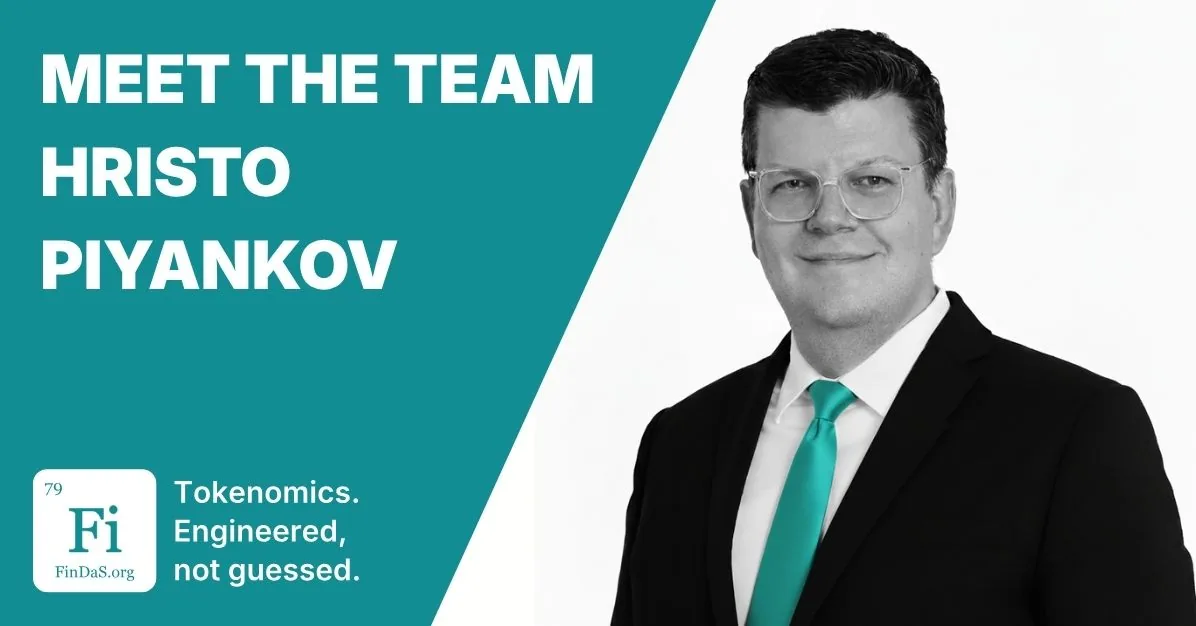
Hristo Piyankov is the founder and lead token economist at FinDaS, a Sofia-based tokenomics consulting firm. He has designed and audited tokenomics for over 300 blockchain projects that collectively raised more than $1 billion, and brings 13 years of traditional finance and data science experience alongside operator time as CPO of a decentralized insurance protocol on Ethereum.
Before tokenomics: traditional finance and data science
Before tokenomics, Hristo spent 13 years in traditional finance and data science. The last stretch of that work was as Director of CRM Analytics at one of China's largest consumer finance companies, where he built behavior models across tens of millions of customers using machine learning, big data pipelines, and credit-scoring systems that had to work at population scale. The crypto industry tends to treat "data-driven" as a marketing phrase. Hristo came from an environment where a model that broke in backtest meant the company lost money that quarter.
That kind of cost discipline is unusual in web3, where a lot of token designers are practitioners of narrative rather than of numbers. In 2017 he also ranked in the top 20 worldwide at the Excel World Championship, a detail that reads as trivia but signals what anyone who has worked with him will tell you: if there is a spreadsheet involved, he is the one who spots the mismatched formula before it ships.
Founding FinDaS and 200+ tokenomics projects
Hristo has been working in crypto since 2015 and founded FinDaS in 2018 to do tokenomics with the rigor he was used to from traditional finance, and without the shortcuts he was seeing at conferences. The firm has now worked on over 300 blockchain projects across almost every live archetype: DeFi protocols, stablecoins, GameFi and play-to-earn economies, DePIN networks, real-world asset tokenization, and infrastructure-layer L1s and L2s. Those projects have collectively raised over $1 billion in funding, though fundraising is the vanity metric in this business. The real signal is how many of those token designs are still standing five years later, and that ratio is what Hristo treats as the benchmark worth optimizing for.
On the named-client side, FinDaS was the tokenomics design partner for Input Output Group on the Midnight network, where the work produced a dual-asset model supporting blockchain privacy alongside regulatory compliance features. IOG's public testimonial on Hristo specifically credits him with challenging their architects' assumptions during design, which is closer to how the firm operates than the label "consultant" implies. The full client list lives on the portfolio page, and the pattern across it is consistent: projects that wanted a token design they could defend to an auditor, not a TGE narrative they could sell at a summit.
Post-launch experience on a live Ethereum protocol
Most tokenomics consultants have never worked inside a live protocol after its token was already trading. Hristo has. He served as Chief Product Officer, post-launch, at one of the first fully decentralized and permissionless insurance protocols built on Ethereum. That role covered the uncomfortable period where the token is already out, governance is already live, and theoretical incentives start hitting real users with real money at stake.
Launch tokenomics are mostly guesswork dressed up as modeling. The numbers that matter come from month 6 onward, when treasury inflows slow down, early voters stop voting, bootstrapping incentives expire, and the protocol has to prove it can pay for its own security. Hristo spent long enough in that seat to know which failure modes are predictable, which ones the documentation never mentions, and why so many protocols that launched cleanly in 2021 and 2022 are now functionally unmaintained. That experience shapes how he weights launch decisions during consulting work. If a mechanic looks fine at TGE but has a clear 18-month failure path, the design is broken at the drawing board, not later.
Teaching and mentorship
Alongside commercial consulting work, Hristo mentors early-stage crypto projects at Brinc and HyperNest, two accelerators that feed a steady stream of teams trying to avoid the common tokenomics failure modes before they hit mainnet. In 2025 he also joined the University of National and World Economics in Bulgaria as a lecturer in one of the first MSc programs in Cryptoeconomics in the country, where he teaches Tokenomics, Decentralized Finance, and Startup Funding.
The teaching is not a side hobby. A lot of bad token designs reach production because the founders running them never had anyone experienced ask them why the model would still work under adverse conditions. Academic courses that take the subject seriously, taught by people who have actually had to clean up after a live protocol, are a thin but real defense against that. Teams that want to stress-test a token design before launch typically come in through a Monte Carlo tokenomics simulation, and teams preparing for European listing often commission a MiCA-ready tokenomics paper as part of the same engagement.
Open source and public work
The commercial work funds a different layer of output that Hristo treats as industry infrastructure rather than as marketing. FinDaS maintains the tokenomics-calculator, a free tool for running basic token supply and emission scenarios, and contributes to the Fair Tokenomics Project, which aims to publish reusable frameworks so early teams can avoid paying for work the industry has already done a hundred times over.
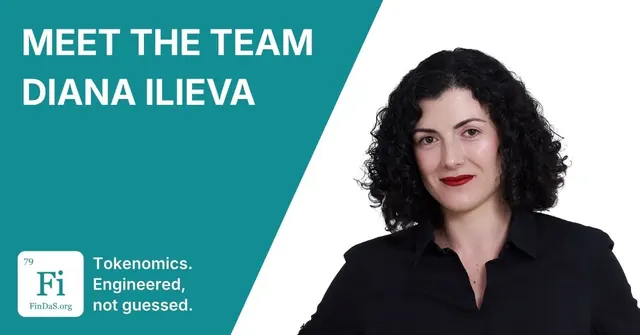
Most of the genuinely useful tokenomics material on LinkedIn in the last three years has come from a small group of practitioners who publish what they have seen in practice rather than what they want to sell. Hristo is one of them. His LinkedIn feed and FinDaS's research output are the clearest window into how the team actually thinks when a client brief lands on the desk, which is usually a better filter for prospective clients than a sales deck. The rest of the team, including Diana Ilieva, publishes in the same register: arguments grounded in what did and did not work across specific projects.
Frequently Asked Questions
01What types of crypto projects does Hristo specialize in?
+
02Does Hristo advise on regulatory topics like MiCA?
+
03How does working with Hristo differ from other tokenomics consultants?
+
04How do I get in touch with Hristo for a tokenomics review?
+