DeFi tokenomics is the rule set that determines who earns, who pays, and who absorbs losses inside smart-contract markets that are permissionless and composable by default. A design that is reasonable for an AMM can be actively harmful for a credit protocol. "Fit" for the scarcity the protocol is actually producing matters more than copying a proven model.
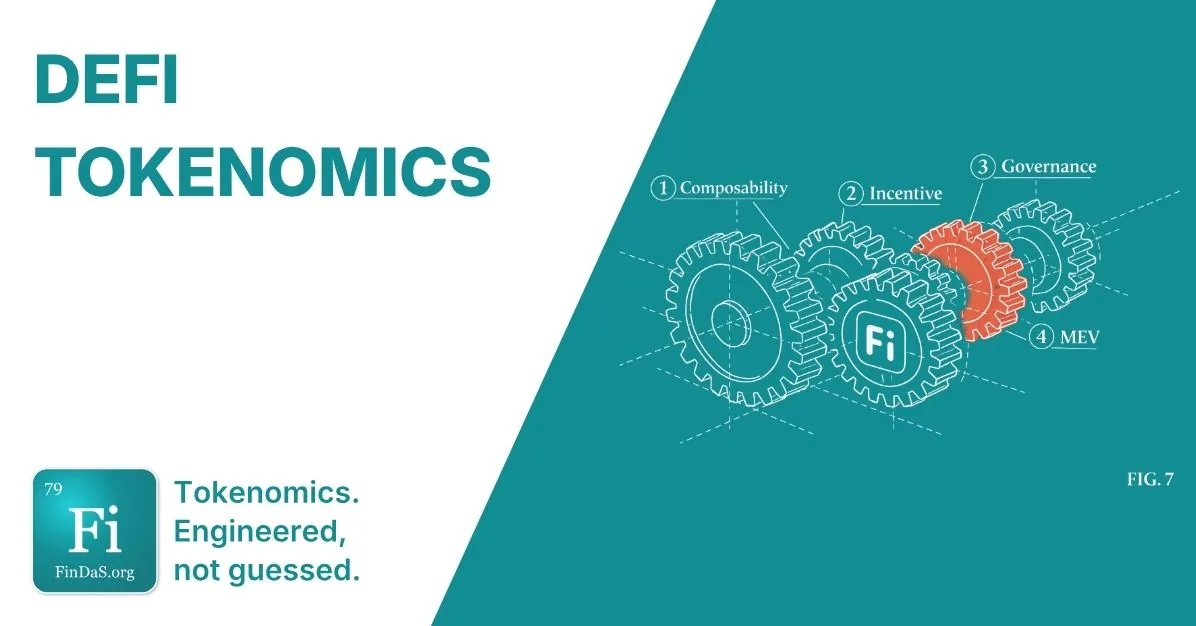
DeFi tokenomics is the set of economic rules that turns smart contracts into a durable market: who earns, who pays, who bears risk, who decides, and how the system changes over time. Those rules have to work under unusually strict conditions: permissionless access, adversarial execution (MEV, liquidations, oracle games, governance attacks), and composability, where other protocols can route value through you without asking. None of these is optional; the protocol ships with all three the moment its contracts are deployed.
That combination is why a good token economy design in DeFi is never generic. A governance-and-fee token model that is reasonable for an AMM can be actively harmful for a credit protocol. A liquidity-mining program that bootstraps usage for a derivatives venue can create toxic flow for a stablecoin. DeFi tokenomics has to fit the protocol's job.
Start with what the protocol is primarily trying to make scarce. The answer differs materially across DeFi categories, and the tokenomics follows from it rather than the other way around. Copy-pasting from a neighbour usually goes wrong here, because the neighbour is solving a different scarcity problem.
- For an AMM, scarcity is liquidity at good prices: depth near the market price and resilience to volatility.
- For a lending market, scarcity is risk-bearing balance sheet capacity: liquid collateral, conservative risk parameters, and backstops against bad debt.
- For a stablecoin system, scarcity is credible redemption and solvency under stress.
- For emissions-based liquidity coordination, scarcity is attention and sticky liquidity across many pools and chains.
Anyone evaluating DeFi systems should treat these as different objective functions, not variations of the same one. Design that ignores the objective function often "works" in calm markets and fails the moment incentives are stressed. That failure mode is the one I have seen most frequently, and it is almost always traceable back to the first question being answered badly.
Composability is not a feature; it is a tokenomics constraint
Composability means your protocol's positions can be held, rehypothecated, hedged, or automated inside other protocols. That interoperability is why DeFi grows quickly, and it is also why DeFi tokenomics has to be robust to second-order behavior. If the design only works when users interact with the protocol directly, the design does not work at all.
Positions-as-money-legos create reflexive demand loops. Lending receipts (like interest-bearing tokens), LP positions, and stablecoins become collateral elsewhere. That expands demand, but it also creates feedback loops where incentives intended to reward "real" usage end up subsidizing leverage: if incentives pay on TVL or notional supplied without distinguishing risk, they can accidentally pay users to create recursive positions that increase systemic tail risk.
Governance power becomes composable and tradable. Governance tokens can be delegated, concentrated, or used in meta-governance. Compound, for example, formalizes delegation as part of the governance mechanism, allowing token holders to delegate voting rights without transferring tokens; its documentation describes the onchain governance stack (token, Governor, Timelock), proposal thresholds, and timed execution delays. Composability here is economic as well as technical: delegation markets professionalize governance, but they also create identifiable governance "choke points" that can be bribed, coerced, or captured.
External routing can extract or redirect value flows. If a token captures value via fees, those fees can be minimized by routers, aggregators, and alternative venues when incentives are misaligned. If a token captures value via emissions, emissions can be farmed by actors who provide liquidity only when paid and then exit the moment the reward thins.
The question for DeFi tokenomics is therefore incentive compatibility under composition: will the best-response behavior of other protocols and automated agents still produce the outcomes your protocol needs? The answer is almost never "yes by default." It has to be designed for, and that design is the tokenomics work.
Incentives and decentralization: liquidity, usage, security, governance, capture resistance
In DeFi, incentives are not a single lever. They apply to different actor classes with different risk profiles and time horizons: liquidity incentives (who supplies inventory, under what conditions, and how quickly it can leave), usage incentives (who trades, borrows, or mints, and whether volume is organic or subsidized), security incentives (who backstops losses, who arbitrages, who liquidates, who runs keeper bots), and governance incentives (who votes, who proposes, who monitors, and what they are rewarded to prioritize). Each class responds to its own mechanism, and stacking them without accounting for their interactions is where most of the bad tokenomics I have seen sits.
Liquidity incentives target inventory that reduces slippage at the prices traders actually use. Paying for "liquidity anywhere" is waste. Concentrated liquidity increased capital efficiency but also made liquidity more tactical and more sensitive to fee structures: Uniswap documentation describes how swap fees are distributed to active, in-range liquidity, and how fee tiers segment market structure by asset volatility. The tokenomics point is that the protocol defines a value flow linked to usage (swap activity), mediated by governance decisions about which pools carry the protocol fee.
Usage incentives should be treated as a last resort, because DeFi usage is highly arbitrageable. Reward "volume" and automated actors loop trades to collect rewards; reward "borrowing" and actors borrow and re-lend to farm. Designs that fit the goal usually reward actions that create irreversible utility (long-duration commitments), valuable externalities (keepers and liquidations that stabilize the system), or meaningful transferred risk (underwriting or backstopping deficits). Many mature protocols evolve toward fee-based sustainability, explicit risk backstops, and governance minimization rather than indefinite broad emissions.
Security incentives buy loss-absorbing capacity. In credit-heavy DeFi, losses happen at the edges: oracle failures, correlated collateral crashes, liquidation congestion, and bad debt. Tokenomics has to specify who pays when that happens. Aave's Umbrella materials describe a model where users stake Aave aTokens to contribute to protocol security and accept slashing risk; when deficits occur, the system can burn corresponding staked aTokens to cover the shortfall without waiting for discretionary governance intervention. The protocol is purchasing insurance capacity, and the rewards should be calibrated to the risk actually transferred.
Governance incentives have a known problem: informed participation is costly and diffuse, while capture benefits are concentrated. Compound's governance documentation encodes capture-resistance primitives such as delegation, proposal thresholds, voting periods, quorum, and a Timelock that delays execution; proposals go through review and voting, queue in a Timelock, and take at least about a week end-to-end. Decentralization is not simply "token holders vote." It is governance process design that makes hostile governance harder and gives the ecosystem time to react.
Decentralization in DeFi tokenomics is an economic property: users supply capital and take risk because they believe the rules will not be changed against them, selectively enforced, or extracted by insiders. Three recurring concepts sit under that: credible neutrality (immutability, minimized privileged roles, transparent upgrades), governance surface area (every changeable parameter is an attack surface), and capture resistance (economic, operational, and technical vectors). These three trade off against each other in practice, which is why protocol design becomes opinionated about which one matters most for a given product.
Maker's auctions illustrate token-linked recapitalization that is both economic and governance-mediated. Maker's documentation describes that when the system has surplus (from stability fees), surplus Dai can be auctioned for MKR, and the MKR received is burned, reducing supply; in deficit scenarios, MKR can be minted via debt auctions to cover outstanding debt that cannot be repaid through collateral auctions. This aligns MKR holders as residual claimants in surplus and residual risk-bearers in deficit, while concentrating incentives around risk parameters and oracle assumptions.
Canonical DeFi tokenomics patterns (with concrete protocol examples)
Fee-based value capture is the default pattern for AMMs and marketplaces. Uniswap ties fees to liquidity provisioning behavior pro-rata to active liquidity, and in late December 2025 governance passed the UNIfication proposal, activating a protocol fee layer that burns UNI. The tradeoff is that fee-based value capture is only coherent if it does not degrade the primary product (execution quality); if protocol fees reduce LP returns enough to move liquidity elsewhere, the system can lose volume and end up with less sustainable value capture, not more.
Emissions-as-liquidity-coordination is how Curve directs where liquidity concentrates. Curve's GaugeController documentation describes how veCRV holders vote on gauge weights and how those weights determine CRV emissions; gauge weights update weekly at Thursday 00:00 UTC, and votes can be modified only once every 10 days. Gauge-directed emissions create a strategy layer (lock, vote, boost, aggregate), which can increase liquidity stickiness while also enabling vote markets, which act as either an efficient signaling mechanism or a capture vector depending on the protocol's goal.
Insurance-like staking and slashing is the credit-protocol pattern. Aave Umbrella frames staking as protocol protection against bad debt: users stake aTokens, earn rewards, and accept automated slashing or burning to cover deficits in specific asset-network pairs. This targets the true scarce resource for lending, which is loss-absorbing capital deployable quickly under stress, not governance participation or raw TVL.
Token as recapitalization and control plane is the stablecoin-system pattern. Maker's burn-in-surplus and mint-in-deficit auction pathway is a solvency architecture expressed in token terms, with auctions involving external actors (keepers) and parameters set via governance. The token is not decorative; it is the mechanism by which the system pays for bad outcomes when they happen, and that role is what gives the token its economic claim in good times.
Governance process as part of token utility binds process to token holders. Compound's governance stack and its constrained sequencing (review, vote, quorum, Timelock delay) makes governance-token "utility" into real utility (the ability to change risk parameters, add markets, upgrade contracts) while bounding that power via process. The bound is what gives the utility economic value: unconstrained governance is a liability, not a feature.
Evaluating DeFi tokenomics without turning it into a design checklist
When stakeholders ask for tokenomics consulting, they often want a single score: is this token model good? The more accurate question is whether the token economy is aligned with what the protocol must do, even when other protocols compose with it and adversaries probe it. A score collapses information that needs to be kept separate.
The more useful frame, consistent with how I work in practice, is a five-step evaluation. Each step forces a specific answer about a specific failure mode, and no step can be skipped or inferred from the others. Token economies that pass all five tend to hold up under stress; ones that fail even one tend to break in the corresponding way.
- State the protocol's primary job in one sentence.
- Trace value flows end-to-end: who pays, who earns, and what enforces it (contracts, governance, auctions).
- Identify the loss function: when the protocol loses money, solvency, or liquidity, and who absorbs that loss.
- Map incentives to actor classes (LPs, borrowers, keepers, delegates, integrators, arbitrageurs).
- Minimize governance where possible; harden it where necessary with thresholds, timelocks, and transparent execution.
For teams that want a second opinion, the most useful output is usually not a prettier emissions curve. It is a defensible argument that the token's role is necessary, bounded, and compatible with composability and decentralization. If you have a specific mechanism under stress, a tokenomics simulation is usually the right next step.
Frequently Asked Questions
01How does DeFi tokenomics differ from L1 blockchain tokenomics?
+
02Why does "fit" matter more than copying a proven model?
+
03What does "capture resistance" mean in practice?
+
04When should a DeFi protocol minimize governance versus expand it?
+