Tokenomics is the rulebook that governs how a token gets issued, distributed, and used. It determines whether a token's price is supported by actual demand or propped up by vesting schedules waiting to release. Reading tokenomics well is what separates a fragile launch from a durable one, whether you're building a token or deciding to hold one.
What tokenomics actually covers
Tokenomics is the set of rules governing how a token comes into existence, who gets it, when they can move it, and what it does once live. That is most of what matters, and not much of what people mean when they use the word loosely. A whitepaper is a document that usually contains the tokenomics along with technical architecture and team bios. A pitch deck is marketing. Charts on the secondary market are outcomes, not design.
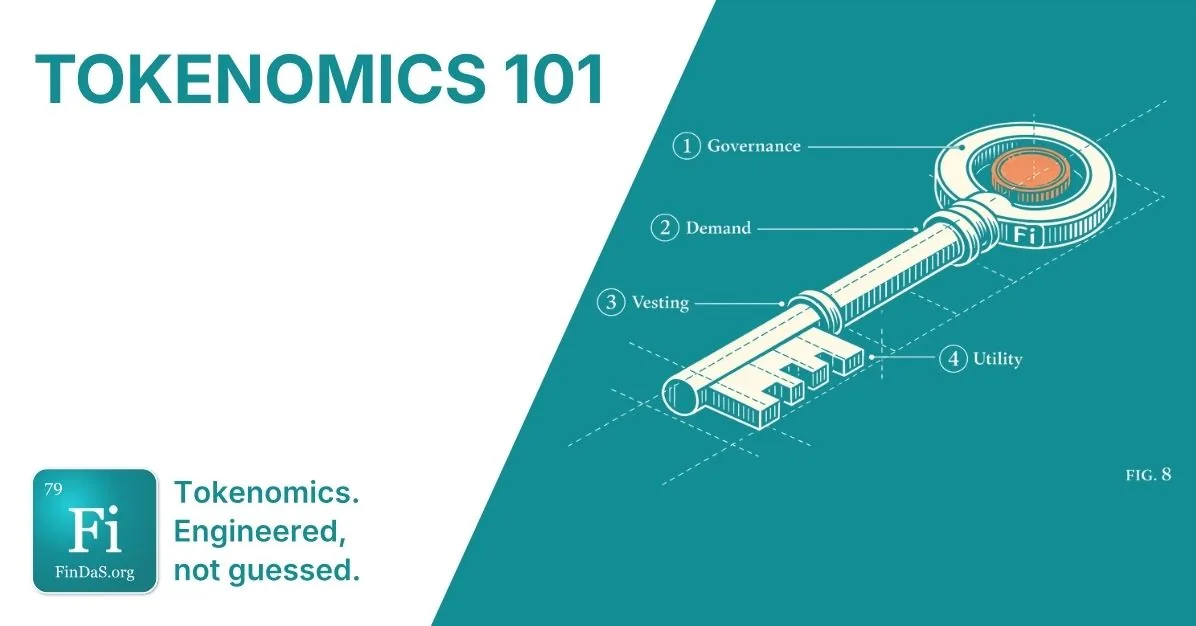
The four moving parts are supply (how tokens enter and leave the system), demand (what actually makes people hold them), distribution (who receives tokens and on what schedule), and utility (what the token does within the system). Most discussion of tokenomics collapses these into one blurred category. I keep them separate because projects usually fail on one specific axis, and pretending it's all "bad tokenomics" makes the fix invisible.
The reason any of this matters: the rules decide whether a token's price is held up by genuine demand or by a vesting cliff waiting to release. Two projects with the same product and the same market can perform very differently twelve months in, entirely because of design choices that nobody read closely at launch. That gap is where the field lives.
Supply: how tokens enter and leave the system
Supply is the easiest of the four to reason about because it's explicit in the code. A token is either fixed-supply (Bitcoin, 21 million, ever), inflationary (minted on a schedule), or some hybrid. Emission schedules set the pace at which new tokens enter circulation, and they can be time-based (Bitcoin's halving cuts issuance by half every four years), activity-based (Ethereum's proof-of-stake issuance scales with validator count), or discretionary (most project tokens, where the team controls emissions against a loose plan).
Burns remove supply. They come in three main shapes: fee burns, where part of every transaction gets destroyed (Ethereum's EIP-1559 is the cleanest example), buyback-and-burn, where the project uses revenue to purchase and destroy tokens, and penalty burns, such as slashing for misbehavior in proof-of-stake systems. The intent is to balance issuance so net supply doesn't grow out of control. Whether burns actually work depends on whether the underlying activity is real; a burn funded by mercenary liquidity that leaves when incentives dry up is just a burn funded by the next round of inflation.
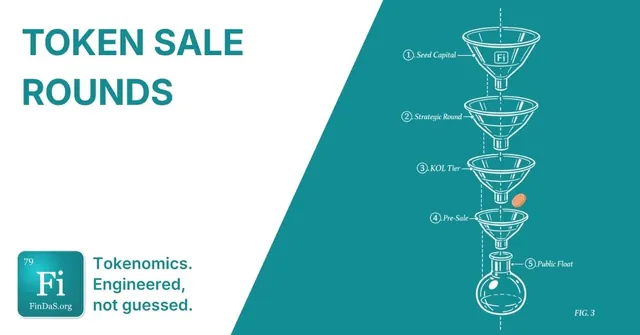
The important thing about supply isn't what's circulating at launch. It's how the circulating supply grows over the next twelve to thirty-six months. A project can launch with a small float (say 12% of max supply), look affordable, and then unlock the other 88% on a schedule that doesn't register on the price chart until it's actively hitting. The different token sale rounds feed into this schedule, since each round (seed, private, public) carries its own vesting terms that stack up on the unlock calendar.
Demand: what actually makes people hold
If supply is arithmetic, demand is behavior, and that's where tokenomics gets harder. A token has real demand when someone has a specific reason to buy and hold it beyond expecting the price to go up. In practice, four drivers show up repeatedly in projects that don't collapse post-launch. The first is pay-for-access: the token is required to use the system (gas on Ethereum, trade execution on some L1s, bandwidth on some DePIN networks). Usage generates demand mechanically.
The second driver is stake-for-yield or security. The token earns returns or locks value against misbehavior, and the yield comes from real revenue rather than from printing more tokens. Without real revenue behind it, "yield" is inflation rebadged as returns. The third driver is governance that actually decides things. If the votes don't move money or power, governance isn't a demand driver, it's a label for one. The fourth is hold-for-upside, which is the messiest and the most common: someone thinks the token will be worth more later, for reasons that may or may not pan out.
The test I use on every project is blunt. If the price stopped appreciating tomorrow, what reason would a holder have to keep the token? If the answer is "governance over a treasury nobody argues about" or "fee discounts worth two basis points on a platform with a thirty basis point spread," the utility is performative. That doesn't automatically make the project worthless, but it does mean the token is pure speculation dressed up as infrastructure. For a deeper breakdown of demand drivers specifically, see what drives the value of a token.
If the price stopped appreciating tomorrow, what reason would a holder have to keep the token?
Distribution and vesting: who gets what, when
Distribution is where most projects already lost before they launched, and it's also where the benchmarks have moved. In 2025, a reasonable allocation for a non-meme project looks roughly like this: core team 18 to 20%, investors 12 to 18%, treasury 20 to 25%, ecosystem and community 35 to 45%, public sale 1 to 5%. Individual projects push tighter; MegaETH's September 2025 MiCA whitepaper allocated 9.5% to the team, which is on the aggressively low end of the range and reads as a deliberate signal to the market.
The allocation table isn't really the point, though. The vesting schedule is. A 20% team allocation with no cliff and monthly linear unlock for twelve months is a different animal from a 20% team allocation with a one-year cliff followed by three years of monthly unlock. The first one starts hitting the market in thirty days; the second starts hitting in twelve months and then continues for three more years. Four-year vesting with a one-year cliff is the standard pattern, adapted from traditional tech equity vesting.
Unlocks are where price usually meets reality. Keyrock's analysis of over 16,000 unlock events found that roughly 90% coincided with price drops, with selling pressure building about thirty days before the cliff and recovery typically starting ten to fourteen days after. A recent example: Monad's upcoming unlock in 2026 releases roughly 15.6% of total supply to investors and team in a narrow window. That's the kind of schedule every sophisticated trader on the book has already priced in, and the cliff date isn't a surprise to anyone except sometimes the project itself, which discovers at that exact moment that its secondary market isn't deep enough to absorb the unlock.
Modeling this takes real work. If you're designing tokenomics and you haven't simulated what happens to price on day 365 and day 730 under realistic liquidity assumptions, that's where the actual work starts, and it's what most of our client engagements come down to. For a broader breakdown of the structural components beyond distribution, see the core components of a token economy.
Where tokenomics breaks in practice
The specific failure modes I see most often aren't exotic, they're the same three or four patterns repeating across projects. Mercenary liquidity is the most common one: a project runs a points campaign or an incentive program, attracts capital that's only there for the yield, and loses half its activity within days of the token generation event. Research on points programs shows 50%+ activity declines post-distribution are common, and 64% of airdrop recipients sell immediately at TGE. The capital was never there for the product.
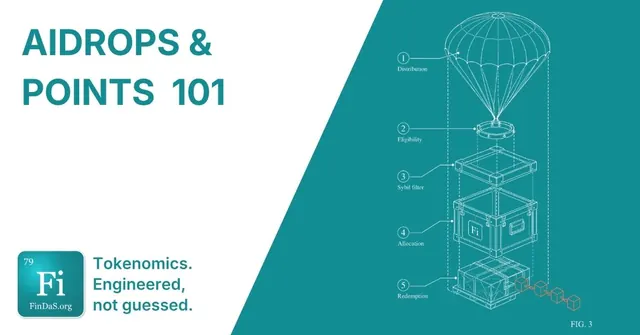
Airdrops that reward behavior the project didn't actually want are a close second. If the criteria reward raw volume, the Sybil farms optimize for raw volume, and the product experience doesn't improve. The numbers from 2024 and 2025 are telling: 88% of airdropped tokens lose value within three months, and Sybil attacks captured close to 48% of tokens in some major drops. Hyperliquid's HYPE is the exception people cite, and it works largely because the underlying product (perpetuals trading) retained users independently of the points campaign.
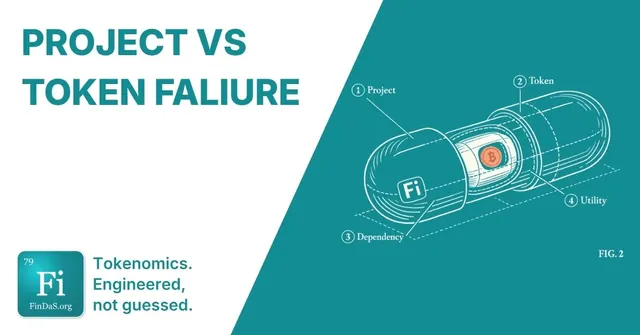
The third failure is theatrical utility. Projects list governance that doesn't govern, fee discounts too small to matter, and staking that pays out in more of the same token funded by dilution. These look like utility on a pitch deck and behave like speculation on the order book. The test is the same as before: take out price appreciation and see what's left.
The fourth is the meme-coin regime, which is a separate category but worth naming. CoinGecko reported 1.8 million tokens collapsed in Q1 2025 alone, and 52.7% of all cryptocurrencies listed between 2024 and early 2025 failed. A lot of that comes from pump.fun-style low-effort launches where the tokenomics is effectively the joke: fixed supply, fully liquid at launch, zero lockups, zero utility beyond attention. Evaluating these as if they were project tokens is a category error, and building a project token with the same structure is usually a mistake.
How to read a project's tokenomics in ten minutes
A practitioner's quick-read is mostly arithmetic, not judgment. The six things I look at, in order, take about ten minutes on a project that has published its tokenomics properly. Most of the signal comes out in the first three.
- Pull the emission schedule for the next thirty-six months. Mark the cliffs. Know what percentage of max supply becomes liquid in month twelve, month twenty-four, and month thirty-six.
- Pull the allocation table and check the share going to insiders (team plus investors). If it's above 35%, look closer. Then cross-reference the vesting schedule separately: an 18% team allocation with no cliff is usually worse than a 25% team allocation with a four-year vest.
- Ask the demand question. If the price stopped appreciating tomorrow, what reason would a holder have to keep the token? If the answer is governance over a quiet treasury or fee discounts too small to matter, the utility is performative.
- Cross-check fully diluted valuation against circulating market cap. If FDV is ten times current market cap, the current price is being supported by 10% of the eventual supply. For the valuation methods that go deeper than this arithmetic, see token valuation approaches.
- Check where the user base actually came from. Is the activity there because of the product or because of points? If there's a last-incentive-campaign-ended date, look at the retention curve after it; if there isn't one, that's its own answer.
- Check alignment between unlocks and product milestones. Calendar-based unlocks with no link to product reality are a design signal, not a neutral choice.
Ten minutes isn't enough to design tokenomics. It's usually enough to tell whether a project's tokenomics will survive first contact with its own unlock schedule, and that's the question worth answering before any of the others. For a worked example of how this reading translates into actual design work on a client project, see our Midnight tokenomics case study.
Frequently asked questions
01Is tokenomics the same as a whitepaper?
+
02Can you fix broken tokenomics after launch?
+
03Do meme coins have tokenomics?
+
04How does tokenomics differ from traditional economics?
+