DePIN tokenomics is the design of a token economy around a physical service: wireless coverage, storage, compute, sensor data, or energy delivered by independently operated hardware. The token coordinates a two-sided market under real-world constraints: hardware cost, geography, fraud incentives, and uptime expectations. Good DePIN tokenomics is less about supply curves than about making honest service cheaper than cheating.
What DePIN tokenomics is actually optimising for
DePIN tokenomics is the coordination instrument for a two-sided market in a physical service. The service is usually one of wireless coverage, storage capacity, sensor data, energy, or compute, delivered by independently operated hardware. The token is not a fundraising asset or a governance primitive by default. It is a price signal for behaviour the protocol cannot directly observe, paid in a currency the protocol controls, to people who bought hardware with money it does not.
The sector has matured enough to be measured honestly. Messari's State of DePIN 2025 puts it at roughly $10B in circulating market cap and $72M in on-chain revenue across the year, with leading networks trading at 10 to 25 times revenue. That is a steep collapse from the 2021 era of 1,000x multiples and the notional $50B market cap of late 2024, but the useful fact sits underneath the headline. Networks with real usage are decoupling: Helium's on-chain revenue grew roughly 8x between December 2024 and December 2025 while HNT fell 77 percent over the same window.
Good DePIN tokenomics is less about elegant supply curves than about answering a small set of operational questions. What service is the token paying for. How is delivery verified. What does the dishonest version cost compared to the honest one. These questions are the ones the generic tokenomics template quietly skips.
Why the generic tokenomics template does not transfer
The standard "launch a token, set emissions, add staking and burn" tokenomics template was shaped around software-native networks, where the thing being produced is on-chain computation or liquidity. The marginal cost of producing another unit of work is whatever gas or validator fee the network charges, and the response to price shocks is nearly instantaneous: adjust parameters, redirect emissions, change fee splits. Tokenomics in that environment can iterate monthly if it has to.
Physical networks break two assumptions in that template. Hardware introduces sunk cost and slow response. An operator who bought a $400 hotspot or a dozen storage drives cannot instantly cut capex when emissions drop or token price collapses. They either absorb the loss or unplug, and both outcomes damage the network. Second, the world is adversarial in non-cryptographic ways. Fake GPS coordinates, duplicated radio signatures, low-effort sensors, and appearing online without actually delivering service are often cheaper than honest provisioning unless the design makes cheating economically irrational.
Templates compress decisions. That is the whole point of a template, and most of the time it is a useful compression. In DePIN it compresses away the decisions that actually matter.
Match the incentive to what the network is missing
Two DePINs can both "reward operators" and still require nearly opposite incentive shapes. An early-stage wireless network is usually missing geographic footprint. A mature storage network may be missing long-duration reliability commitments. A network with supply already in place is usually missing demand-side value drivers, and paying more to operators at that point is counterproductive.
The sector-level numbers make this transition visible. Messari's 2024 report counted more than 13 million devices contributing daily across DePINs, with 20 projects above 100,000 active nodes and five above a million. Supply was effectively solved. By 2025, founders and investors had shifted to demand and monetisation as the primary operating metric, and projects whose revenue stayed off-chain were trading at roughly a tenth of the revenue multiple of projects whose revenue moved on-chain. The design implication is uncomfortable but clear: a tokenomics that looked sensible in year one, with heavy subsidies to hardware deployment, becomes value-destroying by year three if it does not transition to demand-pulled rewards.
This is why a practitioner cannot assess DePIN tokenomics against a generic template. The first question is which phase the network is in, and what the reward structure is buying this quarter compared to next year. A design that keeps paying for supply after supply is saturated is paying for the wrong thing.
Standalone DePIN L1 versus settling on an existing chain
DePINs face an architectural choice with direct tokenomics consequences: operate as a standalone Layer 1, or settle on an existing chain and rent security. Helium ran its own purpose-built chain from 2019 until April 2023, then migrated to Solana after the community approved HIP 70. The motivation was concrete: transaction throughput and developer tooling that a small dedicated validator set could not match.
A standalone L1 lets the economics be designed around the service. Base-layer fees, proof verification, and service-receipt workloads can all be tuned to the physical operation. The cost is that the network has to bootstrap and sustain its own validator set, tooling, and operational reliability. These costs usually surface as inflation, fees, or both. Helium's four years on its own chain are instructive: the protocol worked, but the throughput ceiling and the ongoing cost of securing a specialised L1 outweighed the control benefits once usage grew.
Settling on an existing chain flips the trade. Fees are denominated in a foreign currency whose volatility the DePIN does not control. Congestion on the host chain degrades operational flows. But security is rented cheaply, composability is free, and the team's engineering budget goes to the service instead of the validator set. The 2024 "Chain Wars" that Messari documented, with Solana and Base taking share from other L1s in DePIN deployment, suggests the industry has mostly made its call: new networks settle on established chains, and dedicated DePIN L1s now have to justify their cost in service-specific ways that a general-purpose chain cannot replicate.
Reliability economics: proofs, collateral, penalties that bite
Reliability is often the product in physical infrastructure, and the token has to pay for it in a way that makes unreliability expensive. Two mechanism families carry most of the weight. Live networks almost always use both, weighted differently by what the service physically requires.
The first is proof-based reward, where operators earn only when they provide cryptographic or observational evidence of service. Helium's Proof-of-Coverage uses radio-based proofs and witness networks to verify that a hotspot is physically located where it claims and is generating the wireless coverage it claims. Filecoin uses Window Proof-of-Spacetime: every 24 hours, storage providers must answer a cryptographic challenge within a 30-minute deadline, proving they still hold the sealed sector they committed to.
The second is collateral and slashing, which makes failure expensive directly. Filecoin storage providers pledge FIL proportional to committed capacity, with 75 percent of block rewards vesting over roughly 180 days to keep skin in the game. Missing a WindowPoSt triggers fault fees equal to 3.51 days of expected block rewards per sector, plus sector penalties if the fault was not declared before the proving window. Verified deals under Filecoin Plus carry a 10x multiplier on both rewards and slashing, on the same event. The arithmetic is designed so that a negligent or malicious operator loses more than a compliant one gains.
The enforcement surface has to match the service. Storage has natural cryptographic attestation and clean collateral mechanics. Wireless leans on radio signals, measurement networks, and anti-Sybil heuristics, because you cannot cryptographically prove photon emission. Sensor networks often need challenge protocols, redundancy, and reputation scoring because raw readings are cheap to fake. When the enforcement does not match the service, the network either overpays for activity that never becomes useful, or underpays real operators until they leave. In practice, this is where tokenomics simulation earns its keep. You cannot redesign hardware in production, so the reward and penalty structure has to survive a three-to-five-year stress test before it ships. For a broader cross-project view of how these mechanics diverge, the FinDaS tokenomics review library is a useful reference.
The map problem: paying for geography versus duplicated presence
Physical infrastructure is only valuable where it exists, and the value of the Nth node in the same neighbourhood collapses fast. If the reward design pays equally per node, operators cluster in easy, dense locations and rewards concentrate where the network is already saturated, while genuinely useful sparse regions stay empty. This is the map problem, and every coverage-dependent DePIN runs into it sooner or later.
Helium's Proof-of-Coverage mechanics address this directly with reward scaling. The system pays more for beacon events transmitted from underserved areas and less where local density exceeds target, using oracle-driven density scale values and transmit scaling that adjust as hotspots are added or removed nearby. The design recognises that two hotspots in the same suburban block are, for network purposes, roughly one hotspot.
Geographic incentives create second-order effects that are worth naming. Rewarding rural deployment raises location-spoofing pressure, because the payoff for moving a fake pin to a low-density area is higher. Sparse regions are also harder to verify precisely because there are fewer witnesses and measurement points. And the community's instinct of "coverage everywhere" often conflicts with operators' preference for "coverage where demand is", which is why mature networks typically run blended incentives: baseline footprint expansion early, shifting toward usage-driven rewards as demand appears. Not every DePIN should weight geography the same way. A compute network mostly cares that capacity exists somewhere with good connectivity. A mapping network cares very much where cameras are pointed.
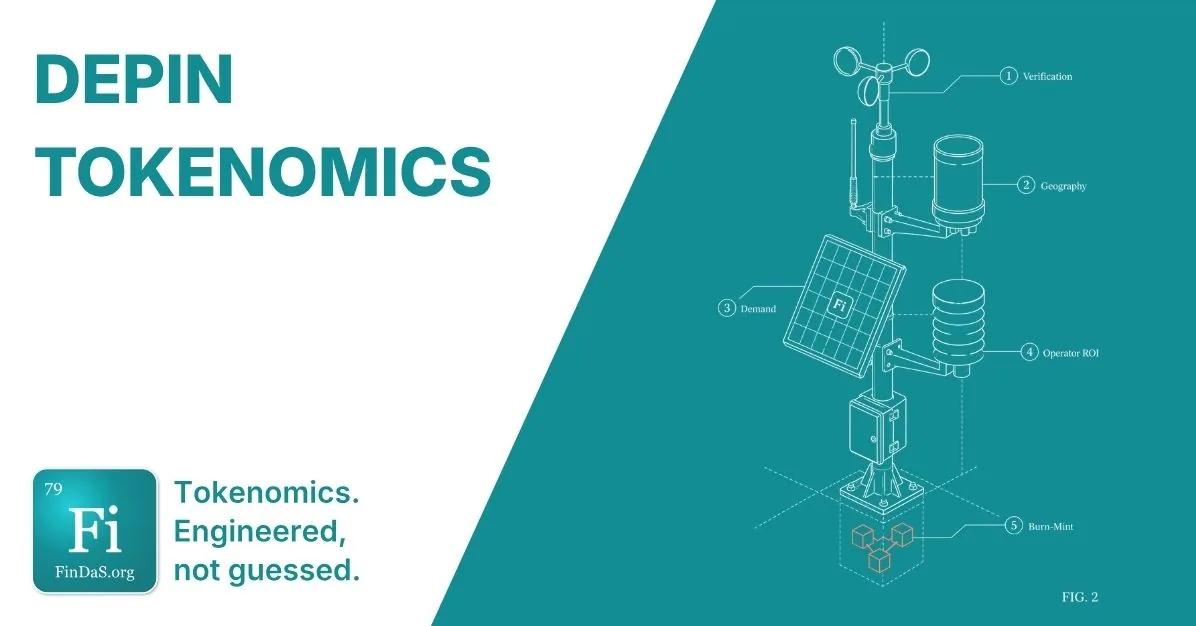
Five questions to evaluate a DePIN tokenomics
If you are assessing a DePIN tokenomics as a founder, operator, or allocator, the five questions below will do more work than any template comparison.
- What service is the token subsidising, and is that service still the bottleneck? If the network has more supply than demand, paying more for supply is counterproductive.
- What evidence counts as proof of delivery, and how does the cost of honest provisioning compare to the cost of cheating? If cheating is cheaper, the design is a lottery, not a payment system.
- What is the minimum reliability commitment, and what is the operator's exposure when it is missed? Collateral that an operator can walk away from is not collateral.
- Where does demand-side revenue actually come from, and is that path stable under three to five years of token price volatility? A demand side that evaporates at the first drawdown is a subsidy in disguise.
- Does the network still function if the token drops 80 percent? At what point do emissions, operator ROI, and user pricing break? This is the question most failed DePIN launches skipped.
The fifth question is the load-bearing one. By the 2025 numbers, most DePIN tokens from the 2018 to 2022 cohort are down 94 to 99 percent from their highs. The networks still producing revenue are those whose tokenomics were designed to hold together at those price levels. A tokenomics that only works in a bull market is not tokenomics. It is a subsidy waiting to run out.
Frequently asked questions
01How is DePIN tokenomics different from DeFi tokenomics?
+
02Can a DePIN function without a token?
+
03Is burn-and-mint equilibrium the default DePIN model, and should it be?
+
04How should founders handle token-price volatility affecting operator ROI?
+