Direct answers to the tokenomics questions we hear most often from founders. The ones that generalize across projects are below. The ones that depend on your specific setup (vesting curves, burn percentages, inflation targets) have to be modeled first.
After hundreds of tokenomics engagements, the same questions come up from most teams. Jump to a section or scroll through.
The fundamentals.
Does tokenomics really matter?
If the goal is raising money, no. You can copy the tokenomics of any recent successful raise and get funded. If the goal is a token that holds up over five or ten years of live markets, design matters more than anything else on the token side. We wrote a longer piece on when it matters and when it does not.
Is tokenomics just the token allocations?
Allocations are maybe 5% of the work. The core is supply and demand design, incentive alignment across participants, value capture, and monetary and fiscal policies such as perpetual reward pools, price floors, and emission schedules. Allocations are a downstream output, not the starting point.
Is there a difference between tokenomics, token economy, and token engineering?
No. Some people use the different terms for positioning or marketing, but the underlying work is the same. Fuller breakdown of the overlap is in our tokenomics vs token economy post.
Can I create my own tokenomics?
Yes, and plenty of projects do. Most of them ship with mechanisms that fail once real money and real incentives enter. Automated tools are useful for generating a starting template, less useful for stress-testing it against your specific project. More on the tradeoffs in tokenomics development vs DIY.
Can my tokenomics be unique?
Mostly no, and that is fine. Almost every viable tokenomics design uses a small set of tested primitives: vesting schedules, staking curves, burn mechanisms, governance patterns. The unique part is how you combine them for your specific business model. Chasing novelty for its own sake is a common failure mode, as we argue in bespoke vs unique tokenomics.
Token design parameters.
What should my token supply be?
Supply is the least important number in your tokenomics. A token can have 1 billion units or 1 unit (ERC-20s divide to 18 decimals either way); it is a unit of accounting. The marketing side matters a little: investors read $0.01 to $0.10 USD as the normal retail price range, so a supply between 500 million and 10 billion usually lands there at launch. For the underlying reasoning, see tokenomics design 101.
What token ticker should I pick if the one I want is taken?
ERC-20 tickers are not unique on-chain, so technically you can use any. It stops mattering until you hit an exchange listing or aggregator like CoinMarketCap, where duplicates get numbered (FIN2, FIN3) and you lose the clean brand handle. Three letters is the standard but not mandatory. Given the choice between a short-but-duplicate ticker and a longer-unique one, pick unique every time.
Which chain should my project launch on?
It depends on your user base and what you need from the chain. Ethereum and its L2s (Base, Arbitrum, Optimism) remain the default for projects needing deep liquidity, DeFi composability, and the widest exchange support. Solana is the serious alternative for consumer apps prioritizing speed and low fees. Other chains (TON, Sui, Avalanche, Cosmos zones) make sense for specific use cases.
What we would not do: launch on a chain because its grant program is generous. The grant ends; the chain stays. Longer analysis in where to deploy your token.
Does my project type (DeFi, CeFi, L1, gaming) affect my tokenomics?
Yes, heavily. A DeFi protocol's tokenomics depend on protocol revenue and governance rights. A CeFi token is closer to a platform loyalty asset. An L1 has block rewards, staking economics, and validator incentives to balance. A gaming token has sink and faucet dynamics driven by player behavior. None of these should share a template.
Design practices.
I want to burn 50% of my supply at launch. Is this OK?
Technically yes. In practice it is a meaningless marketing stunt. Launching with 1 billion tokens is identical to launching with 2 billion and burning half at launch. Anyone who would be impressed by the burn should probably not be your target investor.
Should my token burn or reflect on every transaction?
Generally no. A constant on-transaction burn bakes deflationary expectations into the core design and attracts speculators chasing scarcity rather than users engaging with the product. Price pumps until the first real sell-off unwinds it, then the cycle repeats.
Exceptions exist. EIP-1559 is the cleanest one: the burn is tied to real network usage, not to every transfer. We are not against burning as a mechanism, we are against burning driven by transaction volume rather than by demand for what the token is actually used for.
Should my tokenomics be audited?
Yes, without exception. An independent review catches things the team that built it cannot see, and the cost of an audit is small compared to relaunching after a mechanism fails post-launch. See how we run tokenomics audits for scope.
Launch and markets.
Should I list on a DEX or a CEX?
Both have tradeoffs that we cover in DEX vs CEX and market makers. As a rule: ask where your target users already hold assets and trade. DeFi-native users expect DEX availability. Retail crypto-adjacent users default to CEX. Most serious projects end up on both within the first year.
How much liquidity do I need?
Requires modeling. It depends on your vesting schedule, expected demand, and whether liquidity is seeded by the project, a market maker, or a public LP program. As a rough starting point: market makers typically recommend 5% of circulating supply in USD equivalent by end of year one. We think that is light and usually recommend 10%. For anything beyond a rough starting point, the number has to come from a model specific to your project. Sizing logic alongside venue choice in DEX vs CEX and market makers.
Do I need a market maker?
On a CEX, yes in most cases. On a DEX, there are alternatives: liquidity provider programs and concentrated liquidity pools let you bootstrap without a professional MM. Different market makers use different techniques, and not all fit every project. Pick the liquidity strategy before picking the MM, and see our breakdown of MM models for the options.
How much should I raise?
How much you can and how much you should are different questions. The market may allow a larger raise; that does not mean taking it is wise. Large raises create overhang, sell pressure, and investor misalignment.
Target at least 24 months of runway (36 in a tight market), plus budget for liquidity provision and exchange listings. Round structure matters as much as round size, and we go deeper on that in structuring token sale rounds.
How much does it cost to launch a crypto project?
Wide range, because scope varies heavily. Based on data we collect from projects we have supported, the full cost (excluding reserves and liquidity) lands between $500K and $4M. That covers legal, audits, tokenomics design, smart contract development, marketing, exchange listings, and team runway through launch. Detailed breakdown by category in how to launch a token.
Valuation and legal.
How do you determine the value of a token?
Crypto has no single accepted valuation model. We use several methodologies and triangulate:
- Network value to transactions (NVT)
- Traditional financial multiples adapted for tokens
- Discounted cashflow on protocol revenue
- Quantity theory of money for monetary tokens
- Benchmark comparisons against peer projects
- Full economy simulations
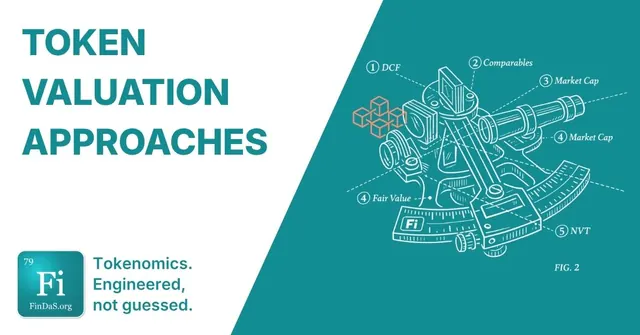
Each one produces a range. The useful output is where the ranges overlap. Full method in our token valuation approaches article.
Is my token a security?
Get a legal opinion. Please. We can help structure monetary and fiscal policies to reduce the probability of a security classification, but only a securities lawyer can give you an actual opinion that holds up with regulators. Any other answer here would be the wrong kind of confident.