Web 2.5 tokenomics is the token economy logic used by products that keep a Web2 operating model (centralized distribution, customer support, familiar UX) while selectively layering in Web3 primitives like tokenized loyalty, digital collectibles, or stablecoin-based settlement. The defining move is not adding a token. It is using token-based instruments to serve an existing business goal such as retention, onboarding, new-SKU monetization, or payment modernization. It works when the token layer behaves like an extension of the current business model rather than a parallel economy competing with it.
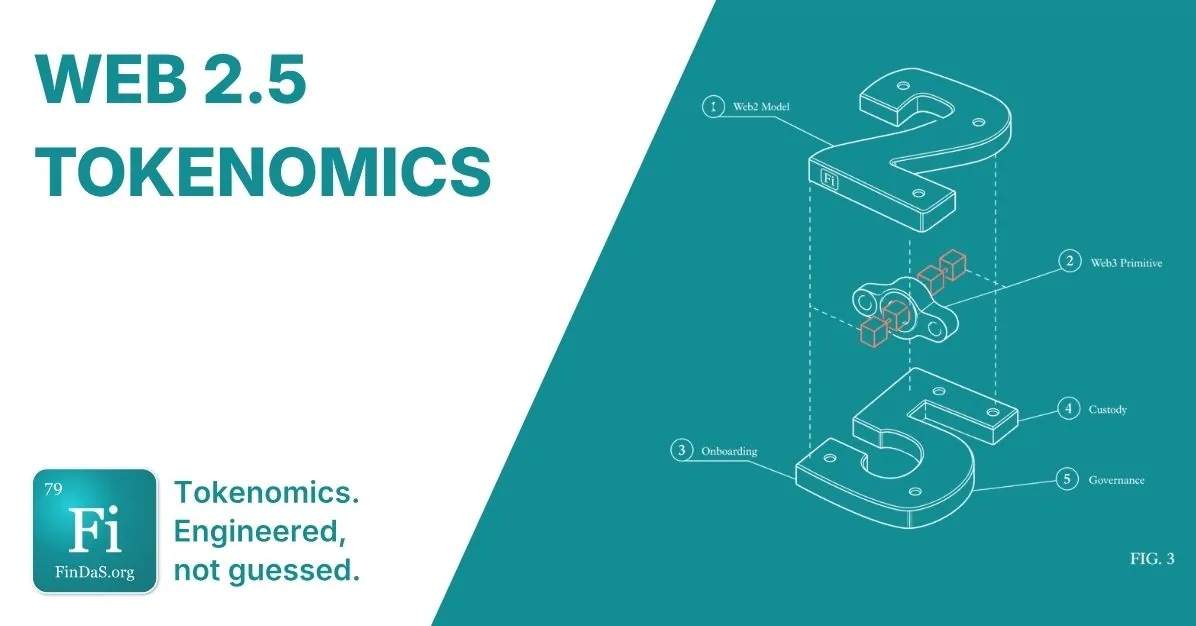
Web 2.5 tokenomics is the token economy logic used by products that keep a Web2 operating model (centralized distribution, customer support, risk controls, and familiar UX) while selectively adding Web3 primitives (tokenized loyalty, digital collectibles, programmable settlement, and portable identity). The defining move is not "adding a token." It is using token-based instruments to serve an existing business objective, without forcing mainstream users to adopt crypto-native behaviors on day one.
That business objective is usually one of four: (1) retention and loyalty economics, (2) lower-friction onboarding into a new product line, (3) incremental monetization (new SKUs like collectibles or memberships), or (4) payment and settlement modernization. Web 2.5 tokenomics works when the token layer behaves like an extension of the current business model, not a parallel economy competing with it.
One frame for Web 2.5 is progressive decentralization: teams sequence product, community participation, and decentralization over time instead of pretending everything is decentralized from the start. That sequencing matters because a Web 2.5 product is typically shipping to a user base that expects password resets, refunds, fraud protection, and customer support.
What makes Web 2.5 tokenomics structurally different
Web 2.5 tokenomics is constrained by operational realities that pure crypto-native systems can ignore. Those constraints are why the category exists, and why tokenomics must be tailored to the business goal instead of copied from templates.
Key structural differences show up in four places. The issuer is accountable to a pre-existing brand promise. If you already run a subscription, marketplace, game, or financial product, your token design cannot contradict your pricing, your customer guarantees, or your margin model. A token that behaves like "volatile money" may be incompatible with a brand that sells predictability.
Distribution is governed by customer lifecycle, not speculation cycles. Web 2.5 tokens are usually earned via behaviors the business already values (repeat purchases, referrals, verified reviews, usage milestones) and redeemed for benefits the business can cost and fulfill. The token layer is judged by cohort retention, conversion, and support load, not by token price.
Custody, controls, and reversibility are first-class requirements. Web 2.5 users often expect recoverability and dispute resolution. That changes the token economy: transfers may be restricted; "ownership" may be expressed as a right within program terms; and off-chain ledgers may remain the source of truth for certain balances.
Compliance, accounting, and consumer protection shape the mechanics. Whether a token is framed as points, credits, a voucher, or a collectible changes what you can promise, how you recognize revenue, and what obligations you create. This is why Web 2.5 tokenomics is not primarily a "token supply" conversation. It is a business systems conversation with a token surface area.
These constraints are not drawbacks. They are the point. Web 2.5 tokenomics is designed to be compatible with existing incentives, customer expectations, and payment rails, so the token layer actually ships and gets used.
Loyalty programs: tokens as programmable points, not a side economy
Most Web 2.5 token economy designs start with loyalty because loyalty already has a language businesses understand: earn rate, breakage, redemption liability, tiering, and partner economics. Web 2.5 tokenomics becomes unique when it turns those familiar levers into programmable instruments while keeping the program's financial and operational discipline intact. A concrete example is Starbucks Odyssey, which tied digital collectibles and points-like progression to an existing Rewards membership and lowered the barrier to entry by not requiring a standalone crypto wallet for participation.
Members could participate using existing sign-in and purchase with a credit card, while the on-chain element sat behind the experience. Starbucks shut down the Odyssey beta in March 2024, but the design pattern it used remains instructive. The important tokenomics lesson is not "NFTs drive loyalty." The lesson is that a Web 2.5 loyalty token must behave like an extension of the existing loyalty contract.
Loyalty tokens must preserve unit economics. If a token is redeemable for real value (discounts, products, experiences), then the business has created a cost. Web 2.5 tokenomics has to map token emissions to a budgeted pool of value, or to margin-positive behaviors. Otherwise, the token becomes a leakage channel.
Loyalty tokens should encode the behaviors the business already wants. In Web 2.5, the "right" incentive is rarely abstract. It is usually one of: higher purchase frequency, higher basket size, lower churn, lower CAC via referrals, more user-generated content, or partner-driven distribution. The token economy works when it is legible to internal stakeholders: finance can forecast it, marketing can run it, and support can explain it.
Loyalty tokens must decide what is transferable, and why. Transferability is not a default virtue in Web 2.5. If a token is meant to represent status (tiering) or earned trust (verified participation), allowing free transfer may break the meaning of the signal. If a token is meant to represent a benefit (a voucher-like claim), transferability can create fraud and customer service edge cases. Web 2.5 tokenomics is defined by these explicit boundaries.
Loyalty tokens must fit the product's fulfillment model. Experiences, early access, premium support, or digital perks each have different marginal costs and operational bottlenecks. A token that can be redeemed instantly for a scarce operational resource (for example, human support time) can create queues and dissatisfaction. The token layer needs to respect the real throughput of the business.
This is where a tokenomics expert adds practical value: not by inventing clever curves, but by translating token behavior into forecastable program economics and controllable operational load. In mature organizations, this consulting work often looks less like "crypto modeling" and more like a cross-functional alignment exercise across product, finance, legal, fraud/risk, and data science. The same pattern shows up across most of the projects we have delivered.
Onboarding: reducing wallet friction without hiding the economic contract
Web 2.5 onboarding is about staged exposure. Users can start with an email login and a familiar UI, then progressively adopt stronger forms of ownership or portability, if and only if the product benefit is clear. A common pattern is to keep authentication and account recovery in a Web2 shape (email, OAuth, device-based recovery) while introducing Web3 authentication options for users who want portability.
Standards like Sign-In with Ethereum define a way to authenticate to off-chain services by signing a message with an Ethereum account, which can coexist with traditional session management for different user segments. The tokenomics relevance is direct: onboarding choices change participation rates, which changes emission rates, which changes liability and cost. If onboarding is "too crypto," participation collapses and the token fails to serve loyalty or network goals. If onboarding is "too invisible," users may not understand what they earned, why it matters, or what constraints exist, which creates support burden and trust issues.
Three onboarding realities shape Web 2.5 tokenomics. Custodial-first experiences reshape perceived ownership: if users do not manage keys, the product must be clear about what the token represents (access rights, loyalty value, collectible ownership, or a mix). Ambiguity creates friction at the moment users try to transfer, sell, or redeem.
Risk controls are part of the incentive design. Fraud and abuse are not edge cases in incentive systems. Referral rewards, sign-up bonuses, and earn multipliers attract adversarial behavior. Web 2.5 tokenomics is distinctive because it assumes you will enforce policy (rate limits, eligibility rules, reversals) and designs incentives that remain attractive even with controls applied.
"First value" must be non-technical. Web 2.5 onboarding works when the first benefit is understood without teaching users blockchain concepts: a better reward, faster checkout, a status benefit, or a unique digital item tied to a real-world perk. That is why Web 2.5 token economy design often starts from customer experience mapping rather than token distribution charts.
This is also why Web 2.5 tokenomics must fit the specific goal. If the goal is retention, you optimize for repeatable, understandable rewards. If the goal is onboarding into a new product category, you optimize for a "first win" moment that feels native to your current UX. If the goal is partner distribution, you optimize for shareable status or cross-brand earn and redeem.
Payment rails: stablecoins, cards, and settlement reality
Many Web 2.5 roadmaps eventually hit payments, not because the product wants to become a bank, but because tokens and payments collide in three practical places: purchasing tokenized items, redeeming rewards across borders, and settling with partners. Web 2.5 tokenomics is distinctive here because it treats payment rails as infrastructure, not ideology. A token can be a reward unit, but value still needs to move through rails customers and finance teams accept: cards, ACH, wallets, and increasingly stablecoin-based settlement in the background.
A relevant signal is that major payment networks have moved stablecoin settlement from experiment to production. Visa's launch of USDC settlement for U.S. issuer and acquirer partners explicitly framed stablecoins as a settlement layer that can provide faster funds movement and seven-day availability without changing how consumers pay. For Web 2.5 tokenomics, the key takeaway is not "stablecoins are the future." The takeaway is that settlement choices affect token utility and program feasibility.
If tokens are purchased, you need a credible fiat path. Web 2.5 monetization often includes digital collectibles, memberships, or premium perks. If the purchase flow requires users to acquire crypto first, conversion drops. If the flow supports cards, conversion is higher but chargebacks, refunds, and fraud rules apply, and token economics must anticipate reversals and dispute handling.
If tokens are redeemed, you need predictable value delivery. A token redeemable for a discount, service credit, or benefit needs clear terms and operational backing. If redemption requires on-chain steps, you need support processes for failed transactions and user errors. If redemption is off-chain, you need integrity controls to prevent double-spend across systems.
If tokens touch cross-border or partner settlement, treasury becomes part of the design. When programs expand to partner ecosystems (marketplaces, franchised businesses, multi-merchant coalitions), the question becomes how obligations net out. Some Web 2.5 systems will keep settlement entirely off-chain and reconcile traditionally. Others will use stablecoins as a backend settlement tool while exposing users to a normal checkout. Either way, the tokenomics has to match the actual settlement workflow, not the idealized one.
This is where tokenomics advisor work often intersects with payments strategy: defining what the token represents (points vs. credit vs. collectible), who owes what to whom, and what happens under refunds, partial fulfillment, or partner disputes. That work is closer to token economy consulting than to speculative token mechanics. The token layer is the surface; the obligations it creates are the substance.
If you are evaluating Web 2.5 tokenomics, the practical "next step" is usually not to draft a whitepaper. It is to write down (in plain business terms) the one program outcome you are buying with token complexity: retention lift, lower CAC, higher conversion on a new SKU, improved partner settlement, or a step-change in onboarding. Then pressure-test whether the token layer can be measured, governed, and supported like any other customer-facing program.
Frequently asked questions
01How is Web 2.5 tokenomics different from Web 3 tokenomics?
+
02Do users of a Web 2.5 program need their own crypto wallet?
+
03What is the biggest failure mode for Web 2.5 loyalty tokens?
+
04Can a Web 2.5 program transition to fully decentralized tokenomics over time?
+