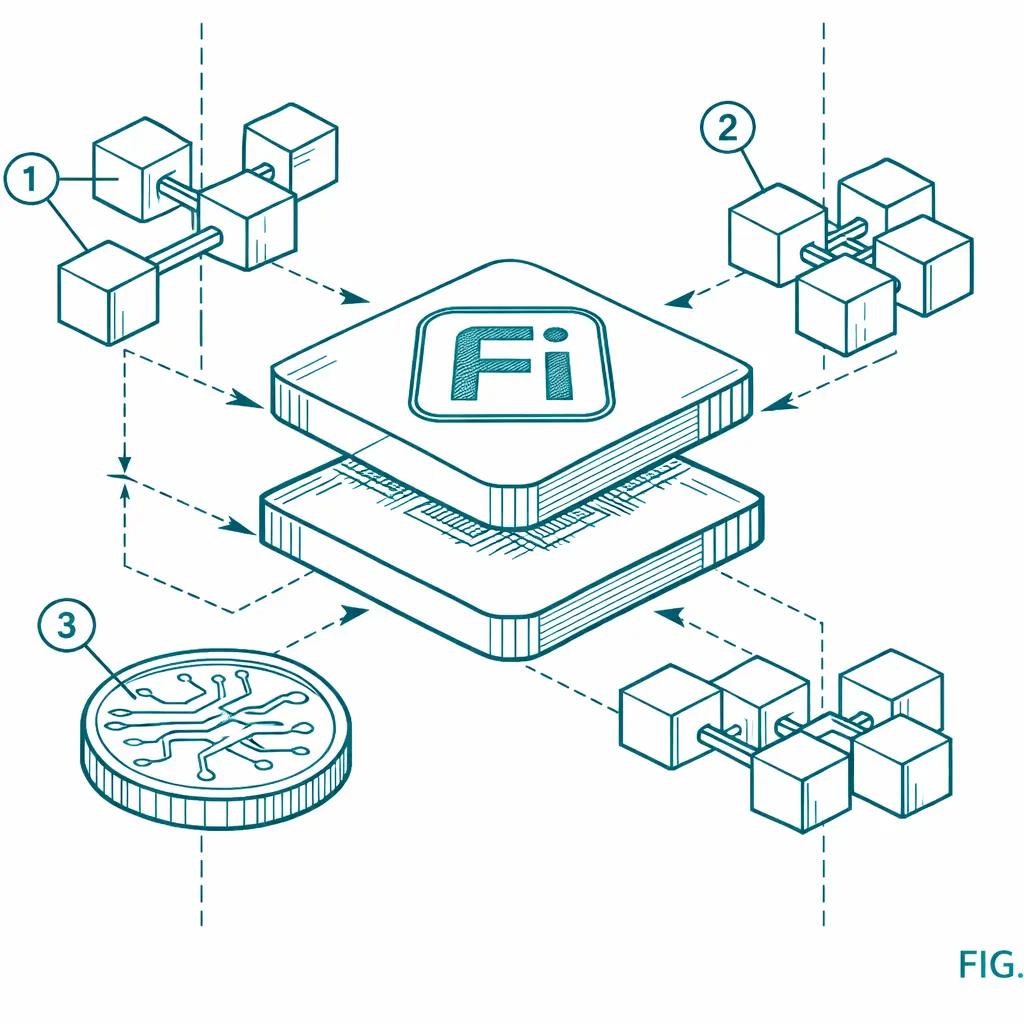
Interoperability is no longer optional infrastructure
Blockchain interoperability matters because the market has already chosen a multi-network future. Polkadot’s own architecture documents assume a world of specialized chains that need to exchange data, assets, and instructions rather than converge into one universal chain, while Cosmos IBC is explicitly built to move authenticated packets between separate ledgers through on-chain clients and off-chain relayers. In practice, that means interoperability is not a cosmetic wallet feature. It is the coordination layer for liquidity, governance actions, cross-chain applications, and token distribution.
The economic payoff is straightforward. If assets and applications can move across networks without forcing users to re-wrap trust at every hop, builders get wider distribution and users get better capital efficiency. Polkadot frames this as trustless communication among parachains under shared security, and Cosmos frames it as packet delivery authenticated by light clients rather than by trusting relayers. Those are different designs, but both target the same bottleneck: isolated state silos suppress composability and fragment demand.
The harder point is political, not technical. Interoperability does not just connect networks. It concentrates decision-making somewhere. That “somewhere” may be the validator set of a relay chain, the tokenholders of a hub, a fixed guardian committee, an app-selected verifier set, or an off-chain solver market. For tokenomics, that is the central question. The interop layer decides who can authenticate cross-chain truth, who captures fees, who can pause or upgrade the rail, and whose balance sheet ultimately underwrites failure.
Not all interoperability models make the same power trade-offs
| Model | Example | How messages are verified | Who holds the most power | Main trade-off |
|---|---|---|---|---|
| Shared-security native messaging | Polkadot XCM | Parachains inherit Relay Chain security and communicate through XCM; most transport still uses HRMP while XCMP remains under development. | DOT-backed validator and governance structure at the Relay Chain level. | Strong internal trust assumptions and good composability, but less sovereignty for connected chains. |
| Light-client sovereign interoperability | Cosmos IBC | Chains verify counterparty state with on-chain light clients; relayers submit proofs but do not define validity. | Each connected chain and its own validator/governance system, unless shared security is added separately. | More sovereignty and cleaner trust minimization, but higher coordination and security bootstrapping costs. |
| PoS middle-chain bridge | Axelar | Cross-chain communication is secured by Axelar’s proof-of-stake network; newer connections can use verifier reward pools and AXL bonds. | AXL stakers, validators, and on-chain governance that can set bonding and slashing parameters. | Scalable external connectivity, but security and policy concentrate in a separate token-governed network. |
| Guardian-attested bridge | Wormhole | Messages become VAAs with a 13-of-19 Guardian multisignature. | A fixed Guardian set for security, plus token governance for broader ecosystem decisions. | Broad chain coverage and operational flexibility, but a visibly bounded security committee. |
| App-configurable verifier network | LayerZero V2 | Applications choose Decentralized Verifier Networks with on-chain X-of-Y-of-N rules enforced by Message Libraries. | Application owners choose the security stack, so control shifts from protocol-wide default security to per-app configuration. | High flexibility, but security quality becomes uneven and harder for users to evaluate. |
| Intent-based bridging | Across, deBridge, Mayan Swift in recent research | Off-chain solvers front liquidity and settle later, improving UX but introducing liquidity-exhaustion risk. | Solver market makers and protocols that shape incentives and settlement parameters. | Fast user experience, but new dependence on solver profitability and liquidity concentration. |
The table shows why “bridge” is too broad a category to be analytically useful. Some systems are closer to native interoperability inside one security domain. Others are external coordination layers that ask users to trust an additional political economy. That distinction should shape both technical due diligence and token economy design.
Polkadot and Cosmos solve interoperability from opposite starting points
Polkadot solves interoperability by subordinating connected chains to a common security and coordination layer. Parachains inherit the Relay Chain’s pooled security instead of bootstrapping their own validator sets, and XCM provides the standard message format for asset transfers and other cross-consensus operations. Bridge Hub extends that approach outward with on-chain light clients and trustless relayers for external chains such as Ethereum. The upside is clear: fewer duplicated security budgets and tighter intra-ecosystem composability. The downside is equally clear: economic and governance gravity pull toward DOT holders and Relay Chain institutions.
Cosmos starts from the opposite premise. IBC treats chains as sovereign peers. A relayer carries data, but the destination chain verifies the proof against its on-chain light client, which means message validity is rooted in the counterparties’ consensus states rather than in a separate bridge committee. That architecture is attractive for fairness because it preserves local governance and avoids handing cross-chain truth to a centralized intermediary. It also means each chain still needs credible security of its own. Sovereignty is not free. It transfers operational and capital costs back to individual ecosystems.
Cosmos Interchain Security exists because that sovereignty cost is real. The Cosmos Hub documentation describes it as a shared security model where Cosmos Hub validators also validate consumer chains, letting those chains focus on product-market fit instead of assembling their own validator agreements. That is a sensible builder incentive. It is also a concentration trade-off. Once a chain rents security from a larger tokenholder base, some of its practical independence moves upstream to ATOM-governed institutions and validator economics.
For informed Web3 teams, the relevant conclusion is simple. Polkadot internalizes interoperability through shared security. Cosmos externalizes it through sovereign verification and then optionally re-imports shared security when smaller chains need help. Both models work. They simply allocate influence differently.
Bridges expand the reachable market, but they import new governance layers
External bridges and messaging stacks matter because most economic activity does not live inside one interoperability family. A project that wants access to Ethereum, Solana, Cosmos appchains, rollups, and emerging enterprise networks cannot wait for one universal standard to win. That is why Axelar, Wormhole, LayerZero, and Chainlink CCIP have gained strategic importance. They give builders a way to ship cross-chain products now. They also add another layer of control that users must price in.
Wormhole is a clean example of the distinction between ecosystem governance and message authentication. Its documentation says the canonical security set is 19 Guardians, and a valid VAA requires 13 signatures. That is not a diffuse tokenholder democracy at the security layer. It is a known committee with explicit thresholds. Wormhole’s token can still govern broader ecosystem direction, but message truth is produced by that bounded operator set. From an allocation-fairness perspective, that means governance token distribution and security control are related but not identical power centers.
LayerZero pushes in another direction. Its V2 architecture lets each channel specify different X-of-Y-of-N verifier requirements, and applications choose which DVNs they want. That is flexible and often economically efficient. It also shifts responsibility from the base protocol to app teams. Users are no longer evaluating one security model. They are evaluating many, pathway by pathway. In tokenomics terms, that can democratize choice for builders while making risk disclosure harder for end users and smaller communities.
Axelar sits between protocol-wide and app-specific models. It is a separate proof-of-stake network for cross-chain communication, and its newer Interchain Amplifier design uses AXL reward pools and bonded verifiers for additional connections. That makes the token economically relevant to security, not just governance theater. But it also means cross-chain connectivity depends on a middle-chain whose own validator incentives, inflation policy, and governance parameters can shape outcomes for everyone using it.
Chainlink CCIP highlights a different control surface: layered oversight. Its Risk Management Network independently verifies activity and must explicitly approve messages before execution, with the ability to halt cross-chain activity if anomalies are detected. That improves defense-in-depth. It also creates an acknowledged intervention point. For institutions, that may be desirable. For protocols that want minimal discretionary choke points, it is a meaningful architectural choice, not a footnote.
Security is the dominant economic constraint on interoperability
Bridge security failures are not edge cases. They are structural. A 2024 survey paper on cross-chain bridge design found that bridges often provide weaker security guarantees than the underlying chains, analyzed 60 bridges and 34 exploits across 2021-2023, and linked architectural components to recurring design flaws. The same paper described 2022 damage in the range of $1.5 billion to $2 billion. That scale matters because interoperability only creates value if users believe the transport layer will not vaporize it.
The key analytical mistake is to treat bridge exploits as random implementation bugs. Many are consequences of architecture. If a design relies on a small signer set, compromised operational security can become systemic. If a design depends on delayed settlement or external liquidity providers, the attack surface shifts from signature correctness to market exhaustion and incentive manipulation. In other words, each interoperability model carries a distinct failure mode, and those failure modes map directly into who bears economic loss.
Recent research on intent-based bridges makes that point sharply. A February 19, 2026 paper analyzed 3.5 million cross-chain intents worth $9.24 billion between June and November 2025 across Across, deBridge, and Mayan Swift, and identified a new class of liquidity-exhaustion attacks. The important implication is not that intent systems are broken. It is that improving UX by letting solvers front liquidity changes the risk model rather than removing it. Faster bridging can mean more exposure to concentrated off-chain market makers.
Standardization is part of the same security problem. IBC’s connection and channel handshakes exist to ensure counterparties and versions are mutually compatible, and Polkadot’s own XCM transport documentation notes that XCMP remains under development while most traffic still uses HRMP. Interoperability standards evolve because cross-chain correctness is hard. The economic implication is that the upgrade path, not just the current design, deserves scrutiny. Protocols that can change verifier sets, thresholds, or message handling by governance are also protocols where governance capture can rewrite security assumptions after launch.
Tokenomics decides who captures the upside and who can rewrite the rules
Interoperability tokens are often marketed as neutral coordination assets. They are rarely neutral in practice. They decide who gets paid for verification, who can subsidize new chain integrations, who governs slashing or bonding rules, and who benefits from fee flows created by network effects. When the interop layer becomes central plumbing, its token distribution becomes a question of long-term market structure, not just fundraising history.
Wormhole shows the tension clearly. The original public tokenomics allocated 12% of supply to core contributors, 11.6% to strategic network participants, and 23.3% to foundation treasury, alongside 17% for community and launch and 31% for ecosystem and incubation. On September 17, 2025, Wormhole announced W 2.0, keeping total supply capped at 10 billion, targeting a 4% base yield for governance staking, and smoothing several unlock categories into bi-weekly releases beginning October 3, 2025, while extending contributor and guardian alignment to October 2028. None of that is automatically bad. But it shows how much of the future economic map sits with contributors, strategic counterparties, and treasury discretion before “community” governance fully matures.
Axelar is more explicit about tying token utility to security. Its documentation says the network is proof-of-stake, and the 2024-2025 Mobius and Cobalt materials describe AXL bonds, verifier reward pools, fee burning, and governance-controlled bonding parameters. That is stronger alignment than a token that only votes on branding or grants. It also means token distribution and staking concentration directly influence who secures an expanding set of external chain connections. A token-backed bridge can decentralize security only to the extent that stake ownership is itself decentralized.
Polkadot and Cosmos expose the same issue from a different angle. Shared-security systems lower the cost for new chains to launch, which is a genuine public good for builders. But they also make the dominant asset in the security layer, DOT or ATOM, a gatekeeper over interoperability policy and validator economics. Sovereign interoperability minimizes that centralization pressure, but then smaller chains face a harsher security bootstrap problem. Builder incentives and concentration risk are in permanent tension here. Evidence does not make one side universally right. It shows that every model picks a different place to socialize risk and authority.
What builders should optimize for when connecting multiple networks
The best interoperability design is usually the one that minimizes unpriced trust. If a product mainly needs communication inside one security domain, native systems like XCM or IBC-style light-client verification are structurally cleaner than committee bridges. If a product needs the broadest possible chain coverage, then external messaging layers may be unavoidable, but teams should disclose exactly who verifies messages, who can pause the system, how upgrades happen, and how fee and token flows concentrate control.
The second priority is matching token design to the real security model. If a token does not actually secure cross-chain verification, governance language should not imply that it does. If it does secure verification, then allocation, vesting, validator access, and slashing design become first-order risks. That is where serious token economy work belongs. The tokenomics question is not “does the token have utility?” It is “which stakeholders gain durable leverage over the cross-chain rail, and what mechanism constrains them?”
For teams building multichain products, that usually means evaluating interoperability and tokenomics together rather than as separate workstreams. At FinDaS Tokenomics, this is where token economy design becomes practical rather than theoretical: mapping message verification, fee capture, staking incentives, treasury discretion, and governance rights into one coherent power model. A bridge can expand distribution. It can also centralize it. The design objective is to widen participation without quietly handing the network’s future to the earliest or best-capitalized insiders.