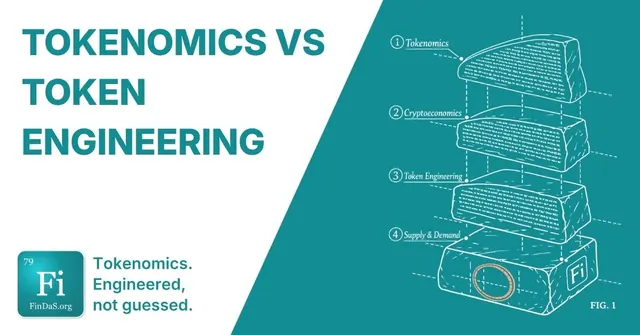
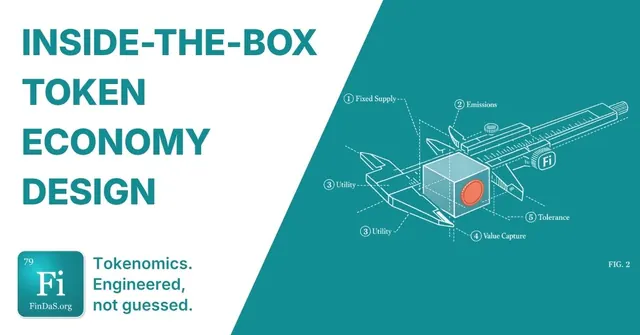
A token economy has a standard list of components: utility, monetary policy, governance, numerical setup (allocations, vesting, launch price), liquidity strategy, funding landscape, analytical valuation, benchmarking, and stress tests. These are usually presented as an independent checklist, but they are actually a dependency chain. Utility and monetary policy decisions determine what the numerical setup should look like, not the other way around. Most projects invert that order, pick allocations first, and end up with tokenomics that unravel in year one when the unlock schedule meets the real market.
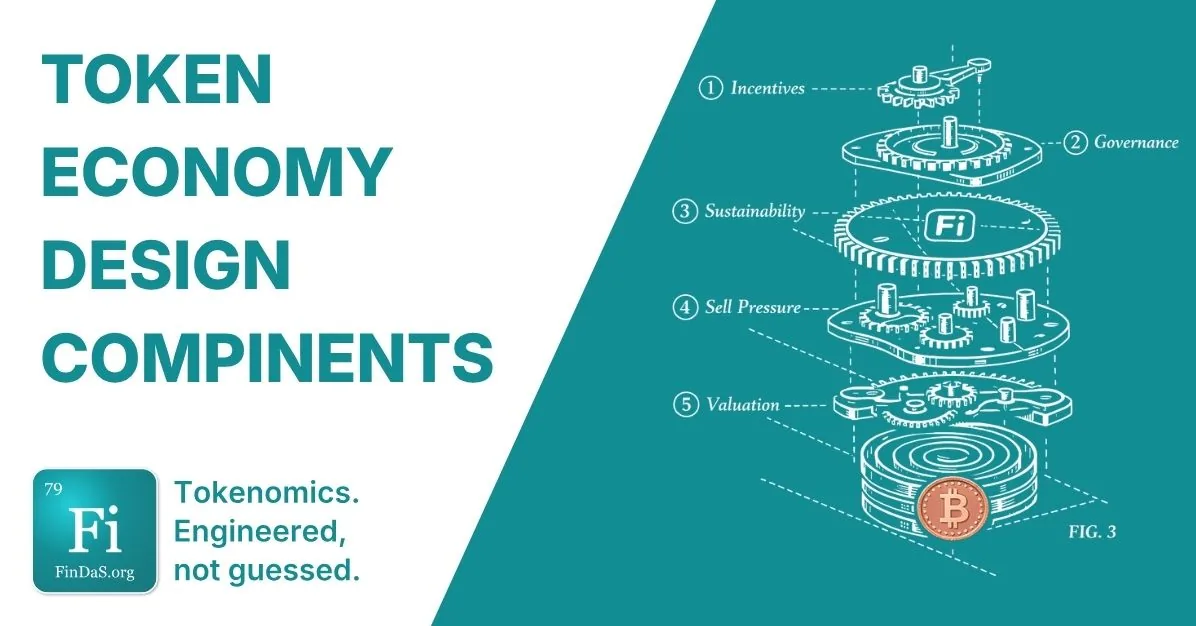
The components list is fine. The ordering is where projects break.
The list of components in a token economy is not controversial. Most guides give you the same set: utility, supply, demand, incentives. Expand that and you get monetary policy, governance, allocations, vesting, sell-pressure analysis, valuation, benchmarking, and stress tests. Standard expanded tokenomics guides cover all of it.
The list is not where projects break. Projects break because they treat it as a checklist where you pick items independently, instead of a dependency chain where each earlier decision constrains everything after it. The modal failure I see (either knowingly, or because the actual answer is inconvenient): a founder decides on a total supply and an allocation split first, negotiates vesting with investors based on what they raise, then reverse-engineers utility to fit the numbers already committed to.
That ordering is backwards, and it accounts for most of the tokenomics that fall apart within the first year. The rest of this article walks the order I think actually works, and what each step constrains for the next.
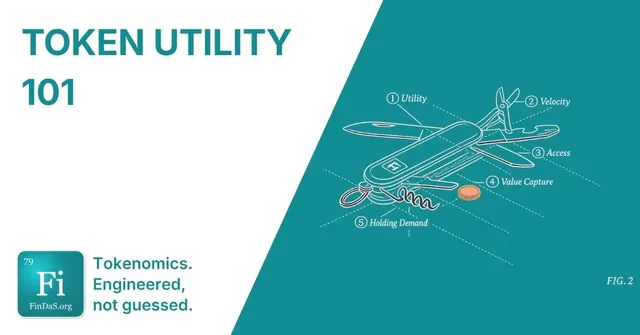
The utility layer: spend, hold, use
Utility decomposes cleanly into three questions. Projects that answer all three with "governance" and then launch are the reason most tokens end the first year below their listing price.
The first question is what can the token actually be spent on: purchases, protocol fees, access to a service, settlement. The follow-up most projects skip is why use the token instead of USD or USDC. If you cannot answer "because the price mechanic or the fee schedule makes the token the lower-cost option in this specific case," you do not have spend utility. You have a token that users will sell immediately and pay in stables. Whether the price is denominated in tokens or in fiat matters here too: fiat-denominated with token settlement often creates the worst of both worlds.
The second is why would anyone hold it. A user who needs the token for a transaction and can buy it on demand has no reason to keep currency risk on their balance sheet. Staking yields, governance rights, tier discounts, fee rebates, priority access: these are the usual answers, and they have to be concrete. "Access to the ecosystem" is not an answer. "30% fee discount above 10,000 tokens held for 30 days" is an answer.
The third is what actions on the platform get rewarded, and what gets penalized. Rewards for trading, commenting, voting, referring, validating. Penalties sit alongside: unstaking early reduces accumulated rewards, validators who produce bad blocks get slashed, users who vote-and-dump lose tier status. Without the penalty side, rewards just subsidize the exit.
Monetary policy: value drivers and sustainability
Once utility is designed, monetary policy becomes the question of whether the token can hold its value at the scale the utility requires. Buybacks, burns, staking yields, reward emissions: these are the mechanisms, and picking between them is the easy part. The harder question most projects skip is whether the emission budget outlasts the incentive horizon.
Running the numbers matters here. If your rewards program hands out 2% of supply per month to reach a target TVL, and your vesting schedule also releases 1 to 2% per month to team and investors over four years, you have compounding sell pressure that a buyback funded by first-year revenue will not dent. A Keyrock analysis of more than 16,000 token unlock events found that roughly 90% of unlocks create negative price pressure regardless of size or type, and team unlocks produced the worst drawdowns at around a 25% decline, largely because teams rarely coordinate their selling the way experienced investors do. That is not an argument against vesting or rewards. It is an argument for calibrating them as one system.
Getting the actual value drivers right before fixing emission targets is the step that avoids the "rewards outrun revenue" problem. When value drivers are weak or cosmetic, the emission budget is effectively a transfer from the treasury to the earliest sellers. The math looks fine at commit time because most emission budgets are sized in percentage terms against supply, not in dollar terms against projected demand, and that distance hides the problem until month six.
Governance: decentralization or optics?
Governance gets designed carefully at projects that will never use it. Most project governance is optics, and that is not automatically a problem. Sometimes it is the right call. But you should know which one you are building before you commit six months of design to it.
Load-bearing governance looks like the Uniswap fee switch debate or MakerDAO's collateral decisions: material calls that affect protocol economics, decided by holders whose votes move real value. Cosmetic governance looks like a proposal process designed in detail for a DAO that votes on treasury grants nobody contests, while the founding team still makes every important decision in a Telegram group. Vote counting is the detail that usually reveals which kind you built, since one token equals one vote with no cap means whales control the outcome regardless of what the forum posts sound like.
If your first year depends on one team making fast decisions, say so in the documentation and do not simulate a DAO on top of it. You can always decentralize later when the protocol is generating something worth governing. Pretending you have decentralized earlier than you actually have costs you credibility the one time you actually need it.
Numerical setup is downstream
Allocations, vesting curves, launch price, raise target, total supply: these are the numbers most founders want to lock in first. They are the output of the four decisions above, not the starting point. Done in the right order, the numerical setup falls out of the upstream work.
The order that actually works:
- Decide utility across spend, hold, and use.
- Decide monetary policy: value drivers, sustainability, emission budget.
- Decide governance shape, honestly about load-bearing or optics.
- Size the emission schedule against the utility's incentive horizon.
- Derive allocations from what the emission schedule and funding needs require.
- Set vesting curves that align team and investor sell incentives with the utility ramp.
- Set the raise target against actual funding-market conditions, then back into a launch price.
- Stress-test everything.
The order most projects default to is almost the inverse. They pick a total supply that looks impressive (one billion is popular), split it by rules of thumb (20% team, 15 to 20% investors, community gets something), match a vesting curve to a comparable project, and set a round-number raise that covers eighteen months of burn. Utility is the last thing they design, after the numbers are already locked.
The 2025 launch data showed the cost of that inversion. A CryptoRank Q1 2025 review flagged Story Protocol, Berachain, and Plume Network among launches with notably low float ratios, where the gap between circulating supply and fully-diluted valuation created asymmetric conditions between early and public investors, a structure that tends to amplify downstream volatility for months after listing. Low float is not automatically wrong. It is, though, a revealed preference about whose sell pressure you would rather concentrate, and that is downstream of utility and vesting, not upstream of them.
Numerical setup is the output of the design, not the starting point.
Before anything gets locked to paper, I put numerical setups through Monte Carlo tokenomics simulations on every engagement. Simulation is where broken orderings surface cheaply. The failures that only appear once the token is live are the expensive ones, and they are almost always the same failures a competent stress test at step eight would have surfaced months earlier.
Sell pressure and liquidity: stress-testing year one
Year one is make-or-break for almost any token. The first unlock, the first meaningful trading volume, the first time vested tokens hit market: all concentrated in months 6 to 18. This is the window where the calibration choices from steps 4 and 6 above actually get tested.
Sell pressure starts showing up before the unlock date, not at it. Traders position into the 30-day runway ahead of scheduled unlocks, which means liquidity is asked to absorb three overlapping pressures: pre-unlock positioning, the unlock itself, and the tokens recipients actually sell. A buyback sized against "the unlock event" absorbs maybe a third of what it needs to.
The DEX-or-CEX question is part of the same calculation. A DEX-only launch with $500K of liquidity against a $50M fully-diluted valuation is not a liquidity strategy; it is a slow-motion disaster. CEX listings give you depth and price discovery but cost real money and concentrate free float where market makers can see it. Which side dominates depends on whether your utility drives spot demand (CEX-favored) or lives inside the protocol (DEX-favored). The longer treatment on DEX versus CEX trade-offs covers the decision framework.
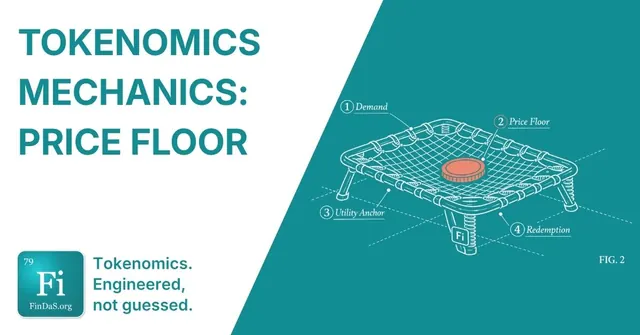
Buyback budgets should be sized as a function of projected monthly net sell pressure, not as a standalone target. The question is: given projected monthly sell pressure from unlocks and reward claims, what is the minimum protocol revenue needed to run a buyback that absorbs a meaningful fraction? If the answer requires revenue your first-year model does not produce, the buyback is ceremonial. A soft price floor mechanic can help, but only if the floor budget is calibrated against the unlock schedule rather than against a round number that sounded good in a pitch deck.
External reality checks: funding, valuation, benchmarking
Three external reality checks sit outside the design chain: funding landscape, analytical valuation, and benchmarking. None of them designs anything, but they catch the bad commitments before they go to paper. Skipping them is cheap in the pitch deck and expensive once the raise is closed.
Funding landscape first. What are investors actually funding right now? The Block's 2025 year-end review found that crypto venture capital held up in dollar terms at roughly $18.9 billion but deal count fell about 60% year over year, with most capital flowing into later-stage deals while early-stage rounds faced the toughest environment in years. If your raise target was built on 2021 comps, you are in the wrong decade. Token sales re-emerged in 2025 but did not replace venture capital, and the rounds that closed at good terms went to teams with traction, not narratives.
Second is analytical valuation. No one can predict a token's price with confidence, and equity valuation frameworks (DCF, multiples) do not transfer cleanly to tokens. What they can do is sanity-check whether enough value actually flows through the token to support the launch price. A project where 5% of platform revenue reaches the token, and holding incentives are weak, is structurally different from one where 80% reaches the token and holding incentives are concrete. A proper analytical valuation exercise forces that math into the open.
Third is benchmarking. Where did comparable projects actually clear, not where did their pitch decks say they would? Pick projects with similar utility, similar stage, similar token mechanism, and similar funding profile, not just similar narratives. Compare current token price to ATH, current circulating supply to initial float, current revenue to projected revenue at pitch time. The comparisons that fail hardest are the ones where the reference project sits in the same category on paper but solved a structurally different problem.
The components list is the easy part. Holding the ordering steady through pressure from investors, timelines, and the temptation to lock numbers early is where projects actually differentiate. Most of the fragile tokenomics I have reviewed were not designed badly; they were designed in the wrong order, and year one exposed it.
Frequently asked questions
01In what order should I design these components?
+
02Can you change a token economy after launch?
+
03Which component do projects usually get wrong first?
+
04Is governance design worth the effort for a small project?
+