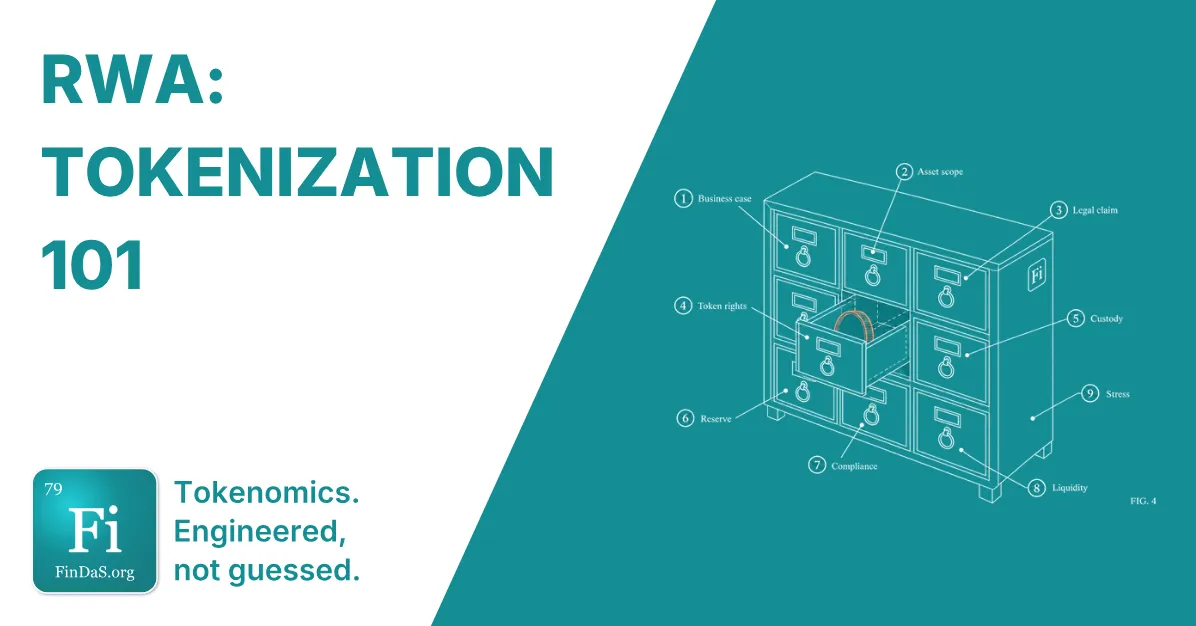
RWA tokenization is the design of an on-chain token whose value and enforceability depend on assets, contracts and controls off the chain. It comes down to nine decisions, best taken in order: whether to tokenize at all, what the holder legally owns, what one token is, who can mint and redeem, what backs it and who holds it, who keeps the yield, which regulatory class the design produces, whether it will trade, and who absorbs a shortfall. Each decision narrows the ones after it.
What RWA tokenization is
RWA tokenization puts a claim on a real-world asset, such as a Treasury bill, a gold bar, a loan or a building, on a blockchain. The token is the easy part. Its value and enforceability depend on what the chain cannot see: the cashflows (interest, rent, repayments), the control of the asset (custodians, administrators, transfer agents), settlement (bank rails and registries), and the legal rights against an issuer, an SPV or a trust.
So RWA tokenomics is the design that keeps a token's supply, redemption, transfers and yield faithful to that asset, without creating classification, liquidity or run risk nobody intended. It is closer to structured finance than to the token design of a crypto network, as Part 6.2 of Tokenomics is Easy put it: the challenge is the plumbing, not the utility. Part 7.1 named the policy: who can mint and redeem, what sits in the reserve, and who keeps what it earns. This series broke the design into nine decisions, and this page is the map.
The nine decisions
Business case
A token gives an asset distribution, faster settlement and use as collateral. It does not give it buyers, so the first decision is whether anyone wants to hold the asset at all.
Legal claim
A direct interest, a contractual claim on an issuer, or a beneficial interest in an SPV or trust. That choice decides what holders recover in an insolvency, and no smart contract overrides it.
Unit
A fixed quantity of one asset, or a share of a pool; one grade or several; a stable price or one that rises with income. Everything later is built on this unit.
Minting and redemption
Who can create and redeem tokens, at what minimum, fee and speed. This is the token's monetary policy, and the door every later decision depends on.
Reserve and custody
What the reserve holds, how fast it turns into cash, who holds it apart from the issuer, and how often anyone checks.
Yield
The reserve's income goes to the holders, stays with the issuer as spread, or pays the partners who distribute the token. Each answer is a different business and a different legal box.
Classification
The design so far, read by each regulator in each market. The class is an output of the earlier decisions, and it sets who may hold the token.
Liquidity
The price stays near NAV only where arbitrageurs can mint and redeem; whitelists shrink that group and split the market. Collateral use is often the liquidity that matters.
Shortfall
When the reserve is worth less than the supply, a rule written before launch decides who is paid: first come, pro-rata, a first-loss layer, or a gate.
How each decision limits the next
The order matters because each answer narrows the next. The legal claim decides what a unit can be: a claim on a pool cannot promise a specific bar. The unit decides what redemption pays out: a fixed quantity redeems for the asset, a pool share at NAV. The door and the reserve together decide whether the price can hold, and so whether the token trades. The yield, the claim and the marketing decide the class, and the class decides who may hold the token, which is the largest single limit on liquidity. The reserve and the claim decide what a shortfall rule has to share.
Our Dravanti engagement shows the chain at work: one set of metal reserves became two instruments, a spot commodity token and a basket security token, because the unit decision split them, and each then carried its own classification and its own market.
What changes by asset class
The nine decisions are the same for every asset. The constraints that shape the answers are not: an asset's cashflow, how it is valued and how fast it can be sold decide which choices are available and which are self-destructive.
| Asset | Cashflow | What the design has to get right |
|---|---|---|
| Treasuries and money funds | Predictable interest or accrual | Redemption that is operationally credible, and accrual that is accurate |
| Private credit | Path-dependent: prepayments, defaults, recoveries | Notice-based redemption, liquidity buffers and loss rules written in advance; daily liquidity is a red flag |
| Invoices and receivables | Short and binary: paid or not | Payment verification as the oracle; reserves and concentration limits |
| Real estate | Rent net of costs, lumpy capital spending | Slow appraisal pricing; redemption gated, periodic or event-driven |
| Commodities | Usually none, and a storage cost | Custody is the product: who pays the carry, and proof the bars exist |
| Funds and structured products | Set by the strategy, often with waterfalls | NAV, dealing frequency and gates mirrored on-chain |
| Equities | Dividends and corporate actions | Cap-table integrity, transfer restrictions and corporate-action handling |
| Carbon credits | None: value comes from retirement | State oracles (issued, retired, invalidated) so no credit is claimed twice |
Liquidity follows the same lines. Research on the RWA market finds tokenized credit and Treasury funds largely static in trading, while gold tokens listed on large exchanges trade widely.
Where to start
- Business case: would anyone hold this asset today, token or not?
- Legal claim: is the holder's claim direct, contractual, or through an SPV or trust?
- Unit: is one token a fixed quantity or a share of a pool?
- Minting and redemption: who can mint and redeem, at what minimum, fee and speed?
- Reserve and custody: what is in the reserve, who holds it, and who checks?
- Yield: does the income go to holders, the issuer or the distributors?
- Classification: what class does this design produce in each market you sell into?
- Liquidity: who can arbitrage it, and where is it accepted as collateral?
- Shortfall: what rule shares a shortfall, and is it written into the terms?
- Dravanti: the case the series keeps returning to.
- REAL: an RWA chain built with an on-chain insurance backstop.
- Tokenize everything, but can you sell it?: our review of the research on RWA liquidity.
Frequently asked questions
01What are the steps to tokenize a real-world asset?
+
02How does RWA tokenomics differ from stablecoin tokenomics?
+
03Can the same RWA structure work under both EU and US regulation?
+
04When should a project tokenize an SPV vehicle instead of the asset directly?
+
05What happens to an RWA token if the issuing SPV defaults or enters insolvency?
+