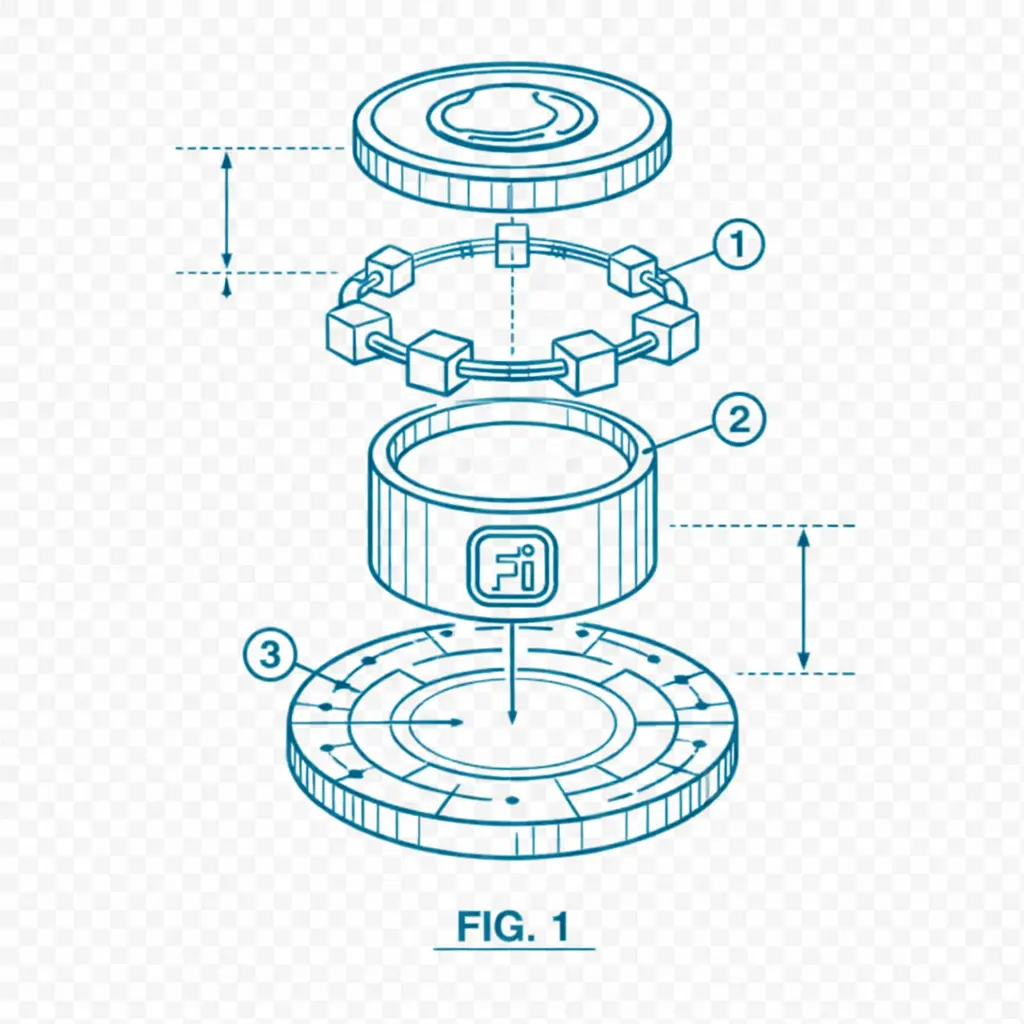
NFTs turned digital objects into tradeable inventory
NFTs mattered because they turned digital objects into tradeable inventory. A non-fungible token is a unique digital identifier recorded on a blockchain, and the ERC-721 standard gave wallets, marketplaces, and applications a shared way to track and transfer those identifiers across platforms.
That interoperability changed the economics of digital goods. Art files, collectible images, and in-game items could move from closed platform databases into open secondary markets where provenance and transfer history were visible onchain.
The public inflection point arrived on March 11, 2021, when Christie’s sold Beeple’s Everydays for $69,346,250. That sale did not prove every NFT had lasting value, but it did prove that a major auction house was willing to treat an onchain certificate as auctionable property.
But NFT ownership was never the same thing as owning the underlying intellectual property. WIPO notes that most NFTs are metadata linked to a work, not the work itself, and that buyers usually purchase the metadata associated with the work rather than the copyright in the work.
The standards mattered because they shaped scale, utility, and monetization
The technical stack mattered because it determined what could scale and what could monetize. In practice, three standards explain most of the sector’s commercial logic, and understanding smart contracts helps explain why.
- ERC-721 made single-item ownership legible. The standard treats each asset as distinct and requires separate ownership tracking, which is why it fit one-of-one art, profile-picture collections, and other assets where identity matters more than quantity.
- ERC-1155 lowered operational friction for games. It lets one contract manage fungible, non-fungible, and semi-fungible items, and its own motivation section explicitly points to blockchain games creating thousands of token types.
- ERC-2981 standardized royalty signaling, not royalty enforcement. The interface lets a marketplace query what royalty is owed, but marketplace policy still decides whether creators actually get paid. OpenSea’s documentation stated on September 25, 2023 that creator fees were optional even while an OpenSea marketplace fee remained required.
That last point is economically decisive. NFT creator revenue depends less on the existence of a standard than on where liquidity sits. If the dominant venue chooses cheaper trading over creator payouts, the market usually follows the liquidity.
Adoption was real, but it happened in specific parts of the digital economy
NFT adoption was real, but it was uneven. The strongest fits were areas where digital scarcity, provenance, or access rights already carried economic value: art, collectibles, gaming items, memberships, and ticketing.
Art and collectibles delivered the first mainstream headlines, yet gaming created a deeper operational use case. DappRadar reported that blockchain gaming activity reached 7.4 million daily unique active wallets by the end of 2024, processed more than 5.7 billion onchain gaming transactions during the year, and saw Immutable record $330 million in gaming NFT volume versus Ethereum’s $282 million.
Brands and consumer platforms also tested NFTs as digital commerce rails rather than purely speculative media. Nike announced its acquisition of RTFKT in December 2021 to combine culture, gaming, and next-generation collectibles. Ticketmaster launched token-gated sales on March 27, 2023. Reddit’s help documentation now says Collectible Avatars are no longer sold on Reddit even though off-platform transfers and sales are still honored.
That mix of expansion and retrenchment is the right way to read the digital economy’s NFT phase. Mainstream firms did not all become permanent NFT natives. They tested where onchain ownership improved distribution, fan access, or digital merchandise, and they pulled back where user demand or unit economics were weak.
The real story was liquidity structure, not mint size
The biggest analytical mistake in NFTs is confusing total supply with market liquidity. A collection can mint 10,000 items and imply a large “market cap,” but the executable market is set by the small fraction of items actually offered near current bids and the venues where buyers are concentrated.
Marketplace liquidity is concentrated. CoinGecko’s August 2024 study put Magic Eden at 36.68% share, Blur at 25.37%, and OpenSea at 19.92%, which means the top three venues controlled 81.97% of tracked marketplace volume.
Collection liquidity is concentrated too. In October 2024, CryptoPunks held 30.9% dominance across the leading collections and BAYC held 12.8%, for a combined 43.7%. CoinGecko’s methodology calculates NFT collection market capitalization by multiplying floor price by total supply, which is useful for comparing narratives but weak as a proxy for realizable liquidity. Floor times supply is an optical metric. Depth at the bid is the harder truth.
The downside of supply optics showed up clearly in blue-chip collections. BAYC’s market dominance fell from 29.3% in January 2022 to 12.8% in October 2024, and its floor price peaked at 153.7 ETH on May 1, 2022 before dropping sharply afterward.
Wash trading made the distortion worse. CoinGecko found that wash trading represented 23.4% of unadjusted trading volume across the six biggest marketplaces in February 2023, and that incentive-heavy venues such as X2Y2 and LooksRare had wash-trade shares above 80% of their unadjusted volume at that point.
The mechanism was straightforward. When platforms subsidized volume with token rewards or airdrop farming, they manufactured turnover without creating durable collector demand. A volume chart built on those incentives said more about reward extraction than about healthy secondary-market liquidity.
The boom cooled hard, but NFTs did not disappear
The NFT boom cooled hard, but the sector did not disappear. DappRadar reported that 2024 trading volumes fell 19% year over year and sales counts fell 18%, making 2024 one of the weakest NFT years since 2020.
At the same time, the market kept rotating instead of dying. DappRadar said NFT trading volume rose to $546 million in October 2025, sales hit 10.1 million, and the average NFT sale price fell from about $321 in January 2025 to $54 in October 2025. Lower average prices meant weaker headline optics but broader affordability and higher unit turnover.
Not every NFT segment survived that reset. CoinGecko found that metaverse land prices in 2024 ranged from 0.08 ETH to 1.88 ETH, about 72% below prior highs on average, with Sandbox land down 95% from its peak.
The post-boom market also diversified across chains. CoinGecko found that the combined dominance of top Bitcoin Ordinals and Solana NFTs grew from 2.5% at the start of 2023 to 14.7% by October 2024, while non-Ethereum NFT dominance hit 25.3% in April 2024.
The practical reading is that NFTs became less singular and more fragmented. Speculative capital left the most crowded narratives first. Utility-driven, cheaper, chain-specific, and community-linked assets retained a smaller but more genuine user base.
The lasting questions are environmental cost, rights, fraud, and market design
Environmental criticism changed materially after Ethereum’s consensus shift. Ethereum states that The Merge was executed on September 15, 2022 and reduced the network’s energy consumption by about 99.95%. Its energy page now estimates annual network consumption near 0.0026 TWh and cites CCRI for a reduction above 99.988%.
That does not end the environmental debate across the whole NFT sector, because NFTs now live on multiple chains with different security models and energy profiles. It does mean the old claim that all mainstream NFT activity necessarily carried Ethereum’s pre-Merge proof-of-work footprint is outdated.
Legal clarity also improved without turning NFT ownership into a blanket IP license. WIPO says most buyers acquire metadata associated with a work rather than the work itself, and the joint USPTO-U.S. Copyright Office study submitted to Congress on March 12, 2024 concluded that current applications of NFTs do not require changes to intellectual property laws.
Fraud risk, however, remains structural. The U.S. Treasury said on May 29, 2024 that NFTs are highly susceptible to fraud and scams and that hype, fluctuating pricing, cybersecurity weaknesses, and IP issues can enable theft and illicit finance. On December 20, 2024, the Department of Justice unsealed an indictment alleging more than $22 million in investor losses across a series of NFT and digital asset rug pulls.
For builders, the lasting lesson is simple. NFTs work best when they represent assets or access rights that already matter, and when the secondary market is deep enough to price them honestly. They work poorly when teams mistake mint size, notional floor-based market cap, or airdrop-fueled turnover for durable demand.
From FinDaS Tokenomics’ standpoint, NFT strategy belongs inside real token economy design, not outside it. The relevant questions are circulating inventory, tradable float, marketplace concentration, fee policy, and holder incentives. Good tokenomics consulting for NFT-heavy products starts there. A collection can advertise scarcity all day. If liquidity is thin and concentrated, the market will price the thin float, not the story.