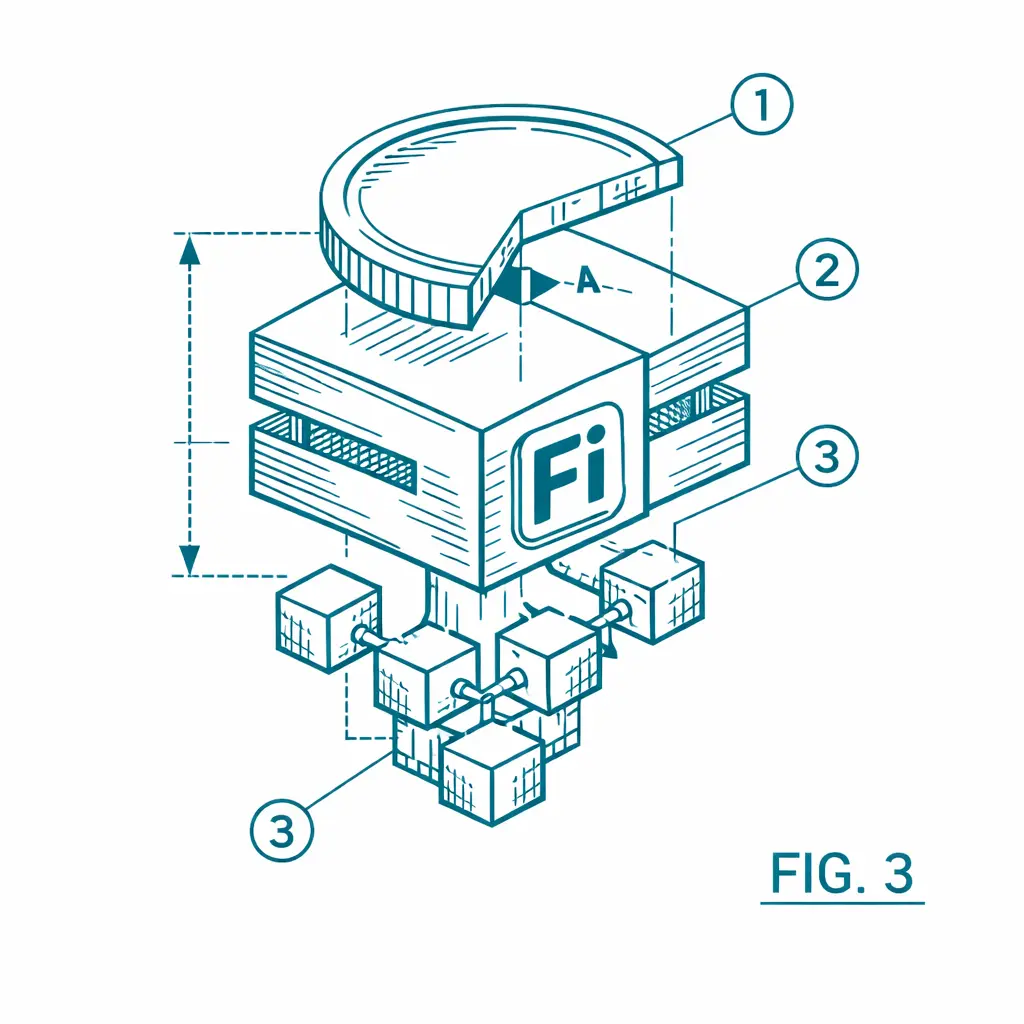
Token sales are float engineering before they are fundraising
A token sale sets the first tradable inventory map for a network. It decides who owns the earliest float, how fast that float becomes transferable, which venue discovers price first, and how much additional supply is scheduled to arrive behind the initial print. That is why the useful variable is rarely total supply by itself. The more relevant variables are transferable float at TGE, sale tranche size, lockup profile, and near-term emissions. Analytics platforms now track those mechanics explicitly through cliff unlocks and linear unlocks, plus next-7-day emission metrics because those are the flows that actually hit market depth.
A sale can clear at an attractive headline valuation and still produce weak secondary trading. That usually happens when the primary sale narrative ignores the handoff into the order book. If the initial float is too small, price can gap on thin liquidity and create unstable reference levels. If the sale sits beside a known unlock calendar, the market will discount future sell optionality almost immediately. If different buyer cohorts settle on different venues or timelines, price discovery fragments from day one. Kadena’s own token economics materials showed this explicitly: a non-U.S. CoinList sale that became liquid shortly after the sale, a separate accredited-investor SAFT tranche vesting later, and earlier SAFT rounds that also began vesting after launch.
For readers thinking about token economics, the right mental model is simple. A token sale is not a static allocation slide. It is the first stage of market microstructure. The sale design determines the shape of early inventory, and early inventory determines the shape of early price.
Sale format writes the first month of trading
| Format | How price is set | How float appears | Main microstructure risk | Direct reference |
|---|---|---|---|---|
| Fixed-price community sale | Issuer sets the price in advance | Usually via allocations after registration and KYC | Listing gap between sale price and first liquid venue | CoinList allocation method |
| Multi-option fixed-price sale | Issuer offers several price/lockup combinations | Float is segmented by vesting cohort | Latent overhang from cheaper long-lock tranches | Covalent, Umee, Stader |
| Liquidity bootstrapping pool | Price path emerges from changing pool weights and trading flow | On-chain, continuous, with liquidity embedded in the sale venue | Front-running, early spikes, and unofficial competing pools | Balancer LBP guide, Balancer FAQ |
| Batch auction | Orders are grouped and competitively settled | Price clears across a batch rather than one-by-one trades | Lower continuous liquidity between auctions if not paired with a deeper venue | CoW docs, CoW batch auctions |
Fixed-price sales are operationally simple, but they outsource a lot of economic work to the secondary market. CoinList’s “filling up from the bottom” method is designed to maximize the number of individual participants while still allowing larger expressions of demand. That broadens distribution, but it does not solve post-sale price formation by itself. It only changes who holds the initial inventory.
Multi-option sales are more interesting because they make time preference explicit. Covalent offered three options at $0.35, $0.30, and $0.25 per token with free trading, a 12-month release, and a 24-month release respectively. Umee used the same logic in a smaller two-option menu, with 3% of supply sold at $0.06 under a longer release and 2% sold at $0.07 under a shorter one. Stader pushed the price gap further, offering $4.50 for the shorter lockup and $3.33 for the longer one. That structure is economically coherent. Buyers who want liquidity pay up. Buyers who want discount accept time risk. But the market inherits every one of those future unlocks.
Liquidity bootstrapping pools solve a different problem in initial DEX offerings. Balancer’s LBP design starts with weights heavily favoring the project token and then gradually flips toward the collateral asset. Balancer’s documentation is unusually clear on the implication: the sale can be calibrated to keep price roughly steady or to decline toward a target minimum, and the mechanism has repeatedly produced early price spikes because buyers rush the opening blocks anyway. That is the right lesson. Mechanism design can improve launch quality, but it cannot fully neutralize reflexive demand and bot behavior.
Batch auctions push further toward fair execution. CoW Protocol describes its system as a price-finding mechanism that groups orders into batches, lets solvers compete for settlement, and can enforce uniform clearing prices while reducing MEV exposure relative to sequential AMM execution. For token sales, that matters when the goal is not just raising capital but also minimizing the tax that early price discovery pays to searchers and arbitrageurs.
Float beats supply narratives because float is what can actually hit the book
The cleanest sale decks often hide the dirtiest market reality. “Only 5% sold in the public sale” sounds conservative until the analyst maps every tranche that can become saleable in the same quarter. Tokenomist’s unlock framework is useful here because it distinguishes cliff unlocks from linear emissions and then normalizes each event as a percentage of current circulating supply, not just total supply.
Covalent is a good example of how sale design creates a staged float. The project sold 1% of supply as freely tradeable inventory, another 1% on a 12-month release, and 0.7% on a 24-month release. Stader did something similar while also disclosing that private-sale allocations could have 0% to 5% unlocked at TGE, with the remainder vesting across 36 months, while team and advisor allocations carried a 6-month cliff and 36-month linear vesting. That is the real trading map. Public sale terms matter, but adjacent non-public inventory matters too.
Kadena’s disclosure made the point even more directly. Before public launch, it had already sold 4.5 million coins at $0.50 in SAFT Round 1 and 17.2 million coins at $0.75 in SAFT Round 2, with SAFT rounds vesting monthly over one year after launch. A public buyer looking only at the CoinList sale would have missed the larger inventory schedule sitting behind the listing window.
Unlock is not the same thing as sell pressure. That distinction matters. Many holders do not sell at first availability. Some stake, some hedge, some wait for deeper liquidity, and some are structurally aligned. But an unlock still changes the optionality set. Once a cohort can sell, market makers, counterparties, and discretionary traders start pricing that possibility.
Compliance now shapes venue choice, buyer mix, and transferability
Regulation is not an external overlay on token sales anymore. It is part of the sale mechanism. The SEC’s investment contract analysis states that a threshold issue is whether a digital asset is a security and notes that federal securities laws may apply through the “investment contract” analysis. In practice, that changes who can participate, how tokens are sold, and when they can be transferred.
CoinList’s current U.S. private-placement disclaimer is explicit. Tokens sold through a Regulation D Rule 506(c) structure may be “restricted securities” and must be held for a minimum of one year from the purchase date unless an exemption applies. CoinList’s DoubleZero validator sale then showed the market-structure consequence in plain language: U.S. purchasers faced a 1-year lockup, while non-U.S. purchasers faced the longer of mainnet launch or 40 days, even though all validators received the same price. Same sale. Same price. Different transferability. That is a liquidity split, not an admin detail.
Jurisdiction filters also directly change buyer composition. CoinList’s Rainbow sale page states that the sale was unavailable in the United States except for U.S. accredited investors, and unavailable in Canada, with EU participation limited by MiCAR exemptions. Once a sale filters out broad retail geographies or channels buyers into accredited-only pathways, the resulting holder base is different in size, sophistication, and likely turnover profile. This also sits inside broader crypto regulations, not just sale ops.
The EU side has become more legible, but not necessarily softer. The European Commission states that MiCA created a harmonized framework regulating the issuance of crypto-assets and the related services around them. ESMA now maintains an interim MiCA register containing crypto-asset white papers and service-provider records, and it states clearly that the white papers listed there have not been reviewed or approved by a competent authority. For token sales, that means disclosure and formatting standards are getting more formal, while responsibility for the content still sits with the issuer and offeror.
Most token sale blowups are secondary-market design failures
Sale failure usually appears first as a trading problem. The common path is straightforward: the sale tells one story, the opening float tells another, and the market trades the second story.
Unofficial liquidity venues are a recurring issue. Balancer’s own FAQ warns that during an LBP there is no way to prevent holders from creating other pools on Balancer, Uniswap, or elsewhere, and recommends that teams clearly identify the one official pool. That warning is more important than it looks. Once parallel venues appear, the sale no longer controls first reference price.
Front-running and slippage are the second failure mode. Balancer notes that delayed LBPs can be front-run in the window between pool creation and paused trading, and it also notes that initial spikes and slippage failures can still occur because buyers rush the first blocks. If the mechanism is sequential and visible, searchers will try to monetize urgency.
Batch auctions are one response because they turn continuous one-by-one execution into competitive batch settlement. CoW’s documentation argues that grouping orders into auctions can improve pricing and reduce MEV relative to standard AMM flow. That does not remove all launch risk, but it changes who captures surplus during discovery.
Segmented settlement is the third failure mode. Kadena’s split between a more immediately liquid non-U.S. sale and a later-vesting global SAFT made the inventory timeline explicit. When buyers, venues, and vesting schedules differ across cohorts, the market can spend weeks discovering not the “correct” price, but which cohort is actually marginal.
What sophisticated teams and buyers should measure before touching a sale
The right diligence questions are mechanical when teams launch a token.
- How much float is transferable at TGE, after 30 days, and after 90 days? Use cliff and linear schedules, not just total-supply pie charts.
- What are the exact price/lockup menus? Public buyers should compare short-lock and long-lock cohorts because those cohorts create different future sell incentives.
- Which non-public tranches unlock near the sale window? Early SAFT, strategic, advisor, and ecosystem inventory often matters more than the headline public-sale percentage.
- How are allocations decided? Randomized or participation-maximizing methods widen distribution but do not guarantee stable holders.
- Where does first real price discovery happen? An LBP, an RFQ venue, a centralized exchange listing, or a batch-auction venue each produces different launch behavior.
- Do transfer rules differ by jurisdiction? If yes, the same sale may create multiple liquidity classes on day one.
In tokenomics design work, FinDaS treats the token sale as a coupled issuance-and-liquidity problem. That sounds obvious, but the market still overweights static supply narratives and underweights the exact route by which inventory reaches a tradable venue. Good tokenomics design is usually less about inventing a novel sale structure and more about matching sale mechanics to realistic post-sale depth, unlock cadence, and jurisdictional transfer rules.
A token sale works when the market can absorb the inventory it creates without needing a myth to bridge the gap. When that condition is missing, the sale may still fill, but the chart usually reveals the design error faster than the deck does.