A typical token launch spans ten distinct workstreams from business plan through post-launch treasury management, and takes six to twelve months from decision to TGE. End-to-end budgets range from under 50k USD for the most stripped-down launches to well over 1 million USD once legal, marketing, product integration, and Tier 1 exchange listings are in scope. Most projects underestimate both the calendar time and the cost of the non-tokenomics work.
Why token launches blow past budget and timeline
Most teams launching a token underestimate what the full process takes. They budget for a tokenomics design and a smart contract, and plan around a three-month runway to TGE. Six months later, they are still negotiating with legal, waiting on an audit report, and short on the marketing budget they scoped before seeing what Tier 1 listings cost.
Over the last several years, we have supported several hundred project launches at FinDaS. The pattern across that sample is consistent: the work breaks down into about ten separate components, most of them outside what people usually mean by tokenomics, and the end-to-end cost lands somewhere between under 50k USD at the absolute bottom and well over a million at the typical full-scope end. Timeline sits around six to twelve months if nothing goes wrong, longer if regulatory review lands in an unexpected place.
The figures below are averages from what we have seen, anchored to November 2023 when this article was first written. Cost ranges have held reasonably well in 2026 for most components. The one that has shifted materially is legal and compliance, where MiCA is now in force rather than a pending regulation, and the work looks different even if the headline budget has not moved much.
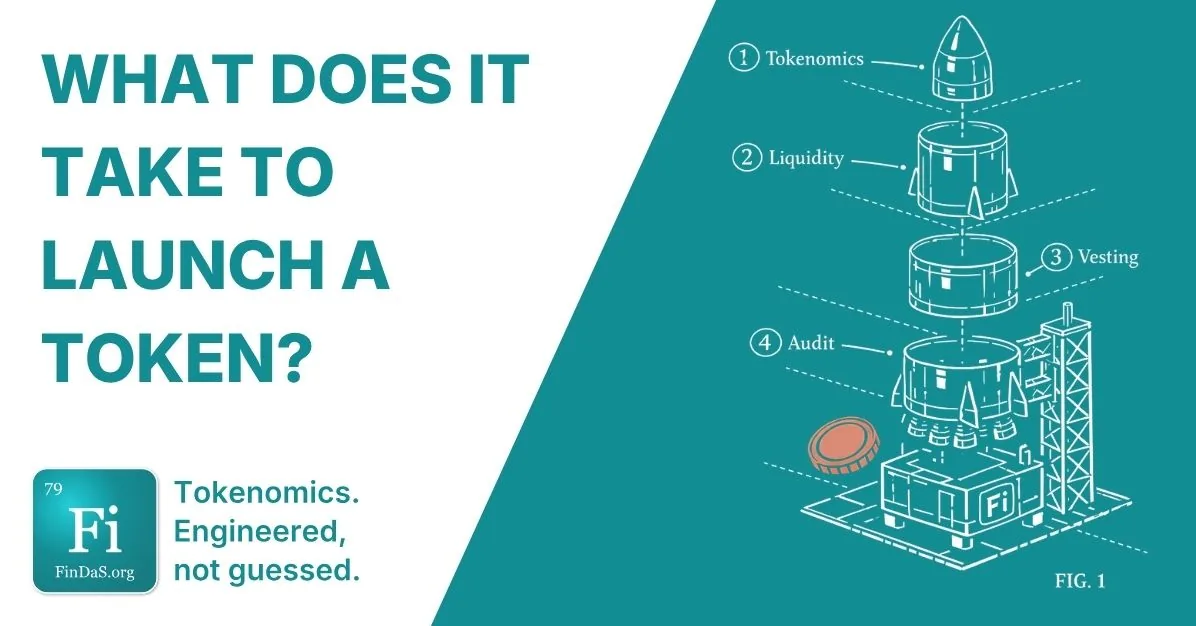
The ten components of a token launch
The components below are listed in the order a project would typically tackle them, though pre-TGE and post-TGE sequencing are not strictly linear, as I discuss in the next section. Cost figures are 2023 averages, which have held up reasonably well with the exception of legal and compliance. Each component can technically be done in-house; I have flagged the ones where I strongly recommend against it.
- Business idea and business plan. How the company actually works and how it makes money. This has nothing to do with web3 at this stage and should be done by the founding team alone. Outsourcing it is a sign that the project does not yet exist.
- Revenue model. The business plan in numbers. Around 5k USD with a dedicated consultant, or doable in-house if the team has financial modelling skills. This is also where token valuation approaches become relevant inputs, since the revenue model shapes how the token is priced later and what circulating supply the model can support. Catching "this is not financially viable" at this step saves multiples of the figure downstream.
- Tokenomics design. Do you actually need a token? What is its utility? What gives it value? How do you measure it? A specialist engagement runs 10k to 20k USD, and the spend is worth it because tokenomics ties into legal, marketing, exchange listings, and product in ways a standalone model cannot anticipate.
- Legal and compliance. Token classification, jurisdiction selection, and regulatory filings. Around 100k USD on average. In 2026, MiCA is in force in the EU, so CASP authorisation and whitepaper notification are operational requirements rather than a future consideration, and the budget now covers compliance infrastructure that did not exist when this article was first written.
- Token development and audits. A plain ERC-20 with no custom logic can be done on UpWork for very little. Anything with non-trivial logic (vesting contracts, custom distribution, hooks into a product) starts around 25k USD and climbs fast. An external tokenomics and smart contract audit is non-negotiable before a mainnet listing.
- Other development and token integration. The actual business logic, plus wiring the token into it. Most projects we have worked with spend between 500k and 1M USD total, usually with only a small fraction upfront. This is the line item teams systematically underestimate.
- Marketing. Can be as little or as much as you want. Projects we have seen typically spend around 250k USD, though campaigns around TGE can multiply this number quickly if a team is chasing Tier 1 exchange visibility.
- Token sale and exchange listings. A DEX listing is free. Listing on multiple Tier 1 CEXs can run into the millions once market-maker commitments, listing fees, and liquidity requirements are counted. A seasoned advisor earns back their fee here by pushing back on listing structures that look cheap and are expensive.
- Post-launch token monitoring. Work on tokenomics does not end at TGE. Dashboards in Dune Analytics and tokenomics simulation tools let a team spot unexpected user behaviour and token flow patterns before they become problems. This is what separates a project with a healthy post-launch curve from one that discovers its sell-pressure problem in month three.
- Treasury management. Active management of the protocol treasury extends runway and protects liquidity. Projects that ignore this line item leave several quarters of operational runway on the table.

Pre-TGE, around-TGE, and post-TGE: the sequence that actually works
The components above do not run in a perfect linear order. Business idea, revenue model, and tokenomics design are strictly sequential: the revenue model cannot start until the business plan is done, and the tokenomics cannot be finalised until the revenue model tells you how the token will interact with cash flows. Legal and compliance has to run alongside tokenomics from an early stage, because the token classification question shapes design decisions that are expensive to reverse later.
Token development and audits sit around TGE. Some teams ship a deployed, audited contract weeks before TGE; others cut it close. Either is defensible. Post-launch monitoring and treasury management are post-TGE by definition, but the dashboards and treasury infrastructure should be built before the token goes live, not after.
Marketing and exchange listings overlap with everything. The realistic version is that they start late in the pre-TGE phase, peak around TGE, and continue indefinitely afterwards. The mistake to avoid is treating listings as a post-TGE activity. By the time the token is live, most Tier 1 CEXs have already made their decision about listing, and the project's ability to influence that outcome has narrowed considerably.
Full-stack providers vs specialists: where the conflict of interest bites
There are plenty of companies offering end-to-end token launch services: tokenomics, smart contracts, marketing, investment, exchange relationships, all under one roof. There are real advantages here, including fewer counterparties, tighter coordination, and sometimes a lower total price. I still recommend against it for two specific components: the project audit, and the tokenomics design.
The reason is conflict of interest. A full-stack shop is incentivised to push the project end-to-end whether or not it is financially viable, because their revenue depends on the project reaching TGE. That incentive structure reliably bends judgement at specific decision points. A firm that does both tokenomics and marketing will allocate more supply to marketing than a pure tokenomics firm would, because the sell pressure is someone else's problem once the campaign ships. A firm that does tokenomics and smart contract development will prefer structures its developers are comfortable with, even when those structures are not monetarily optimal for the project. A firm that invests in projects and also designs their tokenomics will bias toward unlock schedules that benefit their own position, regardless of what sell pressure those unlocks create for the rest of the cap table.
This is not a claim that every full-stack provider cuts these corners. It is a claim that the incentive points that way, and a founder without deep tokenomics experience of their own will have a hard time catching it when it happens. For tokenomics specifically, I would rather pay two firms a total of 30k USD than pay one firm 20k and inherit the incentive problem. The 10k delta buys you an independent check at the one place it matters most, and the tokenomics design process we use is structured specifically to surface these incentive questions before they calcify into a signed contract.
What a realistic launch budget looks like in 2026
The total budget for a token launch depends almost entirely on two choices: how custom your product and token logic are, and how aggressively you pursue Tier 1 exchange listings. A stripped-down launch with a simple ERC-20, minimal product integration, DEX-only listings, and in-house marketing can ship for under 50k USD. We have seen it done. Those launches are usually announcements with a token, not businesses with a token, and the market prices them accordingly.
A typical full-scope launch lands somewhere between 800k and 1.5M USD across the ten components, with the bulk of it in product development (500k to 1M) and marketing (around 250k). Add 100k for legal, 10k to 20k for tokenomics, 25k or more for contracts and audits, and a variable figure for exchange listings that can range from zero to the low millions. Post-launch monitoring and treasury management are ongoing costs, not one-time line items.
The costs projects most often underestimate are product integration, legal, and the post-TGE marketing required to keep the token visible after the launch news cycle ends. None of these are negotiable in the way tokenomics consulting or an audit is. The choice is not whether to spend, but whether to spend deliberately or reactively when the first problem hits.
Frequently Asked Questions
01Do you actually need a token for your project?
+
02How long does a token launch typically take from decision to TGE?
+
03Can you launch a token for under 100k USD and get away with it?
+
04When should legal and compliance work start in the sequence?
+