Launching a crypto token requires coordinating six parallel workstreams: business, tokenomics, legal, development, audits, and funding. The Token Generation Event (TGE) is the end of that coordination, not the start. Most projects that fail compress the legal and audit work to hit a sale deadline, and pay for it later with a broken launch.
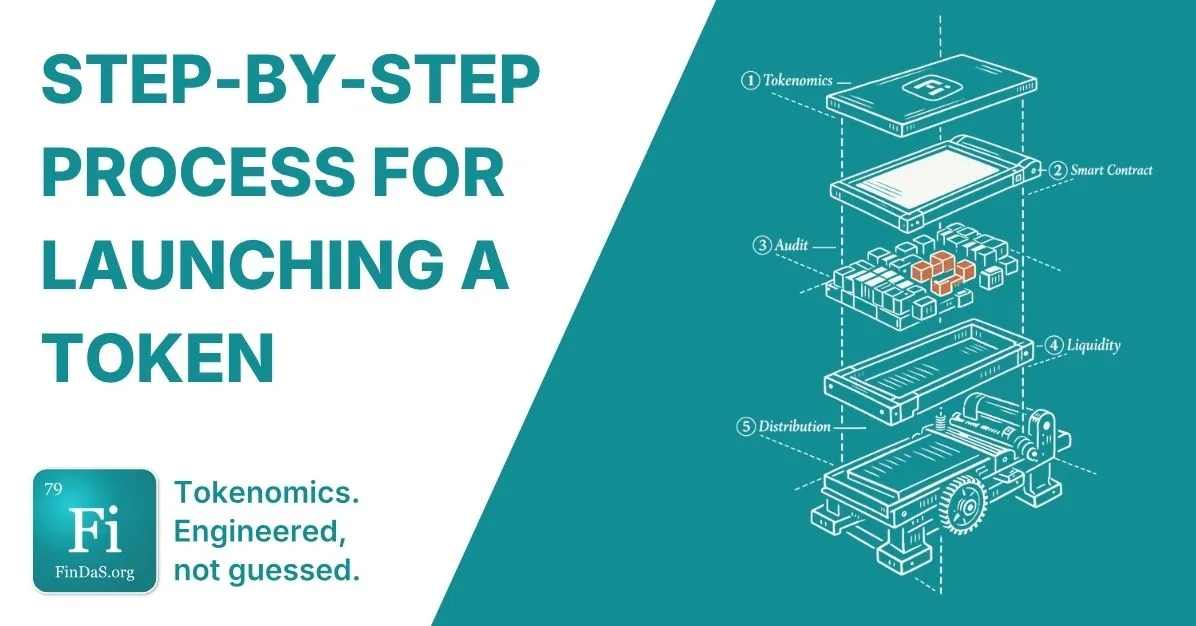
Most token launches do not fail on launch day. They fail in the weeks before, when a legal opinion comes back too late to book a sale date, when an audit uncovers a bug two weeks before TGE, or when the market maker contract sits unsigned because funding rounds slipped. The technical part of minting an ERC-20 takes hours. The coordination around it takes six to nine months if you are doing it properly, and it is the coordination that kills most projects.
Projects arrive at FinDaS at every stage of this process. Some have a token already live and want to restructure. Some have a business idea and an empty Google Doc. The steps below cover the full arc from idea to TGE and apply to any utility-style token launch, memecoins aside. If you want a deeper breakdown of the financial side specifically, our article on what it actually takes to launch a token sits alongside this one.
The six workstreams at a glance
A proper token launch runs six workstreams in parallel: business and product, tokenomics, legal, development, audits, and funding. The chart below captures that structure. The numbered boxes are major deliverables (a signed legal opinion, a published whitepaper, a completed audit, the TGE itself). The arrows are dependencies: the sale contract cannot be signed until the legal opinion lands, audits cannot close until the code is feature-complete, and the TGE cannot launch until the platform integration has been tested against live tokens on MainNet.
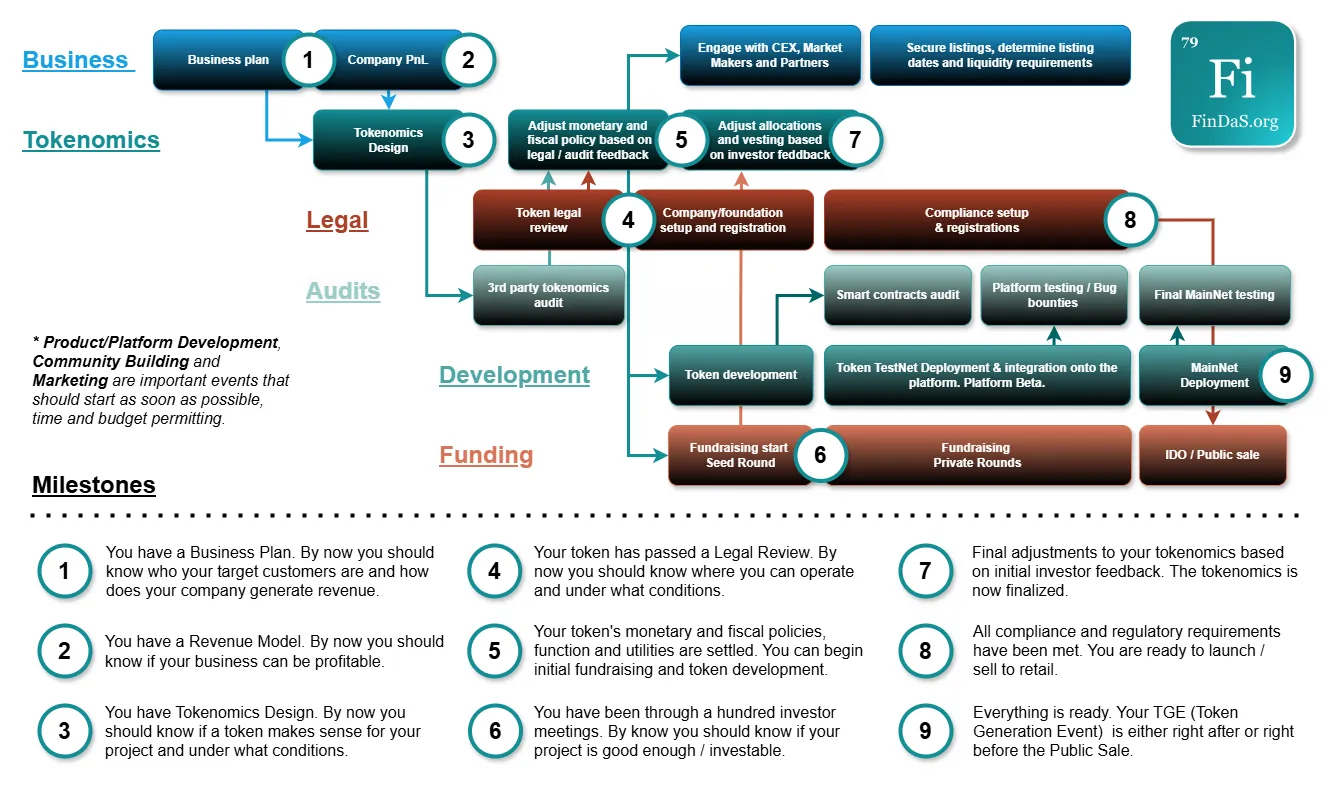
A few points before the detail. The chart depicts what a well-run launch looks like. In practice, many teams skim or skip the audits, testing, and compliance boxes; that choice almost always surfaces later as a stuck sale, a delisting, or an exploit. The Token Generation Event sits late in the chart for a reason: TGE is not when the token is minted. The contract typically goes to MainNet weeks earlier so the platform can be tested against real tokens. TGE is the moment vesting schedules activate and the token becomes transferable and usable on the platform. Confusing the two is the fastest way to miss a committed launch date.
What has to happen before the smart contract
Three workstreams need to clear substantial ground before serious development begins: the business scope, the tokenomics model, and the legal framework. In theory these run in parallel; in practice they have hard dependencies on each other, and skipping one means rework on the others. The sequence below walks through each in turn, because the order matters more than most founders expect.
Business scope is the foundation. What does the protocol actually do, who uses it, and how does the token earn its place in that loop? If the token exists because "every project needs a token," the tokenomics will not fix that. I have seen projects spend three months designing emission schedules for a token that had no business reason to exist, and the redesign almost always starts by asking the team to justify having one at all.
Tokenomics design follows: supply, allocation, vesting, utility, emissions. The tokenomics model is what the legal opinion, the whitepaper, and the audit all get written against, so late changes cascade everywhere. A good design anchors for at least one round of investor due diligence without needing to be rewritten. Our Tokenomics Design 101 guide covers the mechanics in more depth.
Legal review then classifies the token under the relevant jurisdictions and produces the documents investors, exchanges, and regulators will ask for. In the EU, MiCA has been fully in force since December 2024, with the grandfathering period for existing service providers ending July 1, 2026. Most utility-style tokens offered to the public in the EU now require a MiCA-compliant whitepaper notified to a competent authority before they can be admitted to trading. There is a narrow EUR 1 million exemption over twelve months, but it is narrower than most founders assume and does not solve exchange listing requirements. For MiCA-specific preparation we run a dedicated MiCA-ready whitepaper service.
A legal opinion plus a compliant whitepaper together run four to twelve weeks depending on jurisdiction and token design. Projects that start this workstream two weeks before a committed sale date are the projects that announce a "brief delay" and then go quiet. The lesson is boring and load-bearing: legal work belongs at the start of the calendar, not the end.
Development, audits, and the TGE clock
Development splits into two pieces: the smart contracts themselves, and the platform integration that makes the token do whatever the product promises. Standard ERC-20 or SPL contracts can be written and tested in two or three weeks if the tokenomics model is locked. The integration work is where most development time actually goes. Staking contracts, reward mechanics, burn functions, governance hooks, oracle dependencies, each one adds surface area for the audit to cover and for the integration to break.
Audits take two to four weeks of clock time plus a rework cycle, and the pricing varies sharply with scope. A simple ERC-20 runs 8,000 to 20,000 USD at a reputable firm. A medium-complexity protocol with staking, governance, or NFT mechanics runs 15,000 to 50,000 USD. Complex DeFi protocols go well past 100,000 USD, and top-tier firms like OpenZeppelin and Trail of Bits quote roughly 25,000 USD per engineer-week in public governance proposals. Rushing an audit is the single most expensive false economy I see in this process. The fix for a bug found in audit is a code change. The fix for the same bug found by an attacker is a refund, a relaunch, and a ruined reputation, which is why we wrote a separate piece on relaunching a broken token.
The Token Generation Event is where all of this converges. It is the most concrete deadline in the project, because every workstream above has to finish to hit it. The common founder mistake is treating TGE as a marketing date and backing the technical plan into it. The right direction is the opposite: map the latest-finishing workstream, add a two-week buffer for rework, and set the TGE date from there.
Fundraising, listings, and liquidity
Funding and listings are the most visible part of a launch and the part most founders underestimate. A token sale is not a single form. It is a sequence of rounds with distinct terms, investor profiles, pricing, and vesting schedules: seed, private, strategic, public, and post-TGE community rounds. Each needs its own legal structure (SAFT, SAFE with token warrant, direct purchase agreements) and each carries its own lockup. Our article on the different types of token sale rounds covers the tradeoffs in detail.
Exchange listings should not be a reflex post-TGE decision. Tier-one CEX due diligence runs roughly ten weeks from application to listing decision, and the application itself requires audit reports, legal opinions, and traction metrics already in place. DEX listing is faster but forces a liquidity decision up front: a Constant Product AMM pool with enough balance to absorb early volume, a Liquidity Bootstrap Pool for price discovery, or a dedicated market maker with an inventory loan. Our piece on DEX, CEX, and market makers walks through when each fits.
Professional market makers typically charge 10,000 to 50,000 USD per month in retainer fees, plus an inventory loan or a call-option structure on your token. If that feels expensive, the alternative is a thin order book where slippage itself becomes your sell pressure. The real question is not DEX versus CEX, but how much liquidity depth the token needs in its first ninety days and how that depth gets funded. If you want a pressure test on how your tokenomics and liquidity plan interact before either one locks in, that is the kind of review we run as a standard engagement at FinDaS.
Realistic timelines and costs
"How long does it take" has the same answer as "how much does it cost": it depends on what you are building and how much of it exists already. A DeFi protocol with novel mechanics does not share a timeline with a utility ERC-20, and a team with in-house legal counsel does not share a budget with one hiring outside. Some concrete floors, assuming a properly structured launch:
- Simple utility token on an existing L1, with an MVP already live: six to nine months from kickoff to TGE if nothing slips.
- DeFi protocol with custom mechanics: nine to eighteen months.
- New Layer 1, or tokens involving novel cryptography (SNARKs, privacy, cross-chain bridges): twelve to twenty-four months, and custodian support alone can take six to nine months to build out.
Budget floors for the same well-run launch, in 2026 pricing, run wider than most founders plan for. Each number below is a reputable-firm low end, not a bargain-basement floor. A team willing to go with unknown vendors can cut most of them, at the corresponding exposure:
- Smart contract audit: 10,000 to 50,000 USD for most tokens, materially higher for DeFi.
- Legal opinion plus MiCA-compliant whitepaper: 20,000 to 60,000 USD.
- Market making for the first six to twelve months: 60,000 to 300,000 USD in retainers alone.
- Exchange listing fees and liquidity commitments: variable, but tier-one CEX liquidity lockups can exceed 500,000 USD by themselves.
Teams pitching an all-in cost of 50,000 USD for a serious launch either have a personal network that absorbs most of these line items, or they are quietly cutting corners on audits and legal. Either path is defensible if the team knows which one they picked. Drift into corner-cutting without naming it, and the next conversation is with an auditor or a regulator after the fact.
Where most token launches go wrong
The failure modes are predictable enough, after 300+ engagements at FinDaS, that I can list them before the first kickoff call ends. None of these are exotic. They are the same patterns every year, in slightly different clothes:
- Underestimating the cost. Founders budget for development and marketing and treat audits, legal, and market making as optional extras. By the time these land on the critical path, there is no runway left to fund them properly.
- Underestimating the time. The "we are eight weeks away" pattern. Most teams stay eight weeks out for six months. Plan backward from the slowest workstream, not forward from a marketing date.
- Underestimating how difficult the raise is. 2024 and 2025 were brutal for token sales outside of the memecoin cycle. Roughly 85% of 2025 tokens trade below their TGE price, with the median token down more than 70%. Assuming capital will materialize at your preferred valuation is usually wrong.
- Putting everything on-chain. Not every component needs to live in a smart contract. On-chain settlement is expensive, inflexible, and auditable, in that order. If a feature does not need cryptographic guarantees, it usually belongs in a regular backend.
- Cutting the legal work. Post-MiCA and post-SEC enforcement, winging the legal framework is not a cost saving. It is a bet that the token will not attract enough attention to be enforced against, which is also a bet that the launch will fail commercially.
- Skipping audits. Covered above. The cost of an exploit is always higher than the cost of the audit that would have caught it.
- Treating the TGE as the finish line. TGE is ignition, not landing. What happens in the ninety days after launch (vesting cliff management, liquidity depth, governance participation, communication discipline) is what determines whether the token becomes a useful asset or a slow bleed.
A realistic plan, built from the dependencies rather than the calendar, avoids most of these on its own. The teams that get hit are the teams that worked backward from an announcement date and ran out of room when the audit surprised them, or the legal opinion caught a structural problem, or a market cycle turned while the sale was mid-flight. The calendar does not care which.
Frequently Asked Questions
01Do I need to raise money to launch a crypto token?
+
02Can I launch a token before my product is live?
+
03When should my token be listed on exchanges?
+
04Is skipping the audit ever worth it?
+
05Does a utility token need a legal opinion before launch?
+