
Designing REAL: an RWA chain that puts insurers in the consensus layer.
A blockchain for real-world financial assets has to answer the question most of crypto avoids: what happens when the real-world counterparty does not pay. REAL answers it in the consensus layer, and the hard part was never the token.
TL;DR
- Client: REAL (formerly RealFinChain), a Cosmos SDK layer 1 for tokenizing real-world financial assets, built by the team behind CREDEFI. ASSET is the network token, live on Ethereum ahead of mainnet.
- Challenge: design a token economy where the companies that tokenize, score, and insure assets are validators in the consensus layer, where an insurer failing to pay a holder resolves on-chain without an oracle, and where losses are backstopped by a fund that never empties and never floods the market.
- Approach: FinDaS led the token economy and consensus-layer design, valuation-first, modeled in Google Sheets and stress-tested, with the staking, slashing, reward, and disaster-recovery mechanics specified to engineering.
- Result: ASSET launched during a deep bear market and traded from about $0.04 to $0.27 within roughly six weeks, reaching around $37.5M market cap and ~17.2K holders, listed on Kraken, KuCoin, MEXC, and Uniswap v3.
What problems did REAL have to solve?
REAL is a chain for fixed-income assets: bonds, loans, instruments with scheduled cashflows. The team had worked with FinDaS before, on CREDEFI, and brought us in with Hristo as head of tokenomics to make a hard idea work. They knew they wanted to do real-world assets. The problem was that the usual RWA playbook stops exactly where the risk starts.
A counterparty that defaults has to be something the chain can see
Most tokenized-asset designs depend on an oracle to report what happened off-chain: did the issuer pay the coupon, did the borrower default. Oracles are a trust assumption wearing a technical costume. For a chain whose entire pitch is removing intermediaries, importing a new one at the most sensitive point is a contradiction. REAL needed defaults to resolve to a fact the chain already holds, not a report it has to believe. Related: RWA tokenomics
Business validators are not normal validators
A normal validator runs a node and stakes against misbehaviour you can measure in blocks. A tokenization company, a risk scorer, or an insurer carries a different kind of risk: bad metadata, a miscalibrated default score, an unpaid claim. Putting those companies into the consensus layer meant designing stake that tracks economic exposure rather than hardware, with a separate slashing surface for each role. Related: token staking 101
A backstop that cannot run dry and cannot dump the token
When an insurer fails to pay, holders have to be made whole somehow. The naive fix, mint tokens to cover the loss, solves the loss and creates a worse one: uncontrolled inflation every time something breaks. The backstop had to be bounded on both sides, capable of absorbing a wave of claims without emptying, and incapable of flooding the market with freshly issued tokens. Related: treasury management 101
Valuing a token whose demand is locked stake, not speculation
ASSET demand comes mostly from validators and business enablers locking stake against the assets they handle, plus fees on real cashflow volume. That is a different valuation problem from a governance token priced on narrative. Get the velocity and adoption assumptions wrong and the model is theatre. Related: token valuation approaches
How did FinDaS approach the problem?
We ran the engagement through the FinDaS methodology, the same five steps we apply to every token economy, adapted to a chain where the consensus layer does financial work.
Protocol and Business Deep Dive
We started with the asset, not the chain. Fixed income first, because instruments with predictable, scheduled cashflows are the simplest case to make robust. Every promised cashflow had to flow through the chain: the issuer deposits each coupon, dividend, or repayment to the asset's settlement contract by a deadline block, and holders are paid pro rata. An asset whose issuer cannot settle on-chain is simply not eligible. That single rule is what later lets a default resolve without an oracle.
Token Utility and Value Capture Design
ASSET is a behavioural guarantee. A tokenization, scoring, or insurance company picks one or more roles, and each role stakes ASSET against the assets it handles. Stake is not the insurance fund and it is not a yield product; it exists to make misbehaviour expensive enough that honest behaviour is the rational choice. The token's main sinks are stake locked for the life of the asset and a staking target around 60% of circulating supply.
Economic Modeling
We built the economy in Google Sheets as a live model: vesting, emissions, the disaster-recovery flows, and the debt-ratio dynamics that govern how fast losses get repaid. Behavioural and stress scenarios were run as simulations, so the mechanics could be pushed under claim waves and price swings before any of it reached engineering.
Stress Testing and Valuation
We applied the FinDaS valuation framework. The analytical value uses the equation of exchange, with a deliberately conservative hybrid velocity benchmarked against on-chain Bitcoin and Ethereum and the velocity of USD M1 and M2, then reduced further for staking and burning. We cross-checked against multiples, network value to transactions and price-to-fees, and anchored adoption to a conservative assumption of 0.1% capture of the fixed-income market at a 0.5% fee. The point of the conservative inputs is that the model has to survive being wrong, not flatter the project.
Documentation and Launch Readiness
We delivered the tokenomics report and valuation, the live model, and a mechanism specification for the business validators detailed enough for engineers to build from. The whitepaper carries the economic design; the spec carries the stake, slashing, dispute, reward, and wind-down rules.
| Deliverable | Description | Why it mattered |
|---|---|---|
| Tokenomics report and whitepaper | Full ASSET economy: utility, supply, monetary policy, governance, valuation | Gave investors and the community a defensible account of why the token is worth holding, beyond a price story |
| Business-validator mechanism spec | Stake, slashing, disputes, rewards, and wind-down for the three roles, drafted for engineering | Turned a novel consensus idea into something a team could actually build, with the failure modes named |
| Economic model in Google Sheets | Live vesting, emissions, and disaster-recovery dashboard with the debt-ratio simulation | The team can run their own scenarios after handover instead of depending on us |
| Valuation | Equation-of-exchange model plus multiples cross-check | Anchored the token sale and investor conversations to a number with reasoning behind it |
The chain treats an unpaid insurance claim the way other chains treat a missed block: a fact, a penalty, and a fund that makes holders whole.
What did FinDaS design?
REAL was greenfield, so the work was a set of mechanisms built to fit together rather than a redesign of something broken. Five of them carry the architecture.
1. Business validators inside the consensus layer
Tokenization (TV), scoring (SV), and insurance (IV) companies are validators. The model borrows the shape of FileCoin, where storage providers are part of block production, and applies it to finance: the real-world job is part of consensus, and each role stakes ASSET against the work it does. The same legal entity can run all three, but each role has its own stake account and its own slashing surface, with no shared collateral. This was the FinDaS design call. The team knew they wanted RWAs; how to make the risk-bearers part of the chain was ours to figure out.
Outcome: the parties who can actually cause a loss are the parties with stake at risk, so the chain's security and its financial integrity are the same mechanism.
2. No-oracle settlement
Every cashflow settles on-chain against a deadline block. A default is therefore one binary fact: the deposit did not arrive by the deadline plus a fixed grace window. There is nothing for an oracle to adjudicate, because the chain is not asking what happened in the world, only whether the money showed up.
Outcome: the most sensitive event in the system, a counterparty failing to pay, became the cheapest to verify.
3. Notional-based, sublinear staking
Stake is sized against the notional an entity handles, run through a tiered schedule whose marginal rate falls as the portfolio grows. A small operator pays real cost on its first asset; a large one pays less on incremental volume, so the design does not bottleneck scale. Insurers stake hardest, against the full insured cashflows, and are pushed to pair part of their stake in stablecoins, which are liquidated first in a claim so the market is not hit with dumped ASSET. The sell-pressure logic here is the same we write about in early sell-pressure mitigation.
Outcome: stake tracks economic exposure rather than node count, and a claim event drains stablecoins before it ever reaches the token.
4. The NDT and Disaster Recovery Fund backstop
When a claim goes unpaid, holders receive Network Debt Tokens redeemable against the Disaster Recovery Fund. The fund pays out at most a quarter of its balance per period, so it shrinks toward zero but never empties, and refills from business-enabler rewards with a share that scales up as the debt ratio climbs. Redeemed NDT are burned, and any NDT expire after two years. The fund absorbs shocks and self-heals without minting its way out of trouble.
Outcome: losses are backstopped by a fund that is bounded on both sides, so it cannot run dry under a claim wave and cannot inflate the supply to cover one.
5. Duration-weighted rewards with stake locked for the asset's life
Business-enabler rewards weight cashflows by stake ratio, by the duration of the commitment, and by any secondary stablecoin stake. Stake stays locked until each asset's obligations complete, which for a ten-year bond means a ten-year commitment. There is no timeout that lets a failed validator wait out its obligation and recover capital early.
Outcome: the reward math pays for long-term honesty, and the lockups make walking away from a bad book expensive rather than free.
What were the results?
ASSET launched as an Ethereum token during a deep bear market, ahead of the Cosmos mainnet, to bootstrap liquidity, listings, and a holder base. It traded from a low around $0.04 at the end of April 2026 to roughly $0.27 by mid-June, about a 577% move off the launch-month low, reaching around $37.5M market cap on a 1B max supply. By mid-June ASSET had roughly 17.2K holders and was listed on Kraken, KuCoin, MEXC, and Uniswap v3, with a CertiK rating of 4.1.
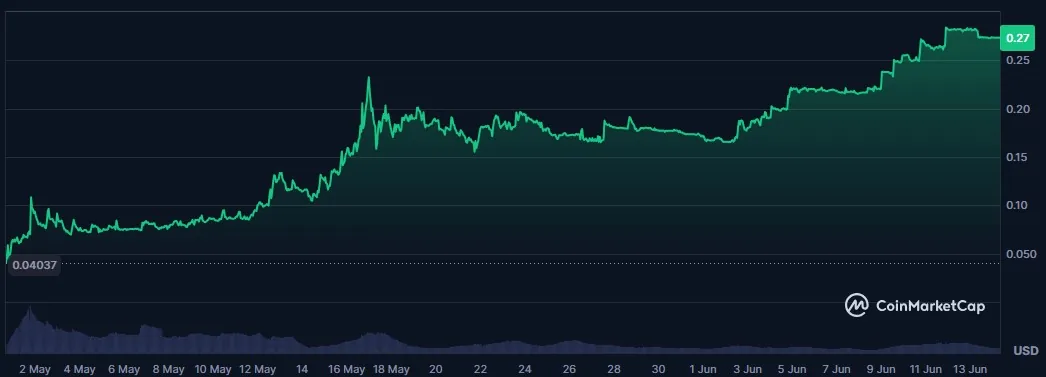
The honest reading of that price action is that it reflects a clean launch, a tight float, and listings landing in a thin market as much as it reflects the design. Six weeks of trading is launch reception, not a verdict on the mechanics. What the launch does show is that the distribution and the token structure held up under real conditions, in the worst market backdrop, which is the part the tokenomics was responsible for at this stage. The consensus-layer architecture and the disaster-recovery backstop are the designed mainnet system and have not yet run in production; their real test comes when the chain is live and the first claim has to resolve on-chain. Without a backstop designed to be bounded on both sides, the first unpaid claim on a live RWA chain is the kind of event that takes the token with it. That is the failure mode the design is built to absorb.
Key takeaways.
An RWA chain's hardest tokenomics problem is not the token, it is what happens when the real-world counterparty defaults.
Put the risk-bearers where the consensus is
If the parties who can cause a loss are not the parties with stake at risk, the chain's security and its financial integrity are two separate systems that can drift apart. REAL makes them the same system by putting tokenization, scoring, and insurance companies into consensus.
Design the backstop to be bounded on both sides
A recovery fund that can empty fails under stress, and one that mints to cover losses inflates the token every time something breaks. A fund capped at a fraction of its balance per period, refilled in proportion to how bad the debt is, survives a claim wave without doing either.
Size stake to economic exposure, not to hardware
Business validators carry financial risk, not block-production risk. Staking against the notional under management, on a sublinear schedule, makes the guarantee proportional to what can actually go wrong while still letting large operators scale.
Value the token from the demand the design creates
When demand comes from locked stake and real cashflow fees rather than speculation, the valuation has to model that demand directly. Conservative velocity and adoption assumptions are what let the number survive being wrong.
What's next.
Mainnet is where the architecture goes live and the business-validator consensus and disaster-recovery fund move from specification to running code. The mechanism spec is the engineering handoff, including the path to permissionless validator registration, which is gated behind checkpoints: at least 18 months live with resolved slashing events of each type, dispute-vote turnout held above a set quorum, and no more than one whale-capture incident in the prior year. The first iteration stays on fixed-income assets with predictable cashflows; expansion to other asset types is deliberately held back until the model is proven on the simplest case. FinDaS first worked with this team on real-world asset design through CREDEFI, and the REAL engagement is the continuation of that relationship.
Bring your project to a real token economist.
FinDaS has designed tokenomics for 200+ projects across L1s, DePIN, gaming, and RWA. Free, no obligation, no juniors. We'll answer every question about your token design and tell you candidly where the weak spots are.
The questions we keep getting.
How do you design tokenomics for a real-world asset (RWA) blockchain?
Start from the business, not the chain. For REAL that meant fixed-income assets with scheduled cashflows, and a token whose job is to make the companies that tokenize, score, and insure those assets behave honestly. FinDaS designed ASSET as a behavioural stake across those three roles, sized to the value at risk, then modeled demand from locked stake and real fees rather than speculation.
What is a business validator in a proof-of-stake network?
A normal validator secures blocks. A business validator on REAL also performs a real-world job: tokenizing an asset, scoring its default risk, or insuring its cashflows. Each role stakes ASSET as a guarantee, and failing the job costs that stake. It is the FileCoin idea applied to finance, where the work itself is part of consensus.
How can a blockchain insure tokenized real-world assets without an oracle?
By making every promised cashflow settle on-chain. The issuer deposits each coupon or repayment to a settlement contract by a deadline block, so a default becomes one binary fact: the deposit did not arrive in time. No oracle has to judge what happened off-chain, because the only thing the chain cares about is whether the money showed up.
How do you value a token whose main demand comes from staking?
You model the demand the stake creates. FinDaS used the equation of exchange with a conservative hybrid velocity benchmarked against on-chain Bitcoin and Ethereum and the velocity of USD M1 and M2, then reduced it further for staking and burning. Demand is anchored to fees on real cashflow volume, not to a price narrative.
Why did ASSET launch on Ethereum before its own mainnet?
ASSET launched as an Ethereum token to bootstrap liquidity, exchange listings, and a holder base while the Cosmos SDK chain is built. The business-validator consensus and the on-chain insurance backstop are the designed mainnet architecture and are not live yet. The launch is the distribution step, not proof the consensus mechanics work in production.
What stops a disaster-recovery fund from running out or flooding the market?
REAL's Disaster Recovery Fund pays out at most a quarter of its balance in any period, so it shrinks toward zero but never empties. Refills come from business-enabler rewards, and the share routed in rises as the debt ratio rises. Debt tokens are burned on redemption and expire after two years, which caps the total claim and prevents an endless payout loop.