Token staking now covers six different mechanisms that look similar from the outside and behave very differently underneath. Consensus staking secures Layer 1 chains. Liquidity staking pairs tokens against a counter-asset to seed market depth. Access staking unlocks features or governance rights. APY staking pays you a yield denominated in the token you locked. Restaking lets the same capital secure multiple services with stacked slashing risk. Points programs are staking in a different shape, where the reward is a future claim against a not-yet-traded token.
The yield numbers across these categories are not comparable. A 4% Ethereum APR funded by fee revenue is not the same product as an 80% protocol APY funded by token emissions, even when both get marketed as "staking." This article walks through what each one actually does, where the rewards come from, and which trade-offs founders and stakers most often miss.
"Staking" used to mean one thing: lock your tokens, validate blocks, earn issuance. It does not mean that anymore. Today, six different mechanisms get marketed under the same word and behave very differently underneath. Consensus staking secures Layer 1 chains and pays from new issuance plus fees. Liquidity staking pairs your tokens against a counter-asset to seed market depth on a DEX. Access staking unlocks features, governance rights, or fee discounts. APY staking pays you a yield denominated in the same token you locked. Restaking lets the same capital secure multiple services with stacked slashing risk. Points programs are staking in a different shape entirely, where the reward is a future claim against a not-yet-traded token. The yield numbers across these categories are not comparable. The risks are not comparable either. This article walks through each, where the rewards actually come from, and the trade-offs founders and stakers most often miss.
Restaking layers yield on the same capital, and layers risk too
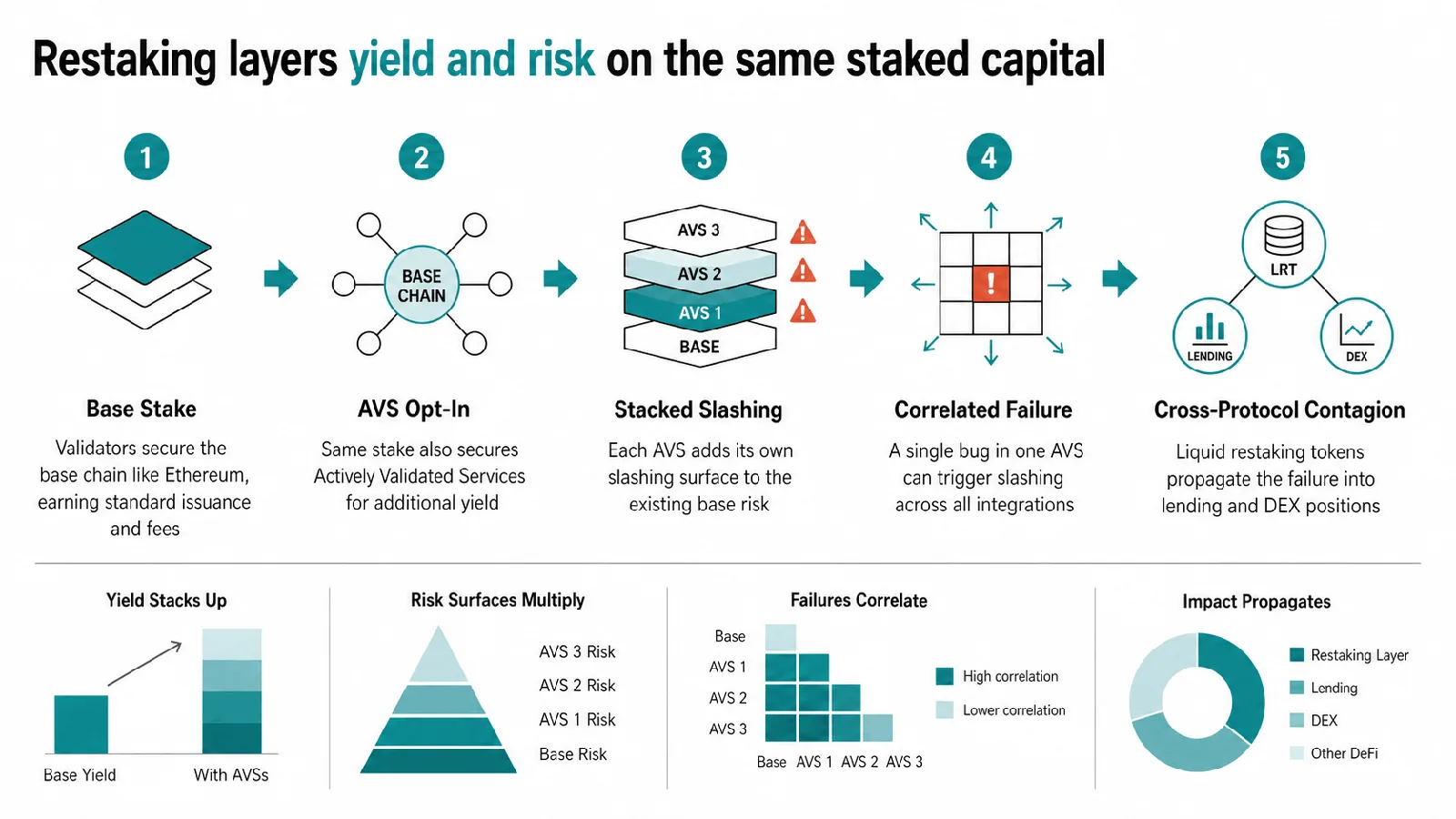
The restaking pattern is simple to describe and easy to underestimate. Validators who already secure the base chain (typically Ethereum) opt their stake into additional services called Actively Validated Services, or AVSs. Each AVS has its own slashing policy. Yield stacks because you earn the base APR plus rewards from each AVS you opt into. Risk stacks because a single bug in one AVS can trigger correlated slashing across every Liquid Restaking Token (LRT) holding that AVS.
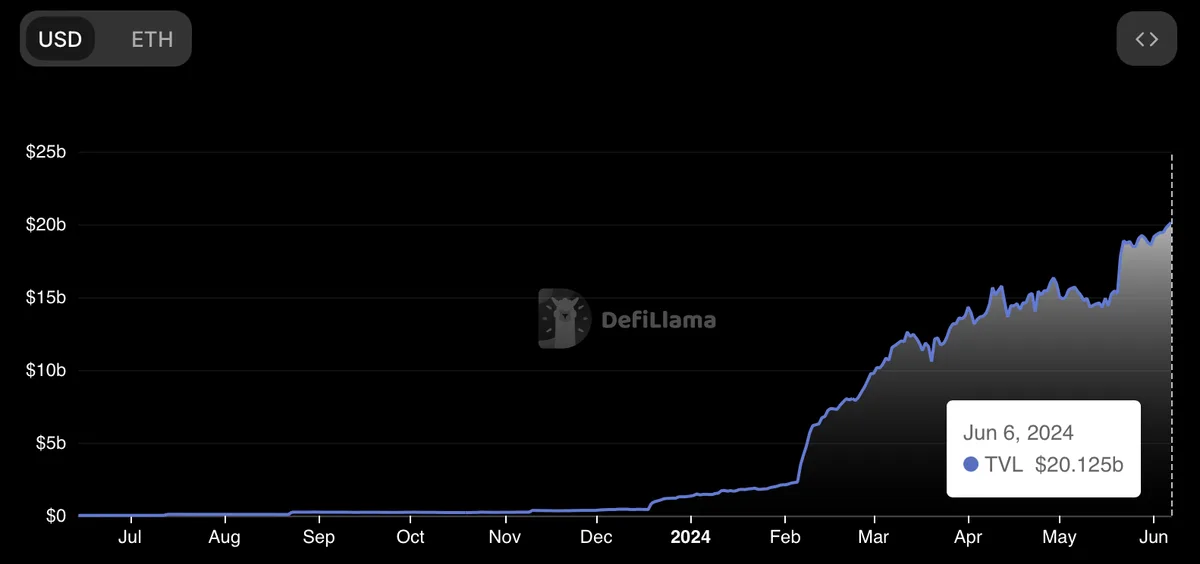
By late 2025, EigenLayer alone held around $20 billion in TVL, with peaks above $25 billion earlier in the year. Liquid restaking accounted for roughly 6 to 7% of all staked ETH at most reads. The Kelp DAO bridge incident in April 2026 (where a $293 million exploit triggered $5.4 billion in Aave outflows and a 19% drop in LDO) is a recent demonstration of how a single failure inside the restaking stack ripples outward through every protocol that integrated the affected LRT. The risk-correlation pattern is not theoretical anymore.
The framing for founders evaluating staking yields: do not look at the headline APR. Ask how many distinct slashing surfaces are layered underneath it, and what correlation between those surfaces would do to the stake. The yield is a single number. The risk is a stack.
When I was CPO at Bridge Mutual in 2021, we already had APY staking on the native token, plus re-staking of the technical token (the receipt you got from staking) for governance weight. We were planning to add re-staking of the LP tokens you received from providing liquidity to Aave, then re-stake the receipts from that to boost liquidity further. This was years before the EigenLayer-led restaking boom. Each layer had a real use case. The thing that stopped us was simpler: how many users were ever going to follow that chain? Most won't. If your staking flow has more than two hops, you are designing for the analyst, not the user.
Liquid staking tokens are the default, not an innovation
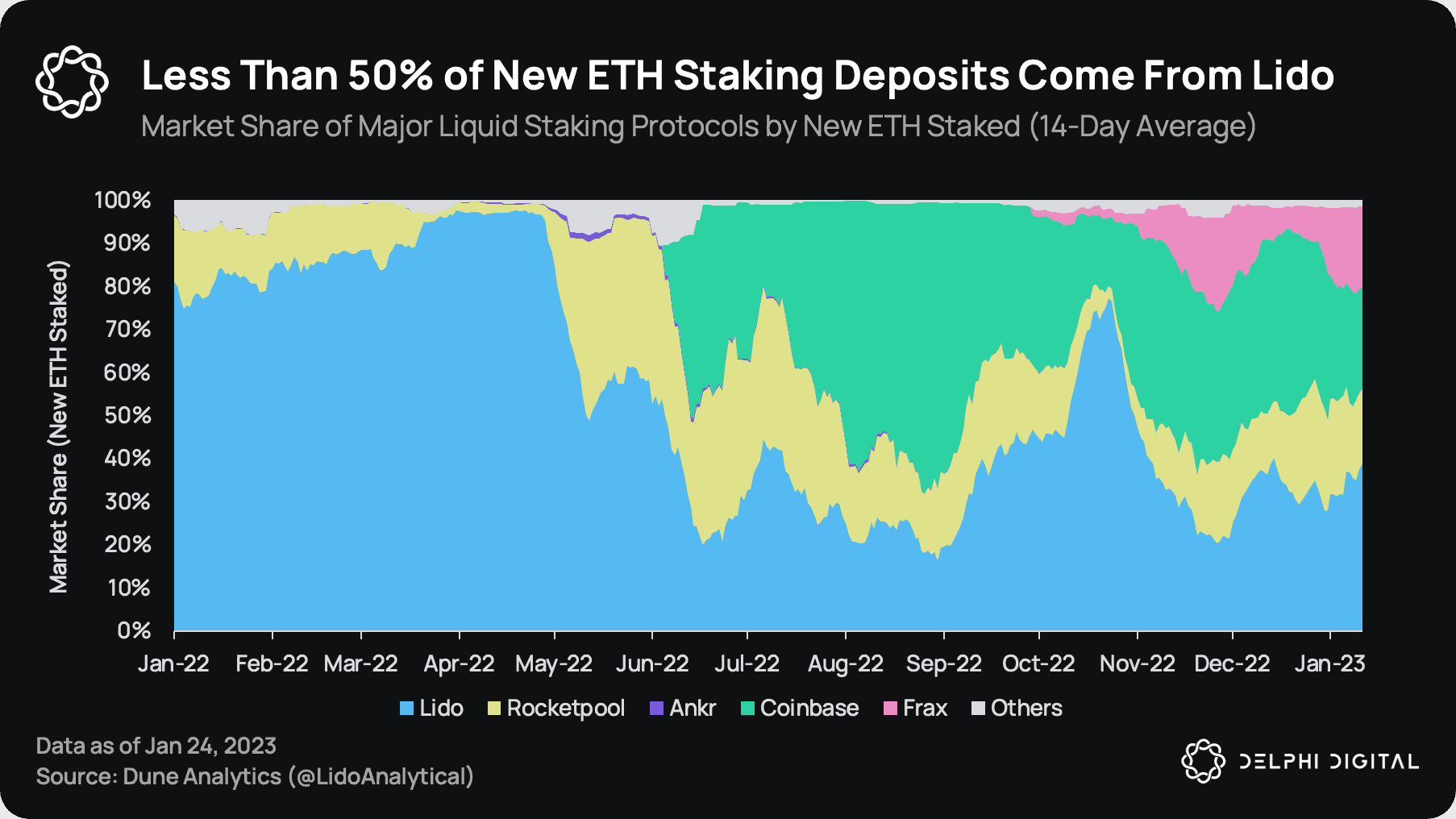
Staking without a liquid receipt is now the edge case. Liquid Staking Tokens (LSTs) account for roughly 31% of all staked ETH. Lido's share of staked ETH sat around 23 to 25% in late 2025, down from a peak above 32% in 2023. The drop is competitive (ether.fi, Coinbase, Figment took share) and not an LST decline. The LST category has gotten more crowded, not less central.
Two implications founders routinely miss. First, if your PoS chain doesn't have a credible LST pathway at launch, stakers will route around you anyway, and they'll do it through custodial LSTs from the largest exchanges, which concentrates validation in operators you didn't pick. The choice is not between LSTs and no LSTs. It is between a native LST that you can shape and an exchange-issued LST that you cannot.
Second, your circulating supply for price-impact modelling is not just your vested float. LSTs are fully liquid and rehypothecatable. Treating staked tokens as off-the-market because they earn yield is wrong: their derivatives trade. If 30% of your supply is staked through LSTs, that 30% is still in active circulation as far as your stress tests should be concerned.
Points programs are staking in a different shape
Most major launches in 2024 and 2025 ran on points rather than token emissions. EigenLayer, Blast, Ethena, Berachain, Hyperliquid pre-TGE, dozens more. Three reasons points replaced emissions:
- Points are a pre-TGE liability that sidesteps securities classification. There is no token, so there is no offer or sale. The SEC's recent staking statements (more on those below) do not extend to points.
- Points don't dilute supply on-chart. If your tokenomics page shows a clean emissions schedule, points let you keep it clean while still paying users to deposit.
- Redemption ratios are decided at TGE, when the team has the most leverage and the most information.
Economically, a points program is staking with a variable reward denominated in a not-yet-priced token. Users are accepting an option whose strike price will be set later, by the team. Sometimes that works out: Hyperliquid points holders did very well at TGE. Sometimes it doesn't, and most of the 2024 to 2025 points-to-airdrop conversions disappointed relative to the social-media expectations they generated. The honest framing for users: a points program asks you to stake your attention and your capital against an unpriced option, and to trust that the team will set the redemption ratio fairly when the option finally trades. That trust is not free. (See airdrops and points 101 for a fuller treatment of how points programs differ from emissions.)
The 2025 SEC clearance and what it actually changed
Two SEC Division of Corporation Finance statements rewrote the U.S. legal frame for staking in 2025. The first, the Statement on Certain Protocol Staking Activities (May 29, 2025), concluded that solo, delegated, and custodial protocol staking on PoS networks does not involve the offer or sale of securities, on the reasoning that providers act administratively rather than entrepreneurially. The second, the Statement on Certain Liquid Staking Activities (August 5, 2025), extended the same logic to LSTs, framing them as warehouse-receipt-style instruments rather than investment contracts.
What that changed for founders:
- The pre-2025 practice of hiding staking under euphemisms ("rewards," "earn," "yield") to avoid the S-word is no longer necessary for standard PoS staking and LSTs. You can call it staking.
- Restaking was explicitly excluded from both statements. So was anything where the provider exercises managerial discretion or pools assets to enhance returns. If your design has either, you are still in the grey.
- These are staff statements, not commission rules. They reflect Corp Fin's current view, do not bind the full SEC, and one commissioner publicly dissented. Future enforcement remains possible.
- EU framing is independent. There is no MiCA staking safe harbor analogous to the SEC's two statements. If you are launching in the EU, the U.S. framing buys you nothing.
The clearance is the largest regulatory shift in U.S. crypto policy in five years. It also did not change the economics of staking by one basis point. The two questions that decide whether a staking product is sound, where the rewards come from and what risks are taken to earn them, are still answered by tokenomics and not by Corp Fin.
Regulatory clearance changed what you can call the product. It did not change where the rewards actually come from.
Real yield versus inflationary yield
Stakers and founders both conflate two completely different yield sources. The conflation is what makes "80% APY" look like a product instead of a warning. It is also the single fastest way to misread how a protocol is actually performing.
Ethereum's roughly 3% staking APR is paid partly from new issuance (which dilutes everyone) and partly from fee revenue (transaction fees and MEV, which represent real economic activity). The fee component is real yield. The issuance component is inflationary yield. They arrive in your wallet identically and they are not the same thing.
A protocol paying 80% APY in its own native token is paying you almost entirely from emissions. If circulating supply expands by 80% per year and demand for the token does not also grow by 80%, the dollar value of your yield craters. The headline number is real. The dollar value is not. A cleaner framing for stakers and founders: net APY equals gross staking APY minus the annualized dilution rate of the token. Most of the staking marketed at high APYs in current circulation fails this test once you do the subtraction. (See token emissions 101 for when emissions are economically defensible, and value accrual 101 for how to identify yield that comes from real economic activity.)
If you are designing a staking module for a token that will live in both U.S. and EU markets, the regulatory perimeter and the economic perimeter are now genuinely different conversations. U.S. clearance and EU framing diverge, and the dilution test is the same in both. The cleanest way to do this work is as part of a structured tokenomics audit.
Slashing economics, the part no one reads
The slashing rules of any PoS chain or AVS are the part that decides whether the staking is real security or theatre, and they are routinely the part that gets a one-paragraph summary in a 60-page whitepaper. Stakers skip them because they are dense and conditional. Founders skip them because they are dense and conditional. The skipping is the problem.
The questions worth asking, as either a staker or a founder writing the rules:
- What exact behavior gets punished? Equivocation (signing two conflicting blocks) is the standard offense. Some chains add liveness penalties (slashing for being offline). Some don't. A chain with no liveness penalty effectively tells validators that downtime is free, which it is not.
- How much, and how fast? Ethereum's correlation penalty mechanism scales with the share of validators slashed simultaneously: a solo double-signing validator loses about 1 ETH, while a coordinated 1/3 attack would burn most of the involved stake. This asymmetry is intentional and load-bearing.
- Has it ever actually happened? Several restaking AVSs promise slashing in their docs and have never enforced one. If the answer to "has anyone been slashed for X here" is "not yet, in any scenario," the staking is closer to theatre than security. The threat must be credible, which means it must be operational.
This is the question the SEC's analysis is silent on, the question your auditor is unlikely to flag, and the question that decides what your stakers are actually buying. It is also the easiest section to skip in a whitepaper review and the most expensive section to skip after launch. Read the slashing rules first.
Duration multipliers, when they work and why ve(3,3) failed
Curve's veCRV is the case study for duration multipliers that work. Lock CRV for up to four years to get veCRV scaling linearly with lock duration, which gives you proportional voting power and a share of fees. It worked because CRV emissions had real purchasing power: gauge weights determined where emissions flowed, projects bribed veCRV holders to direct emissions to their pools, and the lock was a credible commitment to participate over Curve's planning horizon.
Solidly's ve(3,3) tried to extend the pattern by adding rebasing protection (locked tokens diluted less than unlocked ones) and binding emissions more tightly to fees. It collapsed for three connected reasons:
- The 4-year lockup outlasted the median DeFi protocol's actual lifespan. People were locking through projects that were not going to exist when the lock matured.
- The model only works while gauge emissions retain enough purchasing power to be worth bribing for. Once the bribe-per-emission ratio collapses, voting power does nothing useful.
- Voting power concentrated in a small set of long-locked whales whose incentives diverged from the broader ecosystem. The ve mechanism rewards conviction; conviction held by five wallets is just centralization with a longer time horizon.
The successors (Velodrome on Optimism, Aerodrome on Base, Ramses on Arbitrum, Thena on BSC) reduced lock durations to weeks or months, strengthened rebasing protection, and tied emissions more tightly to fee revenue. Some of those work. The original Solidly didn't.
The lesson for founders: lock duration should match your protocol's credible planning horizon, not the maximum the smart contract will allow. If your project genuinely has a 4-year roadmap, fine. If you are going to pivot in 18 months (and most early-stage protocols do), 4-year locks punish your most committed users for trusting you. (See governance 101 for how duration-weighted voting interacts with governance attacks.)
Exchange staking is a different product
When Coinbase or Binance offers 4% APY on SOL, the user isn't staking. They're lending the SOL to the exchange, which then stakes it on its own infrastructure and pays the user a fixed yield. The exchange takes a cut, handles the operations, and absorbs (or claims to absorb) the slashing risk. This sounds like staking and it is not.
Three implications for users:
- Custody risk. The exchange holds the keys. If the exchange fails, the staked tokens are creditor claims against the estate, not collateral the user can withdraw at will.
- Counterparty risk. The exchange may rehypothecate the staked tokens internally. You are stacking exchange credit risk on top of validator risk on top of protocol risk.
- Enforcement risk used to be the largest item on this list. The 2025 SEC clearance reduced it for protocol staking; it did not eliminate it for non-U.S. jurisdictions, and it did not reach products with managerial discretion (which most exchange staking arguably has).
The implication for founders is different and routinely missed. "Percent of supply staked" as reported in your dashboards typically includes exchange-staked tokens that are fully liquid from the exchange's side. The exchange can unstake and sell them overnight, and the user is none the wiser. Those tokens are not actually locked. Treating them as off-the-market in your supply-shock models is wrong. (See DEX vs CEX market makers for a related angle on liquidity assumptions.)
More from the 101 series
This is part of our 101 series on tokenomics fundamentals. If you want to dig further into mechanisms adjacent to staking, the four below are the most directly relevant. The full set covers supply, vesting, emissions, utility, governance, treasury, value accrual, payments, and burns.
- Token supply 101: how supply, circulation, and dilution actually work
- Token utility 101: what gives a token a non-speculative reason to exist
- Token vesting 101: designing lockups for teams, investors, and ecosystem
- Treasury 101: managing project funds across cycles
Frequently Asked Questions
01What's the difference between staking and yield farming?
+
02Can slashing penalties exceed my staked balance?
+
03What happens to my tokens during the unbonding period?
+
04If a liquid staking provider fails, do I still own the underlying tokens?
+