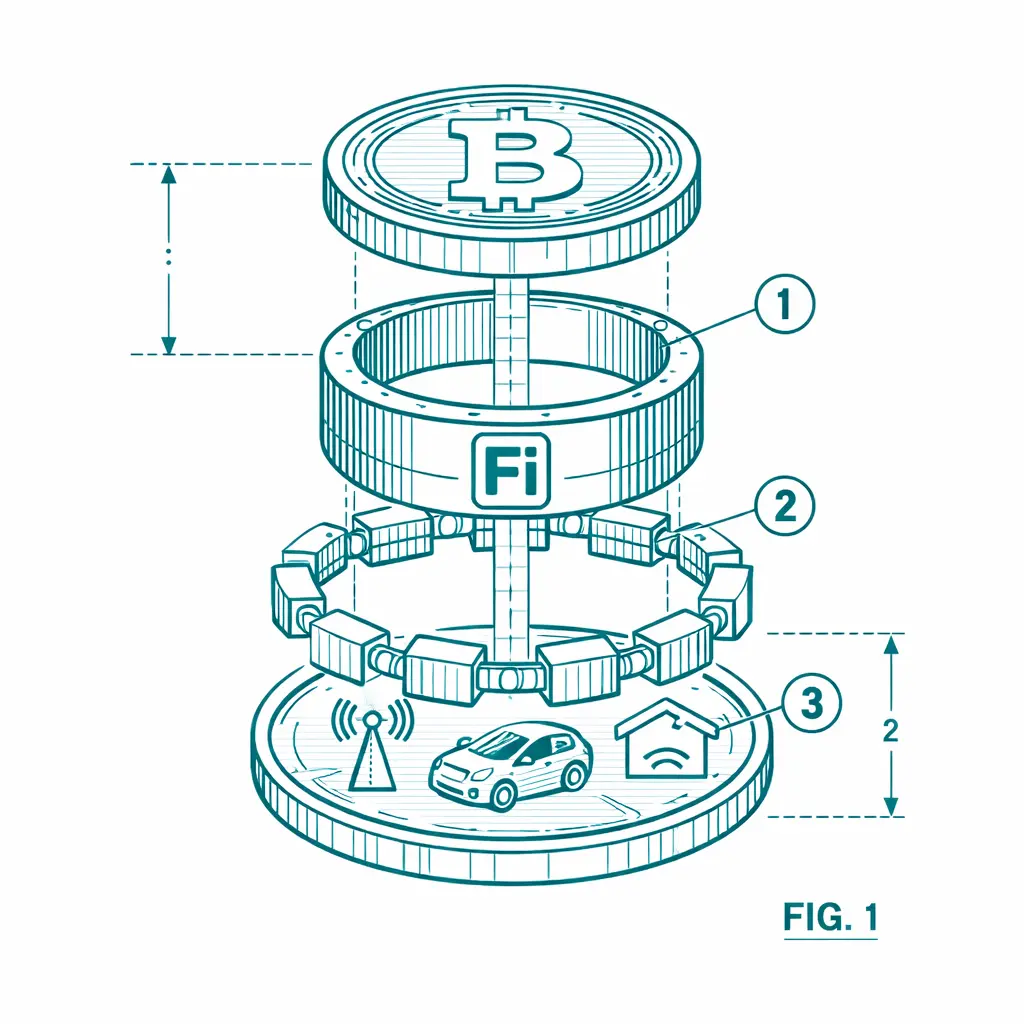
Blockchain matters in IoT at the trust boundary, not inside every sensor loop
Blockchain earns its place in IoT when multiple parties need a shared record and none of them should be the sole source of truth. NIST describes blockchain as a tamper-evident, tamper-resistant distributed ledger that lets a community record transactions in a shared ledger without a central repository or central authority. That property is valuable at the organizational boundary between manufacturers, operators, logistics providers, regulators, and end users. It is far less valuable inside a closed device stack already controlled by one vendor.
That distinction explains why blockchain-IoT architectures keep recurring in supply chains, digital product passports, and machine identity. These are settings where data provenance, authorization, and auditability have to survive company boundaries. They are not settings where every temperature reading, camera frame, or firmware event belongs permanently on a public ledger. Both IOTA and IoTeX now frame their IoT stacks around identity, proofs, and verification layers rather than around storing raw device output onchain.
Blockchain also does not solve the oldest IoT problem, which is insecure devices. NIST IR 8259A defines a core baseline of device cybersecurity capabilities needed to support common cybersecurity controls, and RFC 9019 says firmware updates are a critical part of lifecycle security, especially for devices with long lifetimes or remote deployments. If the device cannot be updated securely, identified reliably, or controlled safely, a token layer mostly adds new attack surfaces and new rent claims.
Where blockchain adds real value in IoT is identity, provenance, and machine coordination
Device identity is the first durable use case. W3C’s DID standard explicitly allows a DID subject to be a person, organization, or thing, and Verifiable Credentials Data Model v2.0 is now a W3C Recommendation. That matters for IoT because a secure device identity layer can be shared across vendors and counterparties instead of being trapped in each manufacturer’s user database.
Both projects highlighted in this sector have converged on that model. IOTA Identity says verifiable credentials stay offchain while proofs anchor to the ledger, and IoTeX ioID integrates DIDs and VCs for privacy-preserving communication between machines and people or between machines themselves. The architectural point is bigger than either project. IoT identity systems only scale when the blockchain stores proofs and permissions while the sensitive credential payload stays portable and selectively disclosed.
Provenance is the second durable use case. IOTA Notarization supports immutable records, dynamic updatable records, and hash-only “digital fingerprint” anchoring for confidential data. IoTeX’s W3bstream is positioned as off-chain verifiable compute for DePIN, using multi-prover verification to address risks such as self-dealing, lazy providers, and malicious responses. In both cases, the blockchain’s role is to verify claims about data and computation, not to become the database for all device output.
Smart homes and supply chain sensors sit at opposite ends of the design spectrum
Smart homes are mostly a custody and privacy problem. The Ucam paper from IoTeX describes a design where blockchain-based passwordless login, device ownership anchoring, integrity checkpoints, end-to-end encryption, and trusted computing are used to reduce account takeover and cloud-side manipulation risks with negligible performance overhead. That is a credible use of blockchain in consumer IoT because the ledger secures ownership and integrity claims while the actual video stays encrypted and offchain.
Supply chain IoT is different. It is an interoperability problem before it is a consensus problem. GS1’s EPCIS 2.0 standard is designed for visibility data across trading partners and now supports sensor data, JSON and JSON-LD, and REST-based capture and query interfaces. If a cold-chain sensor, a shipper, a warehouse, and a regulator cannot speak the same event language, immutability only preserves incompatible records.
Regulation is pushing the same way. The EU Battery Regulation requires battery passports to be interoperable across technical, semantic, and organizational layers, restricts who can access or update passport data, and requires authentication, reliability, integrity, security, and privacy. It also allows the data to be stored by the responsible economic operator or an authorized service provider. That is a strong signal that real-world deployments will be hybrid systems: operational data offchain, integrity and rights anchored through a trust layer. IOTA’s digital product passport showcase fits that direction more than the older “put everything onchain” narrative.
Scalability and standardization are the real economic bottlenecks
Most viable blockchain-IoT systems already admit that raw device data should not live on the base ledger. IOTA Identity keeps credentials offchain. IOTA Notarization can store only a hash. IoTeX W3bstream moves verification of off-chain computation into a separate prover layer. Those choices are not compromises. They are the architecture that makes IoT tractable.
Onboarding is the second bottleneck. IOTA Gas Station lets builders sponsor transaction fees for end users while users keep control of their own on-chain assets. That is good product design because device owners and application users should not need to manage native tokens just to authenticate, register a device, or approve a workflow. It also creates a governance trade-off. The sponsor sets policy rules and funds access, so participation broadens while fee abstraction can quietly reintroduce service-layer gatekeepers.
From an allocation standpoint, that trade-off matters. A machine network is not broadly participatory just because the chain is public. If a few entities fund onboarding, define eligible transactions, operate most validators, or control most treasury assets, they shape the economic perimeter even when the protocol language says “permissionless.” IoT systems expose that tension more clearly than DeFi because the people contributing value often buy hardware, install devices, maintain connectivity, and generate data before they see any token upside.
IOTA and IoTeX represent two different bets on blockchain-IoT economics
| Project | Core IoT approach | Participation design | Fairness pressure points |
|---|---|---|---|
| IOTA | IOTA combines identity, notarization, sponsored transactions, and digital product passport tooling. Its identity stack keeps verifiable credentials offchain, and its notarization layer supports full data, encrypted data, or hash-only anchoring. | The May 5, 2025 mainnet uses self-custodial staking, caps validator voting power at 10%, requires at least 2 million IOTA delegated stake for validator candidacy, and allows builders to sponsor user fees through Gas Station. The tokenomics paper says maximum annual issuance is 279,955,000 IOTA in the first year, with unlocks continuing until September 29, 2027. | The 10% cap is a real anti-concentration mechanism, but validator entry still has a large capital threshold and scheduled unlocks extend early-holder influence. Sponsored UX widens access, yet the sponsor can still decide who gets frictionless participation. |
| IoTeX | IoTeX centers machine identity and verifiable off-chain compute. ioID uses DIDs and VCs for machine identities, while W3bstream is built to verify off-chain computation and reduce self-dealing or lazy-provider behavior. | IoTeX’s MiCA whitepaper states a genesis supply of 10 billion IOTX and circulating supply of about 9.44 billion on August 1, 2025. Governance is veIOTX-based after a 91 to 1,095 day lock, with proposal threshold at 1% of circulating veIOTX or Delegate sponsorship and a 10% quorum. Block production remains centered on the Top 36 Delegates. | IoTeX is more explicit than many peers about retained buckets: 600 million IOTX foundation treasury, 1 billion staking-reward reserve, 200 million DIM incentives, and a 400 million team and advisor tranche unlocking from May 1, 2026 over 12 months. That disclosure is useful. It also shows where bargaining power can remain concentrated even if device usage grows. |
IOTA’s design is cleaner on explicit validator anti-concentration. A hard 10% cap on voting power is one of the clearer governance protections now visible in public blockchain-IoT designs. The trade-off is that the network still depends on who can aggregate enough delegated stake to clear validator entry, and the unlock schedule running into late 2027 means the political economy is still path-dependent.
IoTeX’s design is stronger on explicit machine-economy plumbing. The token is tied to gas, governance, device identity, module settlement, and protocol-level burns, and the 2.0 paper says about 400 million IOTX had already been burned through Burn-Drop by June 18, 2024. But the same public record shows how much steering power still sits with delegates, time-locked governance weight, and treasury structures. That does not disqualify the model. It does mean end users and device operators should not confuse usage growth with ownership diffusion.
Token design decides who benefits from connected-device networks
The hardest tokenomic question in IoT is not utility. It is distribution. If hardware operators, installers, data contributors, and end users create the network’s real-world value, their economic rights should not sit permanently downstream of early treasuries, insider tranches, or validator cartels. Public ledgers can reduce platform dependence, but only if governance weight and reward access are not structurally captured before the physical network scales.
For IoT, fairness starts with three incentive design choices. First, prove real-world contribution before paying emissions. IoTeX’s W3bstream makes that verification problem explicit. Second, abstract token friction for users where possible. IOTA Gas Station does that well. Third, disclose retained supply, unlocks, voting thresholds, and validator power caps in a way outsiders can model. On that front, both IOTA and IoTeX have become more legible than earlier blockchain-IoT cycles.
From a FinDaS Tokenomics standpoint, that is where serious token economy design begins. A credible blockchain-IoT system should specify who owns device identity, who pays for onboarding, who verifies work, who controls treasury outflows, and how quickly operational participants can accumulate governance relative to early capital. That is the substance behind tokenomics consulting in machine networks. Without it, “decentralized IoT” often means decentralized infrastructure with centralized upside.