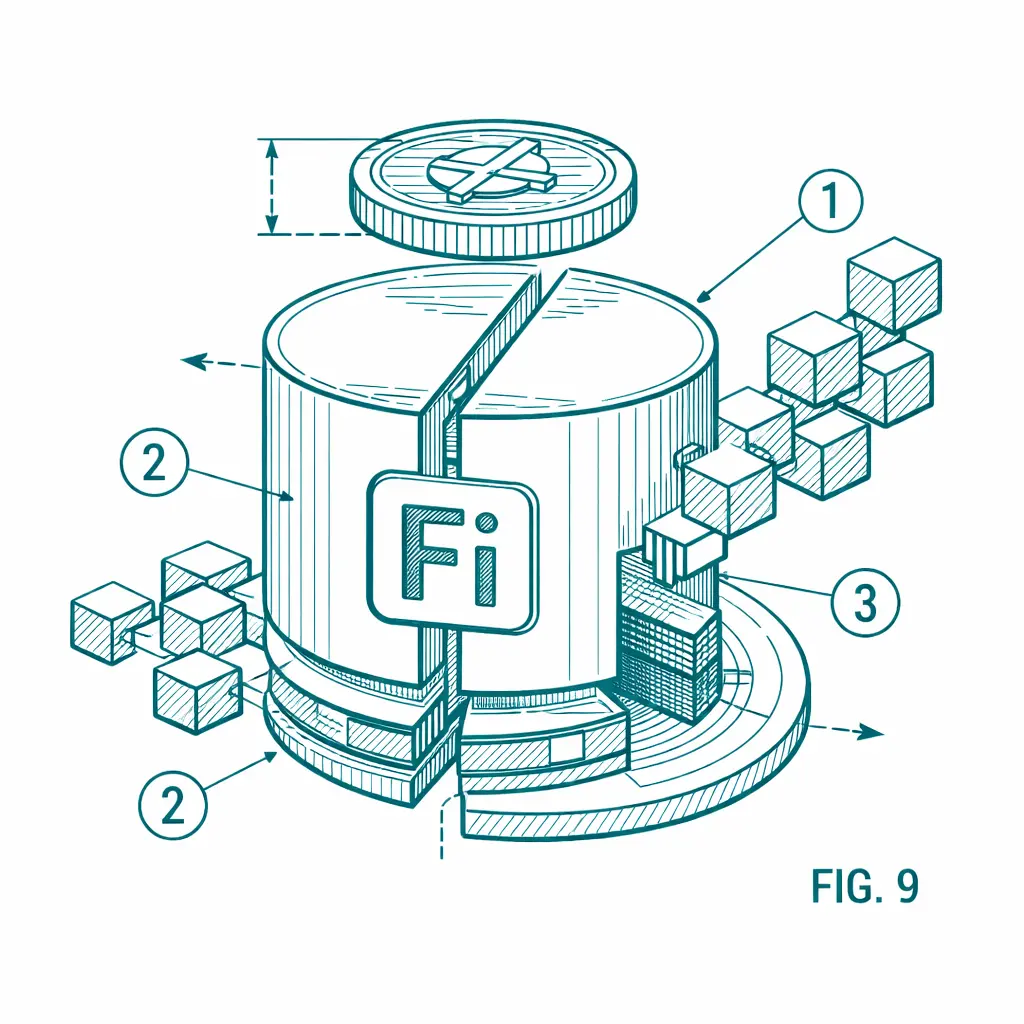
DID matters because wallet signatures are not enough identity for Web3
Decentralized identity matters in Web3 because most wallet-native authentication only proves control of a key, not who the user is, what rights they hold, or which attributes should matter for access, governance, and rewards. ERC-4361, the Sign-In with Ethereum standard, explicitly defines an off-chain authentication flow for Ethereum accounts. It is useful. It standardizes message signing and session establishment. But it still centers identity on an address and whatever external data a relying party decides to fetch about that address.
DID changes that model by giving users a persistent, user-controlled identifier that can be resolved into verification methods and service endpoints without depending on a single centralized identity provider. W3C made the DID Core specification an official web standard on July 19, 2022, and it describes DIDs as verifiable identifiers that do not require a centralized registry. In DID Core itself, DIDs are defined as identifiers created, resolved, updated, and deactivated through method-specific rules, and a DID document can contain verification methods and service information.
That difference is economically important. Token systems routinely need more than account ownership. They need to know whether a participant is a real contributor, a member of a specific cohort, a jurisdictionally eligible user, a repeat attacker, or an entity with earned governance reputation. A raw wallet login does not carry that context. DID infrastructure is the layer that makes identity portable enough to attach verified claims to Web3 interactions without collapsing back into platform-specific user databases. This is an inference from how SIWE, DID documents, and verifiable credentials divide responsibility across authentication, identifier control, and attribute assertion.
What DID actually standardizes in practice
DID is best understood as a coordination standard, not a single blockchain product. DID Core defines the syntax of the identifier, the structure of DID documents, and the responsibilities of DID methods. It does not force one chain, one storage model, or one trust model. In fact, W3C notes that DID methods are often associated with a particular verifiable data registry, and it requires each method specification to explain how identifiers are created, resolved, updated, and deactivated. That is why Web3 identity architectures can be blockchain-based while still remaining method-specific and heterogeneous.
Verifiable credentials are the second half of the stack. W3C published the Verifiable Credentials Data Model v2.0 as a Recommendation on May 15, 2025. The standard describes credentials as claims issued in a three-party ecosystem of issuers, holders, and verifiers, and it frames the model as cryptographically secure, privacy-respecting, and machine-verifiable. In practice, DID without credentials gives you controlled identifiers. Credentials add the claims that make identity useful.
The implementation layer is becoming more operationally mature. OpenID for Verifiable Credential Issuance 1.0 was published as a final specification on September 16, 2025, and defines an API for credential issuance. OpenID for Verifiable Presentations 1.0 had a working group draft published on July 10, 2025, defining a protocol for requesting and presenting credentials. That matters because DID adoption will not be driven by ideology alone. It will be driven by whether wallets, issuers, and applications can use familiar OAuth-style flows instead of bespoke, incompatible integrations.
Privacy is the main reason DID is strategically important
The strongest case for DID is privacy architecture, not branding around “self-sovereign” identity. DID Core is explicit that if a DID method uses a public-facing registry, DID documents should contain no personal data. W3C recommends that personal data move through other channels, including verifiable credentials or service endpoints under the controller’s control. That design choice is crucial in blockchain environments, where writing identity attributes directly to public infrastructure is usually an architectural mistake.
DID also has a built-in answer to correlation risk, although many implementations use it poorly. W3C warns that globally unique identifiers can be used for correlation and recommends pairwise DIDs that are unique to each relationship. It also warns that pairwise protections fail if DID documents reuse the same verification methods or bespoke service endpoints across contexts. In other words, privacy is not automatic. DID can reduce surveillance only if teams deliberately prevent cross-context linkage.
Selective disclosure is where this becomes practical instead of theoretical. RFC 9901, published in November 2025, standardizes selective disclosure for JWTs so a holder can present only the claims a verifier needs rather than the entire token. The EU Digital Identity Wallet offers a concrete policy example. The European Commission states that Member States will make wallets available by the end of 2026, and its wallet materials show an age-check flow where a user can prove age without revealing an exact birth date. That is the privacy model Web3 applications should care about. The goal is not to know everything about a user. The goal is to verify the minimum attribute needed for a specific action.
DID becomes economically valuable when token systems depend on attributes, not just balances
DID has direct value for token economies once participation rights depend on verified attributes. Governance, contributor rewards, retroactive distributions, access-controlled communities, and real-world utility programs all run into the same problem. An address is easy to observe, but difficult to interpret. DID and verifiable credentials make it possible to bind rights to attestable properties such as membership, completion of work, accreditation, age threshold, residency, or organization affiliation without forcing every application to become its own identity silo. That general mechanism follows from the W3C issuer-holder-verifier model and from the credential presentation standards now emerging around it.
DID alone does not solve Sybil resistance. That point needs to be stated plainly because the market still confuses identifiers with personhood. A DID proves control over an identifier. It does not prove that the controller is a unique natural person. NIST SP 800-63A-4 defines identity proofing as the process of establishing a relationship between a subject accessing online services and a real-life person, and its expected outcomes include determining that the claimed identity corresponds to a single, unique individual within the service population. From a token design perspective, human uniqueness, sanctions screening, residency, and eligibility all require proofing and credential issuance on top of DID, not DID by itself.
This distinction matters for airdrops and incentives. If a team distributes value purely to addresses, it rewards address generation, capital concentration, or farmable on-chain activity. If a team distributes value to verified cohorts, it can target incentives with much higher precision. That does not mean every token system should adopt real-world identity. It means teams should decide explicitly which attributes matter and whether those attributes should be asserted by trusted issuers, community processes, or application-specific reputation systems. DID is the plumbing that makes those design choices portable and auditable. This is an inference grounded in the standards’ separation of identifier control, proofing, and claim issuance.
Access control is another underappreciated use case. Web3 teams often frame identity as a compliance burden when it is also a product primitive. Credentials can gate DAO workspaces, premium protocol interfaces, event access, ecosystem grants, or institutional features without forcing users to repeatedly upload the same documents. The EU wallet examples show this clearly in banking, education, travel, and service access. In Web3, the same mechanism can support role-based permissions and segmented utility while revealing less data than conventional KYC portals.
The hard part is not issuing an identity. The hard part is lifecycle and interoperability.
The biggest implementation mistake in decentralized identity is to treat issuance as the finish line. It is the starting line. Real systems need recovery, rotation, revocation, suspension, and verifier-side policy. DID Core explicitly notes that not all DID methods support verification method revocation, and not all methods let verifiers reliably reconstruct historical DID state. That creates real security and legal trade-offs. A verifier deciding whether to trust a past signature or credential may need historical state access that some methods simply do not provide.
Key management remains the harshest UX constraint. The same problem appears in self-custodied identity: users control their keys, but there is no “forgot password” button. DID does not magically remove that problem. It broadens the set of architectures available for recovery and delegation, but the design burden remains. Any DID system that advertises user sovereignty without a concrete recovery model is incomplete.
Credential status is another non-trivial design layer. W3C published Bitstring Status List v1.0 as a Recommendation on May 15, 2025, specifically for privacy-preserving, space-efficient publication of suspension and revocation data for verifiable credentials. That is useful progress, but it also makes the point that identity systems need status infrastructure, not just credential minting. An identity program without revocation semantics is not operationally credible.
Interoperability is improving, but it is still not a solved problem. DID methods differ in trust assumptions, resolver behavior, and update semantics. W3C even requires method specifications that use DLTs to discuss the security assumptions of their network topology. Meanwhile, the market is still converging on cross-wallet presentation flows, and broader interoperability challenges remain. Advisory work in this area should therefore be judged less by slideware and more by concrete choices around method selection, proof formats, status checks, wallet support, recovery, and verifier policy.
What serious Web3 teams should evaluate before they add a DID layer
A credible DID strategy starts with a narrow question: which rights or economic actions depend on which attributes? If the answer is “none,” a wallet signature may be enough. If the answer includes eligibility, role, personhood, residency, accreditation, contributor history, or organization membership, then the team needs a full identity architecture. That architecture should specify the DID method, issuer model, proofing standard, credential format, presentation protocol, status mechanism, recovery path, and privacy model alongside other token economy design components. Anything less is branding.
The second evaluation criterion is whether the identity layer improves incentive quality. For token economy design, identity should increase targeting precision, reduce abuse, and avoid unnecessary data capture. If a DID system cannot explain how it changes reward allocation, governance integrity, access control, or compliance operations, it is not yet a serious part of the product stack. At FinDaS Tokenomics, that is the threshold we use when tokenomics consulting intersects token economy design work. The question is not whether decentralized identity sounds aligned with Web3 values. The question is whether it changes system behavior in a measurable way.
The market should also be tougher on advisors here. DID is a domain where marketing visibility often outruns implementation depth. Teams should ask for threat models, state diagrams, recovery logic, revocation workflows, proofing assumptions, and wallet compatibility details. They should ask how pairwise identifiers are used, how selective disclosure is enforced, and how verifier policy is updated over time. Decentralized identity is important in Web3 because it can make digital identity more private, portable, and user-controlled than platform logins. It only delivers that value when the underlying design is rigorous enough to survive real incentive pressure, real compliance pressure, and real user failure modes.