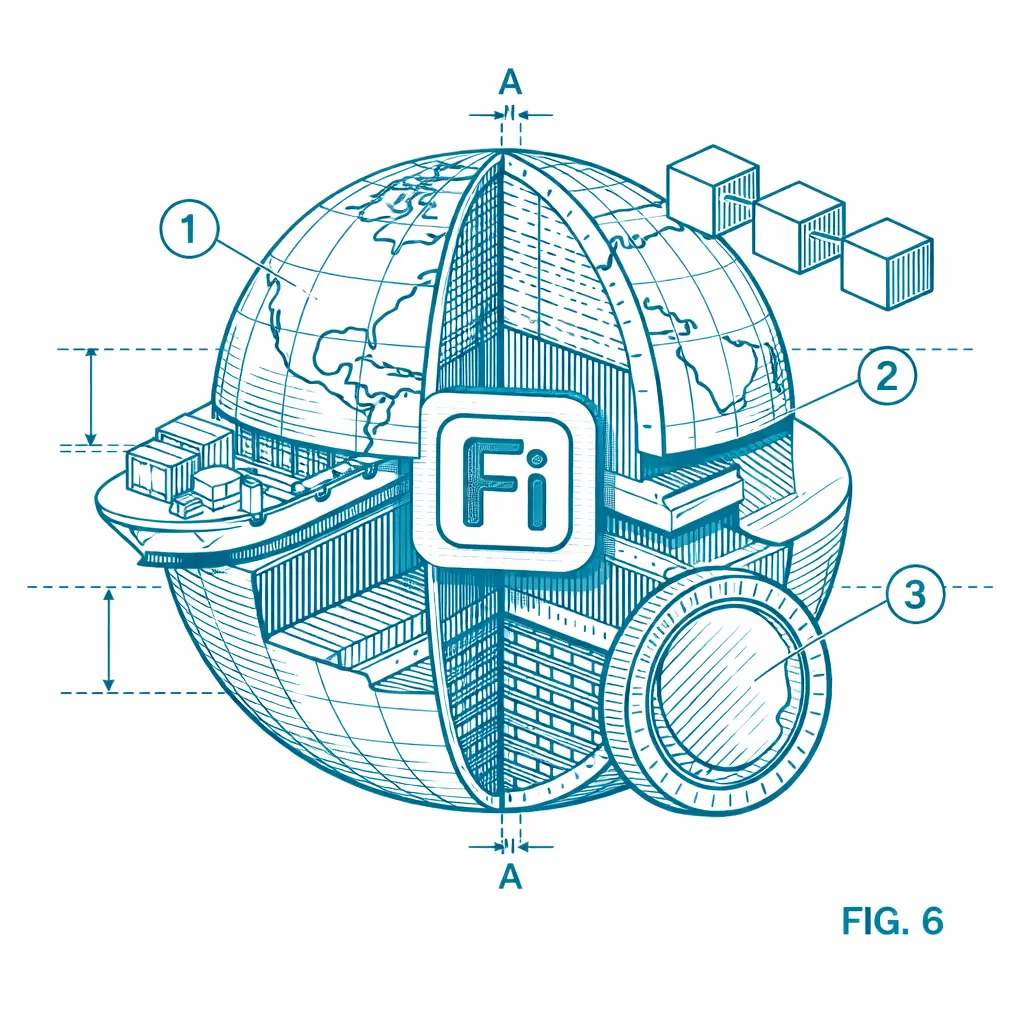
Blockchain’s real trade impact is in document control, not in putting every shipment “onchain”
Blockchain matters to global trade where trade still depends on scarce, transferable, delay-prone documents. That is the core point. Global trade still runs on more than 40 official and commercial documents, and the WTO says fewer than 1% of trade documents are fully digitized. The practical bottleneck is not a lack of databases. It is the difficulty of proving who controls a document of title, whether that control is unique, and whether another party in another jurisdiction will legally recognize it.
That is why blockchain’s strongest trade use cases are narrow and infrastructure-like. Electronic bills of lading, warehouse receipts, trade finance documents, and selected compliance records benefit from tamper-evident state transitions and shared verification. Broader claims that global trade needs every customs filing, invoice, and logistics event on a ledger have not been validated by adoption. The more credible direction is selective use of distributed systems inside a wider stack of legal reform, standards, identity, and workflow integration.
The decisive shift in trade is legal and institutional before it is technical. UNCITRAL’s Model Law on Electronic Transferable Records, adopted on July 13, 2017, was designed to enable legal use of electronic transferable records across borders, and it is explicitly technology-neutral. UNCITRAL states that MLETR can accommodate registries, tokens, and distributed ledgers. That matters more than any one chain choice because negotiability is a legal function, not a software feature.
For a Web3 audience, that point should reset the debate. A token can represent a claim in an application. A token does not, by itself, create possession, endorsement, title transfer, or cross-border enforceability. Trade systems become durable when the legal system, carriers, banks, insurers, and border agencies all accept the state transition. Until then, “onchain trade” is often just a faster pilot deck.
Electronic bills of lading are the clearest proof point
Electronic bills of lading are the clearest place where blockchain has already changed trade mechanics. DCSA says ocean carriers issue around 45 million bills of lading a year. In 2021, only 1.2% were electronic. DCSA’s carriers committed on February 15, 2023 to convert 50% of original bills of lading to digital within five years and reach 100% adoption by 2030. DCSA also cites potential savings of $6.5 billion in documentation costs and $30 billion to $40 billion in annual global trade growth from full eBL adoption.
Adoption is improving, but it is still early relative to the size of the market. ICC DSI currently lists eBL adoption at 12.8%, up from 5% in 2024. That is real progress. It is not mature penetration. The gap between 12.8% and 100% is exactly where the hard work sits: legal acceptance, interoperability, insurer comfort, bank workflow integration, and user incentives after the pilot budget disappears.
The UK’s Electronic Trade Documents Act 2023 shows why the legal layer matters. The Act recognizes that electronic trade documents can be possessed, endorsed, and transferred if a reliable system ensures exclusive control, identifiability, integrity, and divestibility. The explanatory notes explicitly address the double-spend problem and make clear that electronic trade documents can function as legal equivalents of paper ones. The law does not require blockchain. It requires reliable control.
That is the deeper implication for global trade. The winning architecture is unlikely to be “one chain to rule world commerce.” The winning architecture is more likely to be a legally recognized control model that different systems can interoperate around. DCSA’s standards work, ICC’s data harmonization, and national legal reform are all moving in that direction.
Trade finance benefits are real, but coordination failures keep eating the upside
Trade finance is where blockchain’s promise is economically intuitive. Letters of credit, document presentation, title transfer, and fraud checks are still slow because multiple parties inspect the same documents in different systems. ADB’s 2023 Trade Finance Gaps, Growth, and Jobs Survey estimated the global trade finance gap at $2.5 trillion in 2022, equal to about 10% of global merchandise trade, and noted that digitalization can reduce the gap but is being held back by weak harmonization of electronic documents and related systems. A December 2025 ADB update said the gap remained $2.5 trillion.
Singapore’s TradeTrust is one of the more credible examples because it combines legal alignment with interoperable technical rails. IMDA says its framework provides proof of authenticity, origin, and ownership of digital trade documents, and on March 30, 2023 it supported what IMDA described as the world’s first live paperless electronic transferable record using an eBL compliant with MLETR. IMDA also reported the first live digital trade between China and Singapore on October 19, 2023 using TradeTrust and Beijing’s AEOTradeChain blockchain technology.
TradeTrust is also useful because it exposes what actually matters after the demo. On February 4, 2026, IMDA launched a 12-month TradeTrust Readiness Programme to support digital trade platform and carrier pairs, and said the programme was meant to address a key barrier to eBL adoption: lack of coordination across carriers and platforms. IMDA also said four TradeTrust-enabled platforms had achieved International Group of P&I Clubs approval and that the ecosystem included more than 50 digital trade platforms, financial institutions, and carriers. That is what post-pilot progress looks like. The constraint is less “can smart contracts work?” and more “can enough counterparties coordinate around the same rules?”
The negative example is just as important. Maersk and IBM announced on November 29, 2022 that they would discontinue TradeLens because the platform had not achieved the level of full industry collaboration needed for commercial viability. That statement should be read carefully. TradeLens did not fail because trade documentation is unimportant. It failed because a technically viable network did not reach a durable equilibrium of participation and value capture. In token economy terms, the demand side did not stabilize strongly enough to support the operating model.
Traceability and compliance create stronger demand than generic provenance stories
Traceability and compliance are now bigger drivers of blockchain-style trade infrastructure than the old “see where your coffee came from” narrative. As trade rules demand more structured, auditable, cross-firm data, firms need systems that preserve integrity across multiple parties and jurisdictions. That can favor distributed approaches, but only when the data must survive handoffs between parties that do not fully trust each other.
Customs authorities themselves are treating blockchain as one tool among several, not as the entire modernization stack. The WTO and WCO’s 2022 work on advanced technologies in cross-border trade focused on blockchain alongside IoT, big data, AI, and machine learning. That framing is healthy. Border management depends on risk analysis, identity, document exchange, and institutional cooperation. A ledger can help with tamper resistance and shared visibility. It does not replace customs law, product classification, origin rules, or agency interoperability.
European regulation is pushing the market toward richer digital trade data even where blockchain is not mandated. Regulation (EU) 2023/1542 requires an electronic battery passport from February 18, 2027 for LMT batteries, industrial batteries above 2 kWh, and EV batteries, and the passport must be interoperable with other digital product passports. The EU Deforestation Regulation Information System, launched on December 6, 2024, is where due diligence statements must be submitted. In both cases, the commercial effect is the same: cross-border trade is becoming more dependent on machine-readable, shareable, verifiable records.
The important analytical caution is that stronger traceability demand does not automatically mean blockchain wins by default. Many compliance problems can be solved with APIs, registries, digital signatures, and better data standards. Distributed ledgers become compelling when no single actor can credibly own the truth layer, or when the record must preserve transferability and shared control across organizational boundaries. That is a narrower market than many early enterprise blockchain narratives assumed.
Interoperability and legal recognition now matter more than ledger choice
The trade stack is shifting from isolated pilots toward interoperable frameworks. ICC’s Key Trade Documents and Data Elements project, published on April 24, 2024, mapped 36 key trade documents into a more coherent data framework. WTO and ICC’s standards toolkit was built to map widely used standards and address the fact that paper dependence and poor standards adoption still block seamless cross-border data flow. These are boring advances compared with token launch announcements. They are also much more likely to survive.
Legal coverage is expanding as well. UNCITRAL’s status page now lists legislation based on or influenced by MLETR in 13 jurisdictions, including Bahrain, Singapore, the United Kingdom, France, China for bills of lading, and Abu Dhabi Global Market. That matters because digital trade breaks most often at jurisdictional boundaries. Every additional jurisdiction that recognizes electronic transferable records reduces the need for contractual workarounds and lowers the risk that a digital document has to revert to paper mid-process.
The newest legal development is even broader. On December 15, 2025, UNCITRAL adopted the United Nations Convention on Negotiable Cargo Documents. The Convention establishes a uniform framework for negotiable cargo documents in paper or electronic form across transport modes, and UNCITRAL says it is intended to facilitate trade finance, enable sale of goods in transit, promote multimodal transport, and support digitalization of global trade. If widely adopted, that expands the addressable surface for blockchain-based document control beyond maritime eBLs into a more general negotiable cargo layer.
| Trade layer | Where blockchain helps | What actually determines scale |
|---|---|---|
| Bills of lading | Exclusive control, transfer history, and multi-party verification of title documents. | MLETR-style legal recognition, carrier participation, insurer acceptance, and interoperability. |
| Trade finance | Faster document presentation, reduced fraud risk, and synchronized state changes across banks and corporates. | Standards harmonization and enough recurring transaction volume to support the network without subsidy. |
| Customs and compliance | Tamper-evident sharing of certificates, provenance, and compliance events across agencies and firms. | Regulatory alignment, data quality at source, and agency coordination. |
| Future multimodal cargo documents | Programmable transfer and auditable handover across transport modes. | State adoption of the Convention and commercial uptake by operators, banks, and shippers. |
What this means for Web3 builders, token design, and long-term trade infrastructure
The evidence now points to a clear conclusion: blockchain can materially improve global trade, but mostly by shrinking a few specific frictions around negotiable documents, shared verification, and cross-platform trust. That is valuable. It is not the same as a blanket rewrite of world commerce. The most durable winners are likely to be standards-driven, legally recognized, interoperability-first networks that solve a real transfer problem and can survive after incentives fade.
From FinDaS Tokenomics’ standpoint, that has a direct implication for token economy design. A trade network should be evaluated on post-incentive equilibrium, not launch optics. Who pays recurring fees once grants stop. Who bears legal liability when a document transfer fails. Who operates validation or control infrastructure. Whether banks, carriers, and insurers can join without ceding strategic dependence to a competitor. Whether the network still clears real transactions when speculative volume disappears. Those questions matter more than whether a protocol can mint a document-linked token.
That is also why subsidy-heavy Web3 trade models deserve skepticism. Trade participants do not adopt core documentation rails because yield farming temporarily lowers costs. They adopt when the rail reduces errors, shortens cash cycles, satisfies insurers and regulators, and remains neutral enough that counterparties will keep using it for years. In practice, the trade-off is usually short-term traction versus long-term survivability. Global trade punishes systems that optimize for the first and neglect the second. The same logic applies to incentive design.
The practical upside remains large. DCSA’s numbers on eBL savings and trade growth are meaningful. The spread of MLETR-style laws is meaningful. TradeTrust’s movement from pilots toward insurer-approved, cross-platform use is meaningful. The 2025 UNCITRAL cargo documents convention is meaningful. But the systems most likely to capture that upside will look less like speculative crypto networks and more like institutional coordination layers with precise legal hooks and boring operating discipline.