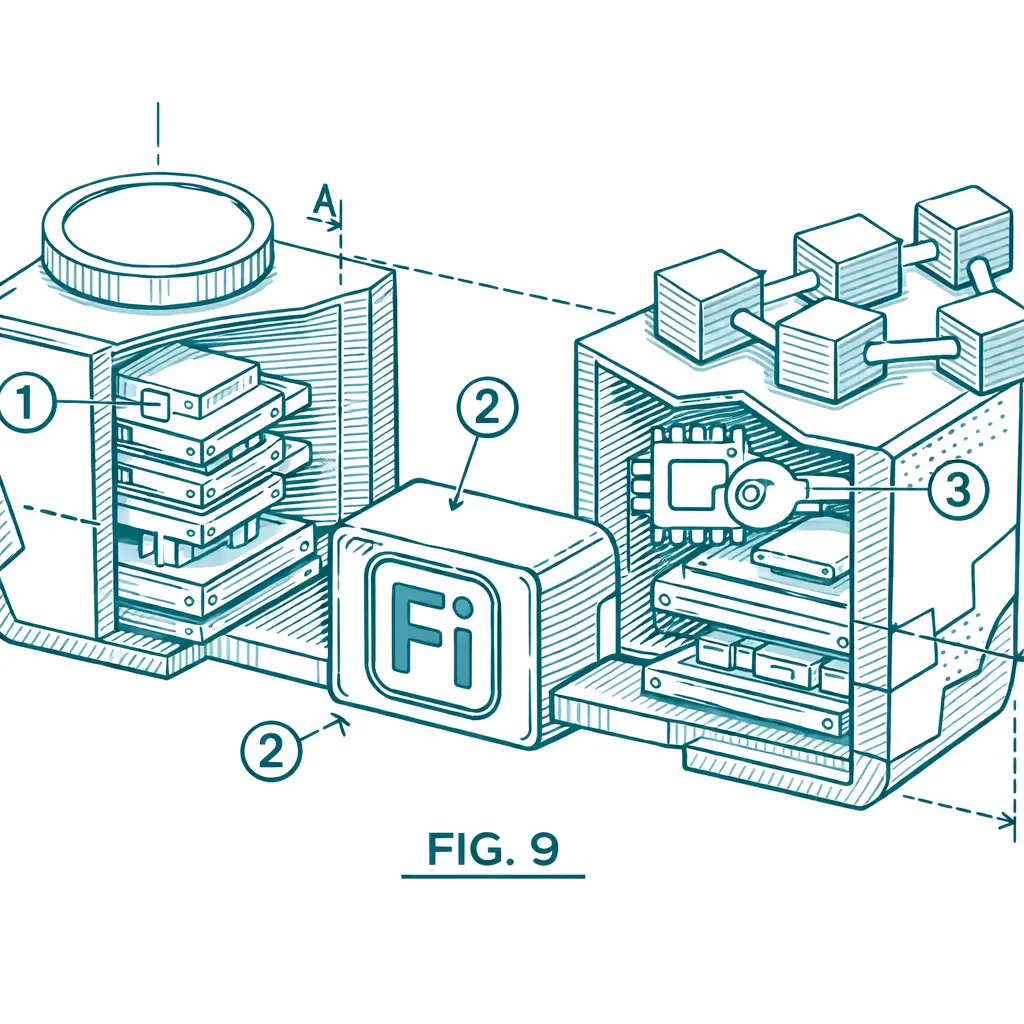
The wallet choice is not mainly a UX decision. It determines who controls the private keys, who can freeze or recover access, who carries the operational loss if something breaks, and which regulatory perimeter is most likely to apply. Wallet guidance makes that distinction explicit by separating hosted wallets, where the intermediary has independent control, from unhosted wallets, where the user interacts with the network directly. Coinbase makes the same split in product terms by distinguishing a custodial Coinbase.com account from self-custody wallets where keys are stored on the user’s device.
For an informed Web3 user, “custodial vs. non-custodial” is only the first layer. The more useful question is what rights and liabilities sit around the wallet: deposit-style rewards, staking, swaps, card rails, KYC, broker-dealer obligations, insolvency treatment, and whether the provider is merely giving you software or actually standing between you and the asset. That is where the legal and token-economic consequences show up.
The core distinction is control of keys and control of transactions
Custodial wallets centralize key control. FinCEN describes hosted wallet providers as account-based money transmitters that receive, store, and transmit crypto on behalf of account holders, with the host having “total independent control” over the value. In contrast, FinCEN says unhosted wallets let the owner interact with the payment system directly and, when used on the user’s own behalf, that user is not a money transmitter.
That sounds abstract until you map it to products people actually use. Coinbase distinguishes a custodial Coinbase.com account from its Base wallet, which is self-custody because the private keys are stored directly on the user’s device. MetaMask states the same model even more plainly: it is self-custodial, gives the user control of access keys, stores wallet data locally, and cannot reset a Secret Recovery Phrase.
The practical consequence is that custodial wallets behave like accounts, while non-custodial wallets behave like signing tools. Custodial products can offer password recovery, account review, withdrawal holds, sanctions screening, and fiat integration because the provider sits inside the transaction flow. Non-custodial wallets let users sign directly into dApps, governance portals, liquidity pools, and bridges, but the provider cannot reverse a mistake in the same way because it does not control the asset path.
Custodial wallets buy convenience by introducing counterparty exposure
Custodial wallets are usually better for onboarding, active trading, and compliance-heavy fiat flows. The provider can batch transactions, manage internal ledger updates off-chain, support account recovery, and apply KYC at account opening. Kraken’s regulatory disclosures show how this plays out across jurisdictions, including MiCA authorization in Ireland for custody and administration of crypto-assets on behalf of clients, exchange services, and order execution.
Regulators also treat custody as a distinct risk-bearing activity. Under MiCA, which applies from December 30, 2024, while Titles III and IV applied from June 30, 2024, crypto-asset service providers that custody client assets must legally and operationally segregate those assets from their own estate, and they are liable to clients for loss attributable to them, capped at market value at the time of loss. The regulation's transitional regime for pre-existing providers ended on July 1, 2026, and no member state may extend it; firms providing crypto-asset services in the EU without MiCA authorisation after that date are in breach and must wind down.
In the United States, custody also becomes materially more complex when the asset may be a security. On December 17, 2025, an SEC staff statement said broker-dealers carrying crypto asset securities should have written policies for distributed-ledger assessment, private-key protection, disruption planning, and lawful seizure or transfer scenarios. That is a useful reminder that “holding the keys” is not just a technical function. It can trigger a full securities-law architecture around possession, control, records, and transfer capability.
The cost of custodial convenience is counterparty risk. Coinbase’s legal disclosures say digital currency on Coinbase is not FDIC- or SIPC-insured, though the company carries crime insurance for a portion of digital assets in storage systems; by contrast, U.S. dollar cash held as cash in qualifying custodial accounts may be eligible for pass-through FDIC coverage up to applicable limits. Kraken is even more direct: exchanges do not qualify for deposit insurance programs because they are not savings institutions. FINRA separately warns that SIPA coverage might not apply to crypto assets, including some assets that may be securities under other federal laws but not “securities” under SIPA.
That means a custodial wallet is safest when the user values service recovery more than trust minimization. It is a strong fit for high-frequency trading, recurring fiat ramps, tax-lot reporting, and users who are unlikely to manage keys well. It is a weaker fit for users whose core concern is eliminating intermediary dependence. That last point is especially important for governance tokens and claim-based token distributions. As an analytical inference, rights that require direct onchain action usually map more cleanly to self-custody because the user controls the address and signature path.
Non-custodial wallets remove intermediary risk and move the burden onto the user
Non-custodial wallets are strongest where direct ownership matters more than managed service. MetaMask says it does not store wallet data, does not associate wallet accounts with email addresses, and cannot access the wallet from its side. Coinbase Wallet says the same thing in product language: it is self-custody, puts users in control of their private keys, and nobody, including Coinbase, can access assets without the recovery phrase.
That design eliminates a class of insolvency and freeze risk because there is no platform balance sheet between the user and the asset. It also enables direct interaction with dApps, which is why non-custodial wallets dominate across DeFi ecosystems, NFT flows, onchain governance, and cross-chain activity. Coinbase’s Wallet Dapp terms are explicit that the service is non-custodial, is not a broker or financial institution, does not custody user assets, and merely provides an interface to third-party smart contracts and wallets.
The trade is brutal but clear. If you lose the seed phrase or private keys, recovery may be impossible. Coinbase tells Base wallet users that if private keys are lost, Base cannot help recover the account. MetaMask tells users the Secret Recovery Phrase cannot be changed or reset. This is not a customer-support nuance. It is the defining economic property of self-custody.
Hardware wallets exist because pure mobile or browser self-custody leaves keys on internet-connected endpoints. Ledger explains the model cleanly: the wallet does not store the asset itself, only the private keys, and Ledger devices store those keys offline in a Secure Element chip and sign transactions offline. Trezor frames the same protection through its “Trusted Display,” which shows verified transaction details on an offline device and is meant to catch malware-induced address substitution.
Security is a different attack surface, not a simple ranking
Custodial wallets concentrate risk in the operator. Non-custodial wallets concentrate risk in the user. Neither model is inherently “more secure” in all cases. The failure modes are just different. FINRA warns that theft, spoofing, and fraud remain common across crypto asset service providers, while recovery of stolen assets is rare.
For self-custody, the most common losses are not cinematic key-cracking events. They are phishing, malicious dApp approvals, address poisoning, fake support, and seed-phrase exfiltration. The FTC warned in May 2023 about phishing emails impersonating MetaMask. The FBI warned in April 2024 that address-poisoning attacks exploit truncated wallet addresses, and in June 2025 it warned that malicious NFT airdrops were being used to trick non-custodial wallet users into connecting wallets or revealing seed phrases.
Good non-custodial wallets now try to reduce those risks without reintroducing full custody. Coinbase Wallet offers token approval alerts, transaction previews, malicious dApp warnings, and permission management. Trezor’s screen-based verification and Ledger’s offline signing are solving the same problem from the hardware side: keep the approval step away from a compromised browser or phone. These tools help, but they do not eliminate user responsibility. A user can still sign a bad transaction perfectly securely.
Yield, swaps, cards, and key-sharing blur the custodial line
The biggest analytical mistake is treating the wallet label as the whole product. A self-custodial wallet can still route the user into regulated counterparties, fee-bearing financial features, or even quasi-custodial flows. MetaMask says the core wallet is self-custodial and does not require KYC, but its wallet-adjacent services are different: MetaMask Swaps charges a 0.875% MetaMask fee, and MetaMask Card onboarding requires account setup and identity verification through a partner.
Custodial wallets can also mutate economically once “earn” features are added. Kraken’s Opt-In Rewards documentation says opted-in assets can be either “unutilized,” meaning they remain held in custody, or “utilized,” meaning Kraken has drawn upon them and they are no longer held in custody. That distinction matters more than the marketing category because it changes the user’s position from pure safekeeping toward a yield-bearing, counterparty-exposed arrangement. Kraken also states that Opt-In Rewards is not available in the U.S. and that other geographic restrictions apply.
This is where the regulatory-pragmatist lens matters. Revenue sharing, wallet-native rewards, and yield wrappers can move a product away from “software that helps you sign” and toward “financial service that intermediates returns.” The design flexibility is real. So is the legal exposure. The correct question is never just who stores the key. It is who can re-use the asset, who sets the reward rate, who performs KYC, who can halt withdrawals, and who bears the obligation if the arrangement fails.
The market is also producing hybrid designs that make the binary even less useful. Coinbase notes that its dApp wallet uses a split-key model in which Coinbase holds half of the private key and the user’s device stores the other half. That is not classic exchange custody, but it is not the same as a pure seed-phrase wallet either. For treasury teams, protocols, and consumer apps, these middle architectures can be useful. They also demand closer reading of terms, recovery flows, and jurisdictional obligations.
What to use, and what Web3 teams should design for
| Model | Typical examples | Who controls keys | Main advantage | Main risk | Regulatory posture |
|---|---|---|---|---|---|
| Custodial wallet | Coinbase.com, Kraken account | Provider | Recovery, fiat integration, trading convenience | Counterparty, withdrawal, insurance, insolvency exposure | Most legible to AML, custody, and licensing regimes |
| Non-custodial hot wallet | MetaMask, Coinbase Wallet | User on device | Direct dApp access and minimized intermediary dependence | Phishing, malicious approvals, lost seed phrase | Core wallet software may sit outside classic custody rules, but adjacent services can still trigger KYC and payments obligations |
| Non-custodial hardware wallet | Ledger, Trezor | User on offline device | Better isolation of signing and key storage | Bad backup practice, physical loss, user error | Low intermediary exposure, strongest for treasury-style holding |
| Hybrid or key-shared wallet | Coinbase dApp wallet model | Shared | Smoother onboarding than pure seed-phrase self-custody | Terms and recovery model can be harder to classify | Needs case-by-case analysis rather than label-based analysis |
The right answer depends on the job. Use custodial wallets for exchange trading, recurring fiat flows, and users who will not safely handle keys. Use hot self-custody for active DeFi, governance, and onchain experimentation. Use hardware wallets for larger balances, treasury holdings, and signers that should not live on a browser extension. Treat hybrid models as their own category, not as a free lunch.
For token issuers, protocols, and apps, wallet architecture is part of token economy design. If a token promises governance rights, revenue-linked rewards, or direct claim mechanics, but the default distribution path routes users into venues that do not clearly preserve those rights, the token design and the access layer are misaligned. At FinDaS Tokenomics, this is one of the most common places where tokenomics consulting meets regulatory mapping: wallet flows, rewards, and rights execution have to be designed together, not as separate workstreams.