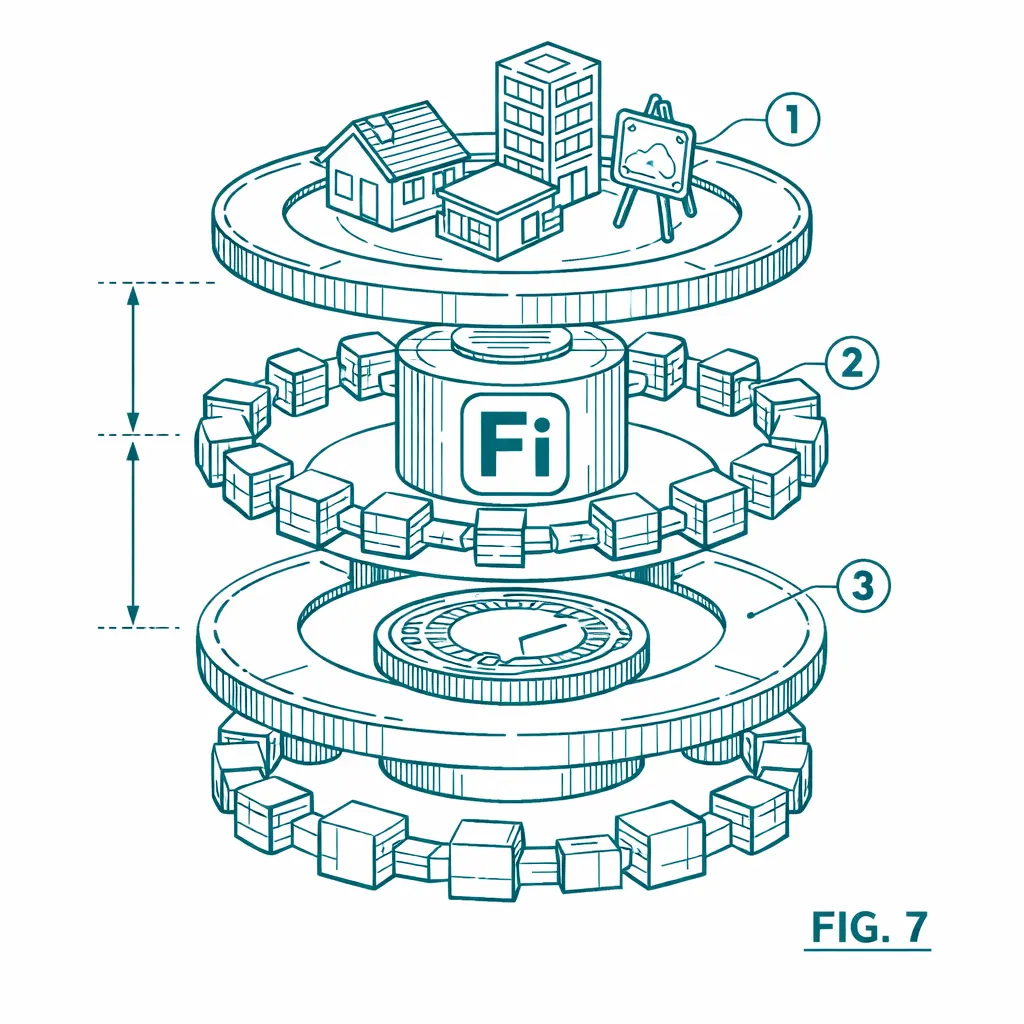
Tokenization is succeeding first where the claim is standardized, not where the asset is romantic
Tokenization has real traction, but the market is voting for standardized financial claims before it fully embraces bespoke physical assets. As of March 11, 2026, public market data lists Figure HELOC Token at $15.65 billion, BlackRock’s BUIDL at $2.24 billion, and Franklin Templeton’s BENJI at $1.03 billion, while tokenized real estate totals only $438.88 million across 64 assets.
That ranking is not accidental. Treasuries, money-market products, and credit instruments already have standardized cash flows, standardized disclosures, and cleaner legal claims. Blockchain mainly improves issuance, transfer, settlement timing, collateral mobility, and distribution. Real estate and art ask the chain to carry much more baggage. They bring property law, custody, appraisal, servicing, tax complexity, and governance discretion. The OECD’s January 9, 2025 policy paper is blunt: adoption remains scarce despite enthusiasm, and lack of liquidity plus the absence of a full ecosystem are central obstacles to scale.
The benefits are still real. The SEC said on July 9, 2025 that tokenization may facilitate capital formation and improve collateral utility, while Franklin Templeton and BlackRock both frame tokenized funds around blockchain-based transferability, transparency, and faster settlement.
The hard truth is simpler. Tokenization improves the movement of claims far faster than it decentralizes control over the underlying asset. That gap is manageable for T-bills. It is much harder for apartment buildings, paintings, or any asset where ownership, maintenance, valuation, and exit require human discretion.
The token is not the asset. The token is a legal and operational wrapper around the asset
Most real-world asset tokens do not put the deed, the painting, or the bond itself “onchain” in any literal sense. They put a representation, entitlement, share, or claim onchain. The SEC’s January 30, 2026 staff statement makes the key distinction explicit: tokenized products can be issuer-sponsored securities, third-party custodial tokenized securities, or synthetic exposures, and the rights attached to the token can differ materially from the rights attached to the referenced asset.
| Structure | What the holder actually owns | Main control point | Representative example |
|---|---|---|---|
| Issuer-sponsored tokenized security | A direct security interest issued in tokenized form | Issuer and transfer agent | Franklin says one BENJI token represents one fund share, but the transfer agent maintains the official ownership record |
| Fund or SPV wrapper | Equity or membership interests in an entity that owns the asset | SPV documents, manager, administrator | RealT states the token is a digital representation of ownership in the LLC or Inc. that owns the deed |
| Custodial tokenized security | An indirect interest in securities held by a third party | Custodian and entitlement records | The SEC warns holders can face third-party risks, including bankruptcy exposure |
| Synthetic tokenization | Exposure to value changes, not ownership of the underlying asset | Issuer of the synthetic instrument | The SEC says linked securities or security-based swaps may provide no voting, equity, or information rights in the referenced security |
This distinction matters more than most token branding. It also clarifies why security and utility tokens should not be treated as the same product category. If the token gives you membership rights in a property LLC, your risk is governed by that LLC agreement, the property manager, the cash distribution process, and the transfer restrictions. If the token gives you synthetic exposure, you may not own the thing you think you own at all. Decentralization starts with entitlement mapping, not with chain selection.
Real estate tokenization expands access, but liquidity remains narrow and control remains layered
Real estate tokenization is strongest when it honestly admits its own structure. RWA.xyz shows the public-chain tokenized real-estate segment at $438.88 million, with 11.73 thousand holders and 875 monthly active addresses as of March 11, 2026. The same table shows a highly concentrated market: RedSwan Digital Real Estate, Ctrl Alt, Groma, Reental, and T-RIZE together account for just over 92% of tokenized real-estate value.
That is not the profile of a deep, permissionless market. It is the profile of a still-fragile issuance business with a few distribution hubs.
RealT gives the clearest retail-friendly description of what is actually happening. It says RealTokens are digital representations of ownership in the LLC or Inc. that owns the deed to the property, and it notes that fractions can trade on a DEX or OTC secondary market.
That model has real advantages. It lowers ticket size. It can distribute cash flow programmatically. It can make cap-table changes faster than legacy registries. It also keeps the crucial truth in view: the holder owns a slice of a legal entity, not direct operational control over the building. Maintenance, leasing, repairs, tenant disputes, and local compliance do not become decentralized because rent is routed through a token rail.
RedSwan represents the more institutional path. Its site says securities are offered through RedSwan Markets, a registered broker-dealer and FINRA/SIPC member, while RedSwan PC is an SEC-registered investment adviser. Its May 7, 2024 announcement says FINRA approved that broker-dealer membership to support compliant tokenized commercial real-estate transactions.
That trade-off is important. Institutional-grade real-estate tokenization tends to gain legal clarity by concentrating operational authority in managers, broker-dealers, transfer agents, and servicing entities. You get cleaner compliance. You do not get trust minimization. From a decentralization standpoint, that is a legitimate design choice, but it should be described as authority concentration in service of legal enforceability, not as open financial infrastructure.
Art tokenization is fractional access to a curator-controlled process
Art tokenization is structurally even more centralized than real estate. A building has tenants, rents, and comparable transactions. A painting has provenance, custody, appraisal conventions, dealer networks, and an exit process that is often discretionary and episodic. The chain does not replace those institutions. At best, it packages them into smaller tradable claims.
Masterworks is the clearest live example of this model. Its FAQ says the platform buys a painting, creates an LLC in the name of the painting, and securitizes that LLC so investors can buy shares representing an investment in the artwork. It also says offerings are made under Regulation A+, the secondary market allows peer-to-peer share trading before the painting is sold, fees include a 1.5% annual management fee plus 20% of profits on sale, and each offering has a stated minimum investment of $15,000.
That is not tokenized self-sovereignty. It is securitized art access under platform administration.
Custody makes the centralization obvious. Masterworks says all artwork is covered by insurance underwritten through Lloyd’s of London, with coverage of $500 million in art in any one location. Someone still sources the work, stores it, insures it, decides when to list it, and ultimately decides when and how to exit.
For art, tokenization solves the ticket-size problem better than it solves the market-structure problem. It can convert a single high-priced object into investable slices. It does not create continuous price discovery, open valuation standards, or autonomous exit liquidity. Investors are still underwriting operator judgment. That is why claims of “democratized art ownership” should always be translated into plainer terms: retail access to an SPV whose economics depend on a centralized acquisition and disposition machine.
Decentralization should be audited across control layers, not inferred from the word “onchain”
RWA systems live on multiple layers of authority at once. A token can settle on a public network and still be highly permissioned where it matters most.
| Control layer | Who usually holds power | Decentralization question | Why it matters |
|---|---|---|---|
| Consensus and settlement | Validators or node operators | How dispersed is transaction ordering and censorship resistance? | A public chain can reduce dependence on a single database operator |
| Transfer administration | Issuer, transfer agent, whitelist operator | Who can approve, block, reverse, or freeze transfers? | This determines whether the token is freely transferable or permissioned |
| Legal asset control | SPV manager, custodian, trustee, property manager | Who actually controls the deed, the artwork, or the underlying securities? | This determines enforceability in bankruptcy, dispute, and servicing events |
| Governance and upgrades | Admin key holders, board, manager, regulated intermediary | What threshold is required to change terms, contracts, or permissions? | This determines whether decentralization is structural or merely aspirational |
BlackRock’s BUIDL shows the split clearly. BlackRock said at launch that BUIDL is issued on a public blockchain and offers 24/7 transfers, but only to pre-approved investors. The same announcement says Securitize acts as transfer agent, tokenization platform, and placement agent, while BNY Mellon is custodian and administrator, and the offering is limited to qualified investors.
Franklin Templeton’s BENJI product is similar, though somewhat more explicit about the recordkeeping split. Franklin says BENJI shares are transferable peer-to-peer on a public blockchain, but its transfer agent maintains the official record of share ownership through a proprietary blockchain-integrated system.
That is the core decentralization lesson for RWAs. Validator dispersion at the settlement layer matters. It improves resilience and reduces dependence on a single ledger operator. But issuer whitelists, transfer-agent authority, SPV governance, and off-chain custody can still dominate the actual power structure. A public chain plus a centralized entitlement stack is still a centralized entitlement stack with better rails.
Regulation is not an add-on. It defines the product, the rights, and the limits of the token economy
The legal layer is not downstream from product design. It is the product design. The SEC’s January 30, 2026 statement says tokenized securities are still securities, that both federal and state law govern the relationships among the parties, and that tokenized transfers must actually result in transfer of control or ownership under applicable state law, including through mechanisms recognized by UCC Article 8.
Europe is moving on similar logic, but the market remains constrained. ESMA says the DLT Pilot Regime is meant to test tokenized trading and post-trade infrastructure, with thresholds that include shares below EUR 500 million market capitalization, bonds below EUR 1 billion issuance size, and UCITS below EUR 500 million in assets under management.
Uptake has been slow enough to be analytically meaningful. In its April 2024 letter, ESMA said only four official applications had been submitted at that point, while flagging cash-settlement solutions, self-hosted wallet treatment, interoperability with traditional market infrastructure, investor-protection issues, and uncertainty around regime duration as key bottlenecks. ESMA’s June 25, 2025 update still described the regime as having had initially limited uptake, even as interest improved.
The Federal Reserve and OECD frame the macro point well. The Fed says tokenization creates interconnections between the digital-asset ecosystem and the traditional financial system, while the OECD identifies legal issues, network architecture choices, interoperability, and liquidity gaps as core adoption constraints.
For token economy design, that has a simple implication. The critical design components are entitlement mapping, transfer restrictions, validator and admin control, cash-leg design, bankruptcy remoteness, and governance thresholds. Emissions schedules and utility narratives sit much lower in the stack. At FinDaS Tokenomics, that is the right order of operations for any serious RWA build. A tokenomics expert looking at real-estate or art tokenization should start by identifying every party that can veto transfer, alter records, or control the underlying asset. If those powers are concentrated, the system is coordinated, not decentralized. That may still be a good business design. It is not the same thing as distributed control.
- Who owns the underlying asset in legal form?
- Who maintains the authoritative ownership record?
- Who can freeze, whitelist, or reverse transfers?
- What governance threshold changes token terms or SPV documents?
- What happens to the holder if the issuer, custodian, or platform fails?
Real-world asset tokenization is valuable when it makes asset rights easier to distribute, settle, and finance. It becomes overstated when it claims to decentralize systems that still rely on concentrated legal, operational, and governance authority. Real estate and art can be tokenized. The harder question is whether the resulting structure disperses power or just digitizes intermediation.