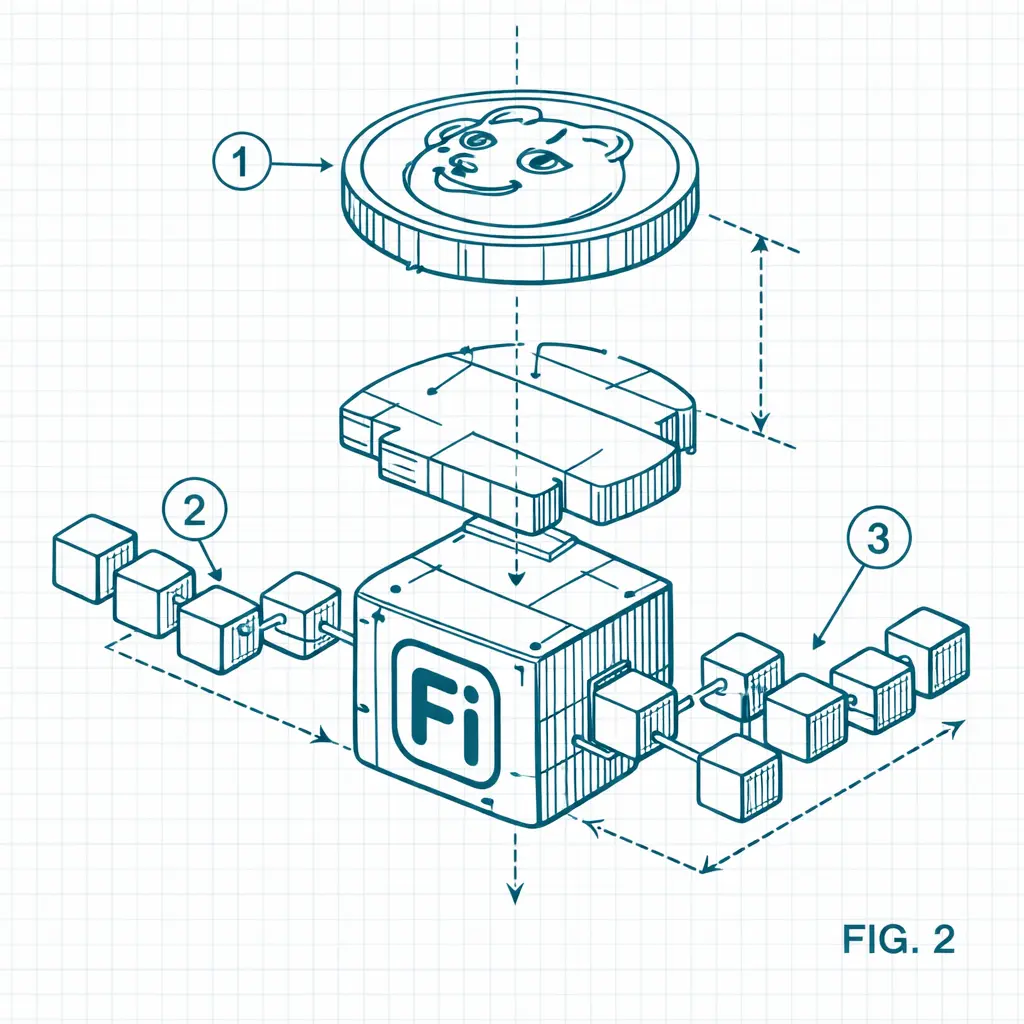
Meme coins are a market structure now
Meme coins are no longer a niche sideshow inside crypto. According to sector research, the first major meme-coin cycle peaked at $88.0 billion on October 29, 2021, then a later cycle pushed the category to a new all-time high of $150.6 billion in December 2024. The same research said the sector had fallen to $47.2 billion by November 2025, which still left it large enough to shape trading behavior across the market.
The category remained material on March 8, 2026. CoinGecko’s live meme-token category page showed roughly $30.4 billion of market cap and $2.33 billion of 24-hour trading volume. The same snapshot placed Dogecoin at about $13.6 billion, Shiba Inu at $3.11 billion, and PEPE at $1.32 billion. Those three names alone represented about 59% of the category by market cap.
This scale matters because meme coins do not just move their own prices. They redirect retail attention, consume exchange bandwidth, fill blockspace, drive listing activity, and create treasury marks that founders, validators, and infrastructure providers start treating as economic reality. In other words, meme coins influence the broader crypto market because they convert culture into tradable flow faster than almost any other asset class onchain.
Attention is the core economic engine
The regulatory description is unusually clear. On February 27, 2025, the SEC’s Division of Corporation Finance said in its staff statement on meme coins that meme coins are typically bought for entertainment, social interaction, and cultural purposes, that their value is driven primarily by market demand and speculation, and that they often have limited or no use or functionality. The same statement also said it was a staff view with no legal force or effect.
That framework explains why meme coins behave differently from tokens tied to fee streams, governance rights over productive protocols, or explicit cash-flow claims. Price formation in meme coins is dominated by distribution. Social reach matters. Repetition matters. Celebrity association matters. Community identity matters. Utility can help at the margin, but it usually arrives after liquidity, not before.
Academic work supports that mechanism. A large-scale study of crypto communities on Reddit found that changes in posting activity often led price changes across several coins, while a separate event-study paper found statistically significant price effects for Dogecoin-related Elon Musk tweets. Meme coins are the purest version of that social reflexivity because they remove most fundamental anchors and leave attention as the primary pricing input.
For market participants, that means meme coins are best understood as traded internet communities with a settlement layer attached. The upside is speed. A new narrative can bootstrap liquidity in hours. The downside is that community momentum decays much faster than teams usually budget for. Treasury plans built on permanently high engagement almost always overestimate the life of the cycle.
Meme coins changed crypto market plumbing
Meme coins have altered how crypto infrastructure earns money. CoinGecko’s memecoin report says Solana was the main engine of the latest cycle, with Solana meme coins reaching a peak market cap of $25.6 billion in early 2025 Q1. The same report says launchpad-based meme coins rose from 1.5% of memecoin market cap in July 2024 to a peak of 20.5% in January 2025, while launchpad meme-coin trading volume climbed from a daily average of $171.6 million to $1.2 billion by November 2025.
Issuance itself industrialized. CoinGecko’s 2025 Q1 report says the run-up around the TRUMP and MELANIA launches helped push pump.fun deployments to a daily all-time high of 72,000. The same report says activity then dropped by 56.3% to about 31,000 daily launches by the end of the quarter after the LIBRA collapse.
Networks captured part of that speculation as fee income. Solana’s network health report said validator real economic value reached an all-time high of about $56.9 million on January 19, 2025 and averaged roughly $800 million per quarter across the prior two quarters. Solana’s consumer page also highlighted 16 million new assets per year and $2 billion of app revenue, which shows how meme-driven activity spilled into infrastructure-level economics.
Launchpads monetized the same flow directly. As of March 8, 2026, DefiLlama listed pump.fun at about $712.6 million of cumulative revenue and roughly $69.0 billion of cumulative DEX volume. That is a better reminder than any theory: meme-coin speculation often produces more durable cash flow for infrastructure than for the meme tokens themselves.
| Transmission channel | What meme coins change | Observed evidence | Treasury implication |
|---|---|---|---|
| Sector liquidity | Pulls retail flow into a concentrated set of culture-led assets | Category market cap near $30.4B on March 8, 2026, despite a major post-2024 drawdown | Market cap can stay large even when fundamentals stay thin |
| Token issuance rails | Makes token creation cheap, fast, and disposable | Launchpad share rose to 20.5% of memecoin market cap; pump.fun launches hit 72,000 per day at the Q1 2025 peak | Supply inflation becomes a market-wide attention tax |
| Network monetization | Turns speculation into fees, tips, and validator income | Solana REV hit about $56.9M on January 19, 2025 | Infrastructure can be a higher-quality exposure than the average meme token |
| Launchpad economics | Concentrates trading and fee capture at the platform layer | pump.fun cumulative revenue near $712.6M as of March 8, 2026 | Revenue-bearing rails tend to survive longer than narrative peaks |
Treasury quality is the real separating line
Treasury quality, not meme quality, is the cleanest line between a collectible and an institution. Dogecoin is still the best example of a meme coin whose economic model is at least easy to model. Official Dogecoin materials say the network has a fixed yearly issuance of 5 billion DOGE, and miner documentation says miners receive 10,000 DOGE per block plus transaction fees. That means network security is financed through explicit ongoing dilution rather than through a large discretionary ecosystem treasury.
Dogecoin’s more formal treasury example is deliberately narrow. The Dogecoin Foundation said in December 2022 that it moved 5,000,000 DOGE into a segregated Core development fund, secured it with a 3-of-5 multisig, and limited payouts to release-based contributor distributions. That is a small fund, but the governance design is strong by meme-coin standards because it constrains discretion.
Shiba Inu took a different path and expanded the product surface around the meme. Official documentation lists Shibarium, ShibaSwap, a bridge, governance, and burn tooling among the ecosystem’s products. Separate SHIB DAO documentation describes four official DAOs and multiple voting methods, including token-weighted, vote-escrowed, identity-based, and quadratic voting.
That does not prove durable value. It does prove something narrower and more important. Some meme projects eventually build governance rails and product hooks that can discipline spending decisions. Others stay simple and culturally honest. Both models can work better than the dangerous middle ground: a large reserve wallet, vague ecosystem promises, and no hard process for who can spend what, when, and under which quorum.
The sector’s structure still skews loose. CoinGecko said “independent” meme coins still accounted for 86.2% of total meme-coin market cap in November 2025, far ahead of launchpad-native tokens. That means most meme-coin capital still sits in assets where governance, reserve management, or budget discipline are often secondary concerns.
The biggest risks are dilution, fraud, and capital misallocation
The downside of meme coins is deeper than volatility. The SEC staff statement said meme coins tend to have significant price volatility and often limited or no functionality. That combination is dangerous because it makes price the main source of perceived legitimacy.
U.S. regulators have also been explicit about manipulation mechanics. The CFTC warned that virtual-currency pump-and-dump schemes use social media and message boards to hype obscure coins, sometimes with false news involving famous technology leaders or investors. Meme coins are especially exposed to that pattern because the promotional payload is often the product.
The supply side is equally brutal. CoinGecko’s failure study, updated on January 12, 2026, said 11.6 million crypto projects failed in 2025 alone, representing 86.3% of all recorded project failures between 2021 and 2025. The same study linked the surge to the ease of launching tokens on modern launchpads and noted that low-effort meme coins were a major part of the deterioration in token survivability.
Political meme coins showed how quickly narrative can become treasury damage. CoinGecko’s Q1 2025 report said LIBRA fell from a $4.6 billion peak market cap to $221 million within hours, and the same report tied the episode to a sharp drop in broader meme-launch activity. This is what capital misallocation looks like in practice. Treasuries get marked at peak prices, teams scale spending against paper gains, and then liquidity vanishes before obligations do.
From a treasury risk perspective, the critical mistake is confusing market cap with spendable capital. Meme-coin balance sheets are usually far less liquid than their headlines suggest. A treasury full of the native token is still one correlated asset. If selling it would move the market, it is not a robust reserve. It is conditional collateral.
What informed market participants should actually measure
Meme coins do contribute something real to crypto. They reduce the psychological barrier to entry, accelerate wallet and DEX adoption, and stress-test consumer infrastructure under bursts of retail demand. The market has learned a lot from that flow. The lesson is not that meme coins are trivial. The lesson is that their value to the ecosystem often appears one layer away from the token itself.
Model the issuance first. Transparent dilution is easier to underwrite than opaque insider supply. Dogecoin’s fixed 5 billion annual issuance is easy to model even if holders dislike it. Hidden concentration is harder to hedge.
Check treasury custody. A segregated multisig with formal payout rules is better than a founder wallet with informal promises. Dogecoin’s Core fund is small, but the governance constraints are clear.
Demand governance before ecosystem expansion. If a meme coin claims product ambitions, parameter changes and spending should route through visible governance. SHIB’s DAO architecture at least creates formal proposal and voting paths.
Follow the fee capture. The higher-quality economic exposure is often the network, launchpad, or exchange that monetizes speculation. Solana’s REV data and pump.fun’s revenue profile make that point directly.
Treat reserves as runway, not as social proof. Treasury resilience comes from diversification, governance constraints, and budgeting discipline. Viral momentum can help fundraising. It cannot replace reserve policy.
At FinDaS Tokenomics, the recurring mistake in meme-adjacent token economy design is treating the treasury as a discretionary marketing wallet. That framing usually ends the same way. Community excitement gets spent as if it were recurring revenue. It is not.
The durable read on meme coins is straightforward. They matter because they price attention faster than the rest of crypto and because that attention now spills into exchange volume, blockspace demand, validator income, and distribution rails. They break when teams or holders mistake a temporary narrative premium for permanent capital.