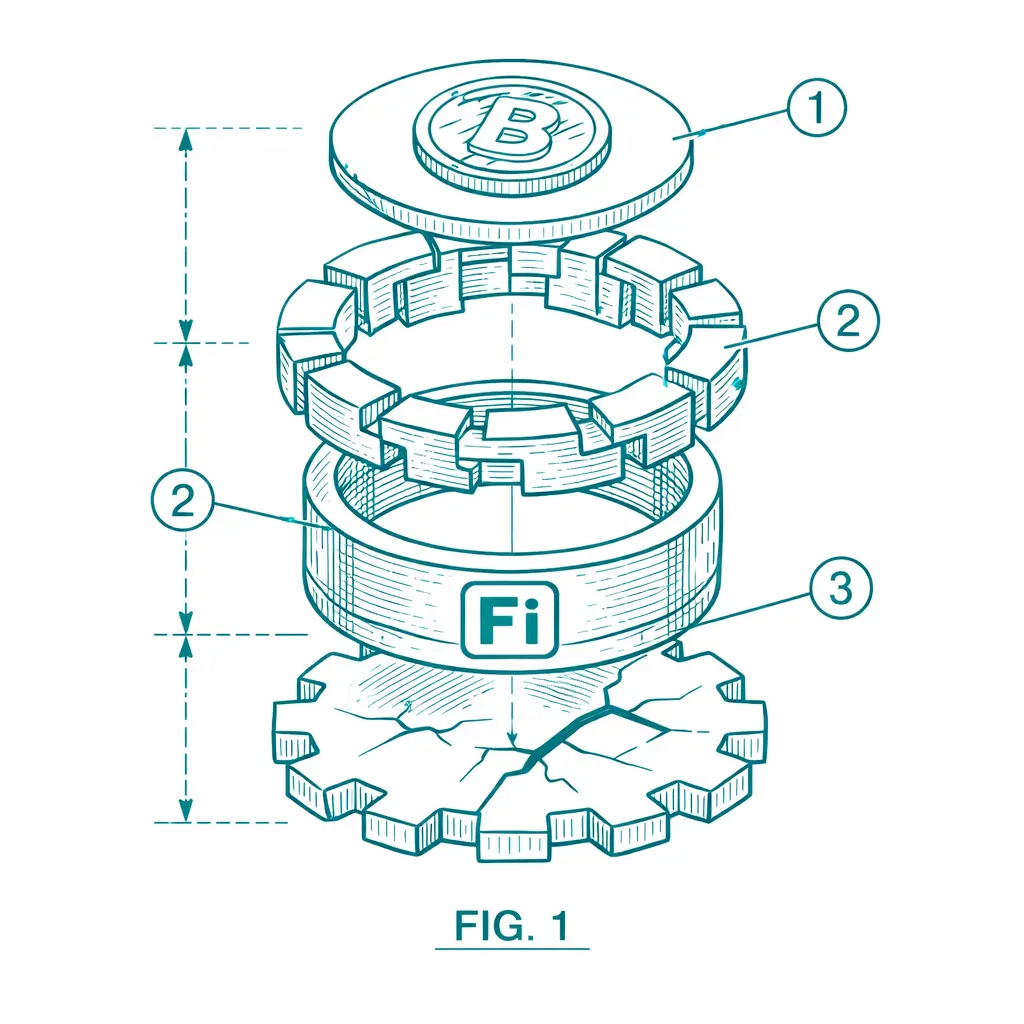
Security flaws in blockchain are failures of trust boundaries, not a single class of bug
The phrase “blockchain security flaw” is too broad to be analytically useful. A blockchain can fail at the consensus layer, in a client implementation, inside smart contract logic, at a bridge verifier, through a manipulated oracle input, or through emergency governance that overrides code after the fact. Bitcoin’s original security model is explicitly conditional on honest nodes controlling more CPU power than attackers, and Ethereum’s proof-of-stake model is explicit about threshold effects around finality and chain control. Security is not absolute. It is a bounded property that holds only while the mechanism’s assumptions hold.
That is why the most important question is not “is the chain secure?” but “which assumptions secure which layer?” Once that framing is clear, most large incidents stop looking like random hacks and start looking like predictable failures of under-specified trust. The table below is the short version.
| Layer | Typical flaw | Failure mechanism | Representative evidence |
|---|---|---|---|
| Consensus | Majority capture or finality failure | Security breaks when honest-majority assumptions or client-diversity assumptions fail | Bitcoin whitepaper, Ethereum PoS attack and defense, client diversity research |
| Execution | Logic bugs, access control, reentrancy | Immutable code deterministically executes exploitable paths | Ethereum fork history, Solidity security considerations, OWASP Smart Contract Top 10 |
| Toolchain | Compiler and client bugs | Correct source code can still compile or execute incorrectly in edge cases | Solidity known bugs, Geth security release |
| Interoperability | Bridge authentication failures or validator-key compromise | Cross-chain messaging adds a new trust layer that does not inherit L1 security | Ronin postmortem, Nomad root cause analysis, Chainalysis bridge report |
| Data and composability | Oracle manipulation and flash-loan-assisted attacks | Code reads a price or state that is valid onchain but economically manipulated | SoK: DeFi Attacks, Chainlink oracle education |
| Governance | Emergency intervention or upgrade abuse | Humans override or redirect deterministic rules in crisis | EIP-779, Ethereum fork history, smart contract security guidance |
Consensus flaws begin where majority assumptions get thin
Consensus security is always threshold security. Bitcoin says it directly: the chain is secure so long as honest nodes control more CPU power than any cooperating attacker. That design turns trust into an objective race over work, but it never removes the need for an honest majority. It just specifies the condition more cleanly than legacy payment systems did.
Ethereum’s PoS documentation notes that 33% of staked ether is enough to prevent finality, while 66% or more can finalize a preferred dishonest chain. Ethereum also treats long-range attacks as a protocol-specific class of risk and counters them through finalized checkpoints and weak subjectivity rather than pretending the problem disappears on its own. This is good mechanism design because the rule set names the attack thresholds up front.
Client monoculture turns a protocol assumption into an operational vulnerability. The Ethereum client-diversity initiative states that if a single client reaches 66% of validators and forks because of a bug, that client can finalize its own chain, while a client above 33% can already stop finality. That risk is not hypothetical. In the November 12, 2020 Geth security release, the Ethereum Foundation described a consensus vulnerability that had already been exploited on mainnet, dropping older nodes off the network and causing roughly 30 blocks to be lost on a sidechain. The Foundation’s own recommendation was simple: network resilience should not depend on any single client implementation.
The practical implication is uncomfortable but important. Decentralization is not just validator count or Nakamoto coefficient. It is also software diversity, stake distribution, and the ability to keep finality inside known bounds without appealing to discretionary rescue. When those conditions weaken, “the blockchain” has not failed in some mystical sense. The mechanism has simply reached a region it was never designed to survive deterministically.
Smart contracts fail deterministically, and that makes them unforgiving
Smart contract exploits are often described as hacks, but the more precise description is unauthorized execution along permitted code paths. The DAO is still the canonical example. Ethereum’s own fork history states that the 2016 DAO attack drained over 3.6 million ETH from an insecure contract. The lesson was not merely that reentrancy exists. The deeper lesson was that a contract can faithfully execute the wrong logic forever once deployed.
Reentrancy remains important, but it is not the whole story. Solidity’s security guidance warns that reentrancy is not limited to Ether transfer and can arise from any function call to another contract, including multi-contract dependency chains. That matters because modern DeFi systems are composed rather than isolated. The attacker does not need to break cryptography. The attacker needs one external call, one stale assumption, or one state update in the wrong order.
Access control is now the more underappreciated category. OWASP’s Smart Contract Top 10 project defines access control vulnerabilities as flaws that let unauthorized users access or modify contract data or functions, and its 2026 data page ranks access control as the top category by practitioner survey while attributing about $220.0 million of 2025 smart-contract losses to that class. Business-logic flaws were even more frequent at 58 of 122 deduplicated incidents, or about 47.5%. Reentrancy gets the headlines. Authorization and logic errors still do a large share of the damage.
Audits help, but the official Ethereum guidance is explicit that audits are not a silver bullet and will not catch every bug. The same guidance recommends planning for failure through upgrades, monitoring, and governance design. That is the correct stance because “audited” is not a security state. It is one checkpoint in a longer control process.
The toolchain is part of the attack surface too. Solidity maintains a living list of security-relevant compiler bugs, and Ethereum has had production-impacting client vulnerabilities. If the industry keeps speaking as if risk begins and ends with application logic, it will keep mispricing execution risk.
Bridges are the clearest proof that security does not compose automatically
Cross-chain bridges concentrate risk because they must verify one system’s state inside another system that does not natively share its security assumptions. That means they add validator sets, message proofs, optimistic timers, multisig signers, relayers, upgrade logic, or some mixture of all of them. In practice, the bridge often has weaker guarantees than either connected chain. Chainalysis estimated on August 2, 2022 that roughly $2 billion had already been stolen across 13 bridge hacks, representing 69% of funds stolen in DeFi that year to date.
The Ronin incident showed what happens when bridge security collapses into key concentration. Sky Mavis reported that on March 23, 2022, the attacker gained control of five of nine validator private keys and forged withdrawals, draining 173,600 ETH and 25.5 million USDC. That was not a failure of Ethereum or of the Ronin base chain’s cryptography. It was a failure of bridge trust minimization. Too much authority sat behind too few keys.
The Nomad exploit showed a different but equally instructive failure mode. Nomad’s root cause analysis says an implementation bug in the Replica contract caused messages to pass authentication improperly, allowing forged messages to be processed if they had not already been processed. Nomad later stated that the relevant code was introduced in an upgrade on June 21, 2022, that the upgrade had been audited during the period, and that the issue was not reported through the live bounty program. Even worse, Nomad’s watchers were designed to react to updater-key compromise, not to bugs in the message-processing path, so the monitoring layer was too narrow for the actual failure mode.
From a mechanism-design standpoint, bridges are dangerous because they often advertise cross-chain portability while importing opaque discretionary trust. If a protocol treasury, collateral base, or emissions logic depends on a bridge, then bridge risk is monetary-policy risk. It should be modeled that way.
Oracle and composability flaws turn valid transactions into exploitable state transitions
Oracle manipulation is usually not an oracle-software bug. It is a protocol-design bug where a contract gives decisive weight to a price that can be moved faster than the protocol can defend itself. Chainlink’s own educational material makes the key point clearly: developers must reason about both the oracle’s security properties and the depth, volume, and trading environment of the underlying market. A formally correct liquidation engine is still insecure if it consumes a manipulable price.
A large survey of DeFi attacks covering 181 real-world incidents found that price oracle attacks and permissionless interactions were the two most frequent incident types at 15% and 10.5%. The same study estimated at least $3.24 billion in losses from April 30, 2018 to April 30, 2022 and found that 56% of attacks were not executed atomically, which means there was often at least some rescue window for detection and response.
Flash loans matter here, but mostly as force multipliers. They compress capital acquisition to a single transaction and make thin-market manipulation profitable. OWASP now treats flash-loan-facilitated attacks and price-oracle manipulation as separate categories because they are related but not identical. The root mistake is usually architectural: a protocol lets transient state determine permanent payouts, liquidations, governance decisions, or collateral valuations.
The disciplined answer is rule-based friction. Use time-weighted prices where appropriate. Enforce liquidity and market-quality requirements before listing collateral. Limit one-block changes in borrow power. Define circuit breakers in advance instead of improvising them mid-incident. Deterministic constraints may reduce capital efficiency in calm markets, but they are cheaper than ex post discretion during stressed markets.
Governance is the last line of defense, and that is both necessary and dangerous
The DAO fork proved that social coordination can override a chain’s prior state when losses become existential. Ethereum’s history page says the DAO fork moved funds from the faulty contract after the attack, and EIP-779 documents the fork as an irregular state change at block 1,920,000 rather than a normal protocol-rule change. That is a crucial distinction. The community did not discover a hidden deterministic rule inside the EVM. It chose an exceptional intervention outside the ordinary execution path.
This does not mean emergency governance is wrong. It means “code is law” is always conditional on a surviving social layer. Ethereum’s current PoS documentation is candid about this too. In the extreme case of finalized dishonest history, the social layer is the fallback. That honesty is preferable to ideology. But it creates a real trade-off: the more credible emergency discretion becomes, the less predictable the rule set is for users who thought they were relying on purely algorithmic guarantees.
Smart contract governance adds its own attack surface. Ethereum’s security guidance warns that onchain governance can be abused if an attacker quickly amasses voting power, including through flash loans, and recommends mechanisms such as timelocks and historical voting snapshots. That is the right instinct. Governance should be constrained by transparent precommitment rules, not open-ended administrator discretion.
Security assumptions belong inside token economy design
Security flaws in blockchain become tokenomic flaws the moment they can change issuance, collateral quality, treasury control, liquidation behavior, or governance power. A staking token is not secure because the consensus layer exists. It is secure only if validator concentration, client diversity, slashability, exit constraints, and offchain coordination risk are all inside acceptable bounds. A governance token is not secure because voting is onchain. It is secure only if vote acquisition cannot be cheaply borrowed, rushed, or routed around timelocks.
For token economy design, the cleanest posture is to convert every major trust assumption into an explicit parameter or operating rule. If a protocol relies on an upgrade path, disclose the exact authority model and delay. If treasury control sits behind a multisig, disclose the signer count and quorum. Ethereum’s smart-contract security guidance explicitly recommends multisig access control because requiring M-of-N consent makes privileged actions harder for a rogue insider or attacker to execute. If monitoring matters, connect alerts to predefined responses rather than vague promises of intervention.
That is the lens we use at FinDaS Tokenomics. Good tokenomics design does not stop at emissions curves and incentive alignment. It includes the adversary model, the emergency model, and the exact points where human discretion can still override algorithmic policy. Informed users can price risk only when those escape hatches are specified in advance. If they are not, the protocol is asking users to trust governance mood as much as code.
The durable takeaway is simple. Blockchain systems are strongest when they minimize hidden trust, constrain emergency powers with ex ante rules, and make security assumptions legible enough to be audited by anyone who depends on the system. That is less flexible in the short run. It is also how you get predictable systems instead of narratives about decentralization that fail under stress.