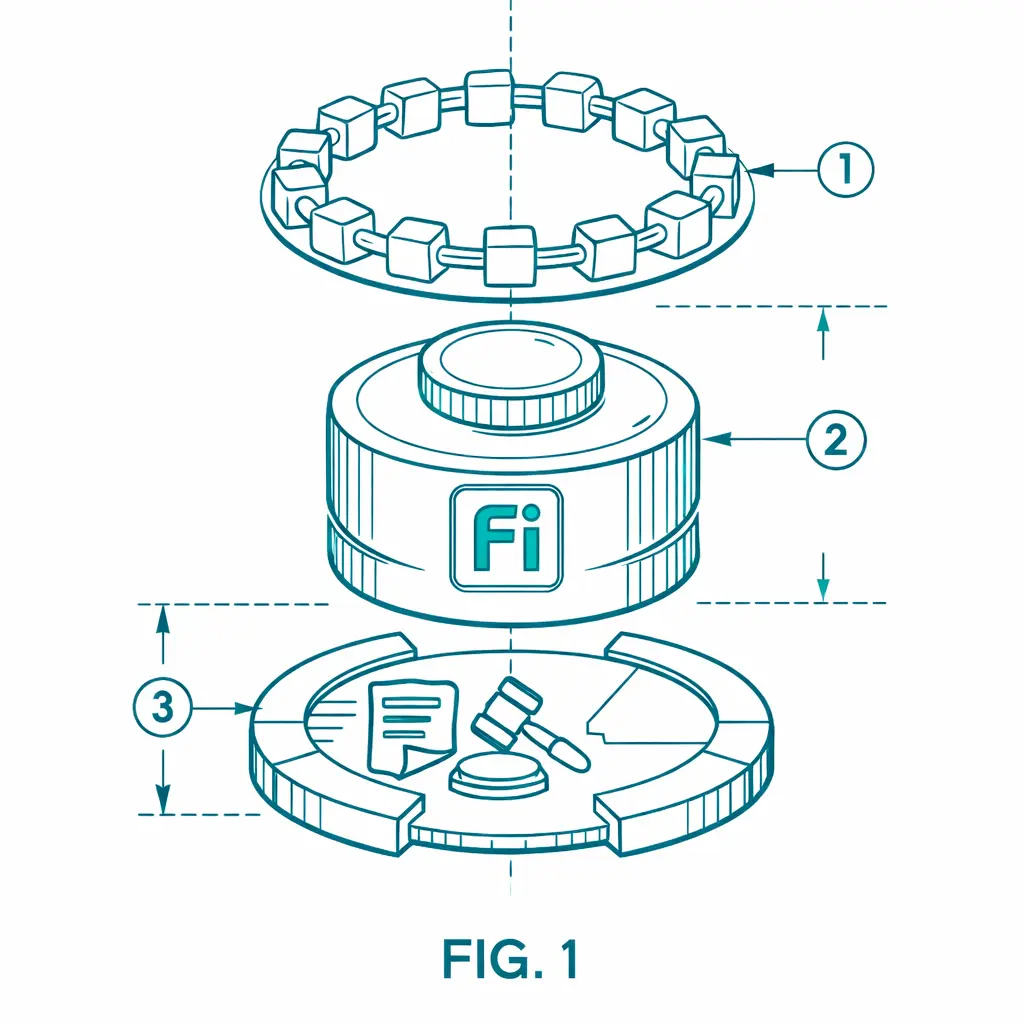
Smart contracts are execution engines, not complete legal systems
Smart contracts are better understood as execution engines attached to legal relationships than as self-sufficient law. The Law Commission said on November 25, 2021 that the legal framework of England and Wales is able to support smart legal contracts, and the UK Jurisdiction Taskforce said smart contracts are capable, in principle, of giving rise to binding legal obligations under English law.
The practical implication is simple. Code can automate performance, but it does not answer every legal question that matters in commerce. Formation, authority, mistake, interpretation, governing law, remedies, and dispute venue still sit around the code. That is why the Law Commission flagged further work around deeds and private international law even while concluding that the existing framework can already support smart legal contracts.
That distinction matters for Web3 because “self-executing” is not the same thing as “self-sufficient.” A contract that automatically releases funds can still fail commercially if the wrong signer had authority, if an oracle supplied bad data, if an upgrade key changed the terms midstream, or if the parties never aligned the code with the natural-language deal. The strongest Web3 legal systems acknowledge that law and code do different jobs. The weakest ones pretend execution alone settles legitimacy.
Legal recognition is real, but it is jurisdiction-specific and conditional
Legal recognition of smart contracts is no longer a fringe proposition. It is already visible in both common-law analysis and statute. Arizona’s statute says a contract relating to a transaction may not be denied legal effect, validity, or enforceability solely because it contains a smart contract term. In England and Wales, the Law Commission concluded that statutory reform is not generally required for smart legal contracts.
The European Union has taken a different path. Regulation (EU) 2023/2854, the Data Act, entered into force on January 11, 2024 and applies from September 12, 2025. For smart contracts used to execute data-sharing agreements, the Regulation imposes essential requirements including robustness, access control, safe termination or interruption, and consistency with the agreement they execute.
| Jurisdiction / framework | What it says | What that means in practice |
|---|---|---|
| England and Wales | The Law Commission concluded on November 25, 2021 that the existing legal framework can facilitate and support smart legal contracts. | Smart contracts can fit inside ordinary contract law, but parties still need to handle interpretation, remedies, and cross-border issues carefully. |
| Arizona | A contract may not be denied legal effect solely because it contains a smart contract term. | Recognition risk is lower, but ordinary contract and commercial-law issues still remain. |
| European Union Data Act | The Data Act applies from September 12, 2025 and requires robustness, rigorous access control, safe termination or interruption, and consistency for smart contracts used in data-sharing agreements. | In the EU, “unstoppable code” is not a complete compliance posture. Control and interruption mechanisms can be legally relevant design requirements. |
The broader point is that legal acceptance is moving from abstract recognition toward operational requirements. That is a healthier direction for Web3. It forces teams to specify who can intervene, who bears risk when automation misfires, and how the system behaves under failure. Those are not peripheral questions. They are the contract.
Hybrid smart legal contracts are usually stronger than code-only commitments
The most commercially durable model is usually a hybrid one. The Accord Project’s documentation makes the point directly: a smart legal contract can combine traditional legal prose with machine-readable clauses, so only the parts that benefit from automation need to be automated. A payment clause can be computable while jurisdiction, force majeure, indemnity, and limitation-of-liability language remains in ordinary legal text.
This architecture is better aligned with how real-world deals fail. Most disputes do not arise because arithmetic is hard. They arise because facts are contested, context changes, or one side claims the code no longer reflects the bargain. A hybrid design lets the code handle measurable obligations and lets legal language govern exceptions, interpretation, and recourse. That is more disciplined than dumping the entire relationship into Solidity and calling the result “trustless.”
Hybrid design also helps with extractability and evidence. If the operative business terms live in structured text, schemas, and signed documents, the parties can audit what the code was supposed to do. If the agreement lives only in opaque deployment scripts and upgrade paths, the stronger technical party usually has the interpretive advantage. From an allocation perspective, that is not neutral. It shifts bargaining power toward whoever writes, deploys, and controls the codebase.
Automated escrow is the clearest use case, until the facts stop being machine-readable
Automated escrow is where smart contracts make immediate legal and commercial sense. Kleros Escrow documents a straightforward pattern: funds are locked in escrow, released when the workflow completes, and if the parties cannot agree, they can create a dispute in Kleros Court. That is a clean example of code automating custody and conditional release while still leaving room for an adjudication layer.
The boundary appears as soon as the release condition depends on offchain facts. Chainlink’s documentation is explicit that blockchains cannot natively access external systems and that the oracle problem is a core barrier for smart contracts that depend on real-world data. If escrow release depends on shipment delivery, quality inspection, service completion, or an external index, then the legal reliability of the escrow partly depends on the oracle, attestor, or evidence process.
That is why the strongest escrow designs are narrow. They automate objective states that can be observed onchain or attested through clear interfaces. Once the condition becomes subjective, the system needs either a trusted counterparty, a dispute resolver, or both. That boundary is especially visible in Web3 x Supply Chain workflows. Web3 does not eliminate that dependence. It just moves it into a new layer that many teams fail to price, disclose, or govern properly.
Even decentralized dispute tooling does not always make enforcement automatic. Kleros states that if Kleros Court is not available on the relevant blockchain, its Dispute Resolver app can still produce an official decision, but without automatic enforcement. That is an important reality check. Some “onchain legal” systems are really structured evidence systems that still depend on a separate enforcement path.
Decentralized arbitration imports its own power structure
Decentralized arbitration is often presented as neutral middleware between counterparties. It is not neutral by default. Kleros’ arbitration stack uses standards for arbitrable and arbitrator contracts, and its court model selects jurors from users who stake PNK. The probability of being drawn as a juror is proportional to the amount of PNK staked, and PNK is also used in governance.
The governance implication is direct. If dispute power scales with stake, then adjudication power is partly a capital allocation function. That structure can still be useful. It opens participation and creates economic incentives for jurors to show up. But it also means that ownership distribution shapes who interprets contested facts, who earns dispute fees, and who can vote to change core parameters. In other words, decentralized arbitration is often less like stateless justice and more like tokenized institutional design.
This is where allocation fairness becomes a first-order legal issue. A protocol can advertise open dispute resolution while concentrating the effective franchise among early or large token holders. That does not make the model invalid. It does mean the model should be described honestly. Builder incentives and fast bootstrapping can justify concentrated early control in some cases. They do not justify pretending concentration is absent. It also mirrors broader Web3 governance design questions.
The real legal question is who can pause, upgrade, or rewrite the contract
The most important legal term in many smart contracts is not the payout formula. It is the control map. OpenZeppelin’s access-control documentation states that privileged functions can mint tokens, freeze transfers, or perform an upgrade that completely changes contract logic. It also notes that governance and permissions become harder to track as systems add more contracts and roles.
That means a legally relevant promise is often hidden in technical architecture. If a contract is upgradeable, the operative bargain includes the upgrade path. If an owner can pause execution, the operative bargain includes the pause conditions. If a multisig can replace an implementation, then the real counterparty is not just the deployed bytecode. It is the signer set behind the multisig threshold. Safe’s documentation is explicit that a configurable threshold of owners must approve transactions before execution.
The EU Data Act effectively validates this framing from the regulatory side. Its requirements around rigorous access control and safe termination or interruption show that lawmakers are treating control functions as part of contract architecture, not as embarrassing exceptions to decentralization rhetoric. In practice, the debate is not “immutable versus mutable.” The debate is whether override rights are disclosed, governable, and proportionate.
For Web3 teams, this is where legal engineering and tokenomics collide. If the same insiders receive the largest allocation, hold the governance token, control the multisig, and can choose arbitrators or oracle providers, then “automation” can mask a highly concentrated power structure. For teams doing tokenomics design or working with a tokenomics advisor, those rights should be treated as allocation questions, not as minor implementation details. At FinDaS, that is the core overlap between legal architecture and token economy analysis: ownership of control rights determines who participates economically and who can rewrite participation rules.
Public-chain transparency is a legal constraint, not just a UX detail
Public-chain transparency creates a basic limit for smart-contract-based legal workflows. Ethereum.org states that by default every transaction written on Ethereum is public and permanent, and that Ethereum’s public ledger makes privacy challenging. That is acceptable for settlement state. It is often unacceptable for negotiated commercial terms, personally identifiable information, sensitive pricing, or evidence files.
The design consequence is straightforward. Put as little sensitive information on a public chain as possible. Store hashes, commitments, references, or proofs onchain. Keep the underlying documents, identities, and evidence in systems with appropriate confidentiality controls, while preserving a verifiable link between the legal record and the execution layer. That is also consistent with the hybrid smart legal contract model. The same design pressure runs through Web3 x Privacy.
This is another place where fairness matters. Public transparency does not burden all parties equally. Sophisticated actors can analyze wallet patterns, infer counterparties, and arbitrage information leaked by onchain behavior. Smaller users and less technical counterparties usually cannot. A system that claims equal access while exposing one side to far greater surveillance is not legally or economically neutral.
What durable Web3 x legal design actually looks like
- Write the legal relationship first, then automate only the clauses that are objective, measurable, and worth enforcing mechanically. Hybrid contracts are usually superior to code-only commitments for real commercial use.
- Publish the control map. Users should know who can upgrade, pause, reset, or replace logic, what threshold is required, and whether delays or timelocks exist. Those powers are part of the deal.
- Treat oracle selection as legal counterparty selection. If the contract depends on offchain data, the data source and dispute path deserve contractual attention equal to the code itself.
- Keep confidential terms and personal data off public chains unless disclosure is intentional and acceptable. Public permanence is a structural feature, not a bug you can lawyer away after deployment.
- Disclose how token ownership shapes governance and dispute resolution. If juror selection, appeals, or parameter changes depend on stake, then early allocation shapes procedural power. Say that plainly.
- Specify the failure path. If an arbitrator’s decision is not automatically enforceable onchain, the contract should say what happens next and who bears the execution burden.
- Assume regulators will care about access control and termination conditions. The EU Data Act already does in the data-sharing context, and that direction of travel is more important than any one slogan about immutability.
Smart contracts become legally useful when they narrow ambiguity, make control rights legible, and align enforcement with disclosed governance. They become legally fragile when they hide discretionary power behind technical opacity. Web3 does not escape institutional design. It encodes it. The key question is whether the encoded institution distributes power fairly or merely automates its concentration.