Climate claims in Web3 live or die at the infrastructure layer
Climate-linked crypto does not become sustainable because the token is wrapped in environmental language. It becomes sustainable only if the underlying system is energy-efficient, the off-chain claim is auditable, and the market structure does not depend on perpetual speculative inflows.
Chain selection is the first climate decision. Ethereum’s transition to proof-of-stake on September 15, 2022 reduced the network’s estimated energy consumption by about 99.95%.
Bitcoin shows why “blockchain” is too blunt a category for sustainability analysis. Cambridge’s 2025 mining study estimated Bitcoin’s annual electricity consumption at 138 TWh, with 52.4% of the electricity mix coming from sustainable sources, while electricity accounted for over 80% of miners’ cash-based operating expenses.
The practical implication is straightforward. A climate application built on a high-energy base layer starts with an avoidable handicap. A climate application built on a low-energy chain can still fail, but at least it is not fighting its own infrastructure.
Carbon markets are the clearest Web3 climate use case, but integrity is the real bottleneck
Carbon markets remain the most obvious intersection between Web3 and sustainability because they already depend on registries, serial numbers, transfer logs, retirement events, and cross-party trust. The market problem is not lack of digitization. The market problem is weak quality differentiation and fragmented settlement.
The World Bank’s 2025 carbon pricing update says direct carbon pricing now covers around 28% of global greenhouse gas emissions, while the global pool of unretired carbon credits reached almost 1 billion tons in 2024 because supply continued to outstrip demand.
That matters for token design. When the underlying market already has excess inventory, tokenizing more units does not create scarcity. It mostly creates a faster distribution channel. If the token wrapper makes low-quality or hard-to-differentiate supply easier to trade, the wrapper can improve optics while worsening price formation.
The World Bank’s Climate Warehouse work frames the opportunity more precisely. Blockchain can improve transparency, connect registries, and help track mitigation outcomes across systems. The same World Bank analysis also states that blockchain is not well suited to storing large MRV data sets and cannot assure data quality on its own.
Integrity standards are therefore upstream of tokenization. The Integrity Council for the Voluntary Carbon Market says its Core Carbon Principles are meant to create a global quality threshold and reduce confusion in the voluntary carbon market.
Registry operators have reacted the same way. Verra states that once a VCU is canceled or retired, the legal and beneficial interests are extinguished, and account holders may not create related instruments without Verra’s express written consent. Gold Standard likewise said that, after a May 2022 terms update, creating tokens or other digital instruments representing Gold Standard credits was not permitted without express written consent.
The evidence points to a hard constraint. Web3 can improve carbon market plumbing, but it cannot bypass the registry, the methodology, or the claims architecture. If the off-chain credit is weak, the on-chain token is just a faster way to circulate weak inventory.
Blockchain is often more useful for coordination and reporting than for trading
The strongest sustainability use cases are not always tradable assets. In many cases, the better fit is a shared data layer that improves traceability across suppliers, auditors, buyers, and disclosure systems.
WBCSD describes PACT as the only globally recognized solution already enabling comparable, verified product-level carbon data calculation and exchange at scale. It also says more than 48 software solutions conform to PACT’s data model and exchange protocol.
PACT’s technical specification is explicitly about data exchange quality, not token hype. WBCSD says the specification includes a data model for product carbon footprint exchange, information on data quality, and information on assurance and verification.
Fujitsu’s 2023 implementation shows what a practical enterprise workflow looks like. The company said it used a blockchain-based PACT-conformant solution to exchange and calculate product carbon footprint data across Tier 0 to Tier 3 of its notebook PC supply chain.
Disclosure infrastructure is moving in the same direction. On April 30, 2024, the ISSB published the IFRS Sustainability Disclosure Taxonomy so investors can search, extract, and compare digital sustainability disclosures, and IFRS guidance states that IFRS S2 requires companies to disclose Scope 1, Scope 2, and Scope 3 greenhouse gas emissions.
This is a crucial distinction for Web3 teams. A transferable token is only one possible interface. For supply-chain emissions, product footprint exchange, and machine-readable reporting, the market may value interoperability, audit trails, and permissioning more than secondary-market liquidity.
Where climate tokens usually break: float, pooling, and weak claims
The carbon-token experiments from the last cycle were directionally useful because they exposed the real market design problem. Climate assets are heterogeneous, thinly traded, and often operationally difficult to settle. Web3 tried to compress that mess into fungible instruments.
Toucan says it has brought $100 million in carbon credits on-chain and enabled $4 billion in transactional volume since launch. Toucan also describes carbon pools as bundles of tokenized credits with similar attributes created to generate liquidity.
KlimaDAO’s own documentation explains the mechanism clearly. Individual carbon projects are tokenized as ERC-721 assets and then aggregated into ERC-20 pool tokens. KlimaDAO also describes BCT as the “lowest common denominator” pool and notes that redemption pricing needs to reflect the gap between the oldest vintage in the pool and the specific credit a user wants to retire.
That design improves tradability, but it also creates a harsh liquidity truth. The deepest pool often forms around the broadest eligibility bucket. In practice, that means the market price tends to anchor around the weakest acceptable inventory, not the average marketing narrative. Pooling can solve fragmentation. Pooling can also flatten quality.
KlimaDAO also states that each KLIMA token has an intrinsic value of 1 BCT held in treasury reserves, and the Klima Foundation says the protocol originally focused on bootstrapping liquidity for tokenized carbon credits.
Even the current infrastructure docs point to that constraint. Toucan’s 2025 FAQ says deposits and redemptions continue to be supported, but liquidity remains at the discretion of liquidity providers. The same FAQ says BCT is no longer a Toucan product, because admin control moved to KlimaDAO in 2024, and that Verra credits not already tokenized have not been eligible for tokenization since 2022.
From a liquidity-structure perspective, that is the heart of the issue. Climate-linked tokens were often evaluated on fully diluted supply, treasury headlines, or abstract “carbon backing.” The harder question was always who provides exit liquidity, what exact asset can be redeemed, how fast, under what rules, and against which off-chain registry state.
What climate-linked token design should optimize for
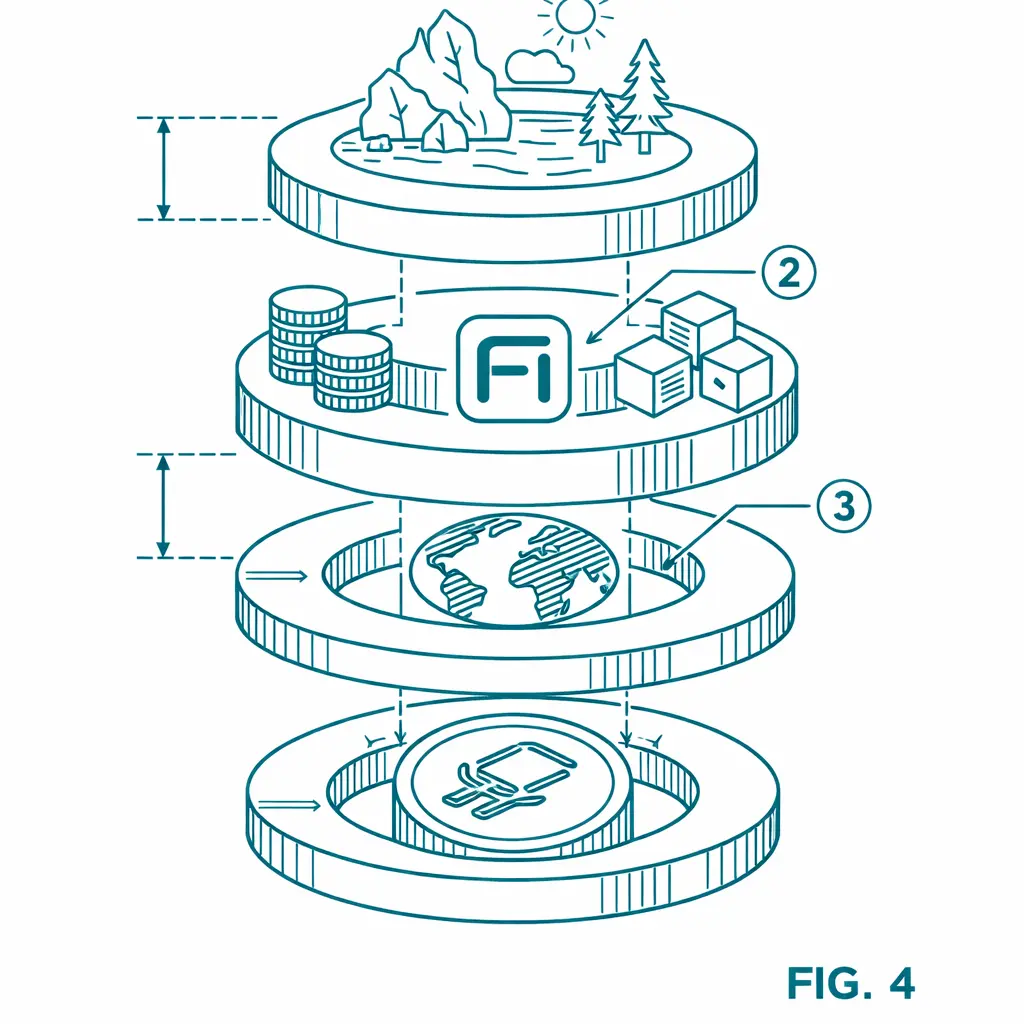
Most climate projects do not need a token first. They need a claims stack. The design sequence should run from legal claim to data provenance to settlement path to liquidity policy. The token, if one exists at all, comes last.
| Design object | What the holder actually gets | Liquidity profile | Main failure mode |
|---|---|---|---|
| Registry-linked credit token | A narrowly defined claim on a live, traceable underlying credit or retirement workflow | Usually thin unless supported by market makers or programmatic redemption | Claim ambiguity between token, registry unit, and retirement rights |
| Pooled carbon token | Exposure to a rule-set of eligible credits rather than one specific project | Better spot liquidity if a broad pool attracts flow | Quality flattening toward the weakest acceptable unit |
| Governance token for climate protocol | Voting and treasury exposure, not direct climate impact per token | Can trade more easily than underlying credits | Environmental narrative overstating the token’s actual claim |
| Non-transferable data or reporting credential | Proof, attestation, or audit trail for reporting and supplier coordination | Often no secondary market by design | Teams force speculation onto a product that should remain informational |
For teams that do issue a token, five rules matter more than almost everything else.
- Define the claim precisely. A climate token should represent one thing only: a credit, a retirement instruction, a governance right, a fee claim, or a reporting credential.
- Publish circulating supply and free float. Treasury balances and fully diluted supply are weak indicators when most units are locked, warehoused, or governance-controlled.
- Show liquidity concentration. If a handful of LPs, treasuries, or custodians dominate the tradable market, that concentration is more informative than headline supply.
- Constrain pool eligibility if quality matters. Broad baskets maximize apparent liquidity but usually weaken the informational value of the price.
- Separate reporting rails from speculation rails. The cleanest climate infrastructure often uses auditable state transitions without creating a free-floating token at all.
This is where tokenomics consulting for climate products needs to be blunt. A sustainability narrative does not repair bad digital assets design. If the claim is fuzzy, the float is concentrated, and redemption depends on discretionary counterparties, the market will price that fragility no matter how strong the mission statement looks.
The durable Web3 climate model is infrastructure first, asset second
The best evidence now supports a narrower, more credible thesis for Web3 and sustainability. Blockchain works when it improves registry interoperability, traceability, supplier coordination, machine-readable disclosures, and auditability across fragmented institutions. It works far less reliably when it tries to manufacture climate demand through abstract reserve currencies or loosely specified green wrappers.
From FinDaS Tokenomics’ perspective, the market will keep converging on the same filter. Climate-linked systems that expose verifiable state changes and clear settlement rights can survive. Climate-linked tokens built on theoretical backing, vague environmental claims, or shallow float usually cannot.
The trade-off is simple. Tokenization can improve access and settlement speed. It can also compress complex environmental assets into a thinner, more fragile market than the narrative suggests. For informed builders, the right benchmark is not whether the product sounds sustainable. The benchmark is whether the liquidity structure, data integrity, and claims architecture remain credible after the marketing premium disappears.