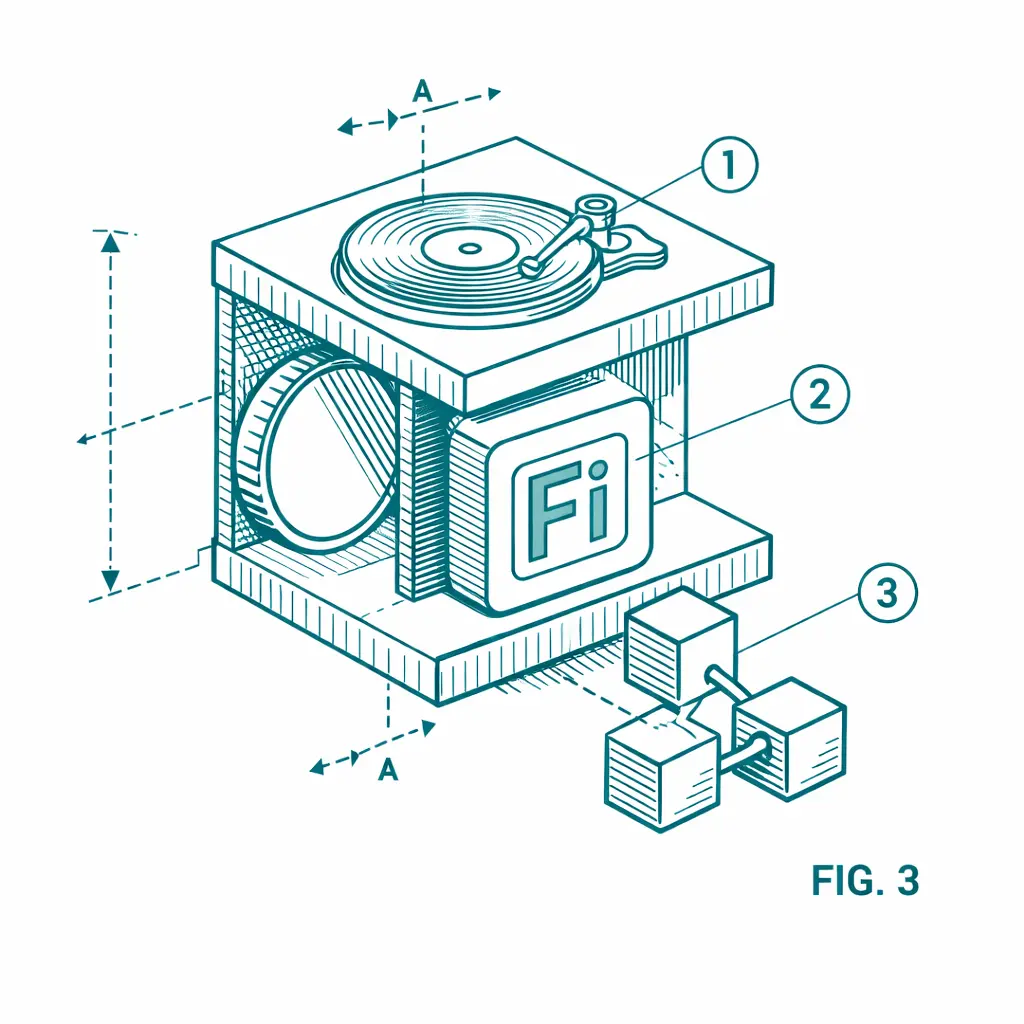
Web3 music is a monetization layer, not a distribution reset
Web3 music matters when it gives artists new ways to monetize fandom without pretending that blockchain will replace mainstream listening. In the United States, streaming generated $14.9 billion of recorded-music revenue in 2024 and accounted for 84% of the market, while paid subscriptions reached 100 million. Globally, IFPI says recorded-music revenue reached $29.6 billion in 2024, with 752 million paid subscription accounts and streaming representing 69.0% of global recorded-music revenue.
That market structure changes the tokenomics question. The core problem is not digital distribution. Spotify, Apple Music, YouTube, and their licensing stack already solve distribution at planetary scale. The unresolved problem is that artist monetization remains thin, delayed, and fragmented once the stream leaves the fan’s wallet and enters the royalty machine. Web3 is strongest where it creates a higher-value transaction than a stream, a clearer claim than a dashboard screenshot, or a tighter artist-fan relationship than a generic subscription bundle.
The most credible music crypto products reflect that reality. They do not try to force all listening onchain. They sit above the streaming layer as collectibles and access products, protocol infrastructure, or royalty-bearing assets. Those categories are economically different, and from a regulatory perspective they should not be treated as interchangeable.
The three design patterns that actually matter
Web3 x Music is not one model. It is at least three separate product categories with different cash-flow rights, governance implications, and legal exposure.
| Design pattern | Representative implementation | What the holder gets | Main tokenomic logic | Regulatory read |
|---|---|---|---|---|
| Collectible and access NFT | Sound / Sound Protocol | Collectible media and proof of support. Sound states artists are not giving away ownership or rights by uploading and remain free to release elsewhere. | Fan spending is framed as patronage, status, and access rather than a direct claim on platform or song income. | Usually the lowest securities risk if the offer stays consumptive and avoids profit language. |
| Protocol token for streaming infrastructure | Audius | Staking, governance weight, exclusive feature access, ongoing issuance, and a stated future role in governing a global fee pool. | The token coordinates node operators and delegates, with slashing risk for node collateral and rewards for participation. | Higher legal surface because governance, rewards, and fee-pool expectations can look financial even when utility exists. |
| Royalty-bearing music token | Royal legacy LDAs | Cash-flow participation. Royal says song royalties accrue from streaming platforms, payouts are on average bi-annual in USDC, and the wallet holding the token at distribution can claim the royalty. | The token functions economically like a transferable claim on song revenue, not just access merchandise. | The highest securities exposure because income rights, distribution expectations, and transferability all point toward an investment analysis. |
Platform resilience is a separate issue from token design. Sound shut down its consumer platform on January 16, 2026, but said proof of support remains onchain, music and metadata remain in decentralized storage, collections still appear anywhere users connect a wallet, and artists can claim remaining funds through Splits. That is a useful stress test. Blockchain can preserve records and assets after a company exits. It does not preserve discovery, demand, or product velocity.
Rights data, not payments rails, is the hard part
Onchain payment does not solve offchain rights ambiguity. DDEX already maintains a Simple Music NFT standard, and its Recording Data and Rights standards are designed to move contributor identity, rights claims, and revenue-reporting data between record companies, performer representatives, and music licensing companies. In other words, the music industry’s core data problem is well known, and the bottleneck is less about inventing a new ledger than about getting reliable rights metadata into the system that actually pays people.
NFT ownership and music ownership are also not the same thing. WIPO’s digital music overview states that a typical music NFT buyer does not own copyright in the composition or the sound recording, and the U.S. Copyright Office and USPTO concluded on March 12, 2024 that current applications of NFTs do not require changes to intellectual property law. The same Copyright Office study also highlighted widespread concern that NFT buyers and sellers often do not understand what IP rights are implicated in creation, marketing, and transfer. That mismatch matters more in music than in profile-picture culture because music rights are already split across masters, publishing, neighboring rights, and contract-specific recoupment terms.
The royalty label itself is too vague for serious token design. The U.S. Copyright Office’s musician income guide explains that royalties under the sound recording compulsory license are distributed by a predetermined statutory split: 50% to copyright owners, 45% to featured artists, and 2.5% each to non-featured musicians and non-featured vocalists. That is one royalty stream for one legal context. It is not the same as mechanicals, publishing income, advances, net receipts, or a distributor statement. Any Web3 music product that says “own the royalties” without specifying the exact right, payer, waterfall, recoupment position, and territory is offering marketing first and legal clarity second.
Revenue-sharing music tokens face real securities risk
The key regulatory line is simple. A fan buying access to a release is one thing. A buyer acquiring a transferable right to share in song income is another. The SEC’s digital asset framework says the analysis turns on whether purchasers have a reasonable expectation of profits from the efforts of others, and it explicitly lists rights to share in income, profits, dividends, or distributions as factors that push a token toward investment-contract treatment. Transferability and secondary-market resale strengthen that risk.
The SEC has already shown a willingness to apply that logic to NFT structures. In its August 28, 2023 action against Impact Theory, the agency said the company conducted an unregistered offering of crypto asset securities in the form of NFTs, alleged that roughly $30 million was raised, and announced a settlement exceeding $6.1 million. That order does not mean every music NFT is a security. It does mean the “NFT” label is not a legal shield when the economic reality looks like an investment product.
Royalty-bearing music tokens sit close to that edge. Royal’s own support material says streaming royalties accrue across platforms, holders are paid when the artist is paid, payouts are on average bi-annual in USDC, and the holder of the token at the time of distribution can claim the cash flow. That does not by itself determine legal status. It does support a straightforward inference: a transferable token that channels song revenue to whoever holds it at distribution is economically closer to a royalty participation instrument than to a pure fan collectible. For a regulatory pragmatist, that is where design flexibility rapidly turns into jurisdictional exposure.
European rules do not erase that tension. MiCA defines a utility token narrowly as a crypto-asset that is only intended to provide access to a good or service supplied by its issuer. It also says that where a utility token concerns goods or services that do not yet exist or are not yet in operation, the public offer period may not exceed 12 months, and the white paper must warn that a utility token may fail to be exchangeable for the promised good or service if the project is discontinued. That is a much tighter utility perimeter than many music token launches imply. A music token that mixes access, speculation, and income rights may end up outside the cleanest regulatory lane in both the U.S. and the EU.
Governance and yield mechanics often add more legal surface than artist value
Protocol tokens can be defensible in music infrastructure, but they often import crypto’s full financial stack into a use case that does not need it. Audius states that AUDIO is staked as collateral for node operation or governance, that stakers earn ongoing issuance, governance weight, and access to exclusive features, and that the token will in future govern a global fee pool from value transfers in the network. Audius also says node operators have tokens at risk of slashing, while delegates earn rewards by supporting operators. That is a coherent crypto-native design for coordinating infrastructure. It is not a neutral artist-fan primitive.
Governance rights are also weaker legal insulation than many teams assume. The SEC’s framework notes that voting rights do not automatically eliminate reliance on the efforts of others, and even points to the DAO example as a case where token holders had voting rights yet still relied on managerial efforts. In music, that matters because a token with governance, rewards, and future fee expectations can look less like a fan utility and more like a financialized claim on network growth. If the goal is helping musicians monetize releases, adding protocol yield and fee-pool narratives often complicates the product without improving the artist’s core economics.
The design trade-off is stark. Governance expands flexibility for protocol builders. It also expands disclosure, marketing, tax, custody, and securities questions for everyone touching the token. That trade-off may be worth it for a decentralized infrastructure layer. It is rarely worth it for a single release, a fan club, or a merchandise-adjacent artist campaign.
What a defensible music token economy looks like
A defensible Web3 music design usually starts by narrowing the promise, not widening it. The strongest structures sell access to something specific that already exists or will exist on a short and clearly documented timeline: a release edition, membership, ticketing wrapper, backstage media archive, or patron badge. That aligns better with MiCA’s narrow utility framing and with the SEC’s emphasis on consumptive use over profit expectation.
- Use tokens to represent access, identity, and participation before using them to represent income. That keeps the product legible to fans and lowers legal ambiguity.
- Use blockchain for rights observability, not as a substitute for rights definition. Mirror DDEX-compatible identifiers, contributor splits, and payout logic rather than assuming the chain can invent legal certainty on its own.
- Keep royalty-bearing instruments in a separate lane from fan tokens. Once the holder receives earnings, dividends, or distributions tied to others’ efforts, the analysis changes materially.
- Separate protocol governance from artist monetization unless governance is genuinely necessary. Most music products do not need a tradable governance asset layered on top of a release.
- Design for platform failure from day one. Onchain records, decentralized storage, and independent claims infrastructure matter because products and front ends can disappear.
From FinDaS Tokenomics’ standpoint, Web3 x Music becomes interesting when the token economy is subordinate to the rights architecture instead of the other way around. The first question is not how to maximize community upside. The first question is what the holder is actually buying, whether any yield mechanic or revenue share is being created, and which jurisdiction will care. For teams evaluating token economy design or tokenomics consulting in music, legal clarity is not a wrapper around the product. It is part of the product.