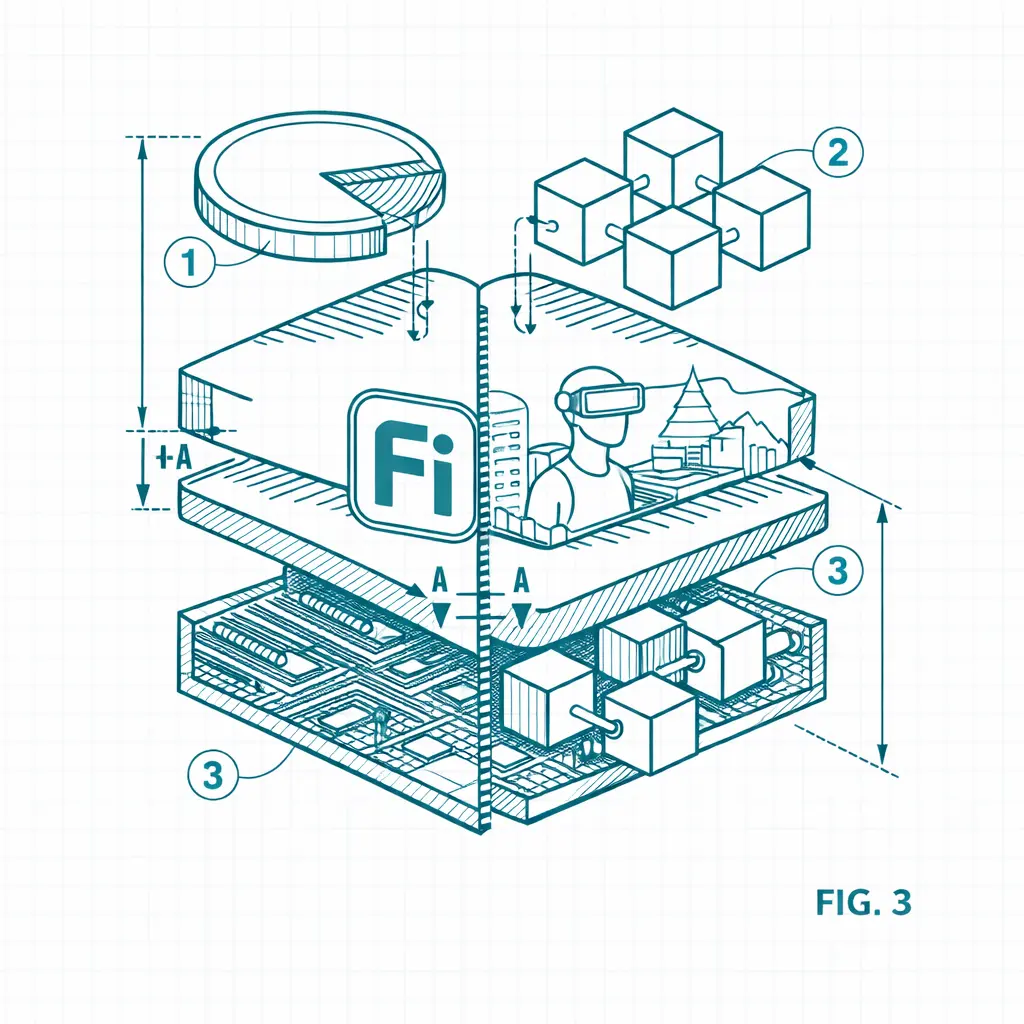
Web3 metaverse value is migrating away from pure scarcity narratives
Web3 metaverse economics do not fail because onchain ownership is useless. They fail when teams mistake tokenized coordinates for durable demand. Decentraland’s original whitepaper defined LAND as a content-serving parcel bought by burning MANA, while The Sandbox defines LAND as digital real estate used to launch and monetize experiences inside a fixed map of 166,464 parcels. In both cases, the scarce object matters only because it is supposed to attract creators, players, payments, and attention.
The important shift is that mature Web3 worlds increasingly monetize usage, not just issuance. Decentraland now routes marketplace fees to the DAO and uses publication fees to fund curators and community initiatives. The Sandbox routes 2.5% marketplace fees to The Sandbox Foundation for creator funding, staking, and rewards. Those are operating flows. They are economically more meaningful than a one-time sale of scarce map slots because they recur when users actually trade, publish, and participate.
That is the core burn-skeptic read on Web3 x Metaverse. Scarcity can shape pricing. It cannot, by itself, create economic value. Durable value appears only when scarce assets sit on top of repeated user actions that would still happen without the scarcity story.
Onchain ownership is real, but interoperability is still narrow
Wallet-level ownership is the part of the open metaverse that works best today. ERC-721 standardizes balance queries, ownerOf, transfers, approvals, and an optional metadata URI. That gives users portable custody over NFTs across wallets and marketplaces.
Functional portability is much weaker. Decentraland’s LAND token stores coordinates, ownership, and a reference to a content description file or parcel manifest. The Sandbox ties monetized publication to LAND, requires ownership of assets used in an experience at publish time, and allows only one monetizable experience to be launched to a LAND at a time. The token can move across wallets. The experience logic, rendering assumptions, asset rules, and discovery systems do not move with equal ease. That is an inference from the platform designs, not a marketing claim from either side.
This distinction matters for token economy design. An NFT standard proves possession. It does not guarantee that an avatar skin, building, or social status object keeps the same utility across worlds. When teams pitch “interoperable assets,” the economically relevant question is not whether the token can be transferred. It is whether another world will honor the same asset with meaningful behavior, rights, and distribution.
Virtual real estate only works when it captures attention or cash flow
Virtual land has no intrinsic rent stream. It acquires value only when it improves distribution, monetization, or identity. Decentraland’s whitepaper explicitly ties LAND utility to adjacency to attention hubs and the ability to host applications. The Sandbox says proximity to major partners affects visitor counts, economy, and visibility, and it highlights paid access, gated gameplay, and advertising space as monetization paths for LAND and Estates.
That is why land scarcity has softened as a creation primitive. Decentraland Worlds are separate from Genesis City, can host up to 100 concurrent users, and can be obtained with a Decentraland NAME that costs 100 MANA or an ENS domain. The Sandbox lets creators build and share any number of experiences for free, lets them create a free experience page without a LAND NFT, and reserves LAND mainly for direct in-map publishing and monetization. Scarcity still controls premium placement. It no longer monopolizes creation.
That change is economically important. Once creation becomes cheap and abundant, land becomes a premium discovery slot rather than a universal production requirement. Premium discovery can hold value. But it behaves more like advertising inventory or mall frontage than like sovereign digital territory. That makes demand more cyclical and much more dependent on platform traffic than early land-sale narratives suggested.
Leading platforms have already moved from burn optics toward treasury and creator funding
Decentraland is the cleanest case study in the limits of burn-first tokenomics. The original whitepaper made MANA burns central to LAND issuance. By October 12, 2020, governance proposed redirecting marketplace fees away from burns and toward the DAO. By January 23, 2023, Decentraland proposed doing the same for NAME minting fees, and the forum records that the change was enacted on April 13, 2023. Current docs now describe marketplace fees and other income streams as DAO revenue.
The logic is straightforward. Burns reduce float. Treasuries fund operations. If the platform needs grants, curation, infrastructure, or growth incentives, redirecting fees into the system is usually more useful than destroying the token and hoping the market rewards the optics. That treasury turn also matters for Web3 x Governance (DAOs), because it shifts power from burn mechanics to budget control.
The Sandbox lands in a similar place even without a headline burn pivot. SAND is positioned as the main utility token and medium of exchange, with a 3 billion maximum supply. The platform’s own docs emphasize purchases, governance, staking, paid experiences, creator sales, and foundation funding. Official LAND sales are priced at 1,011 SAND for regular LAND and 4,683 SAND for Premium LAND, while marketplace sales split proceeds 95% to the seller, 2.5% to the creator, and 2.5% to The Sandbox Foundation. That is a usage-and-revenue model wearing a scarcity wrapper.
| System | Scarce unit | Current economic loop | Burn-skeptic reading |
|---|---|---|---|
| Decentraland | LAND, NAMEs, wearables | Marketplace fees to DAO, publication fees to curators and DAO, Worlds via NAME ownership | Value depends more on creator commerce and identity usage than on MANA destruction |
| The Sandbox | LAND, assets, avatars, Premium placement | SAND purchases, creator sales, staking, foundation-funded rewards, paid or gated experiences | Finite map supply helps pricing, but durable value still comes from traffic and creator monetization |
| Lens | Usernames, accounts, graphs, feeds, groups | Low-cost onchain social actions, app-specific rules, token-gated or paid social features, portable accounts | Recurring social interaction is a stronger demand base than static land speculation |
Identity and social graphs look more durable than map scarcity
The most defensible open-metaverse primitive is identity, not land. W3C made Decentralized Identifiers an official recommendation on July 19, 2022, and Verifiable Credentials Data Model v2.0 became a W3C Recommendation on May 15, 2025. Those standards give the ecosystem a serious base layer for portable identifiers and machine-verifiable claims. That is also the broader context for Web3 x Identity Management.
Lens is a good example of where that logic goes in product form. Lens went live on mainnet on April 4, 2025 with Lens Chain, GHO-denominated gas, prebuilt social primitives, and developer sponsorship tools. On February 25, 2025, Lens said the migration from v2 to Lens Chain was preserving 647,000 profiles, 640,000 handles, 31 million publications, and 45,000 weekly users. Lens also frames accounts as portable across apps, while usernames remain transferable NFTs that can support royalties.
The economic implication is stronger than it first appears. A social graph can generate recurring posting, following, curation, moderation, and monetization events. A parcel of virtual land generates nothing unless people repeatedly choose to visit or transact there. From a token economy perspective, identity-linked networks have more natural routes to repeated demand than fixed map coordinates. That is the stronger demand logic behind decentralized social networks.
That does not mean identity is solved. W3C’s VC recommendation explicitly says issuer trust decisions are out of scope. Open identity standards make credentials portable and verifiable. They do not automatically create trust, discovery, or reputation markets. Those still need app-level design, governance, and often some centralized policy surface.
What Web3 metaverse token economies should optimize for
Price usage before possession. Decentraland Worlds and The Sandbox’s free creation tools show that creation can be opened up while monetized placement remains scarce. Tokens should capture publishing, promotion, curation, event access, or premium discovery, not simply ownership of idle coordinates.
Fund burns from real activity, not from the treasury story. Decentraland’s move from automatic burns toward DAO-controlled fee routing is a practical admission that operations and reinvestment matter more than supply optics.
Separate portability of custody from portability of utility. ERC-721 gives users ownership and transferability. It does not guarantee that the same NFT will carry the same function, art direction, moderation status, or monetization rights across worlds.
Make creator revenue explicit. The Sandbox’s split between seller, creator, and foundation, and Decentraland’s creator-facing royalties and publication-fee logic, are more important than generic claims about decentralization. Creators stay where economics are legible.
Treat compliance and platform mediation as first-order variables. The Sandbox requires KYC for some reward claims, while Decentraland supports social sign-ins and provisions wallets behind the scenes. The “decentralized metaverse” is usually a layered stack with centralized UX, moderation, and compliance touchpoints. Token models should be designed for that reality rather than for a fully permissionless fantasy.
Where the real token value can still emerge
The strongest Web3 x Metaverse opportunities sit where open ownership meets repeated economic behavior. That usually means identity, creator tooling, social graphs, marketplaces, event layers, and premium discovery surfaces. It can also mean scarce locations, but only when those locations measurably improve distribution or monetization. If a token sink is not tied to a user action that already has economic meaning, reducing supply will not rescue it.
For teams doing token economy design in virtual worlds, that is the threshold test. At FinDaS Tokenomics, the first question in any tokenomics consulting brief is whether a proposed sink would still attract demand if token appreciation disappeared. If the answer is no, the mechanism is probably scarcity theater. If the answer is yes, the token may actually be sitting on top of a business model rather than a story.