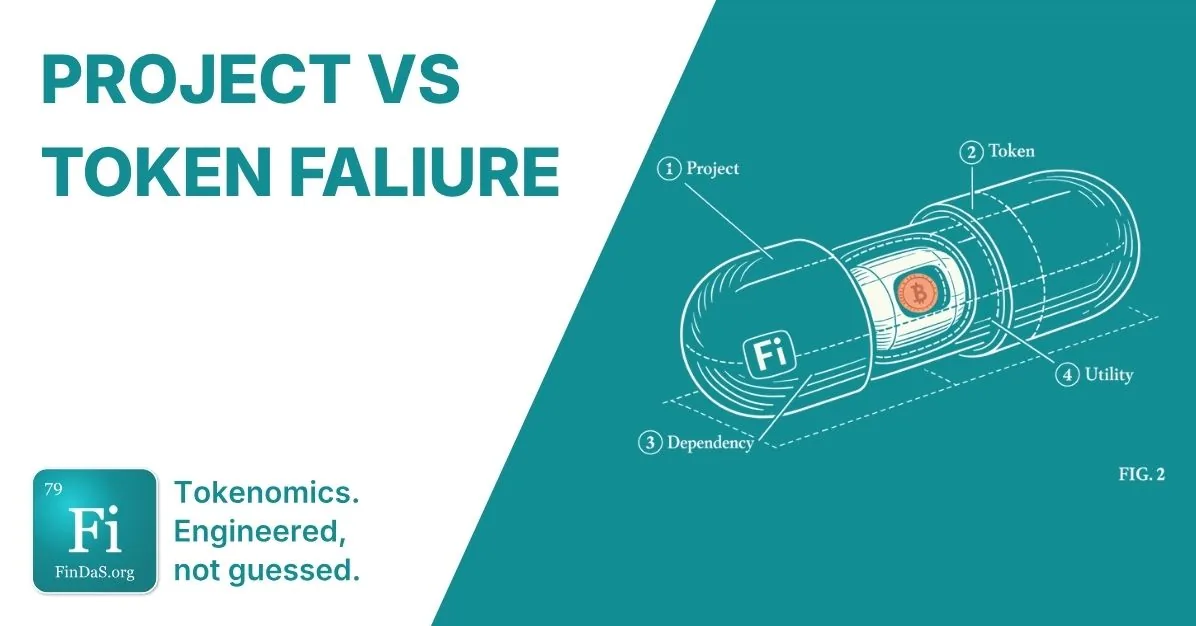
Projects fail when the business or team can't sustain operations: weak adoption, funding gaps, leadership breakdowns, regulatory blocks, competitive irrelevance. Tokens fail when the economic design doesn't hold: no intrinsic utility, poor distribution, uncontrolled inflation, dependence on speculative demand. The asymmetry that matters: project failure almost always kills the token, but token failure doesn't always kill the project, though it makes recovery hard.
Why the distinction matters
Most crypto post-mortems conflate two different failures. A project dies and its token dies with it, so the two get filed under the same heading. But they fail for different reasons, on different timescales, and with different recovery options, and mixing them up leads to bad diagnoses.
The distinction is simple once named. A project fails when the business behind it can't sustain operations. A token fails when its economic design doesn't hold. Project failure almost always drags the token to zero. Token failure can sometimes be survived, but surviving it is harder than most founders expect, and the path is narrow.
What actually kills a project
Project-level failures cluster into five patterns I've seen repeatedly. They're separate from anything the token does:
- No adoption. The product doesn't find users with a real reason to use it. Every other category becomes survivable if users arrive; none of them get survived without.
- Capital environment. Funding dries up mid-build, or the round closes at a valuation that can't be grown into. Bear-market launches face this most.
- Technical or security failure. Scalability collapses under real usage, a critical vulnerability gets exploited, or core infrastructure doesn't ship on schedule for long enough that the window closes.
- Regulatory block. A jurisdiction forces a shutdown, a classification makes the product non-viable, or enforcement drains treasury and leadership attention.
- Leadership breakdown. Founder disputes, governance paralysis, or strategic drift that nobody corrects. Usually slow, usually fatal.
None of these are token problems. You could give any of these projects perfect tokenomics and they'd still die. The token's role, if anything, is to make death faster or slower once it's coming.
What actually kills a token (even when the project is fine)
Token failure is a separate diagnosis. A token can lose most of its value while the underlying product keeps working and the team keeps shipping. What breaks in those cases is usually one of four things.
- No intrinsic utility. The token was a fundraising wrapper rather than a coordination mechanism. Users transact in the product without needing to touch it. Once speculative demand fades, there's no base rate of organic demand to catch the price.
- Bad distribution or vesting. Insiders hold too much, unlock schedules are front-loaded, or launch liquidity is thin enough that a handful of sellers can crater the price. The damage is done at design time and compounds with every subsequent unlock.
- Unchecked inflation. Emissions outpace any sink (burns, buybacks, staking demand). The supply curve drags the price curve down regardless of what the project achieves. Price floor mechanics and similar tools exist for a reason, but most projects discover them after the damage.
- Demand built on speculation. Early holders are there for the pump, not the product. When the pump stops, holders exit at the same time, and that exit is what the next wave of holders sees first.
Rug pulls and outright scams belong in a different bucket. They're not design failures; they're deliberate value extraction. Worth naming so nobody confuses malice with bad tokenomics, but not worth dwelling on. The more useful failure mode to study is the honest project whose tokenomics design quietly undermines its own product.
Terra/LUNA: when token failure kills the project
Terra is the clearest case of token failure dragging an entire ecosystem down with it. In May 2022, the Terra blockchain lost roughly $45 billion of market capitalization in a week. The trigger was the depeg of UST, Terra's algorithmic stablecoin, but the mechanism behind the collapse is the part worth studying.
UST's dollar peg was maintained by arbitrage against LUNA: burn $1 of LUNA to mint 1 UST, or burn 1 UST to mint $1 of LUNA. The mechanism worked as long as LUNA's market cap stayed well above UST's. Demand for UST was driven almost entirely by Anchor Protocol, which paid 19.5% APY on UST deposits, subsidized from Terra's reserves. By April 2022 the subsidy was costing roughly $6 million per day, according to the Harvard CFI analysis of the run.
Once UST started to depeg on May 7, the arbitrage mechanism inverted. Holders burned UST to mint LUNA and dumped LUNA on the market. LUNA's supply went from 343 million to 6.5 trillion in a week. The price went to approximately zero. Terraform Labs filed for bankruptcy in January 2024.
The lesson isn't that algorithmic stablecoins are fragile. It's more specific: the Terra ecosystem had no demand engine other than the token mechanism itself. Anchor yields drove UST demand, which propped up LUNA, which backed UST. When the token economics broke, there was no independent product demand to catch the fall. The project and the token were the same thing.
BitShares: when token failure reflects project drift
BitShares is the slower, quieter version. Launched in July 2014 by Dan Larimer, BitShares ran the first decentralized exchange with a functioning stablecoin (bitUSD), predating most of the current DeFi stack by several years. BTS hit an all-time high of $0.86 in January 2018. It currently trades at roughly $0.001 and ranks around #1,279 by market cap.
The project never shut down. The BitShares chain still operates. But the token lost roughly 99% of its peak value over several years, not days, and the cause was competitive irrelevance rather than a design blow-up. Newer DEXs and DeFi protocols arrived with better UX, deeper liquidity, and tighter integration with the rest of the ecosystem. Smartcoins (BitShares's collateralized stablecoins) experienced global settlement events as BTS collateral dropped below threshold, which broke most of their utility. The tokenomics weren't obviously wrong; they were just outcompeted.
This is the failure mode most projects actually face: not a death spiral, a slow fade. Harder to write about, more common in practice. Valuing a token independently of the project's momentum surfaces this risk earlier than watching the price.
The practical implication: relaunch is harder than people think
A token failure that doesn't kill the project leaves a narrow set of options, and none of them are easy. The temptation is to treat the token as a separable layer, swap it out, and keep moving. In practice, the token's distribution, legal wrappers, market reputation, and holder base are entangled with the project in ways that don't reset cleanly.
Most real recoveries involve one of three moves: restructure the economy around genuine utility that the existing token can capture, split the token and migrate users on terms that compensate early holders fairly, or wind down the token and reissue under a new economic model. Each path is operationally expensive and takes 6 to 18 months minimum. Holder communication and legal review dominate that timeline, not the tokenomics redesign.
If you're considering a token relaunch, the first question isn't mechanical. It's whether the original tokenomics had a genuine utility anchor that was obscured by market conditions, or whether the design never worked. The two cases want very different solutions, and most founders who ask about relaunch are actually asking about the second.
What this means for investors and builders
For builders, the implication is straightforward: the token economy is not a downstream marketing choice. It's load-bearing infrastructure, co-equal with the product and the legal structure. Design it as an afterthought and a market downturn will expose the shortcuts. Most of what I've seen go wrong at the token level traces back to decisions made six to twelve months before launch, when founders were optimizing for fundraising rather than steady-state economics.
For investors and analysts, the implication is that project-level risk and token-level risk are separate lines in the due diligence. A project can be adequately run and still own a token that will fail on its own clock. A promising token can't save a project whose product has no users. Asking which risk you're looking at produces better calls than grading both together.
The two failure modes share vocabulary and not much else.
Frequently asked questions
01How do you tell a failing token from a volatile one?
+
02Can a project survive if its token has already crashed?
+
03Are stablecoin collapses project failures or token failures?
+
04Do token unlocks automatically cause token failure?
+