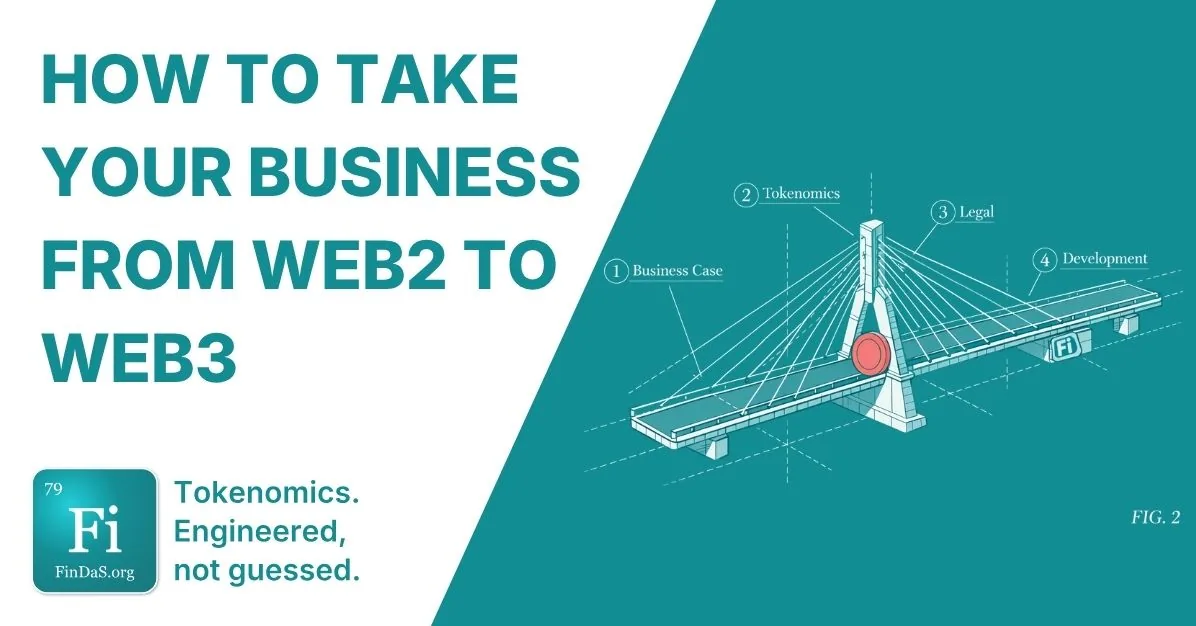
Web3 is an operational upgrade for a business, not a speculative add-on. Moving parts of your stack on-chain cuts payment friction, turns a loyalty program into something users hold real stake in, opens token-based fundraising channels, and lets you tokenize existing assets (from invoices to royalties) that sit illiquid today. The trick is sequencing: business case first, then tokenomics, then legal, then development.
A lot of business owners announce a Web3 transition for the wrong reasons: short-lived attention, reputation lift, or the urge to launch a token without a clear purpose for it. This article focuses on the long-term reasons for transitioning to Web3, what the actual benefits look like, and where to start.
Why go Web3?
The short answer: you risk being left behind. As more businesses tokenize and move parts of their stack on-chain, yours stays in the centralized financing and user-interaction models that are slowly being replaced. Picture the one bookstore on a market street that refused to go online in the late 1990s. When the DotCom bubble burst, that call looked clever for about a year; then it didn't.
Talking of bubbles, Web3 inherits the poor reputation of crypto overall. A lot of people see no value in it beyond issuing a token for pure speculation. For a business, Web3 is an operational upgrade, not a cost center and not a speculation play. It opens new monetization paths, lifts adoption and lifetime value, and automates processes that middlemen currently handle.
How does my business benefit?
I. Operational efficiency
A lot of repetitive work, including user rewards and on-platform interactions, can be automated through smart contracts, which run transparently on-chain. Middlemen get replaced by protocols, and operations that took days are executed in milliseconds. The cost math is stark.
Let's take Stripe. Online payment fees run 2.9% + $0.30, and 2.7% + $0.05 on Stripe Terminals (US rates; international differs). Meanwhile, Ethereum mainnet gas has stayed below $1 for almost all of 2025 and 2026, and as of April 2026, a simple ETH transfer costs well under a cent and a DEX swap three to five cents. You pay overhead early to set up the Web3 stack, but per-transaction costs scale down fast from there.
II. Energize your client base via a Web3 loyalty program
Web3's core bet is that users who own a piece of a protocol behave differently than users who just rent access to one. A crypto-based loyalty program built on that assumption turns customers from outsiders into participants with a stake in the outcome. The pattern carries over well from Web2 loyalty programs if you structure the points-to-token conversion properly.
A well-made points system that converts into tokens drives the exact behavior you want, and ties user incentives to business priorities directly. On-chain transactions are transparent and traceable by design. As users hold more of your token, they acquire real stake in the business doing well, which is a different dynamic than a standard loyalty program.
III. New ways to access capital
Raising funds is a live question for both new and established businesses. Web3 adds a new instrument to the set, the crypto token, which can fund a new venture or a vertical add-on to an existing business. A sustainable token is not a trivial lift: function, sale structure, and valuation all have to be designed properly. We cover the end-to-end process in our guide on launching a token.
IV. Leverage old assets in new ways
Transitioning to Web3 opens ways to use existing assets that don't exist in Web2. Tokenization of real-world assets (RWAs) goes well beyond real estate and commodities: loan agreements, factoring income, royalties, and works of art are all on the table. The regulatory picture is still filling in jurisdiction by jurisdiction, but the product space is already broad enough that most businesses have something tokenizable on the balance sheet.
How to start the Web3 transition?
Getting your business into Web3 takes four components, and only one of them can reliably come from inside your own company. Those four are business expertise, tokenomics strategy, legal opinion, and development. Only the first is usually in-house; the other three are outside partners you vet.
Business expertise: the case for going Web3 has to come from inside the business first. You know your customer, margins, and competitive position; external experts don't. Come in with at least an initial thesis, and let the tokenomics and legal consultants sharpen it with you rather than hand you one.
Tokenomics strategy: the tokenomics partner you pick decides how the whole thing performs in practice. Tokenomics sets the token's function, sale structure, value drivers, and rewards, and creates the game-theoretic alignment between users and platform. For the fundamentals, see our guide to tokenomics design. A good tokenomist also handles early-stage liquidity, which is where most new tokens fall over, and pressure-tests the business case before you spend on legal and development. Loop them in at idea stage, not at launch.
Legal opinion: whatever you build on the drawing board has to clear regulation before it ships. Counsel and your tokenomics team iterate on the product and token economy together, usually across several rounds, until the design is market-ready. In the EU, that means MiCA-ready whitepaper work; other jurisdictions have their own frameworks and your counsel should already know which one applies to you.
Development stage: bring in outside engineering for smart contracts, UI, and backend work. Blockchain-as-a-service infrastructure handles the plumbing most projects don't need to build themselves, which cuts time-to-launch substantially. When the code is done, pay for a proper security audit; on-chain bugs are not the kind you fix in production.
Web3 is a real shift for a business, not a reskin. The operational wins, loyalty upside, capital options, and RWA angle are all on the table, but only if the sequencing works: business case, then tokenomics, then legal, then development. Pick partners who can tell you an idea won't work before you've spent six months building it.
Frequently Asked Questions
01Does a Web2 business need its own token to be considered Web3?
+
02How long does a typical Web2-to-Web3 transition take?
+
03Which blockchain should a new Web3 project build on?
+
04What are the biggest risks of a Web2-to-Web3 transition?
+