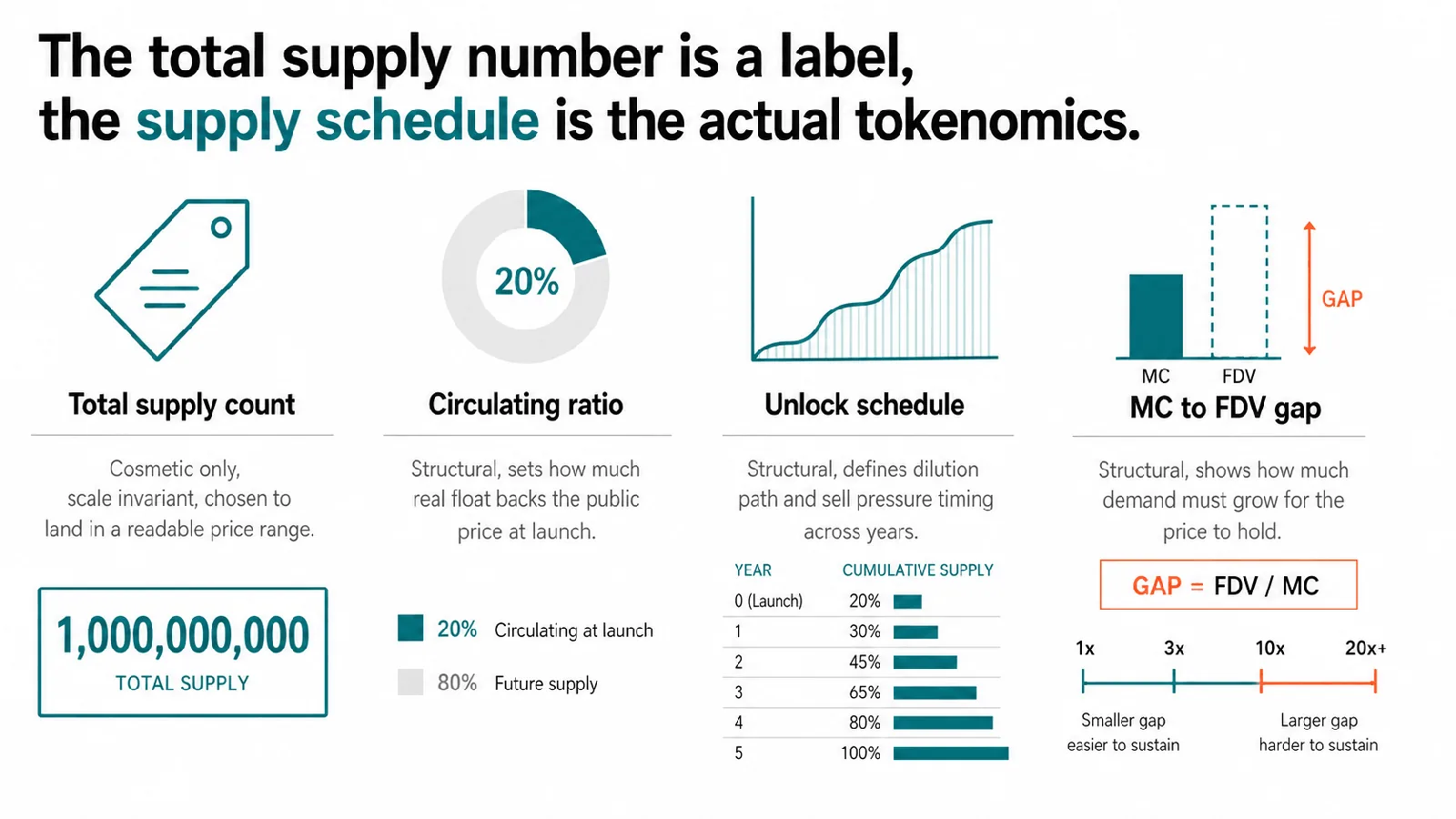
Token supply numbers matter much less than founders think. From a tokenomics perspective, a fixed supply of one million, one billion, or one trillion produces identical incentives, because supply is just a unit of account. What actually matters is the relationship between circulating supply and total supply, the unlock schedule, and the gap between market cap and fully diluted valuation.
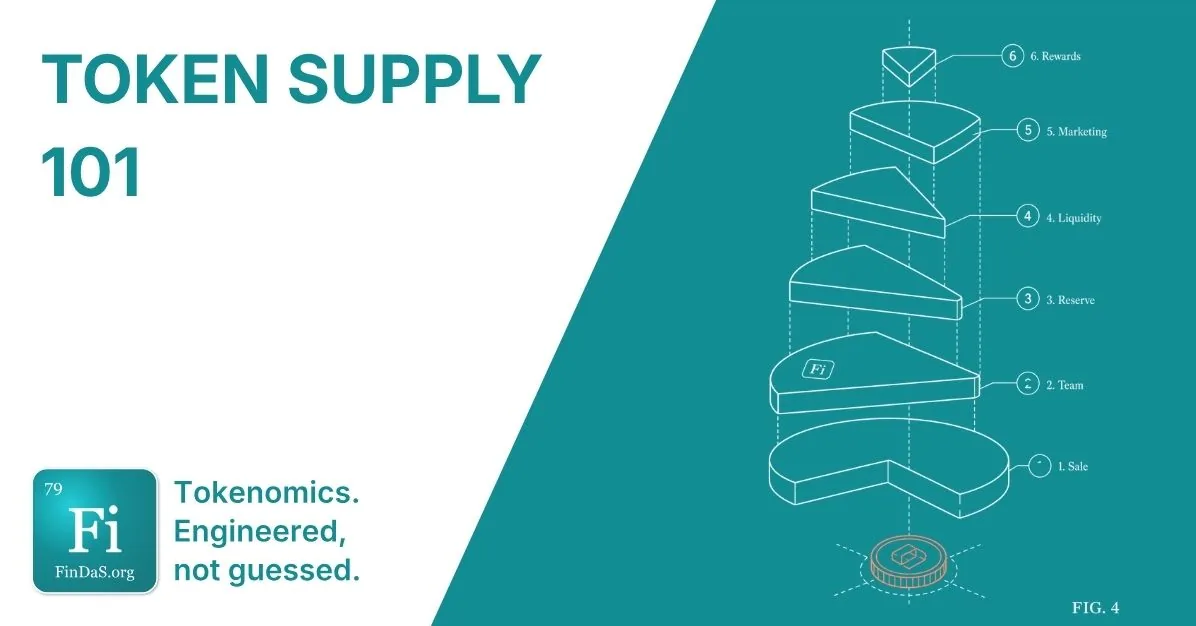
The first question on every consultation call
The first question on almost every tokenomics consultation call is the same: how many tokens should we mint. The short answer is, it does not matter. The long answer is, it matters very, very little, and almost never in the way founders think it does.
The supply number feels load-bearing because it is the most concrete decision in the design. Everything else (vesting, emissions, allocations, value accrual) involves uncertainty. The total number of tokens to issue feels like the one thing you can just decide. So founders fixate on it. They ask whether 100 million is too few, whether a billion is too greedy, whether a trillion will look like a memecoin. They want a defensible answer.
The same instinct shows up at the retail level, in a different costume.
A few years ago I was talking with a financially literate friend about his crypto holdings. He had bought a lot of DOGE because, he explained, $1,000 could get him a meaningful pile of DOGE, while the same $1,000 would not even buy him a single Bitcoin. I walked him through how market caps work, how the price per token tells you nothing about whether something is "cheap" without knowing supply. He nodded along, and then he repeated his original logic. To him, more units for the same dollar was the definition of a better deal.
That is the supply-number illusion at the retail level. Founders do not buy DOGE because the unit price is low, but they make the structurally identical mistake when they treat the total supply as if it carries economic content on its own.
A token is just a unit of account
A token is a unit of account. ERC-20 tokens are typically divisible to 18 decimal places, which gives you absurd amounts of precision regardless of how many whole units exist. Whether your total supply is 1, one million, one billion, or 713 trillion makes no difference to the mechanics of your token economy.
The math works identically. The incentives work identically. You can take any supply schedule and rescale it by a factor of a thousand, and nothing changes about how the system behaves: who owns what fraction, how much dilution unlocks bring, what the implied valuation looks like at a given price. Multiplying every number by the same constant is invisible to the economy underneath. The same logic carries over to how emissions are sized, where the question is not the absolute number of tokens released but the percentage of supply they represent.
This is the part founders find genuinely surprising. Once they accept it, the next question becomes the right one: if the supply number does not carry economic content, why are we talking about it at all?
Where the supply number actually matters: perception
The supply number matters in marketing and price perception, and the conventions vary by region.
In Western markets, tokens priced between 1 and 10 cents tend to be read as having upside. The implicit framing is something like "well, it might climb to a dollar one day". A 1-cent token at a $100M market cap and a $1 token at the same market cap will be perceived very differently by retail buyers, even though the second has 100x fewer tokens to back the same valuation. The first looks like opportunity. The second looks expensive.
In Asian markets, prices below 1 cent are often the default for retail-friendly tokens, with no negative connotation attached. The same prices in Western markets typically read as memecoin territory. None of this is a value judgment. It is a description of how the audience reads supply, and the audience reads it inconsistently across regions.
The other failure mode is going so low that the number becomes unreadable. MOG and similar tokens trade at prices like 0.0000000018, which is technically a number but functionally hard to display, hard to discuss, and hard to communicate gains in. If a 2x move shows up as a change from "0.00000000xx" to "0.00000000yy" on a price feed, your community will struggle to even tell.
So the supply number choice reduces to a cosmetic question: pick a number that lands somewhere readable for your target market. Once that is done, the choice does not come up again.
What actually matters: market cap and FDV
What actually matters is your market cap, your fully diluted valuation, and the ratio between them. Valuation methodology dives into this in depth, but the basics are worth restating here.
Market cap is the price of a token multiplied by its circulating supply. FDV is the price multiplied by the total supply that will ever exist. The gap between these two numbers tells you how much of your tokens are locked, and how much dilution is still ahead of the market.
If you launch with $200M market cap and $2B FDV, you are at a 10% MC/FDV ratio, meaning 90% of supply is yet to be released. If your real demand can support a $200M valuation but you have issued tokens implying $2B, the math has to converge somewhere as those tokens unlock. Either demand grows tenfold to absorb the new supply at price, or price compresses, or some mix of the two. Hope is not a strategy.
The 2024 low float problem
This stopped being a theoretical concern in 2024. According to Binance Research, the average MC/FDV ratio for tokens launched in 2024 was 12.3%. Most launched with under 20% of supply circulating. The same report estimated $155 billion worth of tokens would unlock between 2024 and 2030, requiring approximately $80 billion in fresh buy-side demand just to keep prices flat. That is a demanding ask, and the market has been working through the consequences ever since. The dynamics that follow from heavy locked supply are covered in detail in our piece on early sell pressure mitigation.
In May 2024, Cobie published a widely circulated essay arguing that new token launches had become uninvestable for retail. Most of the upside, he argued, had already been captured privately, in seed rounds at FDVs that bear no resemblance to historical comparables. He cited Solana's seed round at roughly $20M FDV, Optimism's at roughly $60M, StarkNet's at roughly $80M. Modern seed rounds for similar projects routinely clear $100M FDV. By the time a public market opens, price discovery is largely complete.
Cobie's other observation, the one most relevant to supply design, was about phantom markets. When only 10 to 15% of supply is liquid at launch, holders of locked positions start trading those locked claims to other sophisticated investors at deep discounts to the public price. A token quoting $5B FDV on the public market might trade at $2B in the OTC ghost market for locked positions. The "public price" becomes a phantom, anchored by tiny float, while real exit liquidity gets routed through private discount markets.
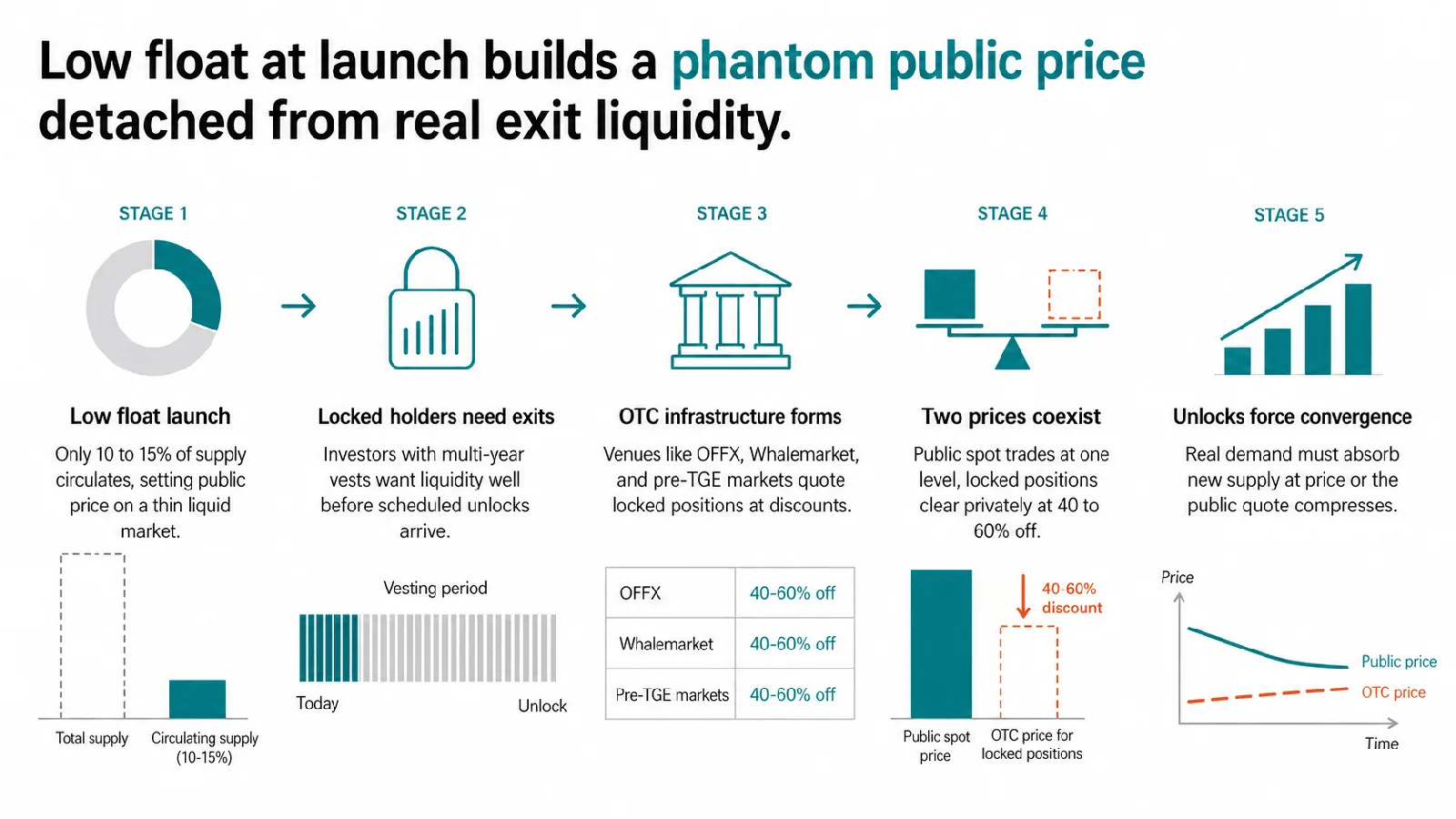
Two years later, this dynamic has gotten formalized rather than gone away. Platforms like OFFX, Whalemarket, and Hyperliquid's pre-TGE markets now offer standing secondary infrastructure for locked positions. The Block reported in March 2026 that median OFFX discounts on locked positions ran around 50% through 2024 and 2025, with positions vesting over 36 months or longer trading at 60% or worse. Median discounts have moderated to about 40% in early 2026, but the long tail is still wide. Monad's MON token launched in November 2025 at a $3.2B FDV with about 10% of supply circulating, which is exactly the structure the original 2024 critique was pointing at.
What this means for the designer
For the founder designing a token in 2026, the operational implication is uncomfortable. Locked supply will be priced by the market whether you allow it or not. If your investors cannot legally transfer their locked allocation, they will hedge it through perpetuals, options, or correlated assets. If they can transfer it, OTC desks will quote it. The selling pressure surfaces somewhere, and the public price has to absorb it eventually.
If you are working through these tradeoffs and want a structured pass through the rest of the design surface, our tokenomics design 101 walks through the full system view in one place.
A few design choices follow directly from the phantom-market dynamic:
- Decide whether locked positions are transferable. If they are, you have effectively created two prices for your token: the public spot price and the discounted private price. Plan around that, do not pretend it does not exist.
- Expect hedging if transfers are blocked. Sophisticated holders with locked allocations and access to perpetuals will hedge. The selling pressure surfaces somewhere, just not on your spot book.
- Consider soulbound or NFT-locked vesting. Binding allocations to original recipients makes secondary OTC markets harder to form, at the cost of removing investor flexibility. There are tradeoffs either way.
- Match initial circulating supply to plausible demand. Not the demand you hope for at peak hype. The demand you can defend through a quiet quarter.
- Treat the unlock schedule as the actual design. What happens between TGE and full vesting matters more than what the cap table looks like at full dilution.
The 2024 to 2026 cycle made one thing clear. The supply schedule is the tokenomics. The total supply number is a label.
So: how many tokens should you mint? Pick a number that lands cleanly in your target market's perception band, somewhere between unreadably small and uncomfortably expensive, and move on. The interesting questions are everywhere else.
More from the 101 series
This article is part of our 101 series on tokenomics fundamentals. A few other entries worth reading next:
- Tokenomics 101, the broader entry point for everything else here.
- Token burning 101, on the supply-side mechanism that runs in the opposite direction.
- Governance 101, on how token-holder voting actually shapes a protocol.
- Value accrual 101, on the question that actually decides whether a token is worth holding.
Frequently asked questions
01What is the difference between maximum supply, total supply, and circulating supply?
+
02Can a project change its total supply after launch?
+
03Should memecoins follow the same supply rules as utility tokens?
+
04Why are most ERC-20 tokens divisible to 18 decimal places?
+