Token emissions are the rules that govern when, how, and why new tokens enter circulation. Three baseline models exist: fixed supply (capped, like Bitcoin), inflationary (continuous issuance, like most Layer-1s), and deflationary (net burn outpaces mint). A fourth, variable supply, ties net issuance to network activity, which is what Ethereum does after EIP-1559. The right model depends on what the token has to pay for, whether that is security, work, or growth. The most common mistake founders make is copying Bitcoin's hard cap because it's familiar, when their protocol actually needs ongoing emissions to fund the people doing the work.
The four supply models
Three labels dominate every tokenomics conversation: fixed, inflationary, and deflationary. They are useful labels but not sufficient ones, because most live tokens drift between categories depending on how they're used. A fourth model, variable supply, drops the static label entirely and ties net issuance to real-time network activity. Founders who want to design well, rather than borrow vibes from Bitcoin, need all four in their toolkit.
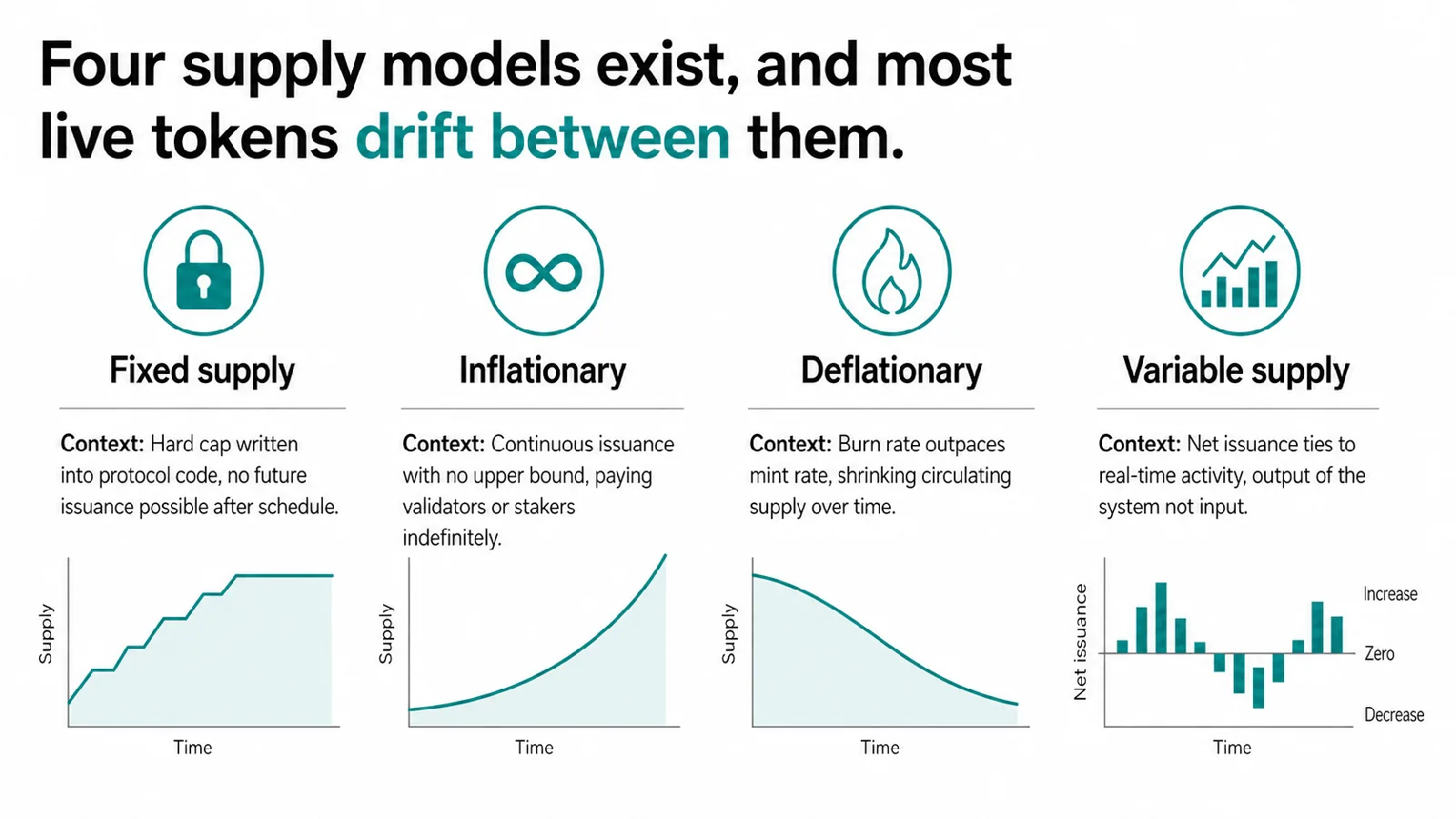
A fixed-supply token has a maximum cap written into the protocol that no future issuance can exceed. Bitcoin's 21 million is the canonical example. Once the schedule plays out, no new units can be created. This works well for a pure store-of-value asset where the network does not need to keep paying anyone after launch, and it has been imitated heavily because it is easy to explain to a non-technical investor.
An inflationary token issues new units on a continuous schedule with no upper bound. Most major Layer-1s sit here. The supply grows perpetually, which sounds bad until you remember that the inflation is paying validators, stakers, or service providers to keep the network running. If the network produces enough value to absorb the dilution, holders break even or come out ahead. If it doesn't, they lose to inflation the same way savers lose to high-printing fiat.
A deflationary token burns more than it mints, shrinking circulating supply over time. Pure deflation is rare at launch since most protocols need emissions to bootstrap. What you usually see in practice is a token that becomes deflationary later, once usage drives burn rates above issuance. BNB and HNT both run versions of this transition, with the deflationary state being an outcome of demand rather than a property baked in from day one.
A variable-supply token has no preset answer to "is this inflationary or deflationary." Ethereum after EIP-1559 is the cleanest example: every transaction burns a base fee, while staking rewards mint new ETH for validators. Net supply moves with chain activity. Heavy usage burns more than it mints, light usage tilts mildly inflationary. The token's monetary behavior becomes an output of the system, not an input.
Why "fixed supply" is really deflationary
Calling a token "fixed supply" is a polite fiction. Lost keys, dead wallets, and irretrievable transfers all subtract from the effectively-circulating set every year, and none of them ever come back. On-chain analytics estimates put permanently inaccessible Bitcoin somewhere in the 15 to 20 percent range of all coins ever mined. That is not deflation by design, but the economic effect is similar: the addressable supply trends downward over time, slowly and irreversibly.
This matters because the marketing claim "21 million max" is not the supply curve actual holders experience. Practical Bitcoin supply is 21 million minus an ever-growing pool of cold zombie balances, and the real circulating set is smaller still once you exclude long-dormant wallets and exchange reserves. Other "fixed supply" tokens follow the same pattern. Anything denominated in keys is also denominated in human carelessness, and humans are reliably careless.
Founders should be honest about this. If your project markets itself as "hard cap, scarcity-driven," you are also implicitly marketing a deflationary trajectory powered by user error. That can be fine, but acknowledging it lets you reason about the model properly. It also raises an awkward question worth sitting with: is your scarcity story partly contingent on people losing access to their assets over time? Most investors do not think about it that way, but founders should, because the answer determines whether the long-term story holds up under scrutiny.
Inflation rate vs emission shape
Two protocols both advertise "5 percent annual inflation." On paper they look identical. In practice they can behave nothing alike, and the difference comes down to two design choices the headline rate hides: how the rate changes over time, and what shape the emission curve takes inside any given year.
Start with the percentage point. Suppose a protocol fixes annual emissions at 5,000,000 tokens forever. In year one, with 100 million circulating, that is 5 percent inflation. By year five, with 120 million circulating, the same 5,000,000 mint is closer to 4.2 percent. By year ten, sub-3.5 percent. A constant absolute issuance is a declining percentage rate, automatically. This is why Bitcoin's emission schedule, which halves the absolute issuance every four years, ends up with both declining absolute emissions and rapidly declining percentage inflation. The schedule does the marketing for free.
Now the shape. Emissions can be front-loaded (most of the schedule paid out in the first year or two), back-loaded (most paid out at the end), or linear. Front-loaded emissions get the cold-start phase off the ground but invite mercenary capital that extracts early and exits, leaving long-term holders with a worse cap table than they expected. Back-loaded emissions starve the early period and rarely get a chance to deliver, since most projects don't survive long enough to reach the back of the curve. Linear is the lazy default and is rarely the right answer for any specific protocol.
A useful exercise before launch: draw your annual emission curve on a chart and ask whether you would still pick that shape if you had to predict, in advance, exactly which year the protocol would need the most incentive budget. Most teams realize at this point that their default choice was driven by spreadsheet convenience, not strategy.
Real yield vs inflationary yield
This is the single most important distinction in token emissions, and it took the market a multi-billion-dollar collapse to internalize it.
A protocol advertising 80 percent APY funded entirely by minting its own governance token is not paying yield. The new tokens come from somewhere, and that somewhere is everyone else's share of supply. The staking subset gets a transfer; everyone else absorbs the dilution. Headline APY net of inflation is the only number that matters, and on most farming programs it lands close to zero or negative once you include token price decay.
Real yield, by contrast, is paid out of fee revenue or external cash flow that the protocol has actually earned. A DEX paying stakers from swap fees is paying real yield. A lending protocol distributing borrower interest is paying real yield. A liquid staking protocol passing through validator rewards is paying real yield, since those rewards are protocol-level emissions but the staker is not the entity being diluted. The mental shortcut is simple: if turning off the printing press would zero out your yield, it wasn't yield, it was an emissions rebate. For deeper treatment of how protocols capture and redistribute real value, the value accrual 101 piece is a good companion.
The DeFi Summer episode of 2020 to 2022 was, structurally, the market learning this lesson. Most of those advertised three-digit APYs were funded by token emissions, and the math could not survive the moment buyers stopped showing up to absorb the new supply. The Terra and Anchor implosion finished the lesson by wiping out an estimated 60 billion dollars in value. After 2022, "real yield" stopped being a niche purist demand and became a baseline question sophisticated allocators ask before deploying capital.
The simple formula founders should be able to cite from memory: net yield equals nominal APY minus token inflation rate minus token price depreciation. Anything below zero is a subsidized customer-acquisition program with a finite runway, not a financial product. Some emissions programs are still worth running under those terms, the same way airlines run unprofitable routes to capture market share. Just be honest with yourself and your token holders about what you're doing.
Work-backed emissions and burn-mint equilibrium
DePIN networks introduced a structurally different reason to mint tokens: paying for verifiable physical work. Helium pays hotspot operators for proof-of-coverage. Filecoin pays storage providers for proof-of-spacetime. Render pays GPU operators for completed render jobs. Hivemapper pays drivers for street-level mapping data. The token is being minted to compensate someone who just produced something measurable, which is fundamentally different from minting to subsidize a yield curve.
This is a different design problem from DeFi liquidity mining. The protocol can tie issuance directly to verified work output, which means emissions only happen when the network is actually being used to produce its core service. The token expands and contracts with the underlying economy, not with a fixed schedule a treasury committee picked once and forgot about.
Burn-Mint Equilibrium, BME, is the specific design pattern most worth naming. Render, Helium, and Hivemapper all run BME variants. Users burn the native token, or a stablecoin-priced derivative of it like Helium's Data Credits, to access services. The protocol mints fresh tokens to pay workers. At equilibrium, burns roughly equal mints and supply is flat. Demand growth pushes the system net-deflationary; supply growth (more workers showing up to claim mint rewards) pushes it net-inflationary.
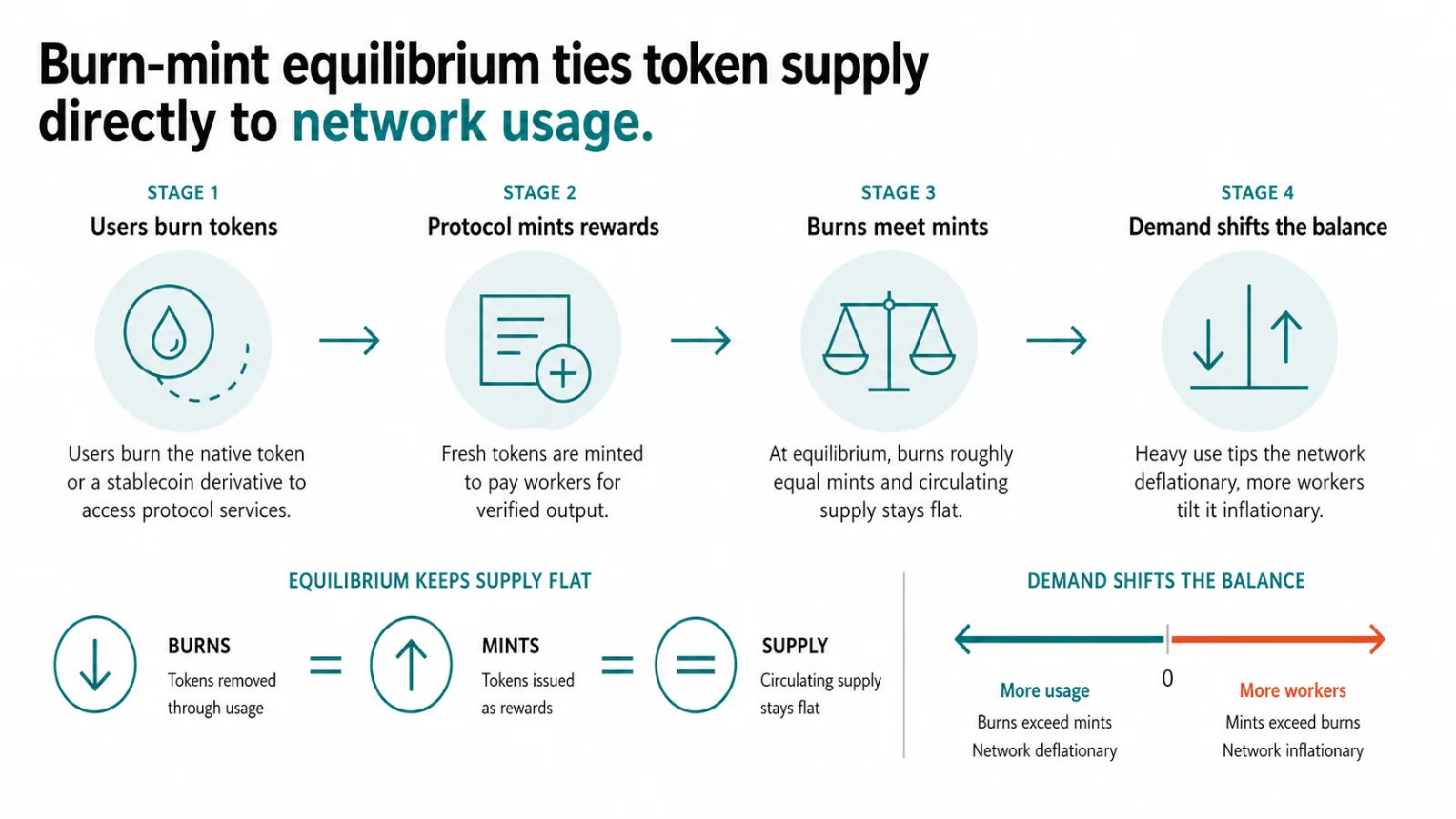
Helium is the live test case. After its August 2025 halving cut annual HNT emissions from 15 million to 7.5 million, and after Helium Mobile subscription revenue began funding ongoing HNT buy-and-burn, the token tipped into net deflation in Q4 of 2025. Burn rates measurably outpaced issuance for the first time in the network's history. That is not a marketing claim; it is an on-chain accounting outcome of a design that couples token supply directly to service demand. For the burn-side mechanics, see token burning 101.
If your protocol has a real usage-based service component, BME deserves serious evaluation as a primary design rather than an afterthought slapped on later.
Validator emissions are a different category
Layer-1 and Layer-2 chains face an emission decision that most other token projects don't: they have to pay validators to secure the network, indefinitely. This is operational expenditure, not user-acquisition incentive, and it should be designed around different math.
Three numbers drive the calculation. First, the minimum yield required to attract enough honest validator capital, given competing risk-free options. Second, the opportunity cost of the capital at target market conditions, since stakers will not lock up ETH or SOL or whatever for less than they could earn deploying it elsewhere. Third, the slashing exposure validators take on, which is a real cost that has to be priced into the gross yield they receive.
Ethereum currently sits at approximately 3 percent staking yield, and that number is calibrated, not arbitrary. It dropped meaningfully after EIP-1559 because some validator compensation now comes from burned base fees rather than fresh issuance. The protocol learned, mid-flight, that paying more than necessary is a transfer from non-stakers to stakers and reduces the token's value to anyone not running a validator. Solana, Cosmos, and other higher-yield chains pay more in nominal terms but also dilute faster, so a meaningful chunk of the headline number gets eaten by inflation over any holding period long enough to matter.
Founders launching an L1 or L2 should set validator emissions based on security budget math: how much stake do we need to make a 51 percent attack uneconomic, and what is the minimum yield that gets us there? Anything above that minimum is wasted dilution. This is the calculation we run for L1 clients at FinDaS, and it almost never produces the yield number the founders started with. The token staking 101 piece covers the staking-side mechanics in more depth. Don't pick your validator yield by surveying what other chains pay; pick it by computing what your specific security model requires.
Lock the schedule, build credibility
The most under-priced design decision in tokenomics is whether the emission schedule can be changed by governance after launch. The answer should usually be no.
The 2020 to 2024 era is full of cases where DAOs voted to extend or increase emissions to keep yield-farming programs alive. Each vote made short-term sense to the participants who showed up, and each vote diluted the long-term holders who didn't. This is a predictable failure mode. Token-weighted governance with time-bounded participation will reliably outvote long-term interests when the question is "do we keep the party going." The only durable fix is to make the question impossible to ask: write the emission schedule into protocol code with a ratchet that lets governance reduce emissions but never increase them. It eliminates an entire class of attack vectors at the cost of zero flexibility you should actually want. The governance 101 piece covers the broader framework for which decisions belong in code versus which belong in a DAO vote.
Beyond the governance lock, there is a softer constraint: market trust in your emission schedule is a function of credibility, not numbers. If a protocol changes its schedule once, the market prices in the possibility of a second change. Change it twice and the market discounts your stated long-term emission as a wish, not a commitment. Bitcoin's schedule is the most credible in crypto specifically because it has never been altered, and the social and political cost of altering it is now astronomical. That credibility compounds. It is also nearly impossible to manufacture quickly, which is why the schedule you launch with should be treated as a near-permanent commitment.
You can have the most elegant token economy design, dynamic supply with mints and burns calibrated to actual usage, and then your project meets the first investor and suddenly the project NEEDS to become very deflationary. That redesign isn't designed for the project. It's designed for the investors.
The pressure runs in both directions. Inside the team, there are reasons to extend emissions to make next quarter's metrics work. Outside the team, there are investors whose mental model is "scarcity good," who will push hard for a hard cap whether or not it fits the protocol. Both pressures push the schedule in the direction of whoever is loudest in the meeting, not toward what the protocol actually needs. Locking the schedule in code at launch is, in part, a defense against your future self.
The recommendation: design the emission schedule once, with the explicit assumption that you will not get to revise it, and write that constraint into the contract.
More from the 101 series
Frequently Asked Questions
01Should a token have a hard cap?
+
02What counts as real yield?
+
03Can a deflationary token still be a bad investment?
+
04What's the difference between emission rate and emission schedule?
+