Crypto points programs reward users for specific on-chain actions with non-transferable, off-chain points that later convert into an airdropped token. They're pre-token distribution mechanisms with engagement signals attached, not loyalty programs in the Web2 sense. Well-designed versions (Hyperliquid's HYPE distribution being the canonical example) reward real product usage and filter wash trading; poorly designed ones (Friend.tech) subsidize mercenary behavior that evaporates the moment tokens land. Whether a points program works depends almost entirely on whether the underlying product is worth using once the points stop.
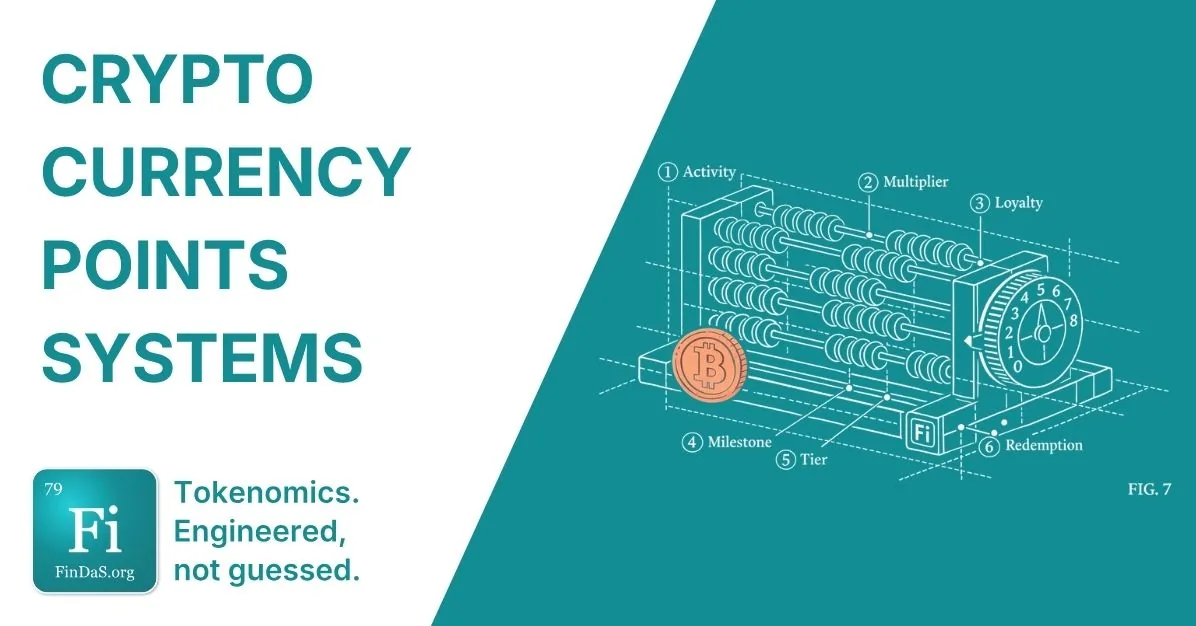
What a points program actually is (and what it isn't)
A crypto points program is a pre-token distribution mechanism dressed up as a loyalty program. Users earn non-transferable, off-chain points for specific actions (trading, providing liquidity, holding assets, referring others), and at a later date those points convert into an airdrop of the project's token. The points themselves don't trade, don't have a listed price, and in most jurisdictions aren't claimed as anything with monetary value. This is one corner of the broader tokenomics design problem, but it's the corner where most go-to-market strategy now lives.
The Web2 comparison misleads. Airline miles and grocery rewards are loyalty systems layered on top of products with established revenue: the business already has something people pay for, and the rewards are cheap retention mechanics. Crypto points programs run before there is a product-market fit to defend, and the economic weight sits entirely at the conversion moment, not in the day-to-day engagement. Treating the points as cosmetic is how projects miss what the system is actually doing, which is pre-staging a token distribution while collecting behavioral data to inform the conversion.
Crypto.com research put cumulative points issuance across protocols at more than 115 billion by February 2024, and the number has grown considerably since. That tells you two things. First, the mechanism is now the default pre-TGE playbook across DeFi, SocialFi, NFT marketplaces, and L2 bootstrapping campaigns. Second, the market has trained users to treat any interaction with a tokenless protocol as speculative farming, which changes what the engagement signals actually mean.
Why projects run them instead of airdropping directly
Four reasons, each real with caveats. A direct sale or retroactive airdrop is simpler to execute and legally cleaner in most jurisdictions, but it gives up properties a points program provides. The first is targeting: a direct airdrop either rewards anyone who held an asset by a cutoff date (wasteful, pays unrelated addresses) or uses a retroactive activity snapshot (relies on heuristics the team designs in private, after the fact). A points program does the filtering in the open and over time, which makes the eventual distribution defensible when users ask why they did or didn't qualify.
The second is Sybil resistance through duration. A single-snapshot airdrop is trivial to farm: spin up wallets, perform the minimum qualifying actions, claim from each. A points program running four to twelve months with continuous-behavior weighting forces farmers to maintain dozens of wallets with capital parked in each, or accept a much worse return per wallet. Farming doesn't disappear, but the cost floor goes up, which shifts the distribution closer to genuine users.
The third is optionality. During the points phase, the team observes behavior across different actions, adjusts incentive weights, and decides conversion ratios after seeing real engagement data. This only pays off if the team has the analytical capacity and the willingness to act on what they see. A lot of teams have neither, in which case the optionality is theoretical.
The fourth is regulatory cover, with the biggest asterisk. Points aren't tokens, which gives teams operating in ambiguous jurisdictions some room to build a user base before the question becomes concrete. That said, "legally ambiguous" is not "safe". Under MiCA in the EU and the current US enforcement posture, clearly airdrop-linked points are starting to be treated as investment contracts regardless of transferability, especially when public messaging makes the conversion a near-certainty. Get jurisdictional advice before assuming the cover holds.
Design choices that determine whether it works
A points program's design collapses to a handful of decisions. Get them right and you get Hyperliquid; get them wrong and you get a wash-trading farm with no retention. The difference is mostly operational and mostly knowable in advance.
Start with conversion transparency. Announce the points-to-tokens ratio upfront and farmers will optimize exactly for it. Hide it entirely and you lose credibility with users who need to believe something will actually happen. The working compromise is to publish the earning rules and season structure but hold the final conversion ratio, and to reserve the right to penalize behaviors flagged as farming. Hyperliquid did this. Most successful programs since have converged on the same pattern.
Then scoring. Pure volume-weighted systems (one point per dollar of trade volume) are wash-trading invitations, which is why early Blur had the wash-trading problem it did. Behavior-weighted systems pay for diverse actions across trading, liquidity provision, asset holding, and referrals, which is harder to game with a single strategy because a farmer has to replicate the diversity across every wallet.
Then loyalty curves. Reward sustained presence, not cumulative activity. A user who provided liquidity for six months should meaningfully out-earn one who matched the total volume in a week of end-of-season farming. Time-based multipliers do this mechanically. Tier systems in isolation rarely move the needle unless the tier benefits are themselves valuable, which loops back to the underlying tokenomics design question of what utility the eventual token provides.
Last, enforcement. This is where most programs fail. Claiming anti-Sybil measures in a blog post is cheap. Running wallet clustering, reviewing flagged accounts manually, and absorbing the political cost of disqualifying farmers who insist they followed the rules is expensive. Lighter.xyz's public Sybil-filtering work in late 2025 redistributed points from flagged wallets to verified users rather than burning them, which gave the integrity signal teeth and showed other farmers the policy was load-bearing. In the audits I run, the anti-farming question is usually the first one I push on.
Most programs fail at the anti-farming step. Cheap to claim, expensive to run.
Hyperliquid: what the gold-standard version looked like
Hyperliquid is the example everyone cites for a reason, and the mechanics are worth going through concretely. The program ran from late 2023 through November 2024 across multiple seasons: closed alpha, Season 1, Season 1.5, Season 2 from May 2024 at 700,000 points distributed weekly, and an unannounced Season 2.5 running through November. Weekly distributions were transparent. Conversion mechanics were deliberately left opaque until the Token Generation Event. Anti-Sybil enforcement flagged wash trading and self-trading, with points withdrawn from flagged wallets rather than left to convert.
At the TGE on 29 November 2024, Hyperliquid distributed 310 million HYPE tokens (31 percent of the 1 billion total supply) to roughly 94,000 eligible users. The team took zero venture funding, so the 31 percent wasn't competing with a VC allocation for supply share. Conversion weighted real engagement (volume from genuine accounts, liquidity provision, platform usage) rather than raw activity counts. The post-TGE performance reflected that: HYPE appreciated rather than dumped, because recipients had operational reasons to hold.
The uncomfortable part is that the points program worked largely because the underlying product worked. A decentralized perpetuals DEX with sub-second execution and a functional order book is worth using without any incentive attached. The points program amplified adoption of a product that had product-market fit. It didn't create it. Projects looking at Hyperliquid as a template often miss this, which sets them up for the opposite outcome.
Friend.tech and the mercenary-capital failure mode
Friend.tech is the opposite case. Launched on Base in August 2023 as a SocialFi protocol, it ran a weekly points program for several months, distributed the FRIEND token in May 2024, and was effectively dead within weeks of the airdrop. The token currently trades at roughly zero. The team stepped back from active development later in 2024 and eventually handed the contracts to the community.
The diagnosis isn't that the points program was badly designed; the mechanics themselves weren't remarkable in either direction. The diagnosis is that the product stopped being interesting once the points stopped. Users engaged because engaging earned points, and when points converted to tokens and a clear end-state arrived, the engagement evaporated. The social layer had no residual value on its own terms, only as a vehicle for earning points.
This is the mercenary-capital failure mode, and it's the biggest single risk with points programs. The program pulls forward engagement that wouldn't otherwise exist, compresses it into the pre-TGE window, and banks on the engagement becoming habit before the points expire. If the underlying product doesn't independently earn retention, the program is funding the demise of the project rather than its launch. Points programs work worst in categories where the product value depends on network effects a temporary incentive can't credibly bootstrap.
Before you launch a points program: questions to answer
Treat the following as the checklist I'd walk through with any team considering a points program. Not every answer has to be yes, but the team should know which trade-offs they're accepting. Skip the checklist and the program will fail in one of the ways this article catalogs.
- Is the product good enough that users would engage without incentives? If not, the points are probably fixing the wrong problem.
- Is there actual anti-farming infrastructure planned, not just claimed? Budget for wallet clustering, manual review, and the political cost of enforcement.
- What percentage of total supply routes through the points program? Typical range is 20 to 35 percent for community-weighted distributions. The upper end requires a very lean ins