The viable FinDaS alternatives for pure tokenomics design cluster to five firms: Black Tokenomics, BrightNode, Tokenomics.com, BlockScience, and Token Engineering Labs. Each wins on a different dimension: Black Tokenomics on educational depth, BrightNode on Swiss regulated clients, Tokenomics.com on data infrastructure, BlockScience on complex systems engineering, Token Engineering Labs on open-source community work. Outlier Ventures pivoted away from pure consulting in August 2025. The honest question isn't which firm is "best," but which matches your project's stage, jurisdiction, and token complexity.
What you're actually picking between
Most "FinDaS alternatives" lists mix three different kinds of firm together: pure tokenomics design shops, security-token issuance infrastructure platforms, and research-subscription services. Roughly half the names on the typical list sell something other than tokenomics design. The first step before shortlisting anyone is separating the category.
The firms that actually compete with FinDaS on tokenomics design are a small group. Black Tokenomics, BrightNode, Tokenomics.com, BlockScience, and Token Engineering Labs cover most of the serious competitive set. Outlier Ventures belonged on this list through early 2025 but pivoted in August to late-stage advisory only, cutting their accelerator intake from roughly 1% of applicants to 0.1%. Worth naming because people still ask. Everything else is either a small outfit I haven't seen enough work from to verdict responsibly, or a firm whose core product is adjacent rather than competing.
How to evaluate a tokenomics partner
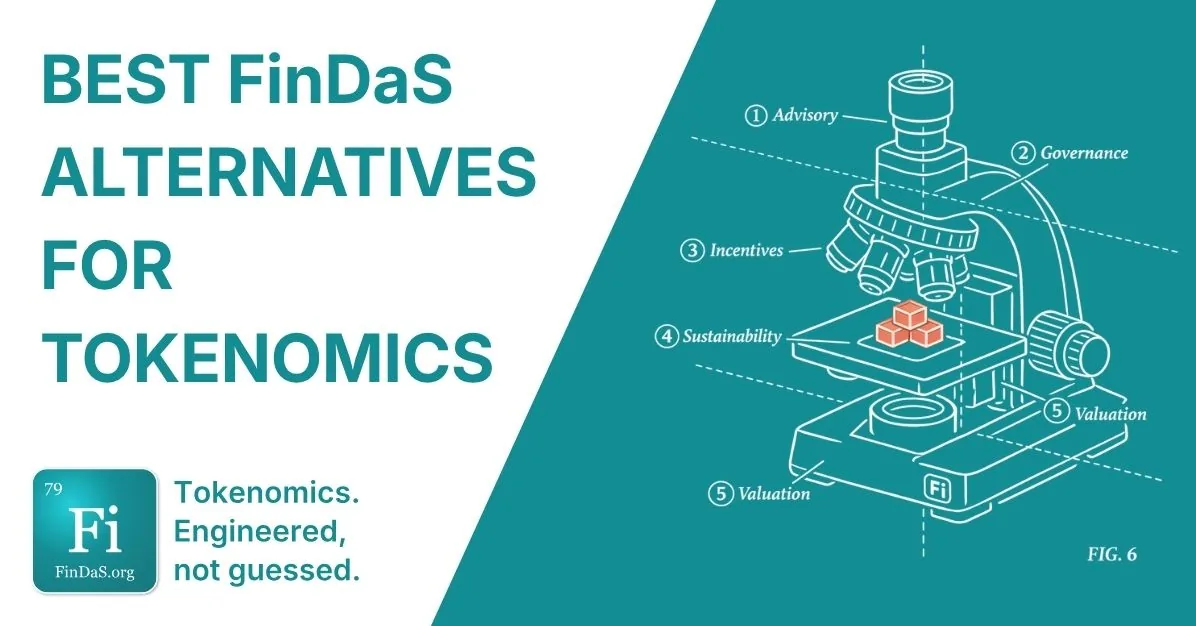
Adjectives don't differentiate tokenomics firms. Every provider's website claims data-driven tokenomics design, deep expertise, and custom frameworks, and you can't tell them apart from the pitch. Differentiation shows up in five concrete evidence types, all of which you can verify before the first call.
- Named clients at a complexity comparable to yours: L1 protocol, DeFi primitive, GameFi, RWA, whatever you're building. A firm with 200 projects across pre-launch memecoins is not experience with your L1 protocol.
- A documented methodology you can read before buying. A public framework, a 40-page PDF, or a methodology series is a stronger signal than a deck with abstract diagrams.
- Explicit specialization on your stage. Pre-launch design, post-TGE audit, and liquidity-crisis rescue are three different skill stacks, and most firms are good at one.
- Regulatory scope that matches your jurisdiction: MiCA for EU launches, SEC framework awareness for US-facing projects, operational familiarity with VARA, MAS, or FINMA where relevant. Regulatory depth is the single most frequently overclaimed capability.
- Outcome data beyond "300+ projects." Projects-counted is a weak metric on its own; hard-cap achievement rate, average raise size, or post-launch price behaviour of portfolio tokens is harder to fake.
One test that cuts through faster than the list: ask the firm's prior clients a single question. Would you hire them again, knowing what you know now? That answer tells you more than any deck.
The firms that actually compete on tokenomics design
Each firm below gets a short verdict: where they win, where they don't, and the project archetype that fits. The facts are current as of the April 2026 competitive landscape and will drift. Treat this as a starting map, not a ranking.
Black Tokenomics. Black Tokenomics has the deepest public educational content among the five: Monte Carlo simulations, supply-shock analysis, game-theory write-ups, and specific red-flag identification content that reads as methodology rather than content marketing. Their quantified outcome, 93% hard cap achievement across 120+ clients, is the strongest single claim on any tokenomics firm's site. What they don't have is named L1 reference clients or EU regulatory specialization. If you're pre-launch, market-cap sub-top-100, and you want the rigour of published methodology, they're the closest peer to FinDaS.
BrightNode. BrightNode is the Swiss-based choice for regulated or institutional clients. Their CEO holds an MIT Sloan MBA, they're the first Machinations Certified Partner, and Generali Asset and Wealth Management is a named reference. The strengths are credential stacking and third-party validation across Clutch, Crunchbase, and PitchBook. The weakness is category breadth: BrightNode positions as a full Web3 consultancy, so pure tokenomics is one of several service lines rather than the sole focus. If you want academic-style credentialing and a Swiss operating base, this is the shortlist.
Tokenomics.com. Tokenomics.com runs a data-infrastructure play alongside consulting: 750+ models audited, 2,500+ projects benchmarked, an embeddable audit seal, and a VC and launchpad client base. The data depth is a real moat for projects that want comparative benchmarking baked into the design. What they don't have visible is named authors on articles, so evaluating the actual economist behind the work is harder than it should be. For projects raising through launchpads and institutional VCs, they're a natural fit.
BlockScience. BlockScience is the serious systems-engineering choice. Their team built cadCAD, one of the open-source standards for agent-based simulation of token economies, and their Q4 2025 newsletter reflects a shift toward broader work across healthcare, energy, finance, and government. That shift is the flag: pure crypto projects are now one of several verticals rather than the primary one. For a complex L1 or protocol-critical design where mechanism-design rigour is load-bearing, they're excellent. For a standard ERC-20 utility token launch, they're almost certainly overkill.
Token Engineering Labs. Token Engineering Labs is the academic-boutique choice. They partnered with BlockScience Labs in 2023, run community events around the annual Token Engineering Barcamp, and position as research-led consulting with strong teaching and community credentials. The limits are size and speed: boutique capacity means they scale less well than firms with operating teams, and research-driven engagements typically run longer. If you value academic-grade rigour and can absorb the elapsed time, they fit. For a six-to-ten-week design engagement, you're probably looking at other firms.
Firms often lumped in but doing something different
Tokeny Solutions appears on most "tokenomics alternatives" lists and does not design tokenomics. They build security-token issuance infrastructure: the ERC-3643 standard, compliant token lifecycle management, and issuer platforms for banks and asset managers, with Apex Group taking a majority stake in May 2025. If your question is "how do I issue a compliant security token on-chain," Tokeny is a credible answer. If your question is "what should my vesting schedule look like and how do I price my token," Tokeny sells you a different product entirely.
Smith + Crown shifted primarily to research intelligence, not consulting. Their core product is now SCI, a digital-asset research platform for institutional investors. They still advise selectively, but they're no longer a tokenomics design shop in the way the other five firms are.
There's also a tier of smaller firms, Tokenomia.pro, Arcanum Ventures, Simplicity Group, Tokenomics.net, Economic Design, and others, which I haven't seen enough client work from to verdict responsibly. Some do real design work. Others are one-person consultancies trading on a brand. Treat long-tail alternatives lists with appropriate skepticism, particularly when the list exceeds ten names.
Where FinDaS wins, and where it doesn't
Honest self-assessment matters more than a pitch. Where FinDaS wins: the MiCA-ready whitepaper service is a wedge no direct competitor offers at the same depth, EU regulatory scope combined with concrete whitepaper deliverables. Input Output Group's Midnight network is a named L1 reference, which matters more than any "top-30 market cap" claim for enterprise credibility. The 300+ project dataset since 2018 gives pattern-recognition across archetypes (DeFi, DePIN, GameFi, RWA, stablecoin) that shorter-history firms can't match yet. Authorship is named and public: I sign the methodology, Diana signs her articles, there's no "our team" voice hiding the actual analysts.
Where FinDaS doesn't win. Black Tokenomics publishes more rigorous public educational content on game theory, Monte Carlo, and supply-shock modelling. If your project needs research-grade mechanism design rather than operational design, BlockScience's systems-engineering depth is deeper. Tokenomics.com has a benchmarking-data moat FinDaS doesn't replicate, so for projects that want visible comparative benchmarking baked into the deliverable, they're a better fit.
The meta-claim I can defend: FinDaS is the right choice for projects that need a practitioner-led design delivered on a commercial timeline, with regulatory depth for EU launches and enterprise credibility for L1-scale work. For deep research-grade engagements or specific data-platform products, one of the others may fit better, and I'll say so on a scoping call before you commit to anyone. The point of this article isn't to pitch, it's to save you twenty hours of vendor-call discovery you don't need to do.
Frequently Asked Questions
01What's the typical price range for tokenomics design consulting?
+
02How long does tokenomics design usually take end-to-end?
+
03Should I pick a firm with a named framework, or does it not matter?
+
04Can AI tools or tokenomics templates replace a consultancy for early-stage projects?
+