Metaverse tokenomics is the economic system that governs how users acquire, use, and retain digital property inside a persistent virtual world. Its distinctive constraint is not the token. It is property rights over land, wearables, and identity assets. Because users treat those assets as owned, every sink, royalty, and governance choice in the system is priced as policy risk by the people already holding the assets.
Why metaverse tokenomics is not just tokenomics with a 3D skin
A metaverse is not a protocol with a UI on top. It is a persistent world in which users accumulate digital property they can see and stand on, and that persistence is the distinctive constraint that shapes the rest of the design. Get the property layer wrong, and no amount of clever sink design will stabilise the economy above it.
In a normal token economy, changing a fee schedule or adjusting a sink is a policy change. In a metaverse, once LAND or core wearables are widely held, the same change reads as a change to property law. Users bought the asset expecting a regime. The proposal swaps in a different regime. The asset is repriced accordingly, often quickly, often by the people with the most at stake. You cannot quietly retune emissions or fees without the market treating the retune as expropriation risk, and the distinctive design surface (sinks, royalties, governance, integration posture) is all downstream of that property-rights layer.
Land, wearables, and the "policy as property law" problem
LAND, wearables, names, and reputation badges are not side features. They are the property layer that makes ownership legible to users and to external markets. ERC-721 is the interface that makes all of them look identical to wallets and marketplaces, so a parcel or a wearable can be held, transferred, priced, borrowed against, or displayed outside the world that minted it. Economically, those NFTs play several roles at once:
- Land and space rights: parcels, districts, leases, and access rights that gate building and monetisation.
- Identity and reputation: avatar wearables, badges, names, and provenance that function as social capital.
- Functional items: tools, vehicles, permissions, and companions that change what a user is able to do.
- Creator inventory and market primitives: the unit of production for studios and artists, and a standardised object that can be listed, bundled, or displayed outside the world.
The consequence is that "property expectations" become a design input that does not exist in most other token economies. Once a parcel has been held and resold three times at increasing prices, any rule change affecting that parcel, whether fees, zoning, moderation, or rendering obligations, is a policy change with balance-sheet consequences for the holders. A DAO vote on those rules is not abstract governance. It is a claim on value that was already priced in.
This is why forcing extreme hard scarcity everywhere is often a mistake. Fixed LAND supply is defensible because the world's geometry demands it. Time-limited access, seasonal cosmetics, reputation, and curation rights are soft-scarce inputs that can be generated in response to demand. If the world's goal is sustained cultural production, soft scarcity paired with credible creator tooling usually does more work than squeezing every asset through a hard cap. For why off-the-shelf templates rarely fit this kind of environment, see our note on bespoke tokenomics.
Designing sinks without breaking the world
Most metaverses end up with at least one fungible unit that handles the accounting work. The danger is treating "add a token" as equivalent to "create an economy." A metaverse currency only holds value if it consistently clears real demand inside the world, and only if the sink side can absorb what the earning side generates.
Demand inside a metaverse is heterogeneous, and this is the part project teams underestimate. A trader wants liquidity and exit speed. A creator wants predictable revenue. A newcomer wants low-friction onboarding and prices that are not vertigo-inducing. A landowner wants long-term upside and policy stability. One token used for all four forces all four into the same volatility, fee regime, and governance exposure, even though their needs are not the same. The earning side should map to behaviours that improve the world. The sink side should map to resources, status, or utility users actually want. The sinks that tend to hold up are:
- Primary sales: minting fees for wearables, items, and LAND-related permissions.
- Marketplace and creator-service fees: transaction fees, promotion slots, featured placement, verification, and asset hosting that fund public goods and creator discovery.
- Customisation and identity spend: cosmetics, names, emotes, and personalisation services.
- Governance-linked spend: locking or staking for voting power, proposal rights, or grant participation.
The loop that kills economies is the extractive one. Subsidise entry, users farm rewards, users sell rewards, the token price collapses, creators and operators lose budget, the world becomes less interesting, the next cohort sees declining metrics and does not show up. I have seen that sequence play out enough times to be confident that "high DAU with token incentives" and "functioning economy" are different things. For a deeper look at the supply-side mechanics that either contain or amplify this loop, early sell-pressure mitigation is a reasonable starting point.
Royalties are a market-structure problem, not a technical one
Royalties were the designed mechanism for funding creators on the secondary market. In practice that mechanism has been partial at best since 2023. EIP-2981 standardises how an NFT contract reports its royalty information through a royaltyInfo() call, which tells marketplaces the intended recipient and amount. The standard is deliberately minimal, and the payment itself is voluntary. A simple transfer is not always a sale, so the standard delegates enforcement to the marketplace.
When marketplaces started defecting, that delegation turned out to matter. Blur launched in late 2022 with optional royalties, and once volume migrated, Ethereum's enforcement regime collapsed in slow motion. OpenSea retired its Operator Filter on 31 August 2023, conceding that the blocklist-based enforcement tool depended on ecosystem support that never materialised. The concrete illustration: between 1 June and 21 August 2023, Bored Ape Yacht Club did roughly 286 million dollars in volume on Blur against 21 million dollars on OpenSea. Almost all of the theoretical royalty revenue from that quarter routed through a venue that did not enforce it.
The practical implication for metaverse tokenomics is that a royalty policy is a market-structure claim, not a technical one. You can signal any royalty you want in the contract. Whether it gets paid depends on which marketplaces users trade on, which of those marketplaces honour it, and whether the project has enough leverage to punish defectors. The workable responses are to front-load economics into primary sales, stand up a project-owned marketplace (Art Blocks did this early, others have followed), move to chains where royalty enforcement can live at the protocol level rather than the marketplace level (Solana and Hedera both offer variants), or restrict settlement to a whitelist of honouring venues.
This matters for metaverse design because the wearable and cosmetic economy is the most creator-dependent part of most worlds. If the royalty math is not realistic, creator inventory shifts to a "sell everything upfront" model, which changes what creator tooling has to do and reframes the platform's role from royalty intermediary to primary-sale distribution channel. It also changes the platform's recurring revenue base, since marketplace fee streams that assumed healthy secondary turnover no longer land as planned.
Governance as a priced risk
A metaverse is not a static product. Rules around curation, moderation, builder incentives, marketplace policy, and grants need to change over time. On-chain and off-chain governance is how those changes become legitimate enough to be absorbed without repricing the entire economy.
Decentraland's DAO is a concrete reference for how this can be structured. MANA, NAMES, and LAND holders vote. Proposals are recorded via Snapshot and IPFS, and approved actions are enacted on-chain by a committee multisig with a security advisory structure overseeing it. In December 2025 the DAO approved an independent smart-contract audit by Regenesis Labs, the kind of accountability infrastructure that turns governance from a performance into a control system. The Sandbox's August 2025 restructuring, where Animoca Brands moved co-founders Arthur Madrid and Sébastien Borget into non-executive roles and laid off roughly half of a 250-person staff, is the opposite lesson: when governance is de facto concentrated in a parent company, an operational shock reprices the whole platform in a single news cycle.
The underlying point is that governance quality is priced. When a user buys LAND or builds a business inside a world, they are implicitly underwriting the policy regime. Opaque or routinely-bypassed governance prices in political risk on top of usage risk. Governance that is too rigid or too easily captured cannot respond to security incidents, economic imbalances, or moderation crises. Most worlds have at least four constituencies with divergent interests (creators, landowners, everyday users, core contributors); if voting power concentrates in any one of them the economy tilts, and if power is too diffuse execution fails.
This is why treasury and public-goods funding should be treated as first-class economics rather than an afterthought. Client software, creator tooling, moderation, discovery, and community programs all need continuous investment, and tokenholders who want upside still need the world to be funded. When we do tokenomics consulting on metaverse projects, institutional cashflows (fees, grants, sustainable incentives, policy levers) usually get mapped before the emission schedule does.
Integration posture sets the incentive ceiling
Metaverse tokenomics increasingly depends on how assets and identity move across tools, chains, and worlds. Interoperability is not only a graphics problem. It is an economic boundary problem. Every standard that makes an asset easier to move is a standard that makes exit from your world cheaper.
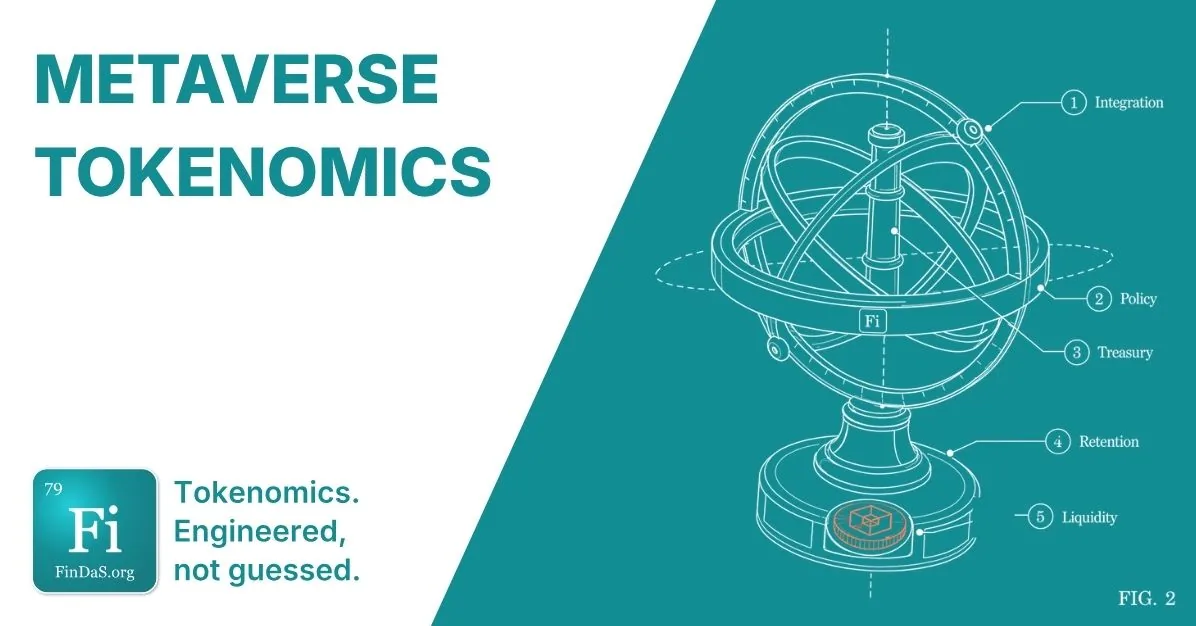
The direction of travel is concrete. The Alliance for OpenUSD published OpenUSD Core Specification 1.0 in December 2025, and the Khronos glTF Gaussian Splatting extension followed in early 2026, with both groups actively coordinating to keep their representations convertible. 3D assets, spatial data, and scene descriptions will increasingly be portable across tools and platforms. For operators, that is a double-edged design input. External liquidity lowers onboarding cost and broadens demand. External liquidity also means internal sinks have to compete with external venues on price. The integration surface typically runs across five layers:
- Market integration: NFTs and currencies tradable on external marketplaces and aggregators.
- Chain and L2 integration: bridging or settling on L2s to reduce transaction costs, with the attendant bridge and custody risks.
- Creator tooling: external DCC tools, asset standards, and publishing pipelines.
- Identity and DeFi: names and reputation that users carry between contexts; tokens used as collateral or liquidity outside the world.
Each layer changes exit options, which changes incentive design. If users can earn inside the world and immediately monetise outside, emissions become more extractable. If creators can sell on external marketplaces without the world taking a cut, in-world monetisation has to compete on distribution, community, and experience rather than access alone. There is no universal best practice here. A world that wants to be a cultural destination can tolerate open trading and focus retention on non-financial loops. A world that wants to be a composable platform has to design around external liquidity from day one and harden against mercenary dynamics. The same tokenomics will not serve both.
Meta's Reality Labs reported another 4.2 billion dollars of losses in Q1 2025 alone. The Sandbox is pivoting toward a memecoin launchpad on Base. Decentraland is shipping a new client, running monthly events for a few thousand committed users, and maintaining a DAO that approves real audits. The open question for the next cycle is not whether metaverses exist. They exist. It is which ones have a property-rights layer credible enough to let a real creator economy form on top of it.
Frequently Asked Questions
01How is metaverse tokenomics different from GameFi tokenomics?
+
02Should a metaverse always launch a fungible token, or can it run on NFTs and fiat alone?
+
03Why did marketplace royalty enforcement collapse, and what do creators rely on now?
+
04Can a metaverse survive a prolonged drop in its native token's price?
+