LBPs are issuance machinery, not valuation machinery
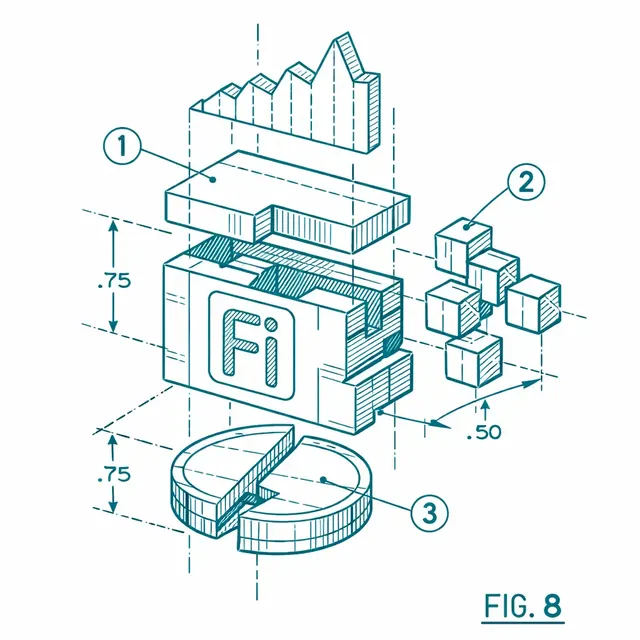
Liquidity Bootstrapping Pools work because they turn token issuance into a controlled market microstructure problem. A weighted AMM with time-dependent weights creates the launch price path mechanically through pool balances and scheduled weight changes rather than by an order book or a fixed sale price. Balancer’s documentation is explicit that spot price is a function of balances and normalized weights, and that the pool’s token ratios change over time.
From a financial-fundamentals standpoint, that makes an LBP a very good selling mechanism and only a mediocre proxy for long-run value. In a standard Balancer design, the pool owner is the only address that can join the pool, and Balancer’s whitepaper states that swap fees accrue to liquidity providers. The practical implication is that the issuer typically captures the reserve asset raised during the auction and also captures swap fees generated during the sale. That is efficient treasury formation. It is not the same thing as durable value accrual for the token buyers who remain after the auction ends.
That distinction matters because Balancer LBPs became a renowned launch format for protocols including Maple Finance, Perpetual Protocol, and Aura Finance. Perpetual Protocol’s documentation says its September 2020 LBP distributed 7.5 million PERP, equal to 5% of total supply, to more than 1,200 participants. Aura’s documentation says 2% of AURA supply was allocated to an LBP and that just under 1.7 million AURA were claimed there. These are real issuance events, not theoretical case studies.
Why the mechanism works better than most token launch narratives admit
The core LBP edge is simple: it manufactures sell pressure on purpose. Balancer’s docs say the starting price should be set above the team’s estimate of fair value so that the programmed weight shift can pull price downward until buyers step in at levels they accept. That reverses the usual ICO psychology. Instead of rewarding the fastest wallet, the structure tries to reward patience. Balancer explicitly frames this as a mechanism that disincentivizes buying early and encourages the market to wait for a fairer level.
That is why LBPs can reduce the opening chaos that standard spot listings often create. Balancer’s own documentation says teams can start with only 10% to 20% of the reserve asset instead of the 50% reserve balance they might need in a conventional two-sided pool, and still end the sale with substantially more reserve currency while avoiding the extreme first-day volatility common in immediate 50/50 launches. That capital efficiency is one of the few launch claims that is not just narrative. It follows directly from the AMM weight structure.
Modern launch platforms have pushed the idea further. Zero Liquidity LBPs use virtual collateral so a team does not need to deposit real reserve capital upfront, and buy-only variants disable selling back into the pool during the sale. Those variants can be useful, but they are economically different products. Zero-liquidity designs reduce upfront funding needs even further, while buy-only designs remove one side of price discovery in exchange for less reflexive dump pressure during the event.
Where LBPs are genuinely strong
LBPs are strongest when the objective is inventory monetization with market-based price discovery. They let a team sell treasury inventory into demand gradually, raise reserve assets with less initial capital than a standard 50/50 pool, and give the market time to settle instead of forcing a single clearing print. For a protocol that wants a transparent public sale without overcommitting balance-sheet capital on day one, that is a coherent use of AMM infrastructure.
LBPs are also better than fixed-price sales when the issuer does not actually know fair value. Fjord’s fixed-price sale documentation is built around the team choosing the token price, the token quantity, and optional wallet limits in advance. An LBP makes a different bet. It accepts uncertainty and lets the clearing level emerge through trading. That is not always superior, but it is more honest when the valuation is genuinely unknown.
There is now a meaningful empirical base behind those intuitions. A Balancer-hosted research report published in 2026 analyzed 961 LBPs across Balancer V1 and V2 on Ethereum, Polygon, and Arbitrum, covering launches from 2021 through 2024. It found that the average LBP lasted about 88 hours, that starting project-token weights were heavily concentrated between 90% and 100%, and that end states clustered around either a near-full flip into reserve assets or a 50/50 “soft landing” that transitions directly into a standard trading pool.
What LBPs do not solve, and usually cannot solve
An LBP does not solve post-launch token demand. It solves how to sell tokens, not why those tokens should retain value after the issuer stops selling. The evidence from actual protocols makes that obvious. Perpetual later routed 15% of trading fees to vePERP holders when the insurance threshold is met. Aura tied 50% of AURA supply emissions to BAL earned on Aura. Maple said fee revenues from Maple and Syrup lending operations would be used to buy back SYRUP. In all three cases, the lasting economic question was not the auction curve. It was the value flow after launch.
LBPs also do not eliminate extractive trading. They mostly reshape it. Balancer’s legacy LBP guidance discusses front-running windows, initial price spikes, slippage failures, and the use of temporary higher swap fees in delayed launches to tax early bot activity. Academic work on dynamic AMMs frames the same issue more formally: changing target weights introduces arbitrage opportunities by design, and the interpolation path affects how much value leaks to arbitrageurs during rebalancing. In plain English, the curve is part of the cost structure.
LBPs are also not maximally trustless at launch. Balancer’s docs say the owner selects the start and end weights, the start and end times, and can pause swaps. Legacy Balancer guidance is even more direct that more retained rights mean more potential manipulation and more trust required. That does not make LBPs unusable. It means the market should price governance and operational discretion as part of the launch.
The parameter choices that actually matter
The most useful recent evidence is not a formula for success. It is a filter for avoidable failure. The Balancer-hosted study found that no single parameter had strong correlation with final launch success, which means there is no magic start weight, swap fee, or duration that can rescue weak demand. That result is important because it cuts directly against the usual token launch superstition that a perfect curve can substitute for real buyer interest.
| Design lever | What the evidence says | Why it matters economically |
|---|---|---|
| Starting weight | Use a very high initial project-token weight. The 961-LBP study found healthy pools averaged about 94.1% starting project weight, while dumped pools averaged about 86.7%. | A higher initial weight creates a higher opening valuation buffer and gives the programmed sell pressure room to work before bots and impatient buyers distort the curve. |
| Duration | The best window was medium length. The same study found bot activity was lowest in the 24-72 hour bucket at about 10.4%, versus about 11.8% for pools under 24 hours and 16.8% for pools above 72 hours. It identifies 48-72 hours as the sweet spot. | Too short and the event becomes a bot race. Too long and arbitrageurs harvest slow price decay. |
| End state | Real launches cluster around two endpoints: a near-full flip into reserve assets, or a 50/50 “soft landing.” | The first maximizes treasury conversion. The second is better if the team wants immediate continuity into a normal trading pool. |
| Swap fee | Balancer’s practical guidance says fees should usually stay low, with temporary higher fees reserved for delayed-launch anti-front-running setups. | High fees can deter toxic early flow, but they also reduce genuine participation and can turn the sale into a tax event. |
| Variant selection | Buy-only and zero-liquidity LBPs are available on Fjord, but they materially change the mechanism. | These are strategic choices, not UI toggles. They alter who bears price-discovery risk and when real liquidity enters the system. |
The highest-value practical takeaway is that slope and duration matter more than cosmetic ratios. The Balancer-hosted analysis explicitly argues that the rate of weight change is the critical mechanical variable and that extreme durations are counterproductive. That aligns with the academic intuition around dynamic AMMs: rebalancing paths are not free, and poor path design leaks more value to arbitrage.
When an LBP is the right choice
An LBP is the right launch format when a team wants open price discovery, needs to bootstrap initial liquidity with less reserve capital than a standard 50/50 AMM, and is comfortable accepting market-clearing uncertainty in exchange for a fairer public distribution process. It is particularly appropriate when the treasury objective is explicit: convert a portion of token inventory into stable reserve assets while minimizing first-block chaos.
An LBP is the wrong choice when the team really wants price certainty, rigid allocation control, or a clean separation between fundraising and secondary-market trading. In those cases, fixed-price or other sale formats are usually more honest. Fjord’s fixed-price flow makes that trade-off clear: the issuer sets the price, quantity, timing, and optional wallet caps in advance. That is less market-native, but it is better aligned with teams that want deterministic fundraising instead of discovery.
LBPs also remain a live part of the Balancer stack rather than a 2020 relic. Balancer’s public deployments repository lists v3 LBP deployments dated March 7, 2025, July 1, 2025, and December 19, 2025. A Balancer governance proposal published on November 10, 2025 proposed disabling the remaining v2 pool factories, including the v2 no-protocol-fee LBP factory, so that new pool creation would move to v3. That is a concrete signal that the mechanism is still maintained and strategically relevant.
For teams thinking about an LBP, the hardest token economy question is usually not the launch curve. It is what happens after the curve. If the token has no defensible claim on fees, no durable utility that drives paid demand, and no credible post-launch liquidity plan, then even a well-structured auction only gives you a cleaner starting point for future underperformance. That is why, in real token economy design, launch mechanics should usually be sequenced after value-flow design, treasury policy, and post-TGE liquidity incentives. At FinDaS Tokenomics, that is the distinction we push hardest in tokenomics consulting: optimize the auction last, after the business model can carry the asset.