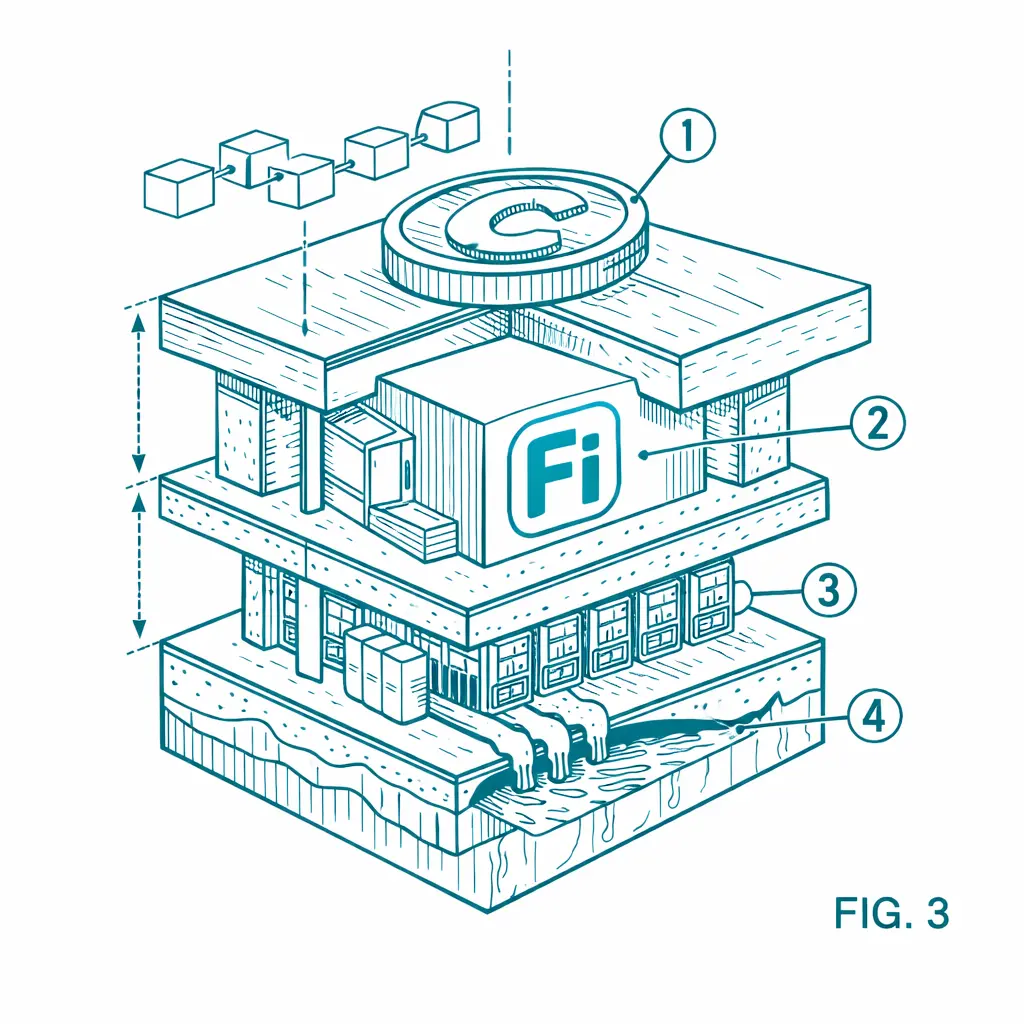
Cryptocurrency mining is not one environmental issue. It is a stack of issues created by one design choice: proof-of-work turns network security into continuous electricity demand. Cambridge’s survey-based estimate put Bitcoin at 138 TWh per year and 39.8 MtCO2e, with 52.4% of reported energy from sustainable sources but 38.2% still coming from natural gas, the largest single source in the reported mix.
The analytical mistake is to treat “crypto” as the unit of analysis. The relevant unit is the consensus mechanism. Ethereum’s switch on September 15, 2022 reduced its energy consumption by about 99.95%, which means the environmental burden of public blockchains is not technologically fixed. It is largely a protocol design choice.
Proof-of-work is the footprint driver, not blockchain activity in the abstract
Proof-of-work creates a direct link between token issuance, fee revenue, and electricity expenditure. When token price or fees rise, more hardware can profitably compete for block rewards. That makes energy demand endogenous to the security model, not a side effect. Proof-of-stake breaks that link because validators secure the chain by locking capital rather than burning power in a compute race.
That difference is visible in orders of magnitude, not marginal percentages. Ethereum’s current annual electricity use is estimated at 0.0026 TWh with annual emissions of about 870 tonnes CO2e. The same source places pre-Merge proof-of-work Ethereum at roughly 21 TWh. Bitcoin remains in the 138 TWh range in Cambridge’s 2025 estimate.
| Network | Consensus | Annual electricity estimate | Annual emissions estimate | Analytical implication |
|---|---|---|---|---|
| Bitcoin | Proof-of-work | 138 TWh | 39.8 MtCO2e survey estimate; 69.6 MtCO2e IP-based model | Security budget is still funded through continuous electricity consumption. |
| Ethereum before September 15, 2022 | Proof-of-work | 21 TWh | 11,016,000 tCO2e baseline cited by CCRI | Mining carried a large recurring environmental load. |
| Ethereum after September 15, 2022 | Proof-of-stake | 0.0026 TWh | 870 tCO2e | Consensus redesign cut the footprint by roughly 99.95% to 99.988% |
The table matters because it rules out a lazy narrative. If a chain still relies on proof-of-work in 2026, its environmental load is not an unavoidable property of decentralization. It is the chosen cost of that security architecture. Evidence from Ethereum shows that the mechanism itself can dominate the footprint outcome.
Electricity demand is large enough to matter at grid level
The U.S. Energy Information Administration estimated on February 1, 2024 that cryptocurrency mining probably represented 0.6% to 2.3% of total U.S. electricity consumption. EIA also noted that ERCOT had 41 GW of requests for new crypto-mining capacity, with 9 GW of planning studies already approved at that time.
A 2025 Nature Communications study estimated that the 34 largest U.S. Bitcoin mines consumed 32.3 TWh from August 2022 through July 2023, with aggregate mine capacity of 3,910 MW. That matters because the system responds at the margin. A mine does not consume an abstract annual average mix. It changes which generators ramp up in its balancing area and, in some cases, neighboring regions.
This is where simplistic “renewable share” marketing becomes weak analysis. Cambridge’s survey points to a cleaner energy mix than older estimates, but the Nature paper shows that marginal demand from U.S. mines can still induce additional fossil generation and downwind pollution far from the mining site itself. A procurement claim about average power mix is not the same thing as a demonstrated reduction in marginal environmental harm.
Carbon is only part of the environmental burden
Air pollution is a first-order issue in mining-heavy regions. The 2025 Nature Communications study linked Bitcoin mine-attributable electricity demand to additional PM2.5 exposure across regions extending from Texas to the New York metro area. In one Staten Island area, estimated Bitcoin mine-attributable pollution reached 0.67 μg/m3, equal to 8.7% of all local PM2.5 air pollution in that area.
Water use is another underpriced externality. A 2024 commentary in Cell Reports Sustainability estimated Bitcoin’s water footprint rose 166% from 591.2 GL in 2020 to 1,573.7 GL in 2021, and suggested it may equal 2,237 GL annually as of 2023. The mechanism is not only direct cooling. Water is also embedded in electricity generation, especially in thermal generation and some hydropower accounting frameworks.
Electronic waste is the third major channel. A 2021 paper in Resources, Conservation and Recycling estimated Bitcoin generated 30.7 kilotonnes of e-waste annually as of May 2021 and could reach 64.4 kilotonnes under higher price conditions. That estimate came from the short economic life of specialized mining hardware, which becomes obsolete when newer ASIC generations compress margins.
The point is straightforward. Environmental impact is not exhausted by carbon accounting. Mining changes local air quality, consumes water through both cooling and electricity supply chains, and accelerates hardware turnover. Any evaluation that stops at one CO2 number is incomplete.
Methodology changes the number, but not the direction
The public debate is noisy because the estimates are genuinely sensitive to method. Cambridge’s 2025 report is unusually valuable because it makes that sensitivity explicit. Using survey data that covered 49 mining firms, 23 countries, and roughly 48% of network hashrate, CCAF estimated annual Bitcoin emissions at 39.8 MtCO2e. Using an IP-based model, the same report produced 69.6 MtCO2e. Cambridge further noted that the survey-based figure could fall to 32.9-37.6 MtCO2e under assumptions that account for the mitigating effect of using otherwise flared gas.
This is not a reason to dismiss the problem. It is a reason to audit models harder. Geography, marginal grid response, hardware efficiency, curtailment behavior, cooling systems, and methane counterfactuals all change the result. The environmentally serious position is not “pick the lowest number” or “pick the highest number.” It is “show the model, show the assumptions, and show the operational evidence.”
The same issue appears in e-waste estimates. Cambridge’s 2025 report estimated Bitcoin mining-related e-waste at only 2.3 kilotonnes for 2024 and reported that 86.9% of decommissioned hardware is resold, repurposed, or recycled. That is materially lower than the 2021 paper’s 30.7 kilotonne estimate. The tension is analytically useful. It shows how much depends on whether older hardware is treated as immediate waste or as inventory that migrates into secondary markets.
Per-transaction energy claims are another weak metric. Ethereum’s documentation explicitly warns that per-transaction estimates can mislead because the energy required to validate blocks is largely independent of the number of transactions inside them. The same logic applies broadly to blockchain comparisons. A low-throughput chain can look artificially terrible on a per-transaction basis even if the more relevant question is the total security budget the network chooses to fund.
What actually reduces mining impact
Changing consensus mechanism is the largest available lever. Ethereum’s post-Merge energy collapse is the clearest real-world case. If a protocol can meet its security and decentralization requirements with proof-of-stake, continuing to use proof-of-work is an expensive environmental choice, not a neutral default.
Cleaner power helps, but only if the analysis is marginal rather than cosmetic. Cambridge’s reported mix improved materially, with sustainable sources rising to 52.4% and coal falling to 8.9%. That is real progress. It is also not the same as proving low impact in every location, because natural gas still accounted for 38.2% and local grid response can remain fossil-heavy.
Demand response is useful, but it is not a full offset. Cambridge reported that miners curtailed 888 GWh of electrical load in 2023, which supports the claim that miners can function as large flexible loads. That can improve grid operations during scarcity events. It does not eliminate the baseline fact that the business model exists because it can consume large amounts of power during non-curtailed periods.
Flared-gas and stranded-energy strategies deserve case-by-case treatment. EIA notes that some miners locate near natural gas wells using waste methane that would otherwise be flared, and Cambridge says emissions estimates can be lower when that counterfactual is valid. But Cambridge also identifies methane mitigation as an area needing further inquiry. The right conclusion is narrower than many industry headlines suggest: these setups may improve some sites, but they do not convert proof-of-work into a generally low-impact system.
Hardware lifecycle management matters more than most mining narratives admit. If decommissioned rigs are genuinely reused, repurposed, or recycled at scale, the waste profile improves. If not, ASIC obsolescence remains a structural cost of the mining model. This is an execution question, not a branding question, and it should be measured with delivered evidence rather than sustainability slogans.
Why this matters for token economy design
Environmental footprint belongs inside protocol design, not in a post-launch ESG appendix. Consensus choice determines how security is purchased. Issuance design determines how long that purchase can be funded. Chain selection determines what environmental externalities an application inherits from its settlement layer. Those are token economy decisions before they become PR problems.
From FinDaS Tokenomics’ standpoint, the useful question in tokenomics consulting is not whether a mining-linked network can assemble a persuasive green narrative. The useful question is whether the application actually needs a security model that burns electricity continuously, what recurring external cost that implies, and whether an alternative mechanism can achieve the same economic and technical objectives with a lower operating footprint. When the answer is yes, environmental impact becomes a design failure if it is ignored.
The evidence is strong enough to support a clear position. Proof-of-work mining can be cleaner than its worst critics claim, especially where energy mix improves, curtailment is real, and waste or methane externalities are handled credibly. It is still environmentally expensive by construction. The deepest reduction comes from eliminating mining as the security primitive, not from polishing its image.