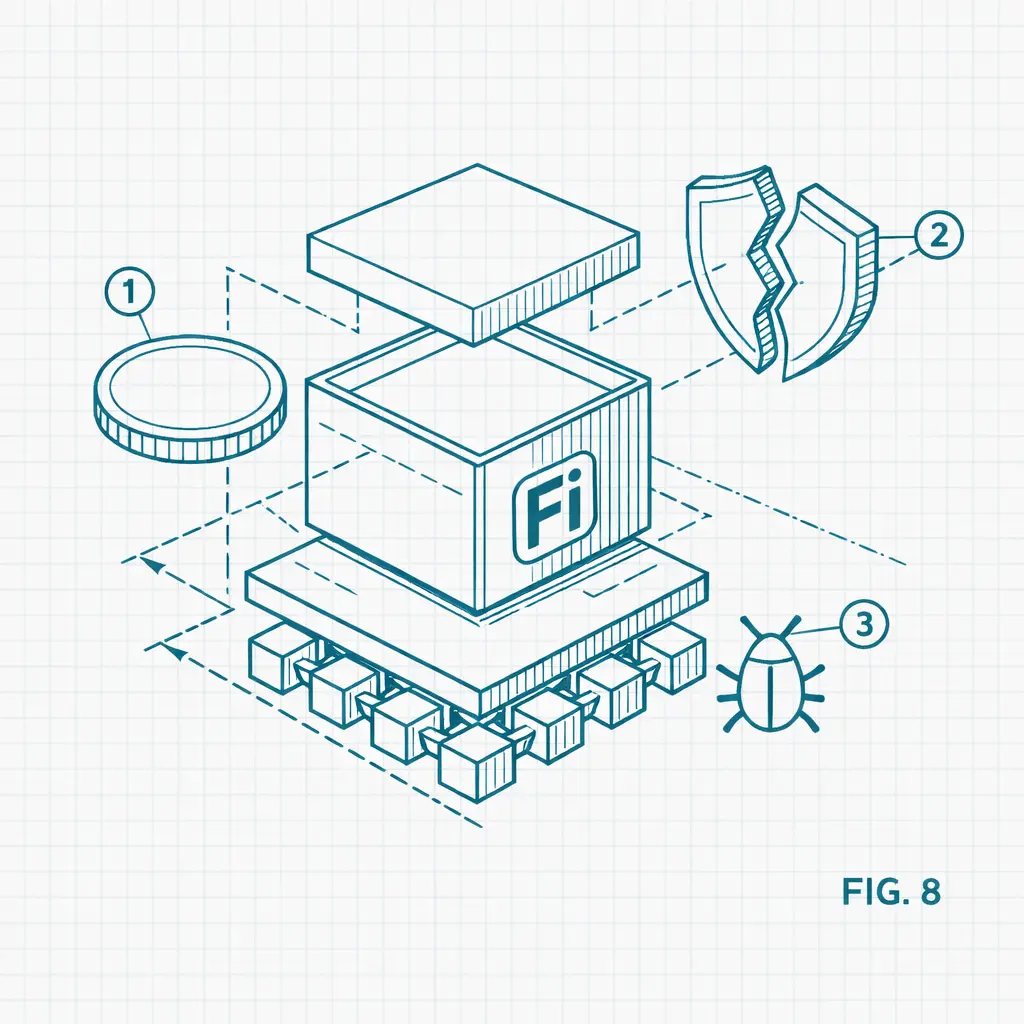
Smart contract vulnerabilities are capital-allocation failures before they are coding failures. Chainalysis reported $3.4 billion stolen across the crypto ecosystem in 2025, while OWASP’s smart-contract-focused 2025 dataset counted 122 deduplicated incidents and about $905.4 million in smart-contract-involved losses. That is large enough to make contract security a treasury-level concern, but it also shows that code review alone is not the whole problem.
OWASP also notes that many of the largest 2025 Web3 losses came from off-chain and operational vectors such as multisig manipulation, supply-chain attacks, drainer malware, phishing, and exchange breaches rather than solely from smart contract bugs. That tension matters. A protocol can ship clean Solidity and still fail if its admin path, upgrade process, dependencies, or incident response are underfunded, which is why blockchain security best practices have to extend beyond code review.
Access control and upgradeability deserve the biggest share of attention
Access control is the highest-leverage smart contract risk because it turns a narrow mistake into full protocol compromise. OWASP’s 2026 ranking places Access Control Vulnerabilities at #1, explicitly because exposed admin, governance, or upgrade paths let unauthorized actors invoke privileged functions or modify critical state.
The Solidity documentation is unusually blunt in its security considerations: never use tx.origin for authorization. The official example shows why. A malicious intermediary contract can preserve the original transaction sender and trick the target contract into treating the attacker-controlled call as authorized.
OpenZeppelin’s access-control documentation makes the practical consequence explicit. Restricted functions often include minting, freezing transfers, and performing upgrades that completely change contract logic. OpenZeppelin also recommends delayed execution through TimelockController because even a legitimate admin can become a threat if users have no time to review or exit before a change lands.
| Surface | Typical failure | Why it is severe |
|---|---|---|
| Authorization | tx.origin checks, missing role boundaries, overly broad owner powers | Lets attackers call privileged functions or bypass intended trust boundaries |
| Upgrade path | Uninitialized implementations, proxy misconfiguration, unsafe upgrade logic | Turns a maintenance mechanism into a takeover mechanism |
| Governance execution | No timelock or weak proposer/executor separation | Users cannot react before a damaging change executes |
History keeps validating this hierarchy. In its September 16, 2021 UUPS post-mortem, OpenZeppelin disclosed a UUPS upgradeability vulnerability and said it had proactively initialized more than 150 uninitialized UUPS implementation contracts across major EVM networks before publishing the advisory. The bug was not in business logic. It was in the upgrade machinery itself.
The Parity multisig incident is the older, harsher version of the same lesson. Parity’s November 2017 post-mortem says an attacker became owner of an uninitialized shared library contract and then destroyed it, blocking funds in 587 wallets holding 513,774.16 ETH. Reviewed code was still enough to freeze a massive amount of value because the shared control surface was wrong.
Reentrancy is now a system property, not a single-function bug
Reentrancy is best understood as control handoff under adversarial conditions. The Solidity docs state that any interaction with another contract hands over control, and that reentrancy is not only a result of Ether transfer but of any function call into another contract. The same docs still recommend the Checks-Effects-Interactions pattern because state must become internally consistent before external interaction begins.
OpenZeppelin’s guidance after Istanbul makes the operational version of that rule concrete. Checks-Effects-Interactions is still foundational, and ReentrancyGuard exists because relying on gas assumptions is brittle. Security controls need to survive protocol-level changes in gas pricing and execution environment, not just the current release of the EVM.
The DAO remains the canonical warning because it proved that a local reentrancy bug can become a chain-level governance event. Ethereum.org’s fork history says the July 20, 2016 DAO fork responded to an insecure contract drained of over 3.6 million ETH. Smart contract failures do not stay inside the contract when enough value accumulates around them.
Composability makes modern reentrancy harder than the 2016 mental model suggests. A 2025 academic study of Ethereum contract dependencies found that 59% of contract transactions involve multiple contracts, with a median of four contracts per transaction in 2024. The same paper found that just 11 deployers controlled 50% of alive contracts and that three of the most depended-on contracts were mutable. That means cross-contract assumptions, shared state dependencies, and mutable upstream components are now part of the reentrancy and privilege story.
Business logic, arithmetic, and oracle failures are where “audited code” still breaks
Many serious exploits are not raw syntax mistakes. OWASP’s 2026 ranking places Business Logic Vulnerabilities at #2, Price Oracle Manipulation at #3, and Flash Loan-Facilitated Attacks at #4. That ordering is important because it shifts attention from isolated coding defects toward design-level assumptions about pricing, sequencing, collateralization, and state transitions.
OWASP’s supporting 2025 incident data is even more revealing. In its smart-contract-only categorization, Integer Overflow accounted for about $260.4 million in losses, Access Control for $220.0 million, Business Logic for $188.7 million, Arithmetic Errors for $138.1 million, and Reentrancy for $42.1 million. Reentrancy is famous, but design and arithmetic failures can be more expensive.
| OWASP smart-contract category | 2025 loss total |
|---|---|
| SC09 Integer Overflow | $260.4M |
| SC01 Access Control | $220.0M |
| SC02 Business Logic | $188.7M |
| SC07 Arithmetic Errors | $138.1M |
| SC08 Reentrancy | $42.1M |
Solidity 0.8.x reduced one class of arithmetic risk by making overflow checks the default, but it did not remove arithmetic risk from protocol design. The Solidity docs note that developers can still opt into unchecked arithmetic, and that even in checked mode overflows may cause a contract to revert into a stuck state if the broader design cannot tolerate the failure path.
Flash loans also need correct framing. OWASP describes them as a way to magnify smaller bugs in logic, pricing, or arithmetic into large drains within one transaction. In other words, the flash loan is often the force multiplier, not the root cause. If a protocol can be broken by transient price distortion or one-block voting power, the real problem is weak invariants and weak governance design.
Denial-of-service style failure is another underpriced category. Solidity warns that loops dependent on storage growth can exceed the block gas limit and stall a contract. That is not always a theft event, but for protocols that need liquidation, withdrawal, rebalance, or reward-distribution liveness, a stalled function can become an economic failure anyway.
A serious security program is layered, ongoing, and expensive on purpose
Ethereum.org says smart contracts need a higher level of quality assessment because code is immutable once deployed. The same guidance recommends testing, formal verification, independent review, bug bounties, disaster recovery plans, secure governance, and reduced complexity. That is the right model. Security is not a launch deliverable. It is an operating expense.
Ethereum.org is also explicit that audits are not a silver bullet. Audits increase the odds of finding flaws, but they will not catch every bug. The practical implication is simple: if the security budget stops at “one audit before TGE,” the protocol is relying on timing rather than discipline.
Formal methods help, but they must be tied to explicit properties. The Securify paper describes a scalable automated analyzer that can prove behaviors safe or unsafe with respect to a given property and had analyzed more than 18,000 contracts in its reported usage. The solc-verify paper describes source-level verification built on the Solidity compiler using SMT solvers to prove invariants and post-conditions. These are powerful tools, but they prove what teams specify. They do not automatically rescue a weak specification.
Compiler hygiene belongs in the same budget. The Solidity project maintains an official list of known compiler bugs and says it is highly suspicious when a contract was compiled with a buggy compiler after a fixed version was already available. That is a reminder that “the code is audited” is weaker than “the code, compiler, and build process are controlled.”
Uniswap v4 is one of the better public examples of defense-in-depth. On November 26, 2024, Uniswap said v4 had undergone nine independent audits, a $2.35 million security competition with more than 500 researchers, and then launched a $15.5 million bug bounty for v4 core and periphery contracts. That does not prove invulnerability. It does show what it looks like when a protocol treats vulnerability discovery as a market it must fund, not as a reputational inconvenience.
Governance and treasury design decide whether a vulnerability becomes existential
Governance design is part of the security model. Ethereum.org warns that onchain governance can itself be attacked if an adversary acquires voting power, including through flash loans, and uses it to push a malicious proposal. The recommended countermeasures include timelocks, historical voting power snapshots, and other mechanisms that make rapid control accumulation harder.
OpenZeppelin’s timelock guidance sharpens the operational trade-off. A timelock protects users by giving them time to review a maintenance operation and exit if necessary, and OpenZeppelin notes that upgrades may justify delays of weeks or even months, not just days. That is the right frame for high-value protocols. Faster admin action lowers short-term friction. Longer delays improve user survivability.
For token economy design, this means security budget should sit next to liquidity incentives, grants, and BD spend, not below them. At FinDaS Tokenomics, we treat admin-key design, upgrade authority, treasury-funded audits, bounty runway, and incident-response capacity as part of token economy design because they shape the credible durability of the protocol. A token economy that cannot fund long-term security operations is not efficient. It is temporarily under-defended.
- Fund repeated audits around major upgrades, not only the initial deployment.
- Reserve treasury budget for bug bounties large enough to compete with exploit economics.
- Use role separation and timelocks so governance mistakes are reviewable before execution.
- Specify invariants early enough that formal verification can prove something meaningful.
- Budget for monitoring and disaster recovery because some failures will be operational even when code is correct.
The enduring mistake in Web3 is to price smart contract security like QA and then discover, too late, that it behaves like critical infrastructure. The protocols that last will be the ones that spend accordingly.