Token vesting controls when allocated tokens become transferable. The 2026 industry consensus: core team and founders vest 3 to 4 years with a 12-month cliff, seed investors 2 to 3 years with a 6 to 12-month cliff, and TGE unlocks for utility tokens stay between 5% and 15% of supply. Team vesting must always exceed investor vesting; projects whose tokenomics fall apart first are usually the ones that compressed these windows under investor pressure.
What vesting actually does (and where crypto bends the rules)
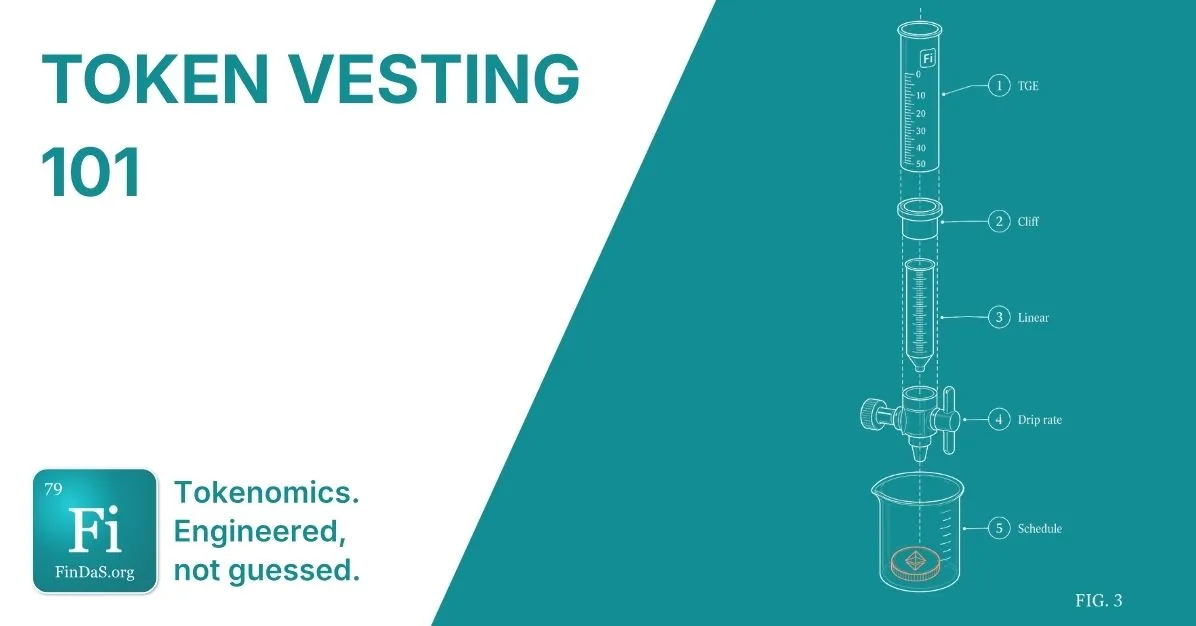
Token vesting is the schedule that controls when allocated tokens become transferable to the people who own them. Three structural pieces do most of the work in any schedule: the TGE unlock (the share of an allocation released at the token generation event), the cliff (a period during which nothing unlocks at all), and the vesting period (how the rest releases after the cliff ends). Anything beyond that is a variation on the same machinery, and the failure modes are mostly about how those three pieces are sized relative to each other.
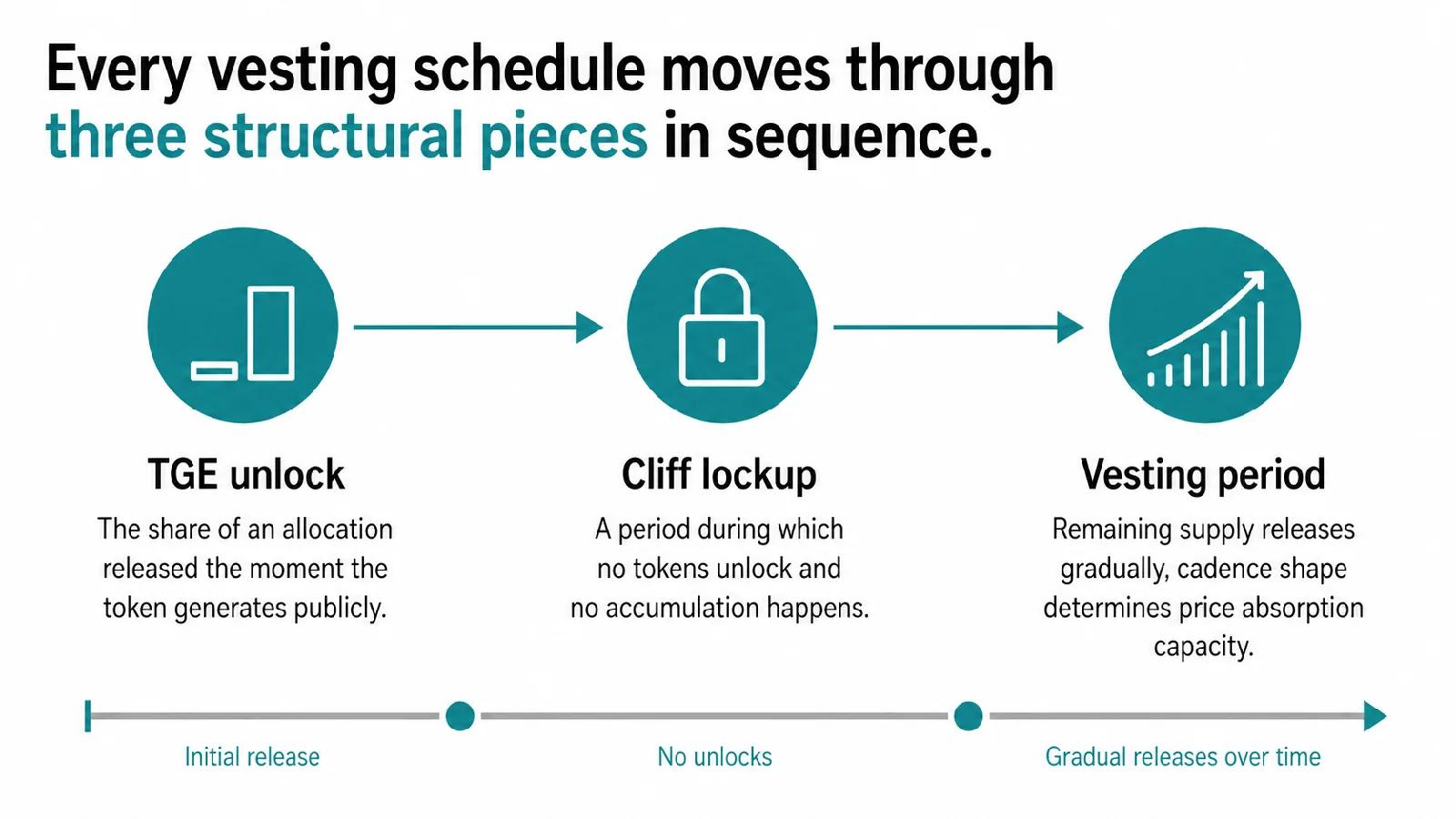
The piece that confuses readers crossing over from tech equity is the cliff. In a traditional 4-year-with-1-year-cliff equity grant, you accumulate vesting credit during the cliff year, you just cannot exercise it until the cliff ends. In crypto, "cliff" usually means pure lockup with no accumulation, and then either a TGE-style chunk release or the start of linear vesting. Two protocols can both advertise "a 12-month cliff" and mean meaningfully different things, so when reading or designing a schedule the operative question is what the curve looks like the moment after the cliff ends.
Milestone-based vesting replaces the calendar with conditions: tokens unlock when the protocol hits TVL, user, audit, or revenue targets. It is more honest about what the project is paying for, but it is harder to write contractually and easier to game. I will come back to it later, but the short version is that milestone vesting works best as a supplement to time vesting, not a replacement. For where these primitives fit alongside supply, emissions, and value accrual, the tokenomics 101 overview is the right anchor.
The 2026 stakeholder benchmark schedule
The industry has converged on a fairly tight set of vesting ranges by stakeholder type. The numbers below are not regulatory requirements, they are the patterns that exchanges, research desks, LPs, and serious community members read as default-reasonable. Founders who deviate get questions, and most of those questions are answerable, but you should know which deviations you are making.
| Stakeholder | Vesting | Cliff | TGE unlock | Notes |
|---|---|---|---|---|
| Core team / founders | 3 to 4 years linear | 12 months | 0% | 4 years with 1-year cliff is the modal pattern, mirroring tech equity |
| Advisors | 1 to 2 years linear | 3 to 6 months | 0% | Allocation usually capped at 1% to 3% |
| Seed / early investors | 2 to 3 years linear | 6 to 12 months | 0% | Cliff length tracks investor sophistication |
| Later-stage investors | 1 to 2 years linear | 3 to 6 months | 0% to 10% | Shorter than seed because they entered closer to TGE |
| Public sale | 0 to 12 months | 0 to 3 months | 10% to 30% | Highest TGE share by design |
| Ecosystem / community | 3 to 5 years | Often none | Varies | Increasingly milestone-based or hybrid |
A few notes on what the table is and is not saying. Public sale percentages span a wide range because public sales themselves do very different jobs across launches: a bootstrapping community sale and a price-discovery liquid event are not the same instrument and do not deserve the same TGE share. Ecosystem and community allocations are increasingly milestone-based or hybrid, since "release linearly over 4 years" for an ecosystem fund tends to mean either underspending in years 1 to 2 or scrambling in year 4. The numbers in the table are starting positions, not destinations.
Two classes of project sit outside this table by design. Fair launches typically have no insider allocation to schedule, since the supply distributes through the launch mechanism itself. Protocols that ship with 100% of supply already vested, including most memecoins and some governance-only tokens, replace vesting with disclosure and let the market price the full liquid float from day one. Both are edge cases that avoid the schedule failure modes by removing the schedule, and both reintroduce different problems around early concentration.
Team must vest longer than investors. Period.
There is a rule in vesting design that almost no founder applies cleanly on the first pass: team vesting must exceed investor vesting. If investors vest over 2 years and the team vests over 4, the project is signaling that the team is committed for longer than the money. If investors vest longer than the team, the signal flips, and that is a red flag no serious LP, exchange, or research desk will miss. This is a fairness signal first and an economics choice second, and founders who haggle the team schedule down to match an aggressive investor schedule routinely give away credibility for cash savings they did not need.
The related rule of thumb that follows from the same logic: the better price someone got, the longer their vesting should be. Insiders who paid below TGE price are sitting on instant unrealized gains, and the schedule is what prevents those gains from becoming day-one sell pressure. A clean default is that any allocation acquired below the TGE price gets at least a 12-month cliff. Founders, who usually paid the lowest implied price of all, should vest the longest of any group on the cap table.
Vesting is the first thing that takes a hit in tokenomics. Every single time. You align the schedule with projected company performance and user expectations. You model edge case scenarios. Then the project goes to its first investor call and instead of 0/12/36 (0% at TGE, 12-month cliff, 36-month vesting), the investor demands something like 20/6/12. One investor I worked across from told the project flatly: "I need enough tokens or price advantage to break even at TGE, after that I can hold for a long time." That is not sustainable tokenomics, it is a sell ticket dressed as alignment.
This is what "destroyed by negotiation" looks like. The schedule survives the modeling exercise, the simulations, the audit, and then collapses in the first investor call. The honest fix is rarely to redesign the schedule, it is to walk away from investors whose terms presume they are the only thing the project needs.
The TGE unlock trap
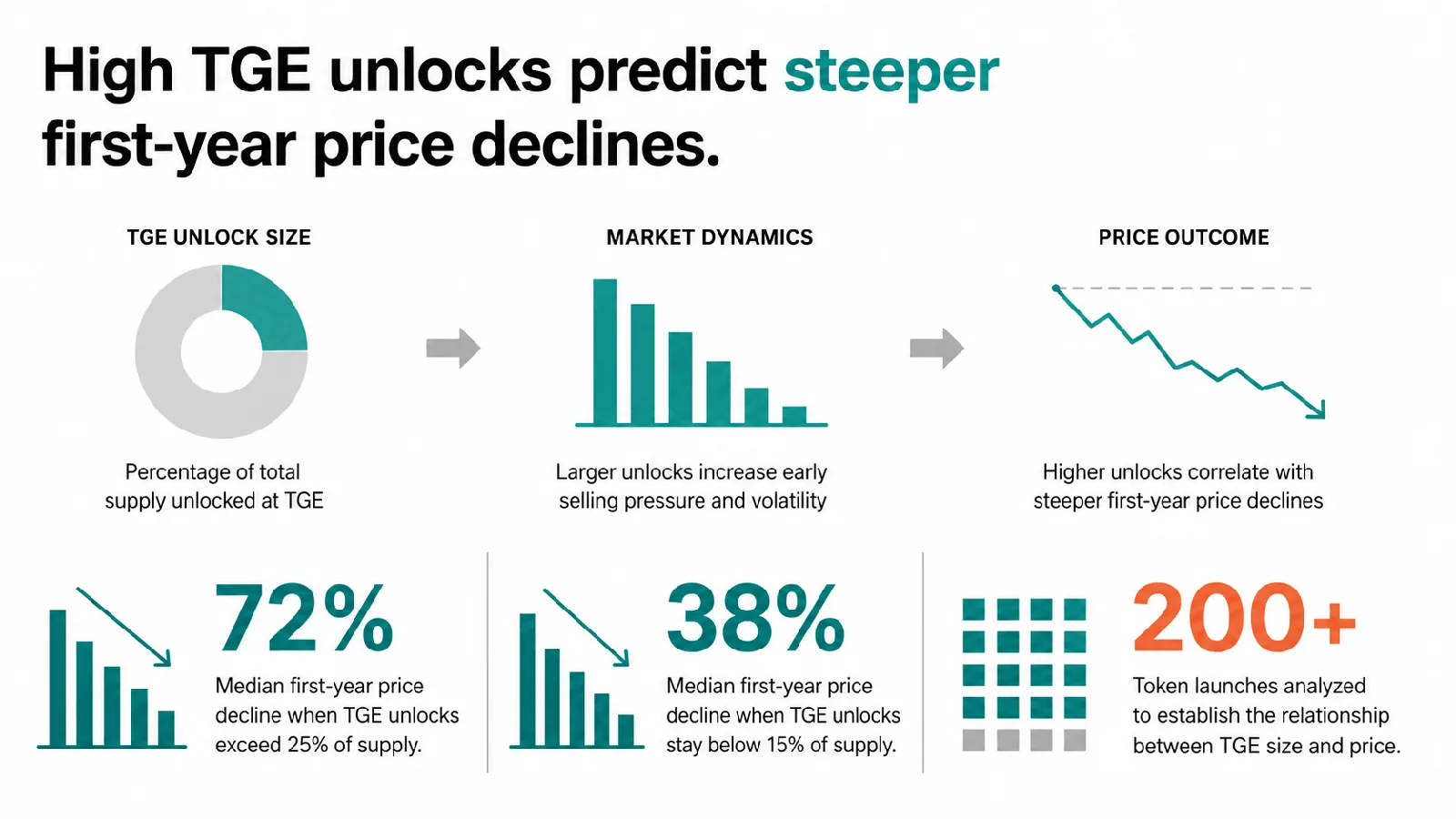
The single most predictive number in a token launch is the TGE unlock percentage. Analysis of more than 200 token launches by Tokenomics.com shows projects with TGE unlocks above 25% experience median first-year price declines of 72%, while projects with sub-15% TGE unlocks see median declines of 38%. The pattern is reliable enough that exchanges and research desks now screen for it before listings, and the intuition is straightforward: a high TGE unlock means immediate sell pressure from insiders who waited years to exit, with no offsetting demand to absorb it.
The conservative default for utility tokens is 5% to 15% TGE unlock, with anything above 20% requiring a real explanation, not a marketing one. "We need liquidity for market making" is rarely the actual reason. Market making depths in the 1% to 3% range work fine, and the rest of the high-TGE allocation is going somewhere else. If you are pushing TGE unlock above the conservative default, the people across the table will assume you are doing it to give insiders an exit, and they will not ask for the schedule, they will price it in.
The related debate that founders inherit from social media is low-float-versus-high-FDV. The framing usually treats both as the same kind of problem. They are not. Low float is fine as long as circulating supply meets organic demand without producing excessive volatility, and most successful launches in the last cycle ran with relatively low circulating supply for the first 6 to 12 months. The actual problem is high FDV, the implicit promise that the rest of the supply, several multiples of what is currently circulating, is owed valuation that the protocol may not earn. Anchoring an investor pitch on a $5B FDV when the protocol generates $3M in annual revenue is the failure mode, not the float ratio. For the longer treatment of these dynamics, the early sell pressure mitigation guide covers the structural fixes that work.
Smooth the curve, or get shorted
Step-function unlocks create predictable price suppression. Monthly cliffs that release more than 5% of circulating supply at once create month-end sell pressure windows that traders short into, and quarterly cliffs are worse. The order of preference for unlock cadence is: daily linear unlocks beat monthly, monthly beat quarterly, quarterly beat any cliff-only release. Sigmoid or S-curve unlocks (slow at the start, fast in the middle, slow at the end) have been gaining ground since 2024 because they map better to expected protocol maturity than pure linear, but the rule that matters more than the curve shape is that no single month should release a spike that is large relative to circulating supply.
Founders should model the percentage of circulating supply unlocking each month and look for spikes. The exercise is mechanical and takes an afternoon, but it is the difference between a schedule that survives the first 18 months and one that does not. Pair the model with token emissions thinking, since vesting unlocks and emission inflation compound on the same circulating-supply denominator and the failure modes interact.
The principle that ties all of this together is that every unlocked token should have a proportionally large amount of protocol revenue or usage demand to absorb it. If your protocol generates revenue or burns at the rate of $X per month and unlocks $5X of new supply per month, the math of price support is impossible regardless of how clever the curve is. This is uncomfortable to face during design, because protocol traction is the variable founders have least control over, but it is the right variable to design against. If you want help structuring the relationship between unlock pace and protocol traction, our tokenomics consulting practice does this kind of modeling on every engagement.
Beyond time: milestone, revocable, soulbound, and re-vesting
Vesting is increasingly being treated as a parameter rather than a one-shot design. Four variations on the standard time-locked irrevocable schedule are worth knowing because each solves a real failure mode of the default. Milestone-based vesting makes tokens unlock when the protocol hits specified TVL, user, audit, or revenue targets; it aligns release with value creation but is harder to write contractually and easier to game, so it is best as a supplement to time vesting rather than a replacement. Revocable vesting returns unvested tokens to treasury if the team member leaves; it solves the "abandoned founder still earning tokens" failure mode but is harder to negotiate at hiring. Soulbound vesting makes pre-vested positions non-transferable, which kills the OTC market for locked claims that can otherwise dilute the project's intended cap table. NFT-based vesting positions are transferable but stay on the original schedule, which is administratively cleaner for treasury accounting but does not solve either of the prior two failure modes on its own.
Re-vesting after launch is now an actual category of design choice rather than a damage-control rumor. The Babylon Foundation's January 2026 amendment moved the team, advisor, and early-private-investor unlock schedule from its original cliff to a new schedule starting May 2026, with 1/36th releasing monthly through April 2029. The honest read is mixed. Re-vesting is sometimes a good-faith adjustment when the original schedule no longer fits the roadmap, and sometimes a desperate attempt to delay unlock pressure that the schedule was already pricing in. Either way, founders should know it is an option that exists, and that doing it more than once destroys credibility. It is not free.
Disclose, or someone else will
Whatever vesting schedule the project ships with, third parties will figure it out. Token Unlocks, Tokenomist, CryptoRank, and Messari already track schedules across thousands of projects, including the ones that did not publish them in machine-readable form. The choice founders actually have is between being the source of truth for their own schedule or letting the trackers, sometimes inaccurately, fill that role.
Practical defaults: publish vesting schedules in formats these trackers can consume, update them when they change, and treat the on-chain vesting contracts as the canonical reference. The token supply 101 piece covers the related disclosure habits for circulating versus total versus fully diluted supply, which trackers also normalize from public data. Opacity here is not a strategy. It is a red flag that gets discounted into the price before the founder finishes drafting the FUD response.
Vesting will not save a bad project. A good project with bad vesting often becomes a bad one anyway, since the schedule is what determines whether the price survives the first eighteen months of insider unlocks. Get it right at design time and defend it through the first investor call, because defending it later is harder than redesigning it would have been.
More from the 101 series
Frequently Asked Questions
01Does vesting have to be on-chain, or can it be in legal contracts?
+
02What happens to unvested tokens if a team member leaves?
+
03How does vesting work for fair launches and 100%-vested-at-TGE protocols?
+
04Are exchanges screening projects by TGE unlock percentage?
+
05Should vesting be linked to token price instead of time?
+