A node sale is a crypto fundraising mechanism where a project sells licenses, usually as NFTs, that grant the holder the right to run a network node and earn rewards. They earn their keep on networks that genuinely need distributed infrastructure: DePIN projects, new L1s, L2s, L3s. They don't on projects where the "node" does no real work and the sale is a token pre-sale with extra steps.
What a node sale actually is
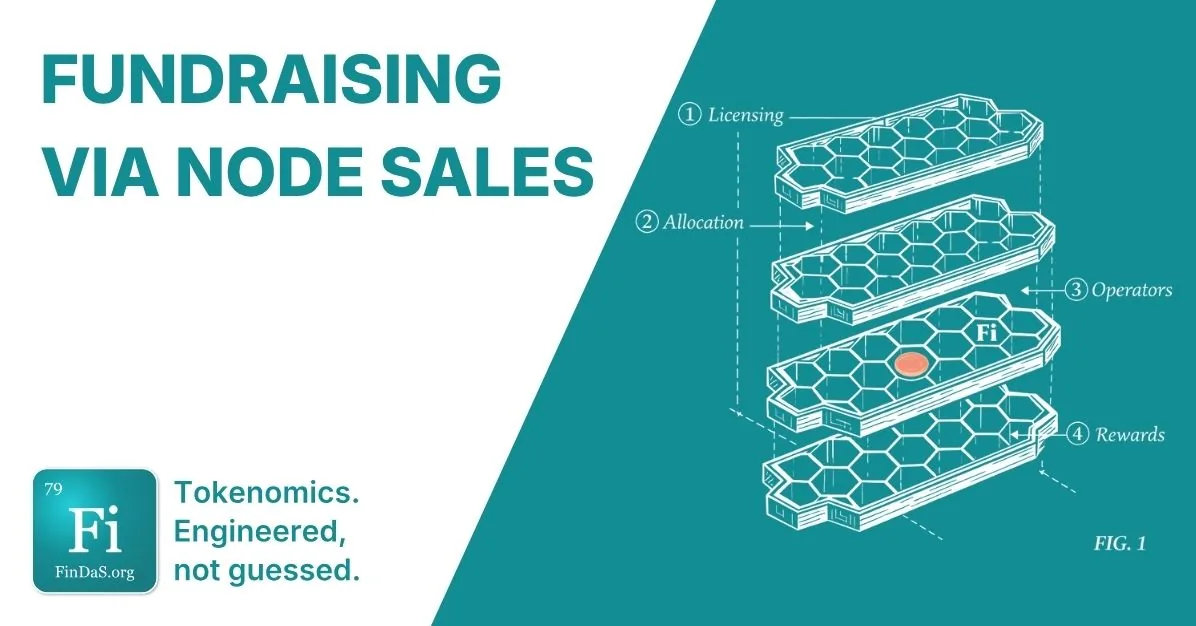
A node license is the right to run a piece of network infrastructure. Projects sell the license, usually as a non-fungible token, often paired with a future token reward stream. The standard pattern is: announce, KYC, buyers pay in ETH or the native token, buyers either install software or receive hardware, buyers earn network tokens over time. That is the mechanism.
The distinction that matters is what the buyer is actually purchasing. A node license is different from a regular token sale because the product is an operational role, not a currency position. It is different from a hardware sale because the operational permission is the product and the hardware (if any) is the means. And it is different from an ICO or IDO round because the buyer is supposed to do some work, or at least run some software, to earn the reward rather than just hold and wait.
Why projects started leaning on them
Three real drivers explain the surge since 2023. First, fundraising math. Node sales regularly raise more per project than the equivalent public token sale. Aethir sold over 66,000 Checker Node licenses for roughly 42,000 ETH, about $130M at the time, against a $2.7B pre-TGE FDV. XAI Games sold 50,000 Sentry Node licenses for $30M. Those are ICO-era numbers in a post-ICO regulatory environment.
Second, regulatory positioning. A license to perform work reads differently from a passive investment, at least on first inspection. This mattered more in 2024 when the SEC was still litigating NFT structures aggressively. It matters less in 2026, but the framing habit stuck.
Third, the decentralization narrative. "We sold licenses to 20,000 individual operators" markets well, even when most operators are passive rent collectors running the default installer on a cheap VPS. I will come back to that. The marketing claim and the operational reality are usually not the same claim.
When node sales earn their keep
The real fit test is whether the network genuinely needs distributed operators doing distributed work. That is the only question that separates a node sale from a token pre-sale with more NFTs attached. Three categories of project pass it cleanly:
- DePIN networks where nodes provide physical resources such as GPU compute, bandwidth, storage, wireless coverage, or location data. Nodes are the product, and reward rates map to real utilization. See DePIN tokenomics for the underlying economics.
- New L1s, L2s, and L3s where validator diversity is load-bearing for security. Nodes do consensus work, and concentration shows up as a measurable attack surface.
- Networks with verifiable off-chain work: indexing, oracles, fraud-proof challenges, zk-prover markets. Nodes are rewarded for catching something or producing something that can be checked.
Aethir is the GPU-compute case at scale: the network reports around 430,000 GPU containers across 94 countries and over $127M in 2025 revenue, with node operators providing the compute that enterprises actually pay for. XAI Sentry Nodes perform fraud-proof challenges against an Arbitrum L3 chain. The work is simple (download blocks, check them, report if something looks wrong), but it is actual work, and honest operators earn rewards when they catch bad blocks, which is a thing that can happen in optimistic-rollup stacks.
When they're fundraisers in costume
The red flags tend to show up in the sale's own documentation, before any money changes hands. One on its own can sometimes be explained; three in the same deal rarely can. In rough order of severity:
- The project doesn't run its own chain and doesn't produce a physical resource. If the "node" is just a wallet that collects rewards on a smart contract, buyers are buying an annuity, not an operational role. The legal structure is an investment contract with a different label, whatever the marketing says.
- The work is trivial or token-gated rather than skill-gated. "Run this installer, click OK, collect rewards proportional to stake" is not operator contribution; it is staking wearing an NFT. There is nothing wrong with staking, but then call it staking.
- Insider allocation outpaces the node allocation. Community allocations in this category range from 15% (Akash) to 48% (NodeOps), with Aethir around 21% and EigenLayer 30%. Anything under 20% should raise questions about whether operators are the beneficiaries or just the funding channel.
- Rewards are backloaded so that early operators bear all the dilution. If 80% of operator rewards unlock on a schedule that sits behind the team and investor unlock cliffs, the math favors insiders selling into operator buying. Check the unlock curves against each other, not just in isolation.
Even when the project is legitimate, the outcome for operators can be ugly. Aethir's network is delivering real revenue and shipping real GPU hours, but the ATH token is down about 94% from its all-time high. Node operators earn rewards in the token. If token emissions outpace network-revenue growth, operators are holding a depreciating asset that happens to yield more depreciating assets. This is the classic project-succeeds-while-token-fails pattern, and node operators wear it most directly because their rewards are denominated in the failing currency.
If you are structuring a node sale yourself and the jurisdiction posture matters, sorting the MiCA-compliant whitepaper early is cheaper than sorting it under regulatory pressure later.
Software nodes vs DePIN nodes
The real distinction is what the node actually provides to the network. Software nodes run on whatever hardware the operator already has. XAI Sentry Nodes, Ethereum validators, and most L2 sequencer backup nodes fall here. The cost to the operator is a license plus a background process and some bandwidth. The risk is that network economics shift against operators (token price, emissions, fee distribution). They fit networks where the bottleneck is the number of independent operators, not the capacity each one provides.
DePIN nodes require specific hardware: a GPU, a Helium hotspot radio, a Hivemapper dashcam, a Geodnet GPS receiver, a storage array. The cost is a license plus capex plus ongoing electricity and maintenance. The risk is that the hardware has no other use if the network fails, and reward markets can go negative net of cost. They fit networks where the bottleneck is real-world capacity the network can't conjure on-chain.
The diagnostic question: if the network's token went to zero tomorrow, does the hardware still have value? For a GPU node, yes, you have a GPU. For a software-only rewards node, no, you have a wallet with a worthless NFT. That does not make software nodes worse; it means the underwriting is different. Software-node buyers are underwriting token price and operator economics. DePIN-node buyers are underwriting both of those plus hardware resale value, which at least gives them a floor.
What to check before launching or buying one
If you are on the project side, the questions are structural. Does the node do work the network genuinely needs, or are you manufacturing a role to justify the sale? What percentage of supply goes to operators versus insiders versus treasury, and how do the vesting curves sit relative to each other? Can the license transfer, creating a secondary market and its behaviors, or is it bound to the buyer's wallet and regulatorily cleaner but harder to sell? What is the jurisdiction posture given that US regulatory treatment shifted substantially in 2025 and 2026, with the joint SEC/CFTC framework carving out a "digital tools" category that utility licenses can plausibly fit?
If you are on the buyer side, the questions are quantitative. What is the break-even timeline, computed from expected reward rate, expected token price, and operating cost, not from the project's own projections? What happens to that break-even if the token drops 50%, or 90%? How confident are you in the project's ability to generate network revenue rather than token emissions alone, and where is the evidence for that? Approaches to token valuation give you the frame; the numbers come from the specific deal in front of you.
If a project has load-bearing node work to do and the sale structure actually decentralizes the network, a node sale is a reasonable way to fund it. If it does not, the sale is an ICO wearing a lanyard. The diagnostic questions above are what separates the two, and they are not hard to answer before money changes hands. Everything else is marketing.
Frequently asked questions
01How is a node sale different from an ICO or IDO?
+
02Are node licenses securities in 2026?
+
03What's a typical token allocation for node operators?
+
04Can a node sale actually cause centralization?
+