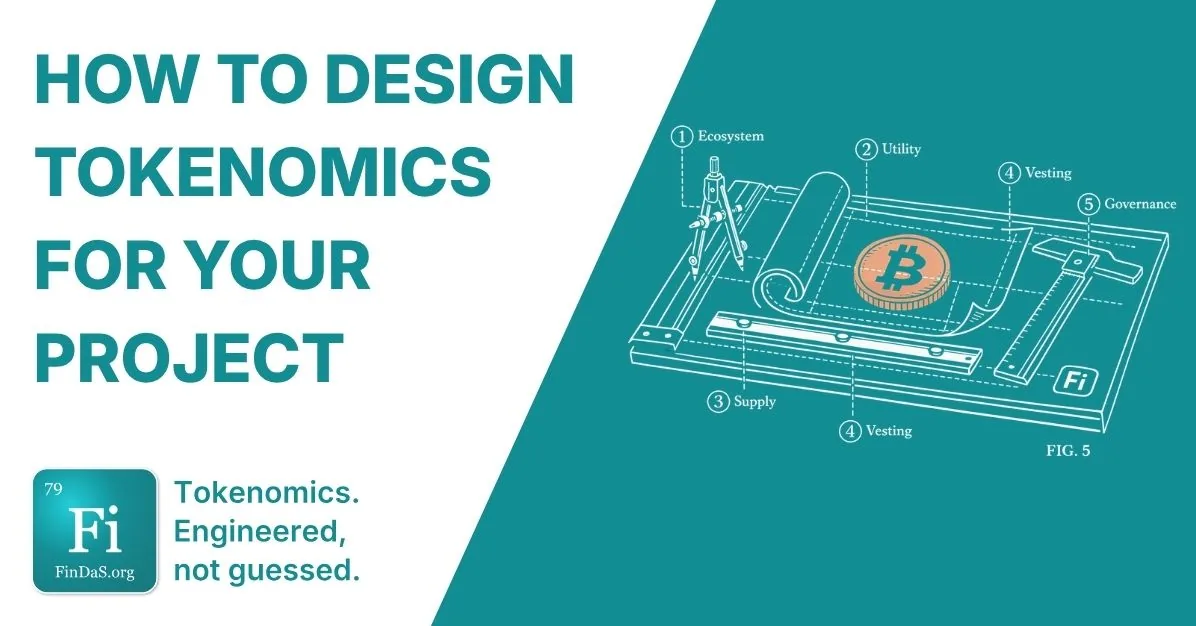
Tokenomics design turns a project's economic goals into a working token model: supply schedule, distribution, utility, incentives, and governance, pressure-tested against realistic scenarios before launch. The best designs start with the ecosystem, not the token, and most failures trace back to teams that skipped that step and went straight to allocation percentages.
What tokenomics design actually is
Tokenomics design is engineering, not branding. The job is to turn a project's economic goals into a working token model: what the token does, who holds it, when they can sell it, where demand comes from, and how the system behaves when someone with 5% of supply wants out tomorrow. The word "tokenomics" gets used loosely, often as a synonym for "allocation pie chart". That's the part most teams start with and it's the part that matters least. A good allocation split with a bad utility design fails. A messy allocation split with a load-bearing utility design can work. Getting the order of operations right is the first practitioner move.
This article is the short version of the process I run with clients at FinDaS, stripped to what actually matters. For the "what is tokenomics" baseline, tokenomics 101 covers definitions. What follows assumes you already have a project, a rough funding plan, and a problem the token might solve; what you need now is a working design.
Start with the ecosystem, not the token
The most common tokenomics mistake is starting with the token. A team decides they want a governance token with a staking mechanism and a burn, then works backwards to figure out what the system is supposed to do. This almost always produces a design where the token extracts value without creating any: fees get paid to holders by users who would rather not pay them, and the token becomes a tax on the thing the project was actually trying to build.
The order I work in is the opposite. First, the ecosystem: who are the users, what are they exchanging, what coordination problem is the project solving. Second, does the project need a token to solve it, because some do not, and forcing one in makes the design worse. Third, only after both answers are clear, what the token's job is. MiCA's utility token definition codifies the same discipline from the regulatory side: a utility token is an asset "only intended to provide access to a good or a service supplied by its issuer", and if your token cannot credibly meet that standard, you have a regulatory problem on top of a design one. FinDaS runs MiCA-ready whitepaper work for EU-targeting projects where this test matters commercially.
Supply, allocation, and vesting
Three decisions sit under "supply design": the total supply, the allocation split between stakeholder groups, and the vesting schedule that controls when each group can sell. All three should be decided together, because the allocation is only meaningful if the vesting is real, and the supply cap is only meaningful if it is not quietly reopened later. Teams often design these separately and end up with a 1B supply cap that looks conservative next to a 100B peer, a vesting calendar built to make the pitch deck look good, and an allocation split optimized for the term sheet, none of which talk to each other.
Allocation splits vary by project type, but a few patterns hold across most launches. Team allocations above 30% are a standard red flag for sophisticated investors and retail alike; anything higher signals either founder misalignment or a fundraising-first design. Private investors typically get 15% to 25%, depending on how many rounds the project ran. Community, ecosystem, and treasury allocations sit in the 30% to 50% range, with the remainder going to liquidity and reserves. The exact numbers matter less than whether the splits match the project's actual needs: a governance-heavy DAO and a play-to-earn game should not have the same pie chart.
Vesting is where most tokenomics fail after launch, and it's the part teams cut corners on because the pain is deferred. The 2026 practitioner standard for team and early investor allocations is roughly a 6 to 12-month cliff followed by 2 to 4 years of linear or monthly release. Short cliffs (under 3 months) signal weak founder commitment; very long cliffs followed by lumpy quarterly releases create the exact unlock overhang the schedule was supposed to prevent. 2025 was the single largest emission year on record, with roughly $97B in tokens released into circulation, and the pattern across the year's biggest crashes was almost identical: a token lists strongly, runs for a few weeks, hits a cliff, and breaks when team plus early investor plus advisor flows land in the same month.
The practical rule I use: model the month-by-month supply schedule in USD (not just in tokens) and compare it to a conservative estimate of the token's daily spot volume. If one month's unlock is more than 2 to 4x the trailing 30-day volume, the cliff is going to hurt, and you should either smooth it, delay it, or renegotiate the vesting before launch rather than after. Public unlock trackers like Token Unlocks and Tokenomist have made this math easy for investors and impossible to hide from them, which means any team shipping a design that fails this test is shipping one the market will price against before the cliff even lands.
Demand and value drivers
Supply is the easy half. Demand is the half that decides whether the token is worth anything a year after launch, and it is where most designs get vague. "Community growth" and "ecosystem adoption" are not demand drivers; they are outcomes of demand drivers working. The real question is what forces a user to hold, buy, or lock the token, and whether those forces persist after the launch incentives burn off.
A working demand design usually has three layers. The first is transactional utility: the token is required to pay for something the protocol produces, and the protocol produces something people actually want (this is the layer MiCA's utility-token test is pointing at, though the design case for it predates the regulation). The second is a sink mechanism: staking with real opportunity cost, burn tied to actual revenue, liquidity provision that earns a real fee, anything that takes tokens out of circulation in a way that is not itself reversed by equivalent emissions elsewhere. The third is governance or status, if the project is one where either of those carries real value; both are usually thinner layers than founders expect them to be.
The trap is designing demand for the airdrop farmer. Airdrop hunters are the cheapest demand to attract and the first to leave, and optimizing tokenomics around their behavior produces high day-one engagement and a collapse by month three. A reference point from 2023: ARB's unlock event sparked renewed market interest partly because the team launched a staking proposal the same day, which absorbed some of the expected sell pressure. That is a demand move, not a supply move, and it worked because there was a genuine reason to stake. Ecosystem-specific patterns differ: DeFi tokenomics lean on fee capture, RWA tokenomics on yield pass-through, and SocialFi tokenomics on retention loops; the right mix depends on which category your ecosystem actually sits in.
If the token can be removed without breaking the protocol, the market will eventually remove it from the price.
Governance and stakeholder alignment
Governance gets treated as a late-stage design question. That is usually wrong. The governance model shapes what a token means as an asset: a token that votes on treasury spend is economically different from one that only pays for transactions, and investors, regulators, and exchanges all read those differences. Designing governance late means retrofitting an economic meaning onto an asset that has already been sold, and the retrofit rarely fits.
The main choices are: what can token holders vote on, what is the voting weight function, what is the quorum, and what is the timing. Most launches get the first two roughly right (vote on treasury, weight by tokens held) and the second two wrong. Quorums set too low hand control to whichever small group shows up, which is usually the investors with the largest concentrated bags. Voting windows set too short create governance that cannot respond to anything actually urgent. Launching on-chain governance too early, before the protocol has any value worth governing, produces a long tail of governance theatre, votes on parameters nobody actually cares about, that trains the community to ignore governance entirely, so when something real comes up, the participation base is already gone.
Vesting and governance should be designed together. If your team and investors together hold 45% of supply, and 40% of that is unlocked by month 18, then your governance power is concentrated in the hands of the people with the strongest incentive to vote for faster unlocks. That is not a hypothetical, it is the default trajectory, and the fix is in the vesting calendar, not in the governance contract.
Simulate, launch, adapt
A tokenomics model that has not been simulated is a pitch deck, not a design. Spreadsheets let you project what the system will do if users behave the way you hope; simulations force you to see what happens when they do not. The difference usually shows up at the edges: the whale unlock nobody priced in, the staking reward that becomes uneconomic when ETH moves 40%, the airdrop cohort that sells 70% of their allocation in the first hour. You will not see any of this in a 4-tab spreadsheet.
The practitioner tool for this is Monte Carlo simulation: pick the inputs that are genuinely uncertain (token price, user retention, emission flows, sell-through rates), specify reasonable ranges rather than point estimates, and run the model across hundreds of paths to see where the distribution of outcomes breaks. I run this step for every client at FinDaS before signing off on a design, because the failure modes a simulation catches are the ones a human reviewing a spreadsheet misses. The goal is not prediction; the goal is finding the corners where the design falls apart, and either fixing them or accepting them with open eyes. You can see a sample of how FinDaS runs tokenomics simulations in Machinations with hundreds of scenario paths.
Launch is the start of tokenomics design, not the end. The first year of a token's life is almost always the most turbulent, and the initial design will need adjustment as the ecosystem actually forms. Keep the monitoring plan as deliberate as the launch plan: which metrics you will track, which thresholds will trigger a review, and which parameters you have reserved the ability to change without breaking your decentralization promises. Tokens that survive the first 12 months usually do so because the team took the second-year redesign seriously, not because they nailed the launch and coasted.
The design mistakes that sink tokens
The failure modes are mostly known. What is less known is how they compound: a team allocation that is slightly too high is survivable, a cliff that is slightly too steep is survivable, a velocity assumption that is slightly too optimistic is survivable, but all three in the same design almost never is. These are the patterns I see most often in audit work, in rough order of frequency.
- Over-allocating to the team. Anything above 30% reads as fundraising-first and gets priced against by sophisticated investors before the token lists; the fix is rarely cutting team motivation, it is shifting the headline allocation to treasury or ecosystem buckets with team sub-control.
- Underestimating velocity. Tokens designed for long-hold behavior often get traded in and out within days, which breaks the scarcity thesis and inflates effective circulating supply beyond what the allocation chart implies; this one is usually caught in simulation and almost never in a spreadsheet.
- Front-loaded unlocks. When 30% to 50% of supply unlocks in the first month against thin liquidity, the price bleeds on listing regardless of project quality; smoother schedules cost almost nothing to implement before launch and are effectively impossible to fix after.
- Utility decoupled from value capture. The token is used for the platform but does not actually capture any of the fees, revenue, or surplus the platform generates; if the token can be removed without breaking the protocol, the market will eventually remove it from the price.
- Governance launched too early. On-chain governance over a protocol that does not yet have anything worth governing trains the community to treat governance as theatre, and by the time the protocol has real decisions to make, the participation base has already left.
None of these are exotic and all are visible in any thorough design review. The reason they keep shipping is that they are individually easy to rationalize and collectively hard to fix once the token is live. If you are 2 months from launch and something on this list describes your design, delay the launch. That is almost always cheaper than trying to renegotiate tokenomics after a cliff has broken the chart.
Frequently Asked Questions
01How long does tokenomics design take from scratch to launch?
+
02Can tokenomics be changed after the token launches?
+
03What is the difference between tokenomics design and token valuation?
+
04How much should a team spend on tokenomics design?
+
05Do I need a tokenomics simulation if my model looks simple?
+