Launching a token can help a business raise funds without giving up company control, reach new customer or investor demographics, and cut operational costs through smart contracts and blockchain payments. The right choice depends on business goals: utility, governance, payment, loyalty, and asset-backed tokens each fit different models. Tokens are not free money, and poor economic design can damage an otherwise good business, so engaging a tokenomics consultant at the very beginning of the process is the best hedge.
In the early days of crypto, it would take some convincing for a business to see any sort of benefit in releasing a token. The high tech barrier, lack of regulatory certainty and the overall dodgy rep of crypto made most founders pull back. Only several cycles later it seems like everyone's had a token at some point. On the regulatory side, we've now got MiCA and the GENIUS Act, and XRP is embedded in the workings of international banking. Suddenly crypto looks "legit".
However, token launches still follow the hype cycle above all else: when the bull market comes, there's a rush by all sorts of businesses to issue their own token. To quote Dr. Ian Malcolm from Jurassic Park:
Your scientists were so preoccupied with whether or not they could, they didn't stop to think if they should.
Jurassic Park
Many businesses venture into crypto without a clear understanding of the challenges and costs (which can be significant), sometimes even thinking a token is "free money". While a Web3 transition may be worth it, you will need professional help to forge a solid Web3 token strategy and navigate the fresh regulatory landscape. So, where do you start?
What are the types of tokens businesses launch?
A great starting point for any business is to have a concept of what they want to achieve with the token launch: is it to raise money, increase customer loyalty, attract a new investor demographic, etc. This will guide the first and most fundamental choice in the process: what type of token are we launching.
Utility token: utility tokens are a great choice for businesses that want to fundraise and create a loyal customer base around their product through token incentives. A great variety of functions can be attached to a utility token, which can be perfectly adapted to fit a company's business model and goals. These can range from payments to governance and complex staking, combining many of the aspects described in the following token types.
Governance token: Ideal for decentralized projects that want to empower the broader community. Centralized projects can also benefit from launching a governance token with a more limited scope of rights for holders, as it can help them build and engage their community. Even when designed as zero-value, many of these tokens do go through highs and lows reflective of the issuing company (look at UNI before UNIfication). The difficulty for most businesses with this token design is how to balance control, fast decision making, and a happy community.
Payment token: Pure payment tokens are suitable for businesses with international operations that want to optimize their currency transfer times and fees. However, they essentially act as an additional "fence" to entry for non-crypto clients. This can be overcome with seamless conversions on the backend that simplify the process for users on the frontend.
Loyalty: Loyalty tokens are a simplified version of utility tokens as they focus on one job, incentivizing the community to engage in desired behavior via token rewards. Often they require a simple digital loyalty point in a standard database, which is then converted to the loyalty token. But can't this be done only with cheaper digital points instead? Yes, but the speculative and interoperable nature of a crypto token opens up many additional attractive possibilities that a simple digital point in a SQL table will never have.
Asset-backed: these are tokens representing any one of a large variety of real-world assets on-chain. An asset-backed token can help a commodity company attract more retail investors, it can turn one large illiquid real estate into liquid, discrete chunks requiring little capital to purchase. The downside is that these tokens have a higher regulatory burden and need a highly skilled tokenomics expert to create the token's various mechanisms (issuance, rebalancing, redemption, etc.). You can read more about what is required to tokenize real-world assets here.
Why are memecoins not mentioned? Simply put, respectable businesses that want to build a product portfolio have no reason to launch one. Although occasionally, someone else might launch one for you.
The good reason to launch a token
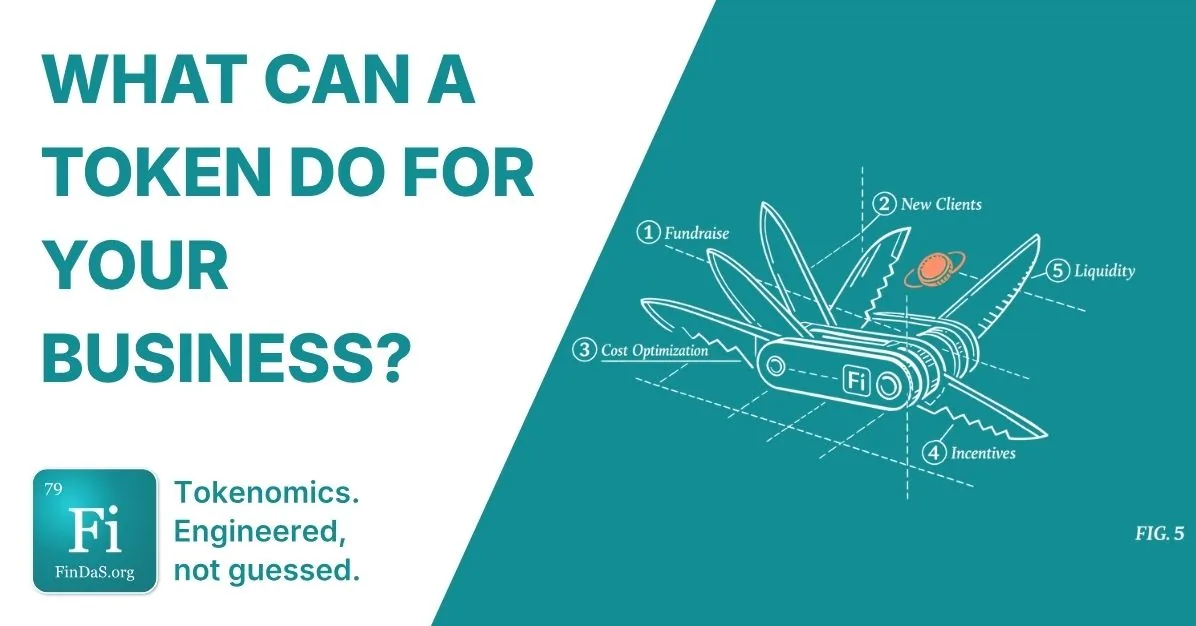
Like any venture, launching a crypto token is not without its risks and costs, so a business needs a solid reason to do it. There are three chief arguments for a business token launch: raise funds without giving up company control, penetrate new market demographics, and optimize the operational costs. Let's dive deeper into each of these:
Fundraise: Both start-ups and mature companies can benefit from a token as a 3rd option to raise funds. Unlike equity, a token doesn't come with so many mandatory hooks: token holders are not quite shareholders (not legal advice!). Unlike debt, it doesn't require the company to make timely payments. A token price is not necessarily guided either by the company's preexisting equity price or its debt burden.
New clients: Launching a token can allow a company to access a new market demographic and improve customer loyalty through a variety of incentives and product-related utilities. In niche cases, expensive assets (e.g. bonds, metals, RE) can be transformed into smaller, retail-fit digital assets, effectively adding retail investors as a new market demographic.
Cost optimization: technological benefits of blockchain operations should not be underestimated. Operational costs can be cut down by automating processes via smart contracts. Settling payments in tokens can reduce fees and settlement times, especially for international transactions.
The wrong reasons to launch a token
As mentioned, hype cycles can create business enthusiasm for launching a token, when it might not add any value to the company. Often this is caused by misconceptions about crypto and tokens as a whole. Here are some of the chief among them:
"It's magic free money": tokens are not free. The cost doesn't come just from the dev work required to build utility. The cost of legal fees and marketing have been increasing, and liquidity can be an ongoing drag if the demand-side of the token is not there.
Hype: Your business launches a token because it's trendy. You decide to "not overthink it", expecting that since over 22 MM cryptocurrencies launched in 2025, it must be simple. This logic neglects to factor in how many of these coins were memecoins and how many tokens failed. If you are building a sustainable, value-added token, the process is long and complex.
Occasionally, a business truly doesn't need a token.
How to do it right
We've broken down the long road to launching a token into 9 distinct steps. As mentioned above, all you need to start is a clear concept of what you want to achieve with the token. Creating a company PnL is recommended, but not a hard requirement to start. The best thing a business can do to set itself up for success, is to involve a professional tokenomics consultant at the very beginning of its Web3 journey. The tokenomics expert will be a key figure in determining:
- Token utilities that fit your business and align incentives between actors in the ecosystem
- Token issuance, allocation and sale price
- A strong liquidity strategy
- The long-term sustainability of your token economy
Once your token economy is completed, you can engage a legal council to advise on the regulatory fit of the token's functionality and change the documentation language as necessary. Only after these crucial steps are completed, can you move on to the technical realization of the project and seeking funding. Your tokenomics consultant can provide support throughout the long processes of development and investor negotiations in two ways:
- Clarifying functional specs of token utilities or adjusting them as needed
- Adjusting sales rounds and prices as per negotiated terms and advising on how this impacts the token economy
Real world examples
There are plenty of theoretical discussions of what makes a token economy good, but ultimately what matters is what happens in practice in the real world. Although crypto's history is brief, there are plenty of examples of the good and the bad side of tokenomics. Let's start with a success story:
I) Ethereum's ETH token
ETH is Ethereum's blockchain token, absolutely essential to the network's operation. It is used to reward Validators, and users need it to pay for transactions. As Ethereum was prepared for growth and scale, it created ETH as an infinite supply (i.e. inflationary) token. The supply-side (block production) supposedly should have been balanced with the demand stemming from network usage. Yet despite the blockchain's success, issuance was running high and so were transaction costs, dampening usage. Ethereum made several key chances to both its underlying technology and its economic setup to balance the supply and demand. First, it transitioned to a Proof-of-Stake network: now Validators had to lock up 32 ETH to continue block production, but more ETH meant a higher chance of being selected. Further, users could contribute to a Validator's stake in exchange for reward-sharing, giving not only Validators, but also users, a reason to stake ETH long-term and keep it out of circulation. Ethereum also added burning based on network activity with EIP-1559: the base fee of each transaction was burned. The result: for the 7 years prior to the change, inflation on the network had been 70% in total, while a couple of years later it stood at -0.22% and it is estimated the overall reduction in ETH inflationary issuance by as much as 80%.
II) Axie Infinity's SLP token
We've mentioned above how not every business needs even one crypto token. However, the popularity of Play-to-Earn blockchain games briefly entrenched the idea of two-token systems. The main Axie token was AXS (governance token) and its secondary token, SLP, issued as user rewards and used primarily for breeding of new Axie monsters (in NFT format). The explosion of Axie's popularity resulted in a large number of users who played the game for a living and had strong incentives to cash out their token earnings as soon as possible. This drove immense sell pressure on its SLP token, while on the demand end the token's only "sink" was expending it to breed new monsters. As soon as the demand for new Axie NFTs slowed, SLP spiraled and its price reduction hit the earnings of professional players. Although the required SLP fee increased with each subsequent breeding, this was not enough to offset inflationary and sell pressures. Unfortunately, an otherwise popular game was affected dramatically by poor token economy design and unwisely structured incentives.
Both examples above illustrate that a good or bad token economy design can significantly impact a good business idea. While businesses and tokens fail for different reasons, one can bring the other down.
A crypto token can be a useful addition to both starting and mature business. It can underpin your product or it can have a supporting role, depending on your specific goals. The token can offer you an attractive way to raise funds, engage your community and issue rewards. Many people intuitively relate the token's success to that of the business, but as seen in the examples above, a successful business can be hurt by poor token economy design. Our advice: engage solid professionals early on, and if you've missed that window, do not hesitate to ask for an audit or economy adjustment later on. Adapt and improve with expert guidance, as even a token economy is a living organism.
Frequently Asked Questions
01How long does it take to launch a token?
+
02What does it cost to launch a crypto token?
+
03Can a business relaunch or restructure a failing token?
+
04Does every token launch require legal registration?
+