GameFi tokenomics breaks when reward emissions are treated as player income and earning is marketed as the core product. Sustainable designs treat tokens as spend currency rather than salaries, tie earning to scarce contributions like skill or liquidity provision, and make spending feel like progression instead of a tax on play.
Why GameFi tokenomics is a different problem
In a traditional game, the designer can double the gold drop rate on Tuesday and cut it in half on Thursday without creating an externally priced balance-sheet effect for any player. The currency is a scoreboard, and the only consequence of a change is that the player grinds a bit faster or a bit slower. Nothing else moves.
In GameFi, the currency is liquidly traded on exchanges, and changing emissions, crafting costs, or drop tables reprices player inventories on live order books within the same hour. Player behavior follows the repricing: players respond as gamers, but also as traders, renters, and in some cases as employers of other players. Emissions become a financial event, not a balance tweak.
That is the core structural difference, and it is why GameFi tokenomics cannot be copied from a project that looked successful. The right economic framework depends on the game's genre, session length, skill expression, and target audience. A competitive battler, a social farming sim, and a crafting MMO do not want the same monetary incentives, and a structure that supports one will dismantle another.
The useful framing is to separate economic reality from market narrative. The market narrative says players earn tokens by playing. The economic reality says tokens are liabilities unless the game creates durable reasons to spend them, and most GameFi economies break in the gap between those two sentences.
The hard limit: earning cannot be the primary product
"Play-to-earn cannot be a business model" is not a moral stance, it is an accounting constraint. A game can subsidize players out of treasury, marketing budget, or token emissions for as long as the funding lasts, but the subsidy stays a subsidy. The player base will treat it as income, reverse-engineer the fastest extraction path, and start behaving like labor: botting, multi-accounting, repetitive quest loops, exit the moment the dollar-per-hour path narrows.
At scale, not everyone can earn. Net earning by the player base requires net spending from someone: other players, a sponsor, or the developer treasury. When most players are trying to withdraw value, the economy depends on continuous net inflows of new entrants or new capital, and that is not sustainability. It is refinancing.
I have reviewed enough GameFi designs to land on one blunt follow-up question when a team walks me through a rewards curve: who is the consistent buyer of the reward token, and what do they receive in exchange that they will not need to sell later? If the answer is unclear, the project is not in tokenomics territory yet. It is still in narrative.
One-token and two-token models both fail predictably
The standard GameFi structure is a two-token split: one governance or staking token for long-term value accrual, one reward token produced by gameplay and spent in-game. Axie Infinity, with AXS for governance and SLP for breeding, is the canonical example. The split communicates intent, one token for holding and one for spending, but intent does not enforce behavior. Markets do.
One-token designs fail because the token is both speculative asset and gameplay unit of account. When price rises, the game becomes expensive in real terms, with breeding, crafting, and entry fees all spiking. When price falls, players feel poorer and stop spending. The game inherits the token's volatility as a balance problem, and balance patches turn into monetary-policy announcements whether the team wants it that way or not.
Two-token designs fail differently. The reward token inflates because emissions scale with playtime while burns do not, and it becomes a sell token. If the governance token is also required for fees or mandatory sinks, that one becomes a secondary sell token during downturns. The economy now has two correlated assets drifting toward extraction together whenever growth slows.
The deeper point is that neither structure is the answer, because token structure is downstream of a more basic question: is the currency priced by the game, or priced by traders? High-frequency, low-value actions (matches, daily quests, crafting runs) want a currency that behaves like an arcade coin, always available from the developer at a known price. Scarce, durable assets (characters, land, rare items) need rules for supply, depreciation, and competitive integrity that do not collapse under speculation. a16z's arcade-token framework is the clearest statement of why: if speculators know they can always buy the token from the developer for a fixed price, they cannot sustainably mark it up. A soft price floor does similar work when the spend token has to stay tradable on secondary markets.
Sources, sinks, and what real utility looks like
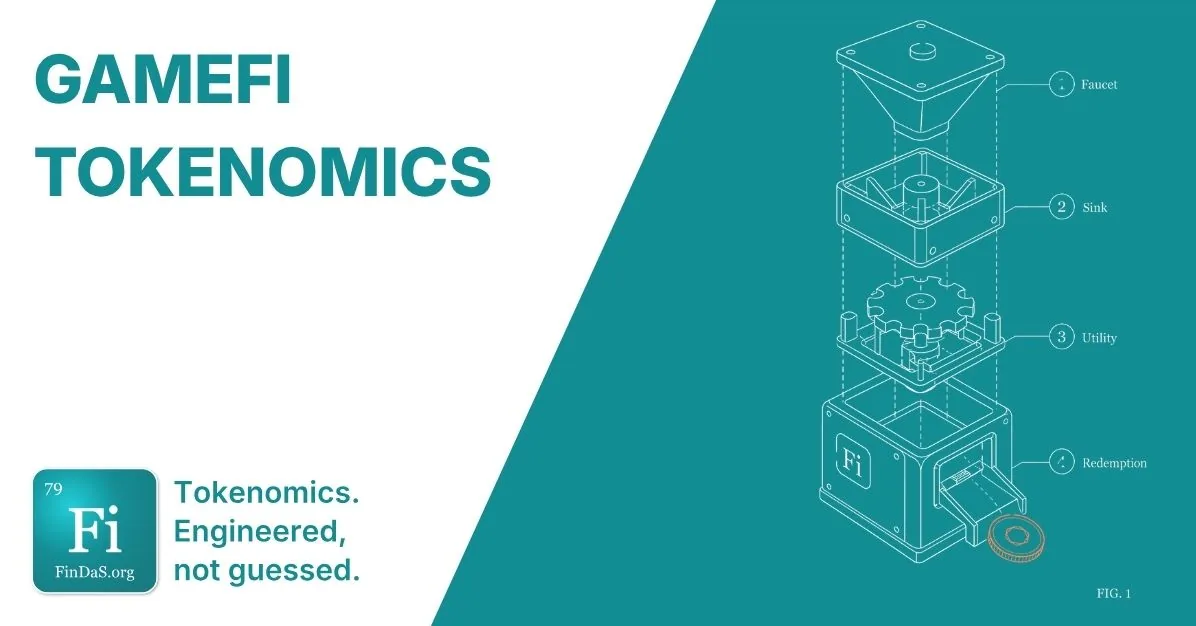
Most GameFi tokenomics discussions overweight sources (rewards, emissions, airdrops) and underweight sinks. Source design is straightforward. Sink design is where sustainability is won or lost, and the mental model most teams bring to it is wrong.
A sink is not a button that burns tokens. A sink is a purchase the player willingly makes because the game is fun, competitive, or socially meaningful. If the sink feels like a tax on play, players treat it as extraction and disengage. If it feels like progression, customization, or mastery, they accept it and often come back for more. The difference comes down to whether the game would already be worth playing without the token.
Three criteria separate a robust sink from a fragile one. It has to be legible (the player understands what they get and why it costs what it costs), it has to be elastic (whales can spend more without forcing everyone else to spend more), and it has to be fair (spending should not convert the game into pay-to-win that drives away the majority). When all three hold, the sink supports the economy. When one is missing, the sink becomes a tax, and players stop paying it. The broader design principles behind this apply outside GameFi too.
This is also where the distinction between earning and extracting becomes operational. Earning tied to competitive skill, content creation, or scarce services (guild leadership, tournament organization, market making) produces a smaller, healthier earner class whose income reflects real value contributed. Earning marketed as a universal promise produces the opposite: an earner class that exceeds what the spender class can fund, and an economy that requires new entrants to keep functioning. Sustainable GameFi treats reward tokens as prizes or rebates, not as salaries. If you want to see where your emissions and sinks break the loop before launch, stress-testing the economy in simulation is cheaper than finding out live.
NFTs as progression vs NFTs as leverage
NFTs in GameFi are not just "assets players own." Functionally they do four jobs at once. They gate access (tickets, membership), they carry state (progression, upgrades, reputation), they act as production units (yield, crafting capacity, energy), and they serve as speculation surfaces (collectibility, scarcity narratives). A single Axie does all four.
That dual nature is not optional, and it is where most GameFi NFT design breaks. Axie's breeding mechanic is a worked example: each breed costs a combination of AXS and SLP, and every Axie can only be bred seven times before it is sterile. That cap is tokenomics masquerading as game design. It controls long-term NFT supply, shapes resale price expectations, and defines demand for the spend tokens. NFT design and fungible token design are coupled, and the coupling is where the failure modes live.
The split that matters in practice is NFTs-as-progression versus NFTs-as-leverage. NFTs-as-progression means characters, cosmetics, and badges that carry the player's history: time, mastery, social standing. Demand comes from what the item means, not from what it yields. NFTs-as-leverage means the NFT is the primary ROI vehicle: breed, rent, extract, flip. Demand comes from expected income, and expected income comes from other players' spending or from inflation. When new entry slows, expected income compresses, and the floor drops.
Marketing NFT yield as broad and reliable pushes the player economy toward a rent-seeking structure that competes with fun. The scholarship flywheel Axie became famous for, where managers lent NFTs to low-income players in exchange for a share of earnings, worked mechanically only while new entrants kept arriving. When they stopped, the structure inverted: the NFT repriced as a financial instrument with a declining yield, and its fair value fell below the cost most scholars had paid to enter.
What a sustainable GameFi economy actually looks like
The sharpest test for whether a GameFi design has a real chance is also the simplest: would the game be fun without the token? If yes, the economy has a natural spender class that pays in time, attention, or money for entertainment, identity, and mastery. If no, the player base will optimize for extraction the moment the subsidy narrows, because nothing else is on offer.
Three years after the Axie peak, the industry has mostly converged on this view in practice if not always in marketing. Sky Mavis itself, the team that wrote the original play-to-earn playbook, overhauled Axie's tokenomics in January 2026. SLP emissions in Origins mode were halted. AXS rewards were replaced with bAXS, a non-transferable token backed 1:1 by AXS that can only be earned by playing and carries a reputation-scaled fee to convert back to liquid AXS. Sky Mavis's own reframing in the rollout materials: not play-to-earn, but risk-to-earn, tied to in-game contribution, with rewards designed to stay inside the economy. That is the argument this article opened with, ratified by the project that made the argument necessary.
Newer games are launching with the constraint built in. Pixels, the largest Ronin game by daily active users, centers its economy on the PIXEL token earned through social farming, with caps and sinks designed against bot extraction. Off the Grid ships an AAA shooter on Epic Games Store where the on-chain layer stays optional and $GUN buys consumables rather than gating entry. Different genres, same commitment: the game is the product, and the token pays for contribution rather than for playtime.
The operational checks for any specific project are narrow. They cannot be read off a whitepaper, and they are the questions that reveal whether the economy is entertainment-led or extraction-led:
- Whether the primary loop is fun without the token.
- Who the consistent buyers of the spend token are, and what they receive that they will not need to sell later.
- Where reward demand comes from when growth slows.
- Whether NFTs add gameplay value or only financial leverage.
- Whether earning is positioned as a prize, a rebate, or a promise.
Treat the economy as an ongoing system that needs monitoring, not a spreadsheet that ships once. Open markets turn balance changes into financial shocks, and the designs that survive those shocks are the ones that started with the game, constrained extraction from the start, and made spending feel like play rather than work.
Frequently asked questions
01Is play-to-earn dead after the Axie crash?
+
02Can a GameFi project launch successfully without a native token?
+
03Do stablecoin-denominated rewards fix the volatility problem in GameFi economies?
+
04What role do guilds and scholarship programs play in sustainable GameFi tokenomics?
+