Stablecoins won the crypto payment layer. Volumes hit $33 trillion in 2025, and regulators have built a regime that channels payment use specifically into them. Project tokens that frame themselves as "the payment layer for X" almost always lose this race, because users prefer not to pay fixed-price invoices in volatile assets and because the regulatory ground is hostile. The honest framing for most project tokens is that they are loyalty programs with onchain settlement, or capital-markets instruments with governance and revenue claims. Both can work. Calling either of them a payment token confuses users and invites regulatory friction without a corresponding upside.
The pitch we hear every week
Every quarter or so, a project arrives with the same thesis. Their token will be the payment layer for some industry vertical. The vertical changes each time, the structure of the pitch does not. Some are broad ("the go-to token for supply chain settlement"), some are oddly specific.
Every year we get at least one client who wants to create the payment layer for something. Ask yourself, why you? Why would everyone use your token and not create their own? We have had requests as broad as 'the go-to token for supply chains' and as narrow as 'the go-to token for horse trading.'
The narrative is clean. A vertical needs a unit of account, the project provides one, network effects compound, the token captures value as the rail itself. It is also wrong almost every time, and the gap between how often the pitch arrives and how often it actually works is the reason this article exists. The point is not that payment is a bad idea. The point is that "payment layer" is the wrong frame for what most of these tokens are actually doing.
Stablecoins already won the payment race
The argument that crypto needs a payment layer was settled in 2025, not by a debate but by transaction data. Total stablecoin volume reached $33 trillion for the year, up 72% year-over-year, with $11 trillion in Q4 alone. USDC processed $18.3 trillion of that, USDT another $13.3 trillion. For comparison, Visa's full fiscal year processed $16.7 trillion. Stablecoins now move roughly twice the value Visa moves, even adjusted for differences in transaction type.
Regulators have been less ambiguous than markets. MiCAR Article 23, applicable in the EU since June 2024, caps any asset-referenced token (and non-euro e-money tokens) used as a means of exchange at 1 million transactions and €200 million per day in any single currency area. Above either threshold, the issuer has to pause issuance and submit a remediation plan. The article was written specifically to channel payment use inside the EU into euro-denominated, fully-reserved e-money tokens. On the dollar side, the practical result has been that USDC took the EMI route via France and stayed listed across European exchanges, while USDT, whose issuer chose not to pursue MiCAR authorization, was delisted for retail clients on most EU venues during 2025. The EU has effectively picked a payment primitive, and it is not anyone's project token.
On the institutional side, the consortium Qivalis (BBVA, BNP Paribas, UniCredit, ING, CaixaBank, Danske Bank, DekaBank, DZ BANK, KBC, Raiffeisen Bank International, SEB, and Banca Sella) is targeting H2 2026 to launch a MiCAR-compliant euro stablecoin under a Dutch EMI license. Visa and Mastercard rolled out stablecoin settlement programs through 2025. The plumbing is being built, in public, by entities with banking licenses. None of them are building it on a project token. For a deeper read on why payment-rail dynamics work this way, see our piece on why most tokenomics sometimes suck, which covers the structural reasons project tokens lose head-to-head against neutral money.
Why nobody wants to pay with your volatile token
Step away from the macro picture and look at what you are actually asking a user to do. You are asking them to hold a volatile asset in order to pay a fixed-price invoice. If the token is up 40% by the time the bill is due, the rational user sells it and pays in dollars. If it is down 40%, they need 1.4x more of it to cover the same bill, which means they have to top up before paying. In either direction, the rational behavior is to convert at the moment of payment. The only people who hold the token to pay are the ones who could not be bothered to swap, and that population shrinks every quarter as wallet UX improves.
There are two situations where volatile-token payment makes any economic sense. The first is when holding the token gives you a discount the user cannot get any other way (BNB on Binance is the canonical example). The second is when no liquid alternative exists for the specific transaction (some Layer 1 gas markets, briefly). Outside those two cases, the user pays a foreign-exchange spread on every transaction and gets nothing for it. That is not a payment design, it is a tax on convenience.
The counterargument I hear most often is that loyal users will hold the token through volatility because they believe in the project. This is true for a small subset of users and untrue for the majority. Across hundreds of token launches, I have not seen a project where "belief" produced a stable payment-side holder base; what I have seen is concentrated holdings by treasury, team, and a small group of believers, while the actual user base behaves like a normal market and prefers stable units of account at the moment of payment. Belief drives speculative holding. It does not drive payment behavior.
The Layer 1 exception, and why it is narrowing
There is exactly one structural reason a non-stablecoin token survives as a payment instrument: paying for block space on a Proof-of-Stake chain. The chain has to charge for execution to prevent spam, and it has to denominate that charge in the asset that secures the network so the validator economy stays coherent. ETH, SOL, NEAR, and similar Layer 1s earn this exception. The mechanism is real, and I do not expect it to disappear.
What I do expect to disappear is the part where users see it. Account abstraction (ERC-4337 on Ethereum, native on StarkNet, zkSync, and a few others) lets dApps sponsor gas in any token, with the protocol handling the conversion under the hood. The user pays a fee in USDC, and somewhere in the stack, ETH is bought and burned to settle the actual gas. Within two to three years, "I pay gas in ETH" will be a developer concept, not a user concept. Note that the L1 token's economic role does not weaken in this transition. Validators still need to be paid in the native asset, and the asset still gets consumed to settle gas. What changes is visibility, not magnitude.
For an L1 founder, the practical implication is to stop building the token's narrative around "pay for transactions" and start building it around staking, security, and protocol revenue capture. Those are the parts that get more visible to users over time, not less. The "pay for gas" story is becoming infrastructure plumbing, and infrastructure plumbing does not anchor a token thesis.
What you are actually selling: loyalty points or a capital-markets asset
Drop the payment frame. In the overwhelming majority of cases, what you have is one of two things. Either it is a loyalty mechanic with onchain settlement, or it is a capital-markets instrument with governance and revenue claims. The mechanics, the regulatory fit, and the right pitch are different in each case, and most of the confusion in the space comes from projects trying to be both at once and calling neither what it actually is.
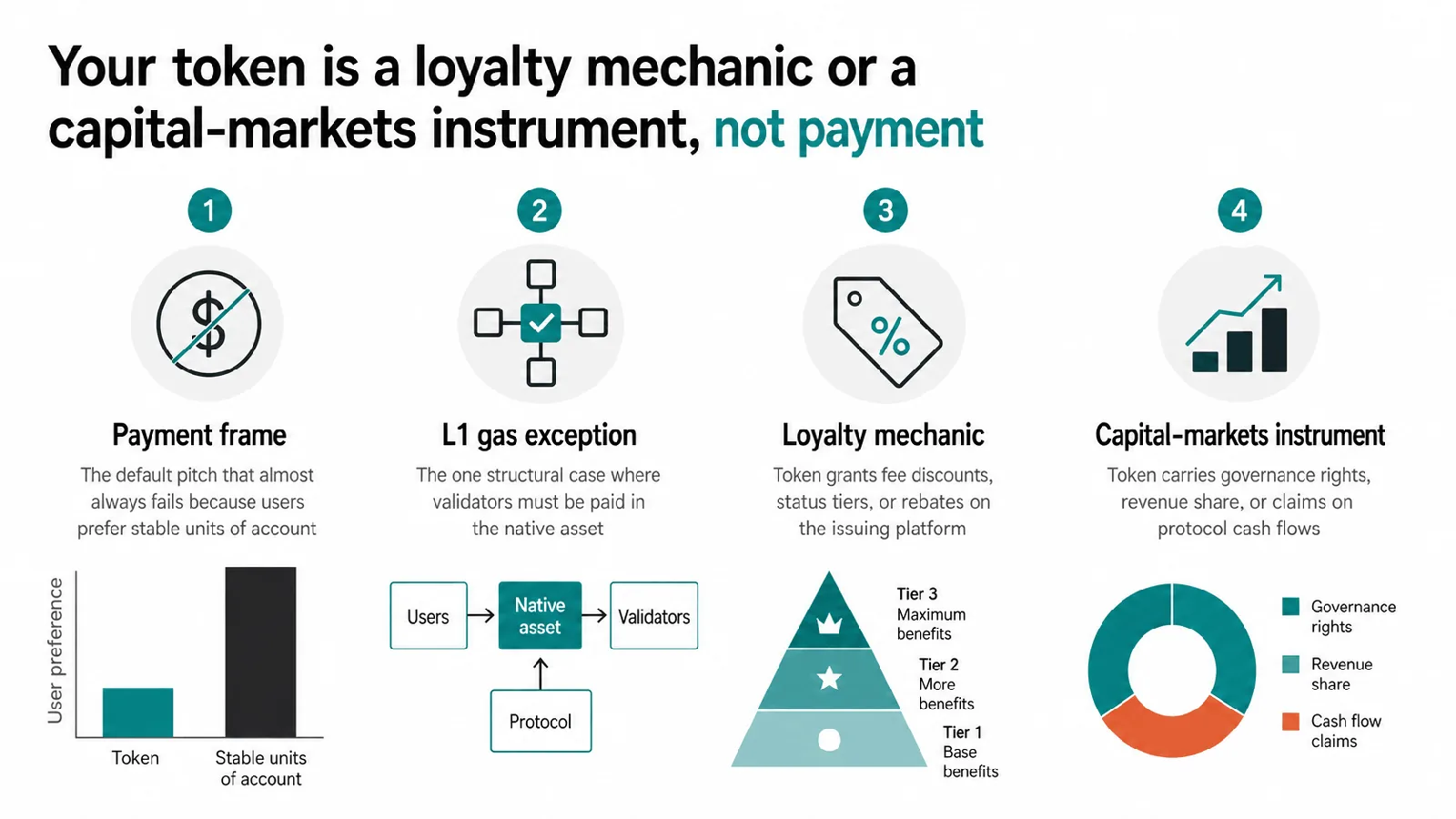
In the loyalty case, holding the token gets the user a discount on your platform's fees, a higher status tier, a cashback rebate, or a soft floor at which you redeem the token for service. Mechanically, this is identical to airline miles or a Costco membership; the only differences are that the points are programmable and tradable. There is nothing wrong with this design. BNB's fee discount on Binance is the canonical case, and BNB is one of the most successful tokens ever issued. The honest framing also avoids regulatory friction in most jurisdictions, because no one is claiming the token is a payment rail.
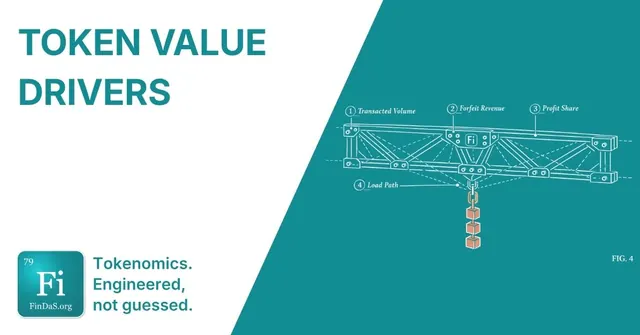
In the capital-markets case, your token carries some combination of governance rights, revenue share, treasury claim, and speculative upside on protocol growth. Mechanically, this is closer to equity than to currency. Calling it "payment" is a category error that confuses users and gives regulators an easy line of attack. The right question for a token in this bucket is: what is the capital-markets thesis for someone holding this, and how does protocol success accrue to the holder? We have written more on that question in our piece on token value drivers. Both buckets are legitimate; the failure mode is calling them something they are not.
The soft-floor mechanic, and how it breaks
One specific design pattern earns its own section because of how often we see it and how often it ends badly. The pattern: users can pay platform fees in your token, and you accept the token at a fixed floor price even when the market price falls below that floor. The intent is to create both a demand sink (the token gets used) and a price floor (the token cannot trade meaningfully below the redemption rate). On paper it looks robust. In practice, the day market price drops below the floor by a meaningful margin, arbitrageurs buy tokens cheap on the open market and use them at the floor price, draining treasury at a discount until the floor breaks.
Defending the floor means one of three things. Buying back tokens at the floor price (expensive, especially under the same market conditions that created the gap), rate-limiting how much can be redeemed at the floor (which voids the promise to users), or installing a circuit breaker that pauses redemption (which voids the promise differently). I have seen all three deployed in panic. None of them work cleanly once the underlying conditions hit. If you want a soft floor in your design, model the cost of defending it under a 50% drawdown before committing to the mechanic; we cover the math more fully in our price floor mechanics piece. Pressure-testing soft floors is one of the more common things that comes up in a tokenomics audit, and almost every time the model has not been run under stress.
What real utility looks like
The cleanest current example of token utility designed without a payment frame is Hyperliquid's HYPE. To deploy a permissionless perpetuals market under HIP-3, a builder must stake 500,000 HYPE as bonded collateral. Deployer misbehavior gets the stake slashed by validator vote. HYPE also captures a share of trading fees through a buyback mechanism. So HYPE is collateral, governance, and a residual claim on protocol revenue. None of the design documents call it a payment token, because it is not one.
This is the right pattern. Token utility that holds up under scrutiny is almost always a staking, collateral, or access function, where the protocol genuinely cannot do its job without the token in the loop. Payment is only that for L1 gas, and even there the user-facing version is fading. If your design relies on people choosing to pay you in your token rather than in something they already have in their wallet, you are designing against the user. Restructure.
More from the 101 series
This piece is part of our 101 series on tokenomics fundamentals. If you want to dig further into the topics this article touched but did not unpack, the following are the most directly relevant.
- Token utility 101 covers what counts as real utility versus narrative utility, with the staking and collateral patterns this article points at.
- Value accrual 101 goes deeper on the capital-markets framing: how protocol success actually translates into token holder value.
- Token staking 101 is the long version of why staking and bonded-collateral designs are usually the cleanest utility story for a non-stablecoin token.
- Treasury 101 covers the buyback and floor-defense mechanics referenced in the soft-floor section.
Frequently asked questions
01If stablecoins handle payments, does my project still need its own token?
+
02My whitepaper described the token as having "payment utility." How risky is that language?
+
03How does ERC-4337 account abstraction change gas-token economics?
+
04Is there ever a case where launching a new payment-focused token still makes sense?
+