A soft token price floor is a commitment by the issuing company to always accept its own token for its services at a minimum rate, regardless of what the market price is doing. It stabilizes the token through usage rather than redemption, and it only works for businesses with margins wide enough to absorb the implied discount.
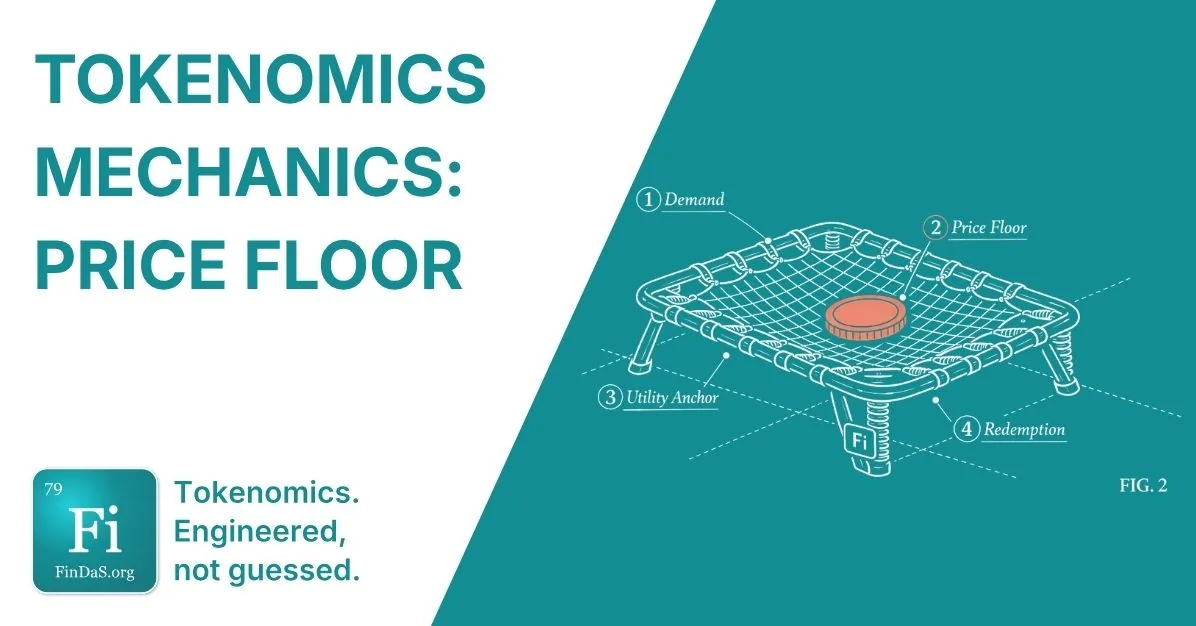
Most tokens have no floor at all. Whatever the market decides is the price, and if that price falls to zero, nothing inside the project can catch it. Certain business models, though, let you bake a soft floor into how the token is used, not how it is traded.
The difference between a hard and a soft floor
A hard price floor is backed by a redemption mechanic. The issuer commits to buying the token back at a defined rate against an asset collateral, which is roughly how collateralized stablecoins function, with some notable exclusions. In practice that commitment is what gives the token its price anchor, since anyone can always exit at the agreed rate.
A soft price floor does not guarantee redemption for cash or collateral. It guarantees usage: the company accepts the token at a specified minimum value for its own services, even when the market price sits below that level. The commitment is narrower (you cannot exit at the floor, only pay for services at it), but the cost to the issuing company is also much smaller.
How a soft price floor works in practice
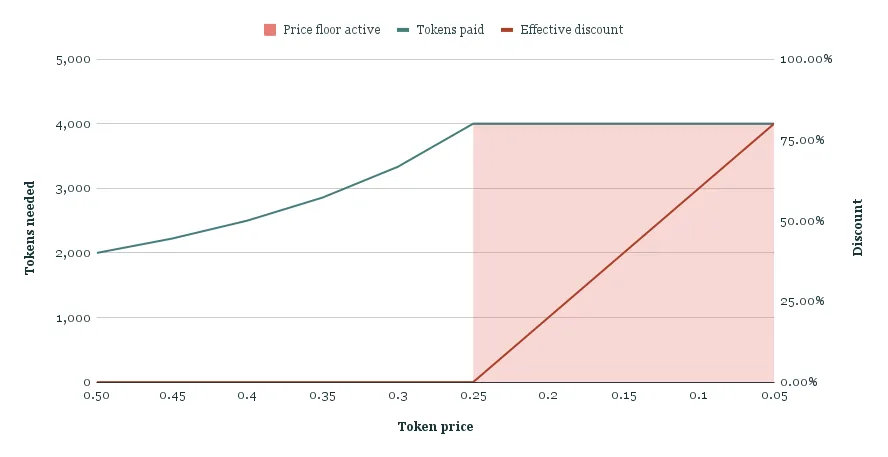
Take a concrete setup. FinDaS Ltd issues the FND token and accepts it as payment for its tokenomics consulting work. The current market price is 0.5 USD, and one service costs 1,000 USD, which means a client can pay either 1,000 USD or 2,000 FND. Suppose FinDaS commits to a soft floor of 0.25 USD: the company will always accept FND for its services at a token price no lower than 0.25 USD, regardless of where the market is. If the token drops to 0.1 USD on an exchange, a 1,000 USD service still only costs 4,000 FND, not 10,000. That is an effective 60% discount on the cash price for anyone paying in token. The chart below plots how the service-redemption rate behaves as the market price moves above and below the floor.
What this does for the token
The floor has compound effects on the token beyond a simple discount during downturns. Once committed and believed, it changes the token's usage pattern and the market's behavior around it. Four separate effects are worth flagging.
- Downturns become discount cycles. When the market price drops below the floor, paying for services in token is a real discount on the cash price, which tends to pull in more paying customers.
- New demand feeds back into the token price. Tokens spent at the floor rate aggregate into market buy pressure, which can push the market price back toward the floor level.
- The discount goes only to real users. Someone holding the token purely to flip it cannot access the floor price, which turns the floor into genuine utility rather than a speculation subsidy.
- The signal alone can keep the price from falling in the first place. If the market believes the company will honor the floor, prices tend not to trade meaningfully below it, and very few redemption events ever happen.
Who pays the bill
Every tokenomic mechanic has to pass the smell test: who pays the bill? A soft price floor is funded by the company issuing the token, which forgoes revenue to support the token price during downturns. At the worst end of a drawdown, the effective discount can run 50% to 70% of the cash price, and every service paid for at the floor rate is revenue the company could have booked in USD. That only works if the underlying margins can absorb it.
I have seen soft price floors work cleanly for businesses with gross margins north of 60%, where a temporary discount does not kill the P&L. Below that, the floor has to be set much closer to the market price to keep the implied discount manageable, which defeats most of the stabilization effect. Before committing to one, model the discount cash flow across a range of market-price scenarios to see how quickly the revenue hit scales.
Frequently Asked Questions
01What happens if the token price stays below the floor for a sustained period?
+
02Can a soft price floor be adjusted or removed once it's set?
+
03Does a soft price floor attract regulatory scrutiny the way a stablecoin peg does?
+
04Can a low-margin business still use a soft price floor?
+