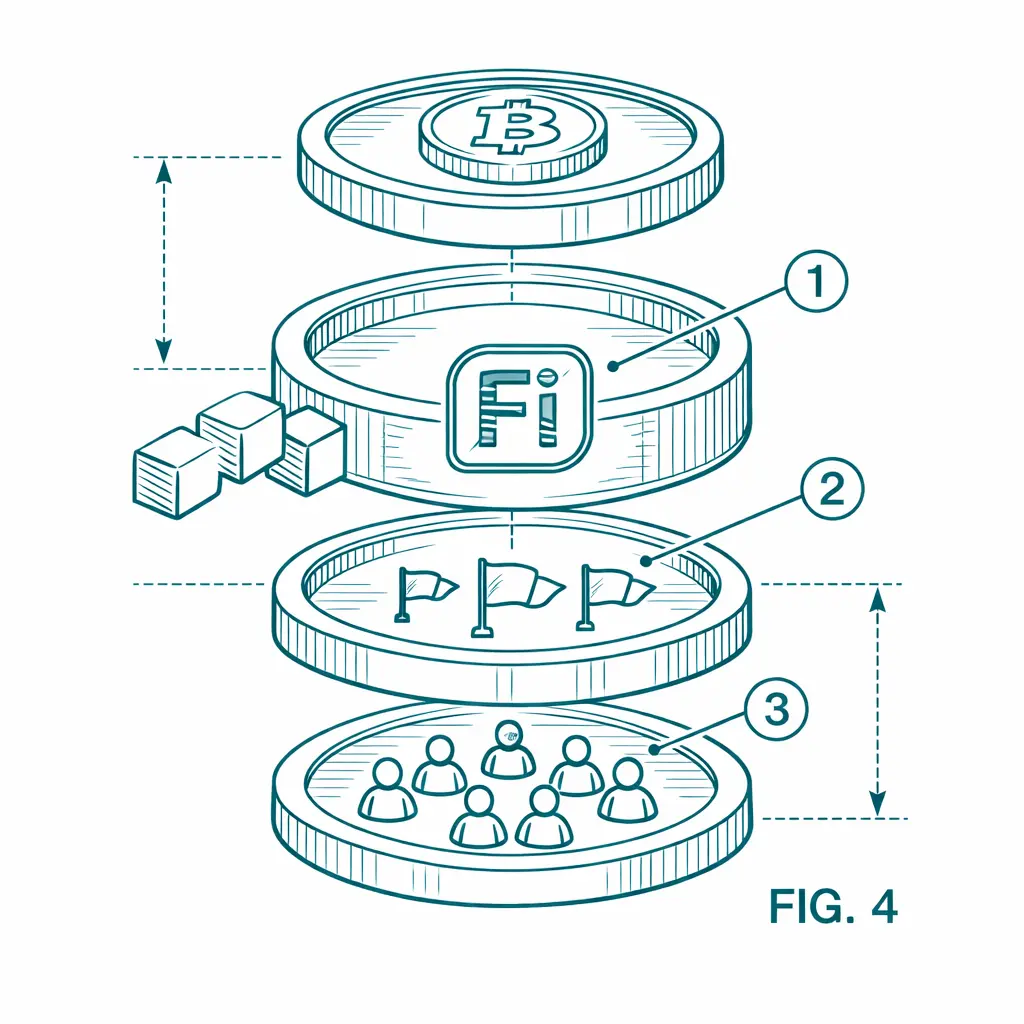
What are community incentives actually supposed to do?
Community incentives should buy durable behavior, not just temporary traffic. The strongest designs reward actions that are hard to fake and relevant to the protocol’s long-term power structure, such as repeated usage, governance participation, contribution to public goods, or meaningful ecosystem activity. Optimism’s first OP airdrop is a useful reference point because it targeted distinct cohorts including active users, DAO voters, multisig signers, Gitcoin donors, and users priced out of Ethereum, rather than rewarding a single shallow metric.
Quests push in the same direction when they are used well. Quest Protocol describes itself as infrastructure for connecting onchain participants with onchain actions, and Galxe’s quest stack is built around verifying user-specific information or onchain tasks rather than just collecting clicks. That is the right frame. A reward system works when it makes contribution legible. It fails when it pays for behavior that has no structural link to retention, governance, or network use.
Airdrops can still create real distribution and attention. They just should not be mistaken for proof of durable community formation. A post-airdrop analysis of Arbitrum found a record spike in users and transactions after the March 23, 2023 airdrop, but also said the long-term retention impact was still uncertain and that the share of transactions by airdrop recipients later settled at about 5%. That is the right caution for any token economy: claims are easy to count, retained contribution is harder.
When should a protocol use an airdrop, a quest, or ongoing engagement rewards?
Use an airdrop when the goal is retroactive recognition at scale. Optimism reserved 19% of OP supply for user airdrops and structured multiple waves around “specific helpful behaviors,” with future drops held in reserve instead of pretending one snapshot could identify every valuable user. That model fits broad ownership distribution and backward-looking recognition better than narrowly choreographed onboarding.
Use quests when the goal is specific action completion. Quest Protocol lets teams target participants with allowlists, upload their own CSV lists, run action and reward on different networks, offer gas rebates, and limit campaigns to a maximum duration of 30 days. The trade-off is cost and coordination. Quest Protocol also charges a 20% fee on each distributed reward, and its own docs warn that pricing rewards too high without an allowlist can attract multi-wallet farming.
Use ongoing engagement rewards when the goal is habit formation over time. Optimism’s SuperStacks materials explicitly say the program is testing the hypothesis that proactive points programs may have a stronger effect than retroactive airdrops. That is plausible. Repeated incentives can shape behavior more effectively than a one-off transfer. But they also centralize discretion unless the rules, scoring logic, and redemption path are published in advance.
Airdrop: best for wide, retroactive distribution and narrative reset.
Quest: best for verifiable, near-term actions with explicit targeting.
Engagement rewards or points: best for repeated behavior and laddered participation, but only if rule changes are tightly governed.
The decentralization trade-off is straightforward. The more precisely a team wants to target “good” users, the more curation, credentialing, and admin discretion it usually introduces. Operational coordination rises as distributed control falls.
How do you make eligibility defensible instead of farmable?
Eligibility has to be layered. A single metric will be gamed. Optimism’s first airdrop combined multiple cohorts and then added global filters for likely sybil farmers, Snapshot spam, exchange and on-ramp addresses, exploiters, and stale addresses. After launch, Optimism applied additional filtering that excluded 17,000 addresses and recovered 14 million OP for redistribution. That is an unusually clear reminder that even well-designed retrospectives leak.
Quest systems are increasingly built around stacked identity and reputation checks. Galxe recommends explicit sybil-prevention requirements and supports external signals such as Gitcoin Passport score thresholds, World ID proof of personhood, and other trust or behavior screens. Galxe also supports dynamic credential management so teams can add, remove, or replace eligibility lists in real time. That matters because anti-farming design is rarely static.
Human Passport shows what a stronger defense layer looks like in practice. Its docs state that Passport is designed to mitigate sybil attacks, that duplicate stamps across multiple wallets can return zero score on later wallets, and that some stamps use model-based detection to score whether transaction history resembles human or sybil behavior. Partners can also use custom score weights instead of a one-size-fits-all threshold.
The practical answer is to combine three signal classes: activity, identity or uniqueness, and context. Activity alone catches grinders. Identity alone excludes privacy-sensitive users. Context alone becomes subjective. Combined, they at least force attackers to pay across several dimensions.
Should rewards be tokens, points, NFTs, or attestations?
Transferable tokens are best when the protocol actually wants to distribute economic exposure. They are the strongest reward instrument, but also the easiest to dump and the easiest to farm. That is why protocols frequently separate contribution recognition from full token transfer. Optimism’s own experimentation with proactive points programs is notable precisely because it tests whether repeated, non-immediate token rewards can shape better behavior than pure retroactive airdrops.
Points are useful when a team wants flexibility before making a hard economic commitment. They can sequence access, ranking, and later redemption. The risk is governance by spreadsheet. If points are mutable, opaque, or centrally recalibrated without guardrails, users are optimizing against a rulebook that can move after the fact. That may be efficient for growth, but it is not distributed control.
NFTs and attestations are strongest when the protocol wants portable proof of contribution without immediate sell pressure. RabbitHole’s flow includes minting a Quest Receipt NFT as proof of completion before reward claim. Human Passport lets users push verified stamps onchain through Ethereum Attestation Service, creating attestations other apps and contracts can query. Those formats are better for reputation, credential portability, and future gating than for direct wealth transfer.
A simple rule helps. Use tokens for value transfer, points for progression, and attestations or NFTs for portable contribution history. Do not collapse all three into one instrument unless the governance and abuse model are already mature.
Should community rewards come with governance power?
Not automatically. Community incentives can widen token ownership, but they do not by themselves decentralize authority. Governance power depends on proposal thresholds, quorum rules, delegation patterns, timelocks, veto rights, and who actually controls upgrades. Compound’s governance requires at least 25,000 COMP to create a proposal and at least 400,000 votes for quorum. OpenZeppelin’s governance guidance similarly treats quorum, proposal thresholds, and timelocks as core design parameters rather than cosmetic extras.
That is the structural point many token launches miss. A quest completer or airdrop recipient may hold tokens, but if real power still sits behind thresholds that only funds, foundations, or a small delegate cartel can reach, the protocol has broadened distribution more than it has decentralized control. In decentralization terms, that is not failure, but it should be described honestly.
At FinDaS Tokenomics, the cleaner pattern is usually phased authority. Reward contribution early. Encourage delegation and reputation building next. Transfer meaningful governance influence only when thresholds, timelocks, and upgrade constraints are explicit. That is slower than the standard “community-owned” slogan, but it is far less likely to confuse marketing with institutional design.
What should teams and users expect after distribution?
Teams should expect mixed outcomes. The right post-launch scorecard is not claim rate. It is retention, repeated usage, governance participation, contribution quality, and whether the program actually changed who has influence. Arbitrum’s post-airdrop data showed strong activity after launch, but long-term retention was still described as uncertain. Treat that as normal. Incentives can buy attention immediately. They earn legitimacy only if the induced behavior survives after the reward window closes.
Users should also assume that rewards have real tax and accounting consequences. In the United States, the IRS states that digital assets are treated as property, and Revenue Ruling 2019-24 says an airdrop of new cryptocurrency following a hard fork creates ordinary income when the recipient has dominion and control over the asset. The IRS also says taxpayers must report digital asset income and answer the digital asset question on their return.
The operational takeaway is simple. If a reward matters economically, structure it like it will be scrutinized. If it matters politically, structure it like power is actually being transferred. And if it matters for decentralization, measure who can propose, who can veto, who can upgrade, and who can coordinate after the campaign ends. That is where community incentives stop being growth theater and start becoming token economy design.