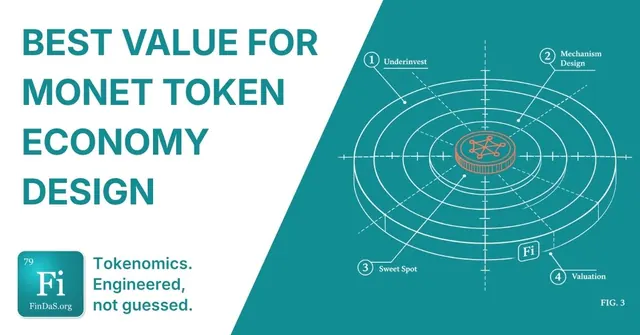
Token economy design starts with picking coordinates on three axes: value capture versus regulatory risk, utility versus complexity, and decentralization versus operational control. Every downstream mechanic, every supply curve, every vesting schedule, every governance rule, depends on where the project sits on all three. Most design failures come from picking mechanics before picking coordinates.
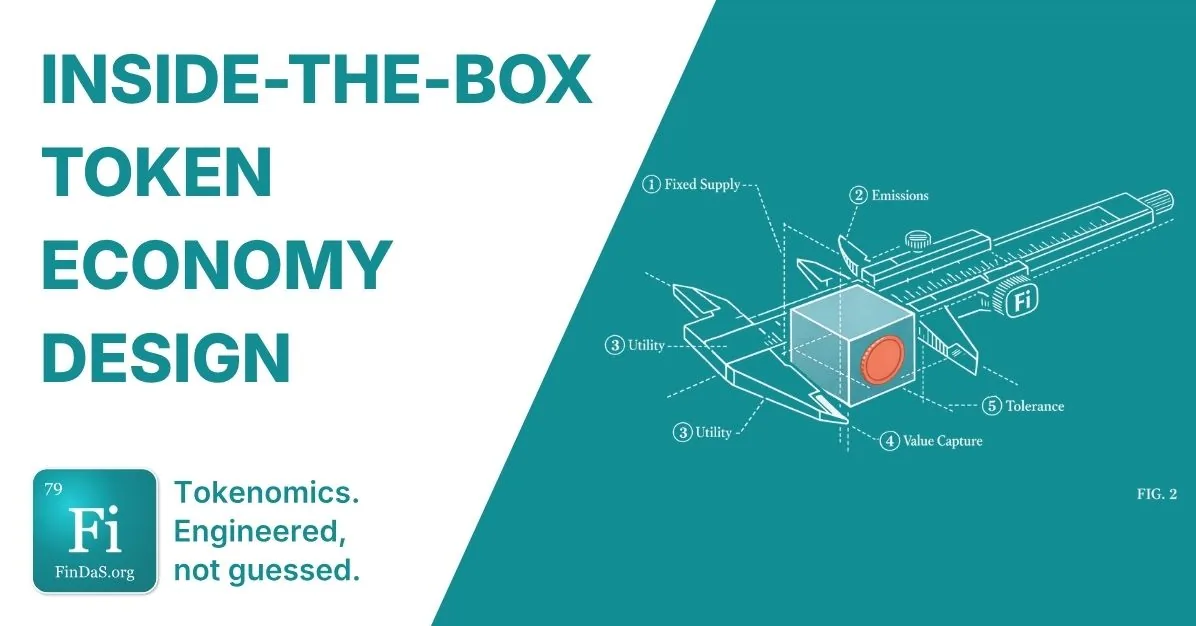
Most token designs start with the wrong question. The founder asks "what mechanics do we want?" when the earlier question is "which coordinates are we picking on the three axes that actually constrain the design space?" Those three axes are value capture versus regulatory risk, utility versus complexity, and decentralization versus operational control.
Across 200+ tokenomics projects, the pattern is consistent. Projects that skip this step arrive at mechanics that fight each other: a deflationary burn stapled onto a token marketed for its utility but paying a sustained yield that looks like a dividend, or a governance token where the team holds 60% of supply, described as "decentralized from day one." The mechanics are not wrong in isolation, they are incompatible with the coordinates the project implicitly picked. Henri Matisse put it better than I can: "I don't think outside the box, I think of what I can do with the box." The box is real, and the interesting work happens inside it.
The three fundamental axes of token design
A token's design is a point in three-dimensional space. Each dimension is a tradeoff with real costs on both ends, and there is no "best" coordinate, only the coordinate that fits the project's product, jurisdiction, audience, and founders' actual appetite for operational discipline. The tokenomics design 101 article covers the mechanic-level vocabulary this piece assumes.
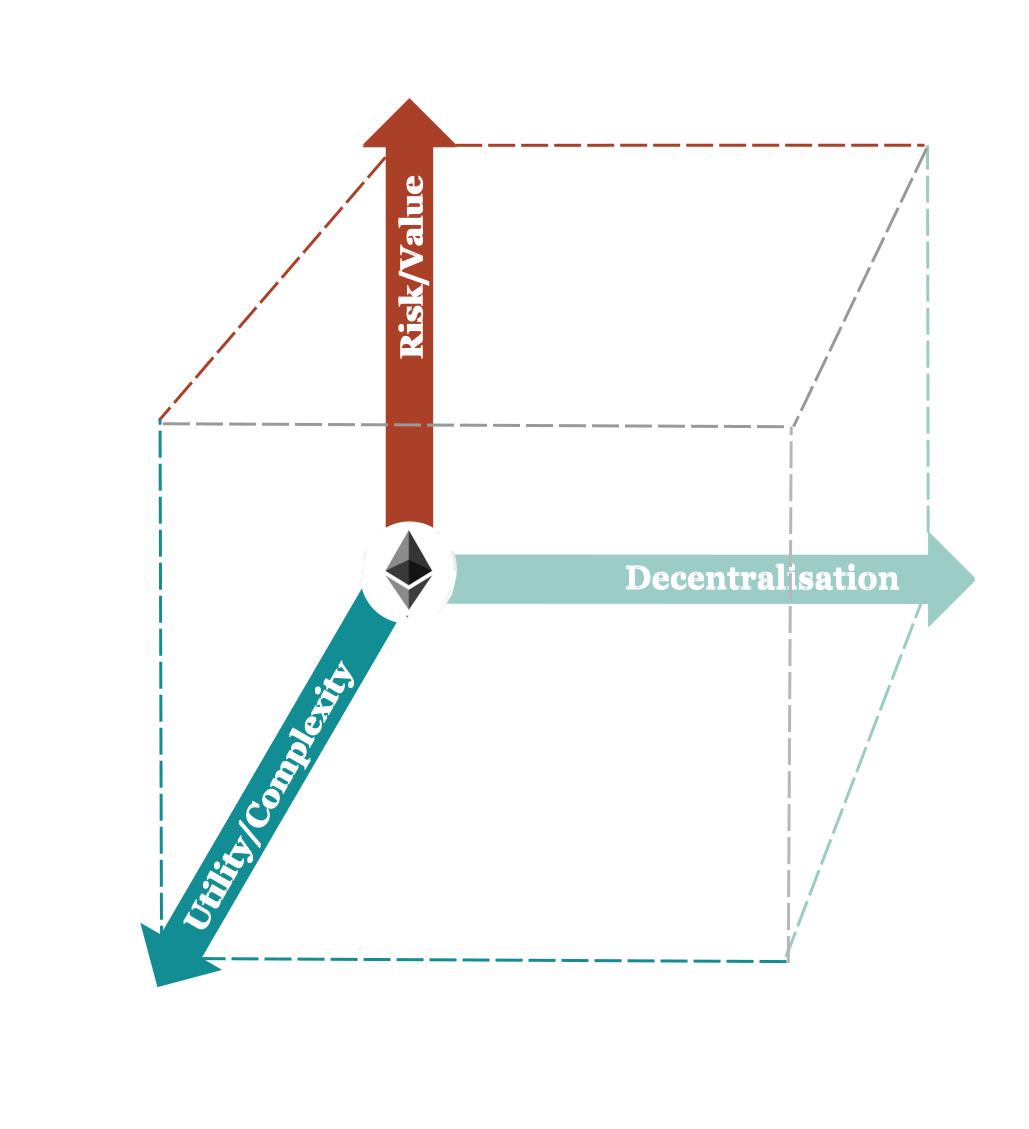
Axis 1: Value capture versus regulatory risk
This is the axis everyone learns first, because it is where the lawyers live. The US Howey test asks four questions: is there an investment of money, in a common enterprise, with expectation of profit, derived from the efforts of others. Tokens with strong value-capture mechanics (burns, buybacks, staking yields funded from protocol revenue, dividend-style distributions) tend to check boxes three and four in a way utility-only tokens do not. No single mechanic is dispositive on its own, classification depends on the full bundle of marketing, distribution, control, and economics. But in some jurisdictions the threshold is lower, and a single deflationary mechanism can tip it.
The US posture in 2026 is softer than in late 2023. Under Chair Paul Atkins the SEC has dropped or settled most headline crypto cases, and crypto was removed as a named category in the SEC's fiscal 2026 examination priorities. None of this repealed Howey, it changed enforcement appetite. The risk is lower, not gone, and it could shift again with the next administration.
The European picture is different and, in some ways, more demanding. MiCA has been in full force since December 2024, with the transitional period ending July 1, 2026. Utility tokens fall into MiCA's catch-all "other" category, but ESMA's March 2025 guidelines apply a substance-over-form test: a token granting profit rights, capital rights, or voting on the issuer's corporate matters can be reclassified as a financial instrument regardless of what the whitepaper calls it.
Some of the mechanics that move a project toward the value-capture end of Axis 1:
- Token burning or other supply-reducing mechanics
- Interest or staking yields funded from protocol fees
- Dividend or fee-share distributions to holders
- Buybacks
The coordinate question on Axis 1: how much value capture do you want, knowing the cost is regulatory exposure in whichever jurisdiction you care about? If the answer is "we are fine being a security," the path is cleaner but legally more expensive. If the answer is "we want utility classification," you sit further from the value-capture end and make up the value story with real utility on Axis 2. (Obligatory: I am not a lawyer. Talk to one in your jurisdiction before making classification decisions.)
Axis 2: Utility versus complexity
If Axis 1 asks how much value you want to capture, Axis 2 asks how you justify holding the token beyond speculation. Strong utility integration protects from the "expectation of profit from the efforts of others" leg of Howey, because holders have operational reasons to hold: gas, staking for access, governance over real protocol parameters, collateral in the project's own lending markets. Each is a reason to hold that does not depend on future price.
The cost is complexity. Strong utility tends to require strong mechanisms around it, and each mechanism is surface area the user has to internalize:
- Duration-based multipliers, with the ve-token family as the canonical example
- Bonding curves
- Penalty or slashing structures that discourage short-term behavior
- Multi-layered reward systems where different actions earn different rewards at different rates
More utility, more surface area, more edge cases where the system can break in ways the team did not anticipate. There is a failure mode here worth naming directly: some projects reach for unique mechanics not because the project requires them, but because uniqueness signals sophistication. The whitepaper looks serious. The problem is that another word for "unique" is "untested," and in tokenomics, testing happens at the worst possible time, which is live, with real capital. Bespoke mechanics should earn their place by solving a real problem a standard mechanic could not.
The coordinate question on Axis 2 is: how much complexity is your user willing to internalize before they walk away? For an institutional audience the ceiling is high. For a consumer-facing project, every mechanic past "stake to earn" is friction the product has to pay for elsewhere.
Another word for "unique" is "untested."
Axis 3: Decentralization versus operational control
The third axis is the one most projects lie to themselves about. Decentralization is a continuum with real operational costs at the decentralized end: slower decisions, coordination overhead, no one to fire. Projects that have not committed to paying those costs will often describe themselves as decentralized without being so, and the mismatch creates its own problems when governance is actually asked to do work.
Three questions need answering in order.
- How decentralized can this project actually be, given its business model and its product? Public-goods protocols can go very far. Projects with off-chain legal obligations structurally cannot.
- Why do you want to be decentralized? Regulatory optics, real belief in community ownership, or something else? The answer determines what "decentralized enough" means in practice.
- When do you want to be decentralized? Day one is rare and usually unwise. Year three, after product-market fit? Never, if the project is really a business with a token on top?
The "sufficiently decentralized" idea, that Ethereum and Bitcoin escaped securities classification because they had diffused enough to have no clear promoter, was always a loophole regulators could narrow at will. In 2026 it is a cooler US enforcement risk under the Atkins SEC, but the underlying logic still matters for MiCA compliance (issuer identifiability drives whether Title II applies), for DAO legal wrappers, and for how governance actually functions once the founding team steps back. Practitioner read: if you are going to be decentralized, commit to the operational cost. If you are not, do not describe the project as decentralized.
Where the examples actually sit in 2026
Four well-known tokens, placed on the three axes. Each has moved meaningfully since late 2023, which is the point: coordinates shift, usually through a deliberate governance move or a crisis, not by accident.
CRV (Curve)
- Value capture: high. Permanent locking for veCRV, fee share for veCRV holders, direct link to protocol revenue. The July 2023 Vyper exploit and the Egorov loan crisis stressed the mechanics but did not change them. Inflation was halved in August 2024 from 20% to 6%.
- Utility: high. veCRV, gauge weight voting, boost multipliers, and the bribe market (Convex, Votium) add real utility and real complexity. See DeFi tokenomics for why these mechanics exist.
- Decentralization: medium, one tier lower than in 2023. The Egorov concentration crisis, where the founder held roughly 47% of circulating supply as collateral across lending positions, showed that vote-count decentralization does not mean token distribution is decentralized. A single holder's liquidation risk was systemic.
UNI (Uniswap)
- Value capture: changed significantly. Before December 2025, UNI was governance-only. The UNIfication proposal, passed December 26, 2025 with 125M UNI in favor and 742 against, flipped the fee switch, routed protocol fees to a UNI burn, retroactively burned 100M UNI from treasury (~$590M), and folded the Foundation into Labs.
- Utility: moderate, up from low. The "token jar" lets holders burn UNI and withdraw an equivalent share of protocol fees. Still simpler than the ve-token family, but no longer pure governance.
- Decentralization: governance up, organizational down. The vote passed cleanly and at scale. The structural outcome concentrates operations in one for-profit entity (Labs) coordinating with DUNI through a service provider agreement.
A standard security token
- Value capture: high. Dividends, revenue shares, and profit-linked distributions are not only allowed, they are expected. No legal risk from value-capture mechanics because the legal category already contemplates them.
- Utility: low complexity. The token does two things: receive distributions, and vote on corporate matters. Mechanics borrowed from traditional equity, no new mental model required.
- Decentralization: low. Security tokens live inside corporate governance frameworks. Even when token holders can vote, the board typically retains the ability to act on most operational decisions without shareholder approval. Decentralization is rarely the point.
ETH (Ethereum)
- Value capture: medium, less deflationary than the post-Merge narrative implied. The 2022 Merge cut daily issuance by roughly 88%. EIP-1559 burns the base fee on every mainnet transaction. Both produced real deflationary stretches from late 2022 to early 2024. The March 2024 Dencun upgrade (EIP-4844) cut L2 data costs by ~90%, activity migrated to rollups, and mainnet burns collapsed. ETH has been net inflationary for stretches through 2025 and 2026.
- Utility: high. Gas, staking, universal collateral across DeFi, settlement asset for L2 rollups. Most of the complexity is hidden from end users.
- Decentralization: mid-high. Diverse validator set, multi-client software, informal governance via the EIP process. Staking concentration risks exist (Lido's historical share), but the network sits further toward decentralized than almost any other major L1.
How to use the framework
The point of the three axes is not to give you the right answer. It forces you to make the tradeoffs explicit before you write the mechanics. Most problems that surface late in design reviews (incompatible mechanics, regulatory exposure the team did not realize they were taking, utility that is not actually utility) come from projects that designed the mechanics first and picked coordinates implicitly.
Run the exercise on your own project: pick a number from 1 to 5 on each axis and write it down. List the mechanics you are considering. If the mechanics do not match the coordinates, either the coordinates are wrong or the mechanics are. You cannot have a utility-classified token with a revenue-funded deflationary burn, stapled onto a DAO with 70% team-held supply, and describe any of that coherently. The valuation approaches article is a useful next step once coordinates are set.
If you want a second opinion on where your project actually sits before the mechanics harden, that is how most of our 300+ engagements start. Discuss your project with us
Frequently asked questions
01Does a deflationary token automatically classify as a security?
+
02Can a project reposition on these three axes after launch?
+
03What does "sufficiently decentralized" actually require in 2026?
+
04Does the framework apply to memecoins or points systems?
+