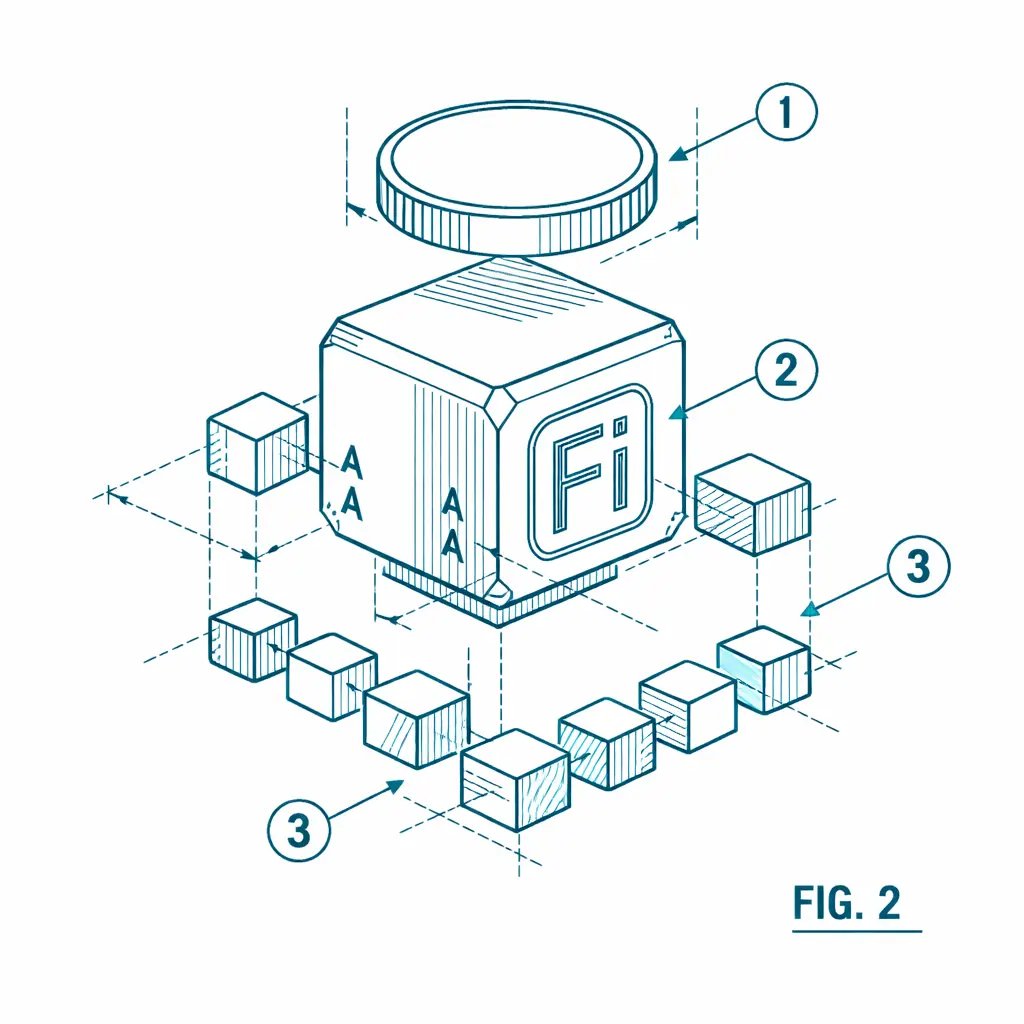
How many tokens should you mint?
Mint enough units to make allocations readable, divisibility practical, and future issuance governable. There is no universally correct headline number. ERC-20 exposes totalSupply and an optional decimals field, so user-facing granularity comes from denomination choices as much as from the raw token count. Bitcoin is the clean proof that the headline number is not the whole story: only 21 million BTC will ever exist, yet BTC can still be divided to 8 decimal places.
The practical rule is simple. Choose the smallest supply that keeps treasury, community, investor, and incentive allocations legible in dashboards, governance proposals, and exchange interfaces. If your design forces everyone to reason in microscopic fractions or absurdly large integers, the denomination is doing unnecessary work. In most token economy design exercises, the real variable is not the absolute supply number. It is the path from fully diluted supply to circulating float.
Does a bigger token count make the token cheaper or more attractive?
No. A larger token count changes unit price optics, not economic value. Market cap, circulating float, unlock structure, and utility determine the economic weight of a token. The idea that “more zeros” makes a token inherently more investable is mostly denomination theater.
Large headline supplies do have side effects. They can make allocation mistakes harder to notice. They can obscure governance percentages. They also encourage weak tokenomics communication around burning zeros instead of explaining issuance logic, vesting mechanics, and treasury policy. For an informed Web3 audience, that is usually a negative signal. Real tokenomics work starts when supply is translated into dated float, not when the team picks a psychologically appealing unit price.
Should supply be fixed, capped, or elastic?
Supply policy should follow the job the token has to do. A hard cap fits assets built around scarcity and predictability. Bitcoin uses a decreasing issuance schedule that ends at 21 million coins. Ethereum takes the opposite approach: it does not have a fixed cap, and EIP-1559 burns the base fee, so net ETH supply depends on the interaction between validator issuance and fee burn. Solana uses scheduled disinflation instead, with 8% initial inflation, a 15% annual disinflation rate, and a 1.5% long-run rate. UNI shows a hybrid model: 1 billion UNI were minted at genesis, released over four years, and a 2% perpetual inflation rate begins after that initial period.
| Supply architecture | Mechanism | What it optimizes | Example |
|---|---|---|---|
| Hard cap | Predictable issuance to a fixed endpoint | Scarcity and simple expectations | Bitcoin stops at 21 million and remains divisible to 8 decimals |
| Burn-aware variable supply | Protocol issuance plus fee burn | Security budget with adaptive net supply | Ethereum has no fixed cap and burns the base fee under EIP-1559 |
| Scheduled disinflation | Higher early inflation that decays toward a terminal rate | Security and validator bootstrapping | Solana launched with 8% initial inflation, falling 15% yearly toward 1.5% |
| Genesis mint plus staged release | Known initial supply, vesting, then optional ongoing inflation | Ownership clarity with future contribution budget | UNI minted 1 billion at genesis, vests over 4 years, then adds 2% annual inflation |
The decision rule is narrower than most token launch decks suggest. If the token must continuously pay for network security, contributors, or ecosystem growth, some form of ongoing issuance may be justified. If the token mainly represents governance, brand equity, or a scarce reserve asset, open-ended inflation needs a much higher bar. This is where modeling depth matters. A fixed cap can underfund future security. An elastic policy can become an unbounded tax on passive holders.
When should you mint the supply?
Mint at genesis when the maximum supply and allocation logic are already known. Then lock what should not circulate. Uniswap followed this pattern: 1 billion UNI were minted at genesis, but access was staged over four years, with team, investor, and advisor allocations vesting on the same schedule.
Genesis minting is usually cleaner because it separates existence from circulation. The supply is auditable on day one. The float is still controlled through vesting and release schedules. OpenZeppelin’s VestingWallet is built for exactly this pattern, holding ERC-20 tokens and releasing them according to a defined schedule.
Mint later only when later issuance is genuinely conditional. That means staking rewards, governance-approved budget emissions, or formula-driven incentives. If a mint function remains live, the control plane matters as much as the policy. OpenZeppelin’s access-control guidance recommends secure governance such as a DAO or multisig behind a timelock, and explicitly notes that even minting operations may deserve delays of weeks or months so users can audit them.
Vesting contracts are better than spreadsheet promises, but they are not magic. OpenZeppelin also notes that ownership of a vesting wallet can be transferred, which means unvested economic rights can still be sold or reassigned in some setups. That detail is easy to miss and analytically important. Locking tokens is not the same as eliminating transferability risk.
Why do teams get token supply wrong?
Most supply failures are float failures. Teams obsess over fully diluted supply and under-model circulating supply by milestone. The result is predictable. Too little initial float makes the token hard to use, easy to manipulate, and often poor for governance legitimacy. Too much initial float improves usability and liquidity, but raises treasury sell pressure and shortens strategic runway. There is no free version of this trade-off.
Another common mistake is using burn mechanics to compensate for weak issuance design. Burns can be useful. Ethereum’s base-fee burn is now a structural part of ETH supply dynamics, and standard ERC-20 libraries include burnable extensions. But burns do not rescue a schedule that mints too much, unlocks too fast, or leaves mint authority in weak hands. Burn narratives are often more marketable than disciplined issuance policy. They are rarely a substitute for it.
What is a defensible token supply process?
A defensible process works backward from required float, not forward from a vanity total. At FinDaS Tokenomics, the useful starting questions are operational. Who must hold the token in year one. Which behaviors need ongoing emissions. What percentage must remain locked. Who can authorize new minting. Which exact dates create the first meaningful unlock cliffs. If those answers are vague, the supply number is premature.
- Set denomination last. Define economic needs first, then choose a readable supply and decimal format.
- Separate max supply from circulating plan. Publish both, with exact unlock dates.
- Prefer onchain vesting over verbal lockups. Vesting logic is auditable and enforceable.
- If mint authority exists, disclose the controller, cap, and delay. DAO or multisig plus timelock is the minimum credible baseline.
- Map each issuance stream to a function. Security budget, liquidity incentives, ecosystem grants, contributor compensation, or governance treasury. If an issuance line has no clear function, cut it.
- Stress-test the first major unlock. The headline supply matters less than the first month when real new float reaches the market.
The short answer is usually this. Mint the smallest headline supply that keeps allocations readable, divisibility sufficient, and future issuance explicit. Mint at genesis when the cap is known. Mint later only when later issuance is formula-driven and governance-constrained. Everything else is mostly denomination theater.